


TL;DR:
- A structured Spanish study process involves organizing learning into clear, repeatable stages that balance vocabulary, grammar, speaking, listening, and reading. It relies on setting specific goals using CEFR milestones, using effective tools like spaced repetition and early speaking practice, and maintaining a consistent daily routine. This systematic approach helps learners overcome plateaus, track progress, and achieve fluency more efficiently over time.
A structured Spanish study process is a systematic method for learning the language by organizing your efforts into clear, repeatable stages that balance grammar, vocabulary, speaking, listening, and reading. Without this structure, most adult learners plateau early, lose motivation, or waste hours on methods that feel productive but deliver little real progress. The good news: research shows that combining spaced repetition tools like Anki, speaking practice from week one, and a consistent daily routine produces measurably faster fluency gains than unguided self-study. This guide walks you through every component of an organized approach, from setting your first milestone to pushing past intermediate plateaus.
What does a structured Spanish study process actually look like?
A structured approach to learning Spanish means you know exactly what you are studying, why, and for how long, every single day. It is the difference between opening Duolingo for ten minutes and calling it practice, versus following a deliberate plan that builds each skill on the last.

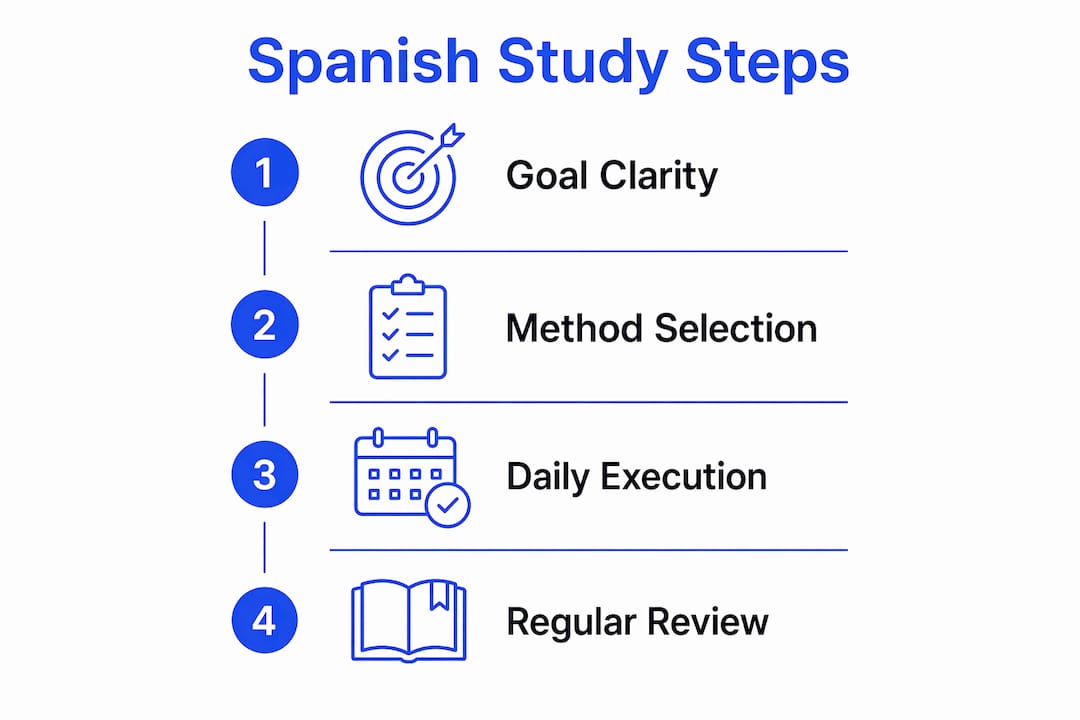
The core framework has four pillars: goal clarity, method selection, daily execution, and regular review. Each pillar depends on the others. Strong goals without consistent execution produce nothing. Daily effort without the right methods wastes time. Most learners skip the review stage entirely, which is why progress stalls after the beginner phase.
A hybrid approach combining structured study with immersive input and active output outperforms reliance on any single method. This means your plan should never rely on one app or one textbook alone. The structure holds the methods together and keeps you moving forward.
How to set clear and achievable Spanish learning goals
Goal clarity is the single most underrated factor in language learning success. Vague intentions like “I want to speak Spanish” produce vague results. Specific targets tied to measurable milestones produce real progress.
The Common European Framework of Reference for Languages, known as CEFR, gives you exactly those milestones. CEFR levels map vocabulary size, grammar knowledge, and speaking ability from A1 beginner through C2 mastery. Reaching A1 requires roughly 60 to 80 hours of focused study. Reaching B1 intermediate requires approximately 300 to 350 hours. Knowing these numbers lets you set a realistic timeline instead of guessing.
Use these benchmarks to build your Spanish language learning strategy:
- Define your target level. Are you aiming for conversational confidence at B1, or professional fluency at B2? Your target shapes every other decision.
- Set weekly hour commitments. Five hours per week gets you to A2 in about six months. Ten hours per week cuts that timeline roughly in half.
- Choose resources that match your goal. A business professional targeting B2 needs different materials than someone learning for travel.
- Set monthly check-in dates. Review your progress against CEFR descriptors every four weeks and adjust your plan accordingly.
Pro Tip: Read the guide on setting Spanish learning goals before you start your first study session. Learners who define their goals in writing before beginning are significantly more likely to reach their first milestone.
What are the most effective tools and methods for Spanish learners?
Spaced repetition systems improve vocabulary retention by up to 200% compared to massed practice, with learners retaining over 90% of vocabulary using automated review intervals versus roughly 20% without them. That gap is enormous. Anki is the most widely used spaced repetition tool for Spanish learners because it lets you build custom decks and schedule reviews automatically.
The quality of your flashcards matters as much as the tool itself. Contextual vocabulary flashcards outperform simple word-to-word cards because they give the brain a full sentence to anchor the new word. Instead of “casa = house,” your card reads “Vivo en una casa pequeña cerca del centro.” The full sentence provides grammar context, word order, and a memory hook all at once.
Shadowing is the method most adult learners ignore and most fluent speakers credit. Shadowing native speech improves prosody, meaning rhythm, pitch, and natural pacing, in ways that passive listening alone cannot achieve. The technique involves listening to a native speaker recording and speaking along simultaneously, matching their speed and intonation exactly. Podcasts like “Coffee Break Spanish” and YouTube channels with transcripts work well for this.
Speaking from the first week is non-negotiable. Early speaking trains the brain to produce language rather than just recognize it, which accelerates real-time recall and fluency development. Platforms like Tandem connect you with native speakers for conversation exchange at any level.
| Method | Effectiveness | Best tool | Time per day |
|---|---|---|---|
| Spaced repetition | Very high | Anki | 15 to 20 minutes |
| Contextual flashcards | High | Anki, StudyCards AI | 10 to 15 minutes |
| Shadowing | High | Podcasts, YouTube | 10 minutes |
| Conversation practice | Very high | Tandem, tutors | 20 to 30 minutes |
| Grammar study | Moderate | Textbooks, apps | 10 minutes |
Pro Tip: Combine at least three of these methods in every study session. Structured course combined with conversation practice and immersion produces the highest fluency gains over time. No single method covers all four language skills.
How to build a daily and weekly Spanish study routine
A sustainable Spanish study routine does not require two hours a day. A 30-minute daily plan that touches listening, speaking, reading, and writing produces consistent progress. The key is protecting that time and using it deliberately.
Here is a step-by-step daily structure for a 45-minute session:
- Anki review (10 minutes). Start with your spaced repetition deck. Review due cards only. Do not add new cards on days when your review count is high.
- New vocabulary input (10 minutes). Add five to eight new contextual cards. Use full sentences from a source you are currently reading or listening to.
- Listening or shadowing (10 minutes). Play a podcast episode or YouTube clip at your level. Shadow one short segment out loud.
- Speaking or writing output (10 minutes). Write three sentences using today’s new vocabulary, or record a 60-second voice note describing your day in Spanish.
- Grammar noticing (5 minutes). Review one grammar point from your current lesson. Focus on patterns you have seen in your input today.
For your weekly routine, add one 30-minute conversation session with a native speaker or tutor. Review your Anki statistics every Sunday to check retention rates and adjust your daily card count.
Consistent study time tracking improves both session duration and quality. Learners consistently overestimate how much they study without a timer. Use a free tool like Toggl or even a phone stopwatch to log real study minutes. Honest data lets you spot gaps before they become habits.
Pro Tip: Use an AI writing assistant or a tool like ChatGPT to generate contextual example sentences for new vocabulary. This cuts card creation time by half and reduces the burnout that kills most self-study plans.
How to overcome plateaus and common learning challenges
Every learner hits a wall. The beginner plateau usually appears around the A2 level, when the initial excitement fades and the volume of new material feels overwhelming. The intermediate plateau at B1 is harder to break because passive exposure stops producing noticeable gains.
The most common causes of plateaus are:
- Too much passive input, too little active output. Watching Spanish TV feels productive but does not train speaking or writing. Active output forces retrieval, which builds real fluency.
- Switching methods too often. Sticking to one course and one spaced repetition app for at least 90 days maximizes retention. Frequent method switching resets accumulated learning context and slows progress.
- Avoiding speaking due to perfectionism. Motivation and risk-taking attitudes strongly influence oral proficiency. Learners who speak imperfectly but often develop faster than those who wait until they feel ready.
- Ignoring grammar patterns in input. Conscious noticing of grammar during reading and listening helps adult learners internalize rules that children acquire naturally.
“The learner who speaks badly every day will outperform the learner who speaks perfectly once a week. Volume and consistency beat perfection every time.”
Breaking a plateau requires shifting your ratio of input to output. If you spend 80% of your study time consuming Spanish and 20% producing it, flip that ratio for two weeks. Write more. Speak more. Record yourself and listen back. The discomfort of active output is exactly where growth happens.
For speaking anxiety specifically, structured conversation practice with a patient tutor removes the social pressure of real-world interactions. It gives you a safe space to make mistakes, receive feedback, and build the confidence that carries over into real conversations. You can explore the Spanish Explorer teaching approach to see how structured feedback is built into every lesson.
Key takeaways
A structured Spanish study process works because it combines clear goals, proven retention methods, consistent daily execution, and active output into a system that compounds over time.
| Point | Details |
|---|---|
| Use CEFR milestones | Set A1 to B2 targets with hour estimates to create a realistic, measurable timeline. |
| Prioritize spaced repetition | Anki with contextual sentence cards retains over 90% of vocabulary versus 20% without intervals. |
| Speak from week one | Early speaking builds production skills that passive study cannot develop. |
| Protect your daily routine | A consistent 30 to 45-minute daily session beats irregular two-hour marathon sessions. |
| Commit to one method for 90 days | Frequent tool switching resets learning context and slows measurable progress. |
Why structure changed everything for me
Most learners I talk to have tried Spanish before. They downloaded an app, made it three weeks in, then quietly stopped. The app was not the problem. The absence of a real system was.
What I have seen consistently is that the learners who make the fastest progress are not the most talented. They are the most organized. They know their CEFR target. They track their study hours. They speak badly and often, and they treat every mistake as data rather than failure.
The counterintuitive truth about structured learning is that it actually creates more flexibility, not less. When you have a clear plan, you can miss a day without losing momentum because you know exactly where to pick up. Without structure, one missed day becomes a week, then a month.
The other thing most guides will not tell you: grammar study alone will not get you to fluency. I have seen learners with near-perfect grammar who cannot hold a five-minute conversation because they never trained their brain to produce language under pressure. Speaking early, even with a tiny vocabulary, rewires how your brain accesses Spanish in real time. That is not a motivational claim. It is how language production actually works.
Balance discipline with flexibility. If a method stops working, adjust it. If a topic bores you, find a more engaging source on the same content. The structure is the container. What you put inside it should keep you genuinely interested.
— Paul
Start your structured Spanish learning journey with Spanish Explorer
Spanish Explorer offers adult Spanish courses in Singapore designed around exactly the kind of organized, progressive curriculum this article describes. Whether you prefer group classes, private lessons, or flexible online sessions via Zoom, every course follows a structured path from foundational skills to real-world conversational and professional fluency.

Certified instructors guide you through each stage with clear feedback, practical speaking practice, and a curriculum built for adult learners with real goals. Browse the full range of structured Spanish courses to find the right fit for your level and schedule. If you want a faster, more personalized path, explore private Spanish classes tailored to your specific goals. Spanish Explorer is located at 10 Anson Road, Level 22, International Plaza, Singapore 079903, directly above Tanjong Pagar MRT.
FAQ
What is a structured Spanish study process?
A structured Spanish study process is a systematic learning plan that organizes your study time into clear stages covering vocabulary, grammar, speaking, listening, and writing. It uses proven methods like spaced repetition and CEFR milestones to track progress and maintain consistency.
How many hours does it take to reach conversational Spanish?
Reaching B1 conversational level requires approximately 300 to 350 hours of focused study, according to CEFR guidelines. At five hours per week, that translates to roughly 14 to 16 months of consistent effort.
Is Anki the best tool for learning Spanish vocabulary?
Anki is the most widely recommended spaced repetition tool for Spanish learners because it automates review intervals and supports contextual sentence cards. Learners using spaced repetition retain over 90% of vocabulary compared to roughly 20% with unstructured review.
How do I break through an intermediate Spanish plateau?
Shift your study ratio toward active output: speak and write more than you listen and read. Committing to one course and one spaced repetition app for at least 90 days without switching also prevents the context loss that causes most plateaus.
Should I start speaking Spanish before I feel ready?
Yes. Speaking early, even with mistakes, trains the brain to produce language rather than just recognize it, which accelerates real-time recall and fluency. Waiting until you feel ready delays the production skills that only come from regular speaking practice.
Sorry, the comment form is closed at this time.