

TL;DR:
- The Spanish Explorer method emphasizes structured, goal-oriented curriculum with measurable progress.
- It combines real-life simulations, frequent assessments, and bilingual instructors tailored for Singapore learners.
- Flexibility and ongoing feedback are key, ensuring steady progress towards fluency and certification.
Most Spanish courses in Singapore look similar on paper. You show up, follow a textbook, practice a few dialogues, and hope it sticks. But learners who are serious about passing DELE exams or reaching real conversational fluency quickly discover that method matters far more than motivation. Spanish Explorer takes a fundamentally different approach, one built around structure, measurable progress, and the specific needs of Singapore learners. Whether you are a working professional, a student, or someone pursuing Spanish for personal growth, understanding what sets this teaching style apart could be the deciding factor in your language journey.
Table of Contents
- Understanding teaching methodologies in Spanish education
- What defines the Spanish Explorer teaching style?
- How classes are structured for maximum progress
- Spanish Explorer style versus other Spanish programs in Singapore
- Our perspective: Why structure and support matter more than style
- Start your Spanish journey with Spanish Explorer
- Frequently asked questions
Key Takeaways
| Point | Details |
|---|---|
| Structured learning path | A step-by-step curriculum ensures steady progress from beginner to fluency. |
| Exam-focused outcomes | Lessons and assessments are aligned to DELE and SIELE certification for Singapore learners. |
| Flexible class formats | Choose from online, in-person, or blended classes that fit different lifestyles and goals. |
| Supportive community | Experienced teachers and interactive sessions foster motivation and sustainable learning. |
Understanding teaching methodologies in Spanish education
To understand the value of the Spanish Explorer method, it is key to first look at how Spanish is taught worldwide and in Singapore.
There are three dominant approaches you will encounter in most Spanish programs. The grammar-translation method focuses heavily on memorizing rules and translating text. It builds reading ability but often leaves learners unable to hold a real conversation. The communicative approach prioritizes speaking and listening, sometimes at the expense of grammatical accuracy. Immersion drops learners into full Spanish environments, which can be effective but overwhelming without proper scaffolding.
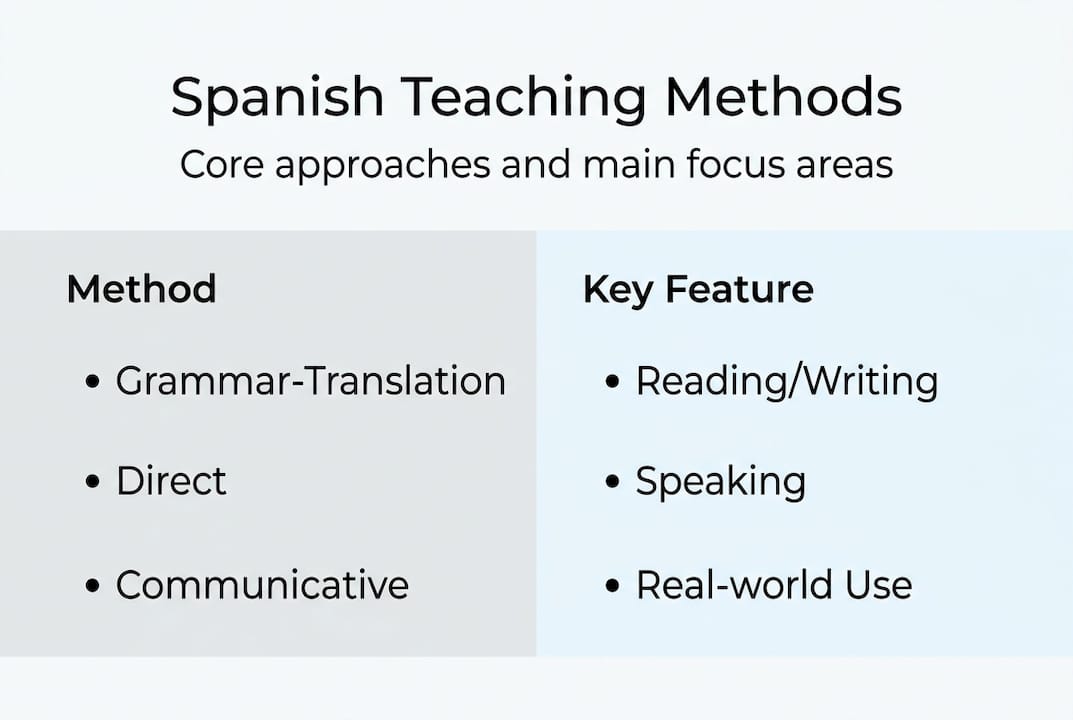
Each method has genuine strengths. But each also has a critical weakness: none of them alone is optimized for a goal-oriented learner in Singapore who needs to hit a specific proficiency level by a specific date.
Here is a quick comparison of how these approaches typically play out:
| Method | Strength | Common weakness |
|---|---|---|
| Grammar-translation | Strong reading and writing | Weak spoken fluency |
| Communicative approach | Natural conversation skills | Inconsistent grammar accuracy |
| Immersion | Fast vocabulary acquisition | Can be overwhelming without structure |
| Structured outcome-based | Clear milestones, exam readiness | Requires consistent commitment |
What most generic courses miss is the outcome-based layer. Knowing Latin American vs Spain Spanish differences, for example, is not just a fun cultural fact. It directly affects your DELE exam performance and your ability to communicate in professional settings. Structured teaching builds these distinctions into the curriculum from day one.
Singapore learners also bring a unique profile to language learning. Many are already multilingual, highly disciplined, and time-pressed. A method that wastes sessions on unfocused activities or skips feedback cycles costs them more than just time. It costs them confidence.
The key differentiator in effective Spanish education is not which single method you use. It is how deliberately you combine them around a learner’s actual goals.
What defines the Spanish Explorer teaching style?
Now that you know the big-picture landscape, let’s zoom in on what actually sets the Spanish Explorer method apart.
At its core, the Spanish Explorer approach is built on a structured curriculum that maps directly to proficiency levels from A1 (complete beginner) to C2 (mastery). This is not a loose framework. Every module has a defined learning outcome, and students always know exactly where they are and what comes next.
Here is how the key features break down:
- Bite-sized, progressive modules that build on each other without overwhelming learners
- Real-life simulations such as ordering food, negotiating in a business meeting, or navigating travel scenarios
- Interactive pair and group work that mirrors how language is actually used
- Frequent assessments aligned with DELE and SIELE exam rubrics, so exam prep is woven into regular class time
- Dedicated support for individual, group, and corporate learning contexts
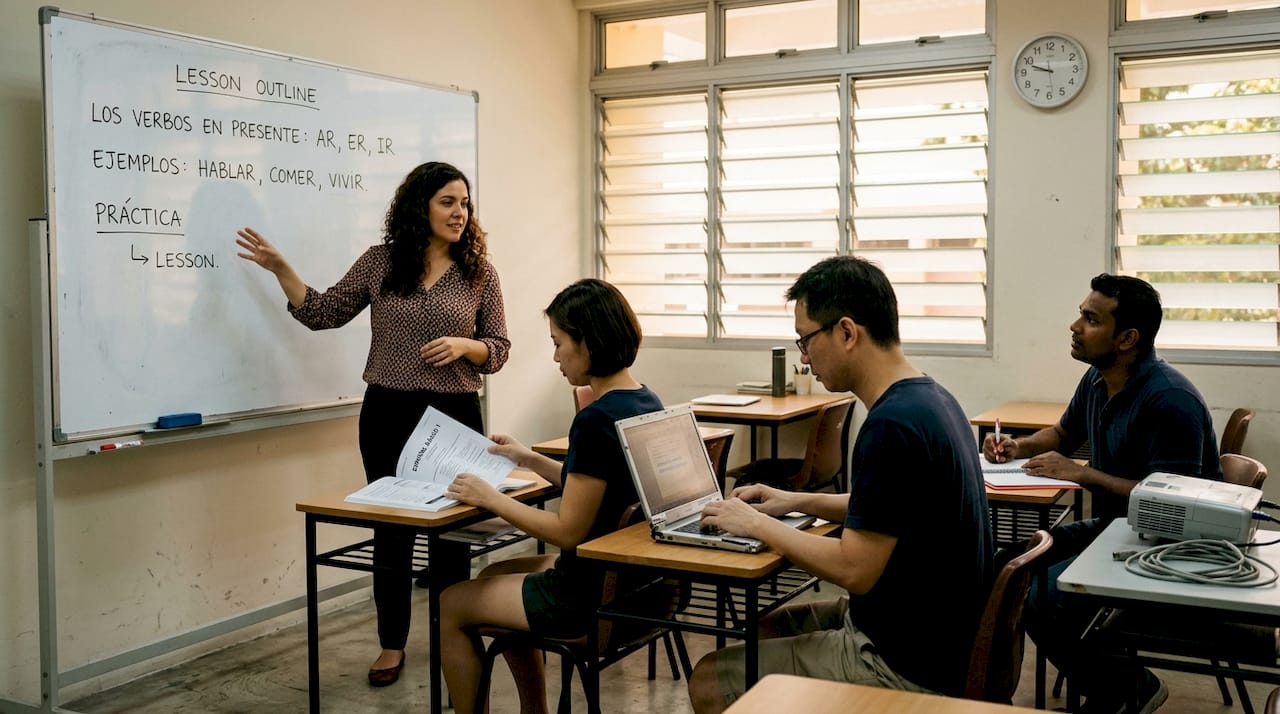
The certified Spanish instructors at Spanish Explorer are fluent in both Spanish and English, which matters enormously for Singapore learners. They can explain nuanced grammar points in English when needed, then immediately switch back to Spanish for practice. That code-switching ability removes a major barrier that pure immersion programs create.
One of the most underrated features is the focus on Singaporean learner strengths and struggles. Singaporeans tend to be strong at pattern recognition and disciplined study habits. But many feel self-conscious about speaking aloud, especially in a group. The Spanish Explorer method addresses this directly through structured speaking tasks that gradually build confidence rather than forcing early, uncomfortable performance.
As the structured curriculum helps students progress methodically towards fluency, it removes the guesswork that derails so many independent learners.
Pro Tip: If you are preparing for a DELE exam, ask your school how many class hours are explicitly tied to exam-format practice. A vague answer is a red flag.
The result is a learning environment where progress feels visible and earned, not accidental.
How classes are structured for maximum progress
With a clear teaching philosophy, here is how Spanish Explorer puts its method into action in everyday classes.
Spanish Explorer uses a blended learning model, combining in-person sessions with online resources and practice tools. This is not just a convenience feature. It reflects how modern learners actually absorb language, in short, repeated exposures across different contexts rather than one long weekly session.

Here is a breakdown of the main session types available:
| Session type | Best for | Key feature |
|---|---|---|
| Group classes | Social learners, budget-conscious | Peer interaction, shared progress |
| Private classes | Fast-track goals, specific needs | Fully personalized pacing |
| Intensive courses | Exam prep, tight timelines | High contact hours, rapid progression |
| Corporate classes | Professional teams | Industry-specific vocabulary and scenarios |
A typical class session at Spanish Explorer follows a clear rhythm. It opens with a short review of the previous lesson, moves into new content delivery, then shifts to guided practice, and closes with a communication task that requires students to use what they just learned. This structure is deliberate. It mirrors the input-output cycle that language acquisition research consistently supports.
Flexible class structures support diverse learner needs, including working professionals and students who cannot commit to rigid schedules. If you prefer in-person Spanish classes for the social energy, those are available at the central Singapore location. If your schedule demands flexibility, online Spanish classes deliver the same curriculum without the commute.
Feedback is built into every session, not saved for end-of-term reports. Teachers correct errors in real time using a technique called recasting, where they repeat the student’s sentence correctly without interrupting the flow of conversation. This keeps confidence intact while reinforcing accuracy.
Technology plays a supporting role too. Digital resources, vocabulary tools, and supplementary exercises extend learning beyond the classroom. For Singapore learners balancing demanding careers or academic schedules, this means progress does not pause between sessions. You can explore Spanish courses in Singapore to see how these formats are structured across different levels.
Spanish Explorer style versus other Spanish programs in Singapore
Seeing the Spanish Explorer method in action is useful, but how does it really measure up to other options in Singapore?
Let’s look at a direct comparison across the most common alternatives:
| Feature | Spanish Explorer | Generic group course | App-only learning | University-style class |
|---|---|---|---|---|
| Curriculum structure | DELE-aligned, level-mapped | Variable | Self-directed | Academic, theory-heavy |
| Certification readiness | Built-in exam prep | Rare | None | Partial |
| Instructor quality | Certified, bilingual | Varies | None | Academic credentials |
| Flexibility | Group, private, online | Limited | High | Rigid schedule |
| Feedback frequency | Every session | Weekly or less | Automated | Infrequent |
The difficulty of learning Spanish is often overstated, but the research is clear: students prefer structured, certification-aligned methods for long-term fluency. Apps like Duolingo are excellent for building vocabulary habits, but they cannot replicate the feedback loop of a live instructor or the social pressure that makes speaking practice stick.
University-style classes have rigor but often lack the practical, communicative focus that real-world Spanish demands. You might graduate knowing every verb conjugation but still freeze when a native speaker talks at natural speed.
“The biggest mistake learners make is choosing a program based on price or convenience rather than alignment with their actual goal. If you want a DELE certificate, you need a program that practices DELE-format tasks from week one.”
Generic group courses can work for casual learners, but they rarely offer the individualized pacing or exam-specific preparation that serious learners need. For those using SkillsFuture Spanish courses funding, the investment in a structured program pays off significantly more than a generic alternative.
Pro Tip: Before enrolling anywhere, ask to see a sample lesson plan and ask how the program tracks your progress toward a specific level. Transparency here is a strong signal of quality.
Spanish Explorer’s advantage is not just in what it teaches but in how consistently it measures and adjusts. That ongoing calibration is what separates learners who plateau from those who keep climbing.
Our perspective: Why structure and support matter more than style
After reviewing specific comparisons, let us step back and share what really matters in language progress.
Here is something most language learning articles will not tell you: teaching style is largely secondary. What actually drives progress is a clear, goal-oriented learning path combined with consistent feedback and accountability. A charismatic teacher with no structure will almost always produce worse outcomes than a methodical one with a well-designed curriculum.
For Singapore learners specifically, the cultural context matters. Many of us grew up in systems that reward precision and measurable results. A program that offers vague “conversational practice” without milestones will feel unsatisfying and produce inconsistent results. You need to see progress. You need to know your level is moving.
What most articles miss is the role of accessible support between classes. Can you ask your teacher a question on Tuesday if class is on Thursday? Does the school track your attendance and flag when you are falling behind? These operational details are not glamorous, but they are what separates programs that work from programs that sound good. Explore Spanish Explorer course options if you want to see what a transparent, milestone-based program actually looks like in practice.
Start your Spanish journey with Spanish Explorer
If you are ready to put this teaching style to work for your progress, here is how to get started.
Spanish Explorer offers a clear, structured path for every type of learner in Singapore. Whether you are starting from zero or preparing for a certification exam, the curriculum is designed to move you forward with purpose.
You can explore Spanish courses to find the right level and format for your goals. If your schedule demands flexibility, online Spanish classes deliver the full curriculum without requiring you to commute. For those targeting a certification, DELE exam preparation courses are built specifically to get you exam-ready. Both group and private lesson options are available, so you can choose the format that fits your learning style and timeline. Reach out to the team to book a consultation and take the first step toward real, measurable Spanish fluency.
Frequently asked questions
What makes the Spanish Explorer teaching style different from other Spanish classes?
The Spanish Explorer style uses a structured curriculum with outcome-based modules and frequent progress assessments tailored specifically to Singapore learners, rather than a one-size-fits-all approach.
Can I prepare for DELE or SIELE exams with Spanish Explorer?
Yes, Spanish Explorer’s classes are mapped to DELE and SIELE levels, with exam-aligned assessments woven into regular coursework so exam preparation is continuous, not last-minute.
Are there options for both online and in-person Spanish classes?
Spanish Explorer offers in-person, online, and blended learning formats, with flexible class structures designed to fit the schedules of working professionals and full-time students alike.
How fast can I become fluent with the Spanish Explorer method?
Progress depends on your starting level and weekly commitment, but the structured curriculum helps most students see tangible improvement within a few months of consistent, goal-directed study.
Sorry, the comment form is closed at this time.