


TL;DR:
- Regular daily practice, even for 10 minutes, greatly enhances Spanish fluency.
- Combining solo routines, structured classes, and real-world exchanges builds confidence effectively.
- Immersion and consistent speaking practice are key to accelerating Spanish speaking progress.
Finding real opportunities to practice spoken Spanish in Singapore can feel like searching for a needle in a haystack. Most learners hit a wall after classes end, unsure how to keep their conversational skills sharp outside the classroom. The good news is that Singapore offers more options than you might expect, from local meetups and language exchanges to AI tools and structured conversation classes. This guide walks you through proven, practical ideas for every level, whether you are just starting out or pushing toward fluency. You will leave with a clear plan, real resources, and the confidence to speak more Spanish starting today.
Table of Contents
- How to evaluate Spanish speaking practice options
- Top daily routines to build Spanish speaking confidence
- Maximize results with structured conversation classes in Singapore
- Language exchanges, meetups, and virtual immersion: real-world practice options
- Role-play, tech tools, and creative solo speaking activities
- What really works for Spanish speaking progress: our experience
- Take your Spanish speaking to the next level with expert guidance
- Frequently asked questions
Key Takeaways
| Point | Details |
|---|---|
| Short, daily practice | Consistent, focused practice every day is the most effective way to build your Spanish speaking skills. |
| Local classes and meetups | Joining structured classes and language exchange events in Singapore offers invaluable speaking opportunities and feedback. |
| Creative solo activities | Role-plays, self-talk, and tech tools help you practice speaking even without a partner. |
| Mix methods for best results | Combining different approaches—solo routines, exchanges, classes—drives faster, more enjoyable progress. |
How to evaluate Spanish speaking practice options
Not every practice idea works for every learner. Before you commit to a method, it helps to measure it against a few key criteria so you spend your time on what actually moves the needle.
Here is what to look for when choosing a Spanish speaking practice strategy:
- Frequency: Can you do it regularly, ideally daily?
- Interactivity: Does it involve real speaking, not just passive listening?
- Feedback: Will someone or something correct your errors?
- Immersion quality: Does it expose you to natural, real-world Spanish?
- Local availability: Is it accessible from Singapore without major barriers?
- Enjoyment: Will you actually stick with it long-term?
Balance is key. A Spanish study plan for beginners works best when it mixes structured learning with variety, so you stay motivated week after week. Routine prevents forgetting; variety prevents boredom.
Your current level also shapes which options fit best. Absolute beginners benefit most from guided tools and classes where errors get corrected immediately. Intermediate learners, on the other hand, gain the most from conversation partners and real-world speaking tasks. If you are unsure where you stand, checking a realistic Spanish learning timeline can help you set honest expectations.
Consistent, short daily practice outperforms long, irregular sessions, especially for busy Singaporeans. Empirical studies on immersion also confirm that regular, meaningful exposure to spoken Spanish accelerates fluency far more than cramming.
Pro Tip: Even 10 minutes of spoken Spanish daily beats one long session per week. Consistency is the single biggest factor in language retention.
Top daily routines to build Spanish speaking confidence
With your criteria set, let’s look at simple routines you can use daily. No partner required.
These four core habits, done consistently, build real speaking confidence over time:
- Self-talk in Spanish about your day. Narrate what you are doing as you cook, commute, or walk. This trains your brain to think in Spanish rather than translate from English.
- Record and review yourself. Use your phone to record a 60-second Spanish monologue each morning. Play it back and notice where you hesitate or mispronounce words.
- Listen to and mimic podcasts. Repeat phrases out loud immediately after hearing them. This technique, called “shadowing,” trains your mouth to produce natural Spanish rhythm and intonation.
- Use flashcards for active recall. Tools like Anki help you retain daily Spanish vocabulary by forcing you to produce the word before seeing the answer.
Daily 30-minute routines combining vocabulary, listening, self-talk, and quick grammar review build speaking confidence faster than passive study alone. Try pairing two of these activities each day to keep things fresh. For example, combine self-talk in the morning with podcast shadowing during your commute.
Role-playing daily scenarios aloud is especially powerful. Pretend you are ordering kopi at a café but in Spanish. Practice asking for directions to Orchard Road. These micro-scenarios build the spontaneous speaking ability you need for real conversations. AI practice tools can also simulate these scenarios with instant feedback, making them ideal for evenings when no human partner is available.
A solid step-by-step Spanish routine ties all these habits together into a sustainable weekly plan.
Pro Tip: Use a voice-to-text app like Google Voice to speak a sentence in Spanish and check if it transcribes correctly. If it does not, your pronunciation needs work in that area.
Maximize results with structured conversation classes in Singapore
Beyond solo practice, joining a class provides structure and invaluable correction.
Classes offer something no app or podcast can fully replicate: a trained instructor who catches your errors in real time and explains why they happen. That kind of feedback accelerates progress dramatically. Many schools in Singapore also run conversation-focused workshops specifically designed to build spoken fluency, not just grammar knowledge.
Here are some schools worth considering:
- Spanish Explorer: Offers group, private, and corporate formats with certified instructors aligned to DELE standards. Spanish courses in Singapore are available in-person and online Spanish classes for flexible scheduling.
- Spanish Studio: Known for practical, conversational lessons with a strong community feel.
- Berlitz Singapore: Uses an immersive method where lessons are conducted almost entirely in Spanish from day one.
“Joining local Spanish schools for structured conversation classes with native teachers focused on real-life scenarios is one of the most effective ways to build spoken fluency.”
Structured classes also provide accountability. When you know a teacher and classmates are expecting you, you show up and practice even on days when motivation is low. That consistency compounds over time. If you are ready to learn Spanish in Singapore with professional guidance, a structured class is the fastest path from hesitant beginner to confident speaker.
Language exchanges, meetups, and virtual immersion: real-world practice options
For real-life interaction, language exchanges and meetups in Singapore bring the Spanish-speaking world to your doorstep.
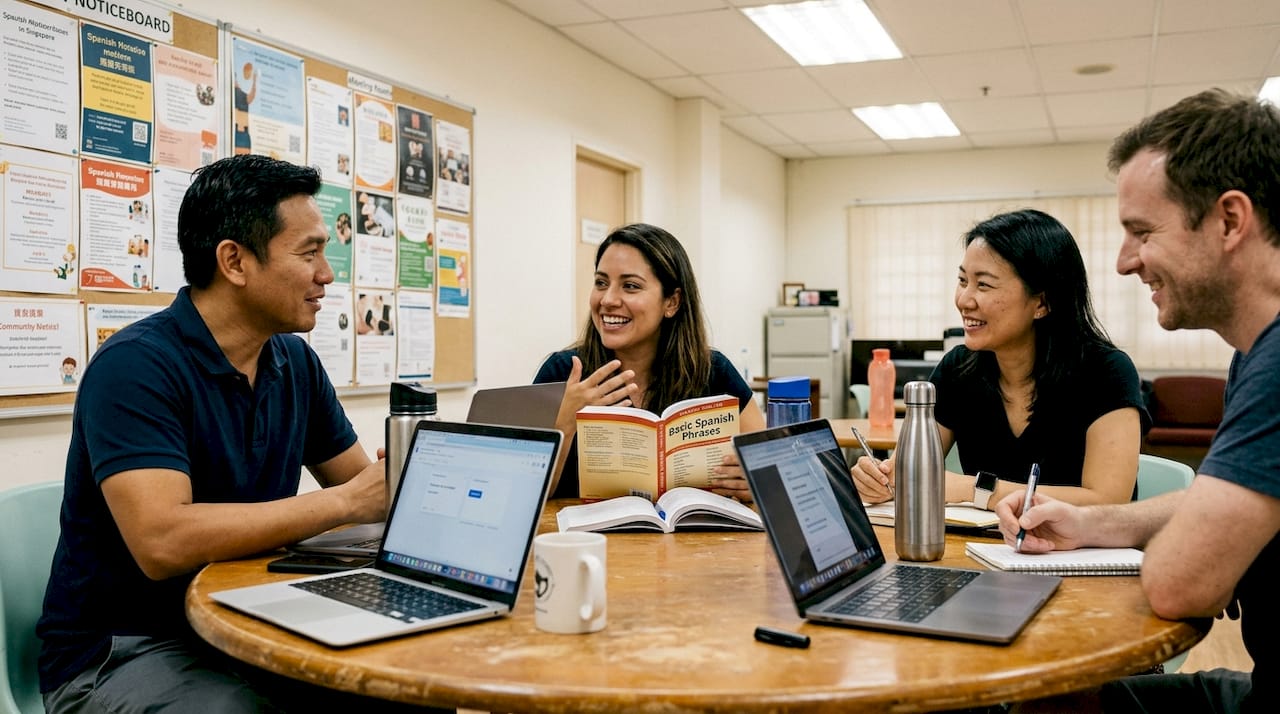
Singapore has a surprisingly active Spanish-speaking expat community, and several platforms make it easy to connect with them. Language exchange platforms and apps connect learners in Singapore with native speakers for mutual practice, meaning both parties benefit from the exchange.
Top platforms and resources to explore:
- Meetup: Search for Spanish language groups in Singapore for regular in-person gatherings.
- Eventbrite: Lists one-off Spanish conversation events and cultural nights.
- Reddit: The r/askSingapore thread on Spanish meetups has active recommendations from locals.
- MyLanguageExchange: Matches you with a native Spanish speaker who wants to learn English.
- Local expat Facebook groups: Many Latin American expats in Singapore actively seek conversation partners.
Here is a quick comparison of the top platforms:
| Platform | Cost | Interactivity | Community size |
|---|---|---|---|
| Meetup | Free to join | High (in-person) | Medium |
| MyLanguageExchange | Free/Premium | High (1-on-1) | Large |
| Eventbrite | Varies | High (events) | Small to medium |
| Reddit groups | Free | Medium (async) | Growing |
| Virtual buddy programs | Free | High (video call) | Large |
Empirical studies show immersion experiences greatly improve spoken Spanish fluency, and virtual exchanges count as immersion when done consistently. For maximum benefit, prepare two or three conversation topics before each session, ask your partner to correct your grammar, and alternate between speaking and listening roles. You can also explore local Spanish language programs that incorporate community practice into their curriculum.
Role-play, tech tools, and creative solo speaking activities
When in-person meetups are not possible, tech tools and solo activities keep your Spanish speaking on track.
Role-playing everyday situations and self-talk describing your surroundings enhance real-world readiness, and AI tools provide low-pressure practice for learners who feel shy about making mistakes in front of others.
Here are some of the most effective solo and tech-enabled activities:
- Role-play scenarios: Practice ordering food, asking for directions, or checking into a hotel. Do it aloud, even if you feel silly.
- Narrate a Singapore walk: Describe what you see in Spanish as you walk through your neighborhood or a hawker center. Colors, sounds, people, smells.
- AI conversation partners: Tools like ChatGPT or dedicated Spanish AI practice apps let you hold full conversations in Spanish with instant corrections.
- Speech-to-text challenges: Speak a full paragraph in Spanish and see how accurately your phone transcribes it.
- Storytelling aloud: Pick a photo and describe the story behind it in Spanish for two minutes without stopping.
- Practice compliments and small talk: Phrases like “Me encanta tu camisa” or “¿Cómo estuvo tu fin de semana?” are perfect for building social Spanish.
These activities work especially well for introverts or learners who feel self-conscious in group settings. There is no audience, no pressure, and no judgment. You build fluency in private before taking it public. For more ideas, explore effective ways to learn Spanish and get tips from Spanish teachers who understand the unique challenges Singaporean learners face.
What really works for Spanish speaking progress: our experience
After years of working with Singaporean learners, we have noticed a pattern. The students who progress fastest are not the ones who study the most hours. They are the ones who practice speaking every single day, even for just a few minutes, and who combine that habit with regular feedback.
A common myth is that you need to move abroad or find a native-speaking partner to get fluent. We have seen learners reach conversational fluency entirely in Singapore by mixing daily self-practice, weekly class sessions, and AI tools during gaps. The environment matters far less than the consistency and quality of your practice.
Another thing we have learned: waiting for the “right moment” to start speaking is the biggest fluency killer. Most learners hold back because they fear making mistakes. But mistakes are the data your brain needs to improve. The sooner you start speaking imperfectly, the sooner you start speaking well.
Learning Spanish in Singapore is not just possible. With the right mix of tools, community, and daily habits, it is genuinely effective and even enjoyable.
Take your Spanish speaking to the next level with expert guidance
Ready to get more out of your practice? Personal guidance and real conversation make all the difference.
At Spanish Explorer, we offer Spanish courses in group, private, and corporate formats, all taught by certified, experienced instructors who are fluent in both Spanish and English. Whether you prefer face-to-face sessions in Singapore’s central business district or flexible online Spanish classes, we have a format that fits your schedule and goals. Our curriculum is built around real-world communication, so every lesson adds directly to your speaking confidence. Join a community of motivated learners and get the structured feedback that solo practice simply cannot provide.
Frequently asked questions
What is the best way to practice Spanish speaking in Singapore if I am a beginner?
Start with structured classes or guided apps to build your basics, then join language exchanges or meetups for more real-world practice once you have foundational confidence.
How can I find Spanish language meetups or partners in Singapore?
Use platforms like Meetup, Eventbrite, Reddit, and MyLanguageExchange to connect with Spanish-speaking groups and expats actively looking for conversation partners in Singapore.
Are there ways to practice speaking Spanish alone?
Yes. Solo ideas include recording yourself, self-talking aloud, using AI chatbots for practice, and simulating daily scenarios like ordering food or giving directions entirely in Spanish.
Does immersion help with Spanish speaking fluency?
Studies show immersion significantly improves oral proficiency and spoken complexity, especially when combined with consistent daily practice rather than occasional intensive sessions.
Sorry, the comment form is closed at this time.