

TL;DR:
- Choosing a Spanish class depends on your specific goals, schedule, budget, and learning style.
- In-person classes offer social interaction, while online lessons provide flexibility and convenience.
- Teacher quality and class size are crucial for effective learning and real progress.
Choosing the right Spanish class sounds simple until you actually start looking. Do you go with a group class at a local school, hire a private tutor, or take online lessons from your home office? Each format serves a different kind of learner, and picking the wrong one can slow your progress or drain your motivation entirely. Whether you’re brushing up Spanish for a job opportunity, preparing for a DELE exam, or simply want to hold a real conversation, the format you choose matters just as much as how hard you study. This guide breaks down every major class type so you can make a confident, informed decision.
Table of Contents
- What to consider before choosing a Spanish class
- In-person Spanish classes: Group and private formats
- Online Spanish classes: Flexibility and formats
- Specialized Spanish classes: Exams, business, and speaking practice
- Our take: How to truly maximize learning from your Spanish class
- Find your ideal Spanish class in Singapore
- Frequently asked questions
Key Takeaways
| Point | Details |
|---|---|
| Group vs private classes | Group classes are cost-effective and social; private classes offer faster personalized progress. |
| Flexibility of online learning | Online Spanish classes suit busy schedules but require self-discipline. |
| Importance of native teachers | Native speaking teachers and interactive small classes boost effectiveness. |
| Specialized course options | Exam prep, business Spanish, and speaking clubs fill specific needs beyond general lessons. |
What to consider before choosing a Spanish class
Before you compare class formats, you need an honest answer to one question: what exactly do you want from learning Spanish? Your answer shapes everything else. Someone aiming to pass a DELE exam in six months has very different needs from a professional who wants to negotiate deals in Latin America, or a retiree learning for fun.
Here are the main factors to evaluate:
- Your primary goal. Speaking fluency, writing accuracy, reading comprehension, or formal exam certification each require a different instructional focus.
- Your schedule. Fixed weekly classes build routine and accountability. Flexible online options suit irregular work hours or frequent travel.
- Your budget. Group Spanish courses are consistently more affordable than private sessions, sometimes by 40% to 60% per hour.
- Your learning style. Some learners absorb language through conversation and debate. Others prefer structured grammar drills or self-paced video modules.
- Social vs. solo preference. Group settings provide peer interaction and friendly competition. Solo study or private Spanish classes give you undivided teacher attention.
Pro Tip: Write down your goal in one sentence before researching classes. If you can’t summarize it, you’re not ready to choose a format yet.
Format alone won’t determine your success. One widely recognized observation is that in-person classes offer better social interaction and discipline, while online classes provide flexibility. Neither is universally superior. What matters is matching the format to your life and your goal, not chasing whatever seems most popular at the moment.
In-person Spanish classes: Group and private formats
In-person classes remain the most common entry point for Spanish learners in Singapore, and for good reason. Face-to-face interaction creates a learning environment that’s hard to replicate on a screen.
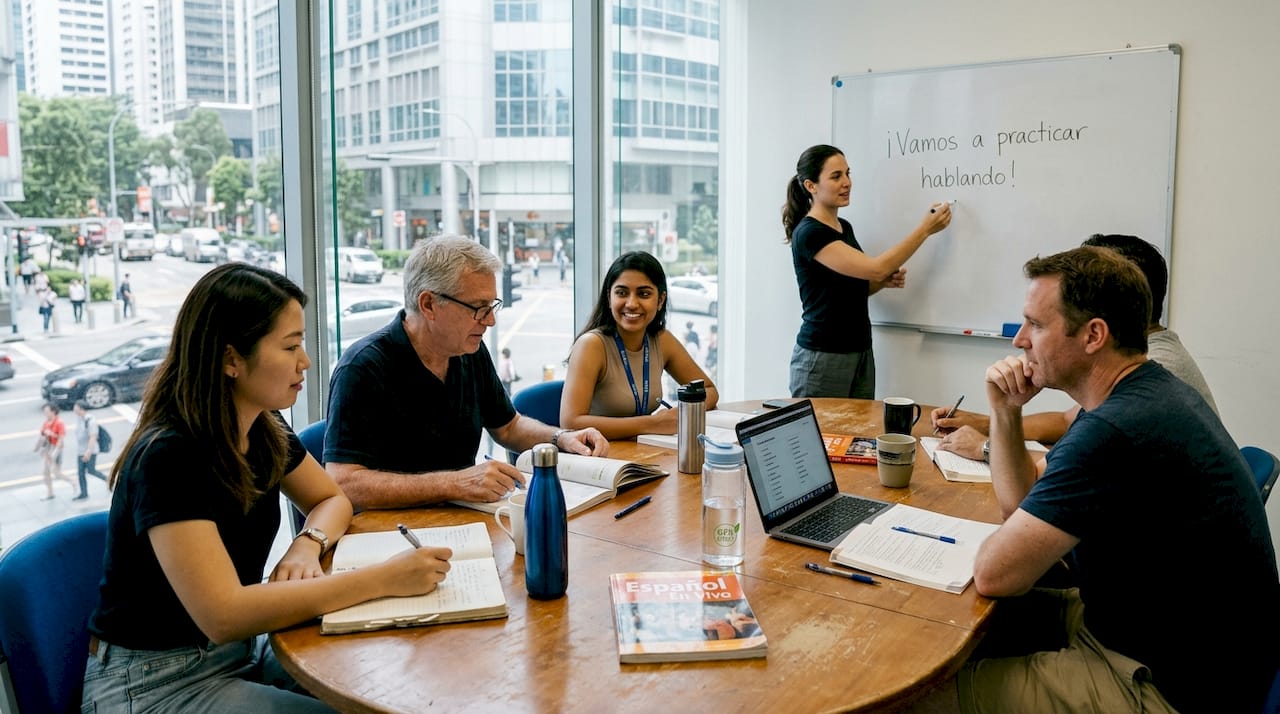
Group classes are structured, social, and affordable. You’ll practice speaking with classmates, get corrected in real time, and build the habit of showing up weekly. The energy of a live classroom pushes most learners to stay consistent. The tradeoff is that the pace is set for the whole group, so if you’re ahead or behind, the class may not adjust for you.
Private classes flip that equation. Your instructor focuses entirely on your weaknesses, your vocabulary gaps, and your speaking rhythm. Progress can be noticeably faster. The cost, however, is higher, and some learners find one-on-one settings less motivating without the energy of peers.
Here’s a side-by-side comparison:
| Feature | Group classes | Private classes |
|---|---|---|
| Cost | Lower per session | Higher per session |
| Pace | Set by the group | Tailored to you |
| Speaking practice | Peer interaction | Instructor only |
| Flexibility | Fixed schedule | More negotiable |
| Ideal for | Social learners, beginners | Fast-trackers, exam prep |
As research consistently shows, group classes are cost-effective and best for social learning, while private classes deliver faster personalized progress.
Practical focus, native instructors, and interactive formats consistently outperform unstructured self-study. Structure and accountability are what turn occasional learners into fluent speakers.
For a deeper breakdown, explore group Spanish class benefits or review the private Spanish course details to see which format fits your current stage.
Pro Tip: If you’re torn between group and private, start with a small group of 6 to 8 students. You’ll get structured input and enough speaking time to know whether you need more personalized attention.
Online Spanish classes: Flexibility and formats
Online Spanish classes have grown into a serious option for Singapore learners, not just a fallback. They come in several distinct formats, and the differences between them matter.
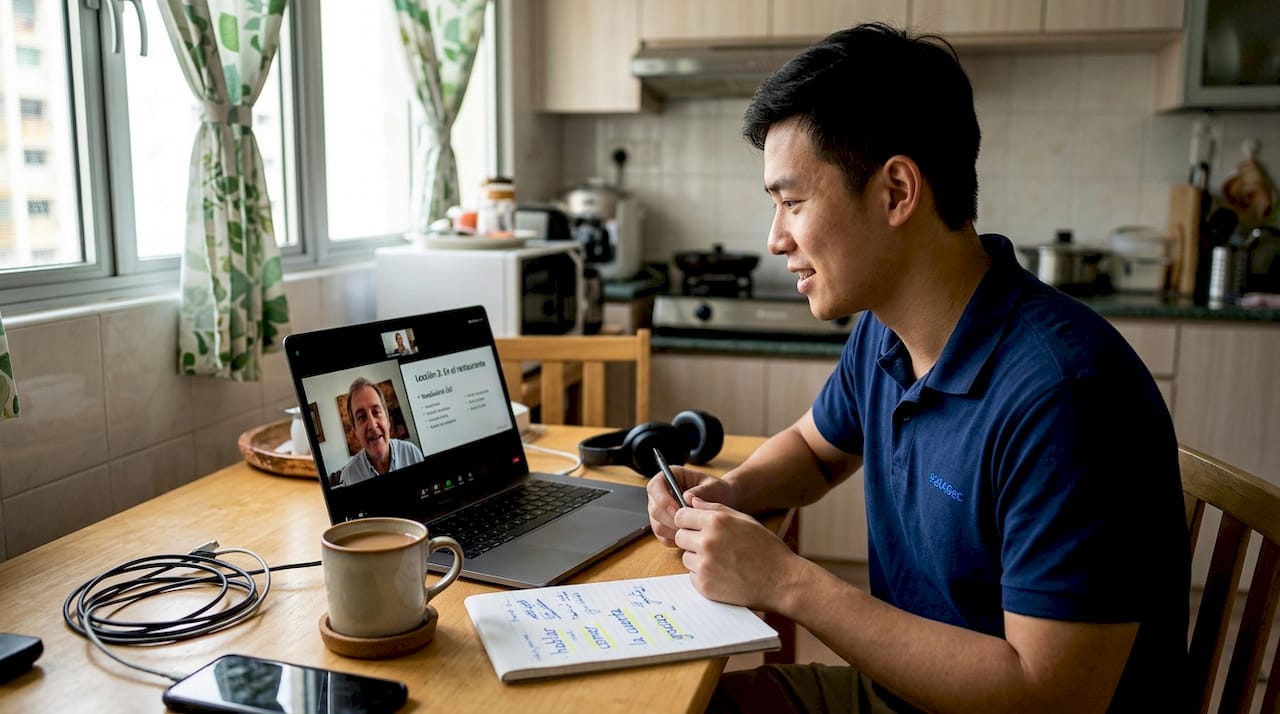
Live online group classes replicate the classroom experience over video. You attend at a set time, interact with classmates, and follow a structured curriculum. The social energy is present, though slightly reduced compared to being in the same room.
Private online lessons offer maximum flexibility. You schedule sessions around your work calendar, and the instructor focuses entirely on your goals. These work especially well for professionals with demanding or shifting hours.
Hybrid courses blend live sessions with self-study modules. You might attend two live classes per week and complete grammar exercises or listening tasks independently. This format suits learners who want structure but also value self-directed practice.
Key advantages and limitations at a glance:
- No commute, which matters in Singapore’s CBD traffic
- Access to instructors regardless of physical location
- Easier to record or review sessions for reinforcement
- Requires strong self-discipline to stay consistent
- Technical issues can disrupt learning flow
For busy professionals and students with unpredictable timetables, online Spanish classes often provide the only realistic path to consistent study. Skipping a class because of an MRT delay or a late meeting becomes a non-issue.
That said, a fair trade-off exists. Online learning offers flexibility but may lack the social interaction and discipline that in-person formats naturally build. The key is choosing an online program that actively builds accountability through live sessions, not just pre-recorded videos.
Pro Tip: Test your setup before committing to an online course. A poor internet connection or a noisy home environment will undermine even the best instructor.
Specialized Spanish classes: Exams, business, and speaking practice
For learners with a specific outcome in mind, a general Spanish class may not be the fastest route. Specialized classes target exactly what you need, cutting out content that doesn’t serve your goal.
Here are the main specialized formats available in Singapore:
- DELE and SIELE exam preparation classes. These are structured around the official exam format, test-taking strategies, and timed practice papers. A good DELE exam prep course teaches you not just the language but how to perform under exam conditions.
- Business Spanish classes. These focus on professional vocabulary, email writing, formal presentations, and industry-specific language. Ideal for executives or teams with Latin American clients or partners.
- Conversation clubs and speaking-focused sessions. These informal classes prioritize output over input. You speak, get corrected, and speak again. Great for breaking through the intermediate plateau where grammar is solid but speaking confidence is still low.
If you’re unsure which exam certification suits your professional goals, the DELE vs SIELE guide offers a clear comparison. And for those specifically targeting speaking fluency, speaking practice tips can supplement any class format.
| Specialized class | Best for | Key benefit |
|---|---|---|
| DELE/SIELE prep | Certification seekers | Exam technique and structure |
| Business Spanish | Professionals | Workplace-ready vocabulary |
| Conversation clubs | Intermediate learners | Real-world fluency and confidence |
According to language educators, small groups are optimal for speaking practice and exam skills development. When class sizes stay small, every student gets meaningful speaking time rather than passively listening to others.
Pro Tip: If your goal is exam certification, don’t just look for a general Spanish class with an exam module tacked on. Enroll in a course specifically designed around the DELE or SIELE format from day one.
Our take: How to truly maximize learning from your Spanish class
Most learners spend hours comparing class types and prices. Far fewer ask the question that actually predicts outcomes: who is teaching, and how?
Teacher quality is the biggest variable in language learning, and it’s the one most students ignore because it’s harder to compare than price or schedule. A qualified, native Spanish teacher brings authentic pronunciation, cultural nuance, and intuitive correction that textbook-trained instructors often can’t replicate. Native teachers and interactive small classes are key to effective learning, and this isn’t just theory. Learner reviews consistently praise practical-focused classes and native teachers as the defining factor in their progress.
Small, interactive class sizes also matter more than most people realize. A class of 20 students feels like a Spanish class. A class of 6 to 8 feels like a conversation. The difference in speaking time per student is enormous.
Our honest advice: don’t enroll based on brochures alone. Request a trial lesson. Ask about your instructor’s background. Find out what percentage of class time involves actual speaking versus passive listening. These questions reveal whether a school delivers real results or just the appearance of them.
Find your ideal Spanish class in Singapore
Now that you know what each Spanish class format offers, the next step is finding a school that actually delivers on its promises.
At Spanish Explorer, we offer structured, expert-led Spanish courses for every learner in Singapore, whether you’re a complete beginner or targeting DELE certification. Our complete Spanish course options include group classes, private sessions, and corporate programs, all taught by certified native instructors. Prefer to study from home? Our online Spanish courses bring the same quality instruction to your screen. Request a trial lesson today and find out exactly which format fits your goals, your schedule, and your learning style.
Frequently asked questions
Are private Spanish classes more effective than group lessons in Singapore?
Private classes often deliver faster, more personalized progress, but small group lessons are better for speaking practice and social learning. The right choice depends on your goal and how you learn best.
What’s the main advantage of online Spanish classes?
Online Spanish classes offer flexibility for busy schedules and easy access, though they may lack some of the social interaction and built-in discipline that in-person formats naturally provide.
How important are native teachers for Spanish learning?
Native teachers and interactive small classes are critical to effective learning for most students, and learner reviews consistently back this up as the top factor in real progress.
Can I prepare for the DELE exam in group classes?
Yes. Many schools offer specialized DELE prep in small group formats, and small groups are optimal for the speaking practice and exam skills development the test demands.
Sorry, the comment form is closed at this time.