

TL;DR:
- Effective Spanish learning in Singapore requires quality teachers and small class sizes.
- Flexibility and real-world practice are key for sustained progress and confidence.
- Combining formal classes with conversation practice accelerates fluency development.
Finding the right Spanish learning resource in Singapore sounds simple until you actually start looking. Dozens of schools, online platforms, tutors, and apps compete for your attention, each promising fluency in record time. Without a clear set of criteria, it is easy to waste money on courses that don’t match your goals, your schedule, or your current level. This guide cuts through the noise by laying out what actually matters when choosing a Spanish program, reviewing the top schools available in Singapore, and matching specific recommendations to different types of learners so you can move from research to real progress fast.
Table of Contents
- How to choose the right Spanish language resource
- Top Spanish schools and centers in Singapore
- Comparing learning options: classroom, online, and self-study
- Situational recommendations: find your best fit
- Our take: what most Spanish learners in Singapore overlook
- Ready to start your Spanish journey?
- Frequently asked questions
Key Takeaways
| Point | Details |
|---|---|
| Choose by benchmarks | Prioritize small classes, native-speaking teachers, and trial options for the best Spanish learning experience in Singapore. |
| Top schools identified | Spanish World, Spanish Council, and Spanish Studio are highly recommended centers in Singapore. |
| Flexibility is vital | Select a resource that matches your schedule, goals, and preferred learning style—classroom, online, or self-study. |
| Trial before commitment | A trial lesson lets you find the best class fit and teaching style without upfront risk. |
| Practice boosts progress | Combining classes with real-world practice, such as conversation groups, accelerates real fluency. |
How to choose the right Spanish language resource
Before you sign up for any class, you need to know what separates a genuinely effective program from one that simply looks good on a website. In Singapore, the landscape is broad but uneven. Some schools deliver structured, internationally aligned curricula. Others are informal setups that rely on inconsistent teaching styles. Knowing what to look for saves you from costly mistakes.
Teaching quality is the single most important factor. A native-speaking or near-native teacher does more than just model pronunciation correctly. They bring authentic cultural context into every lesson, correcting errors in real time and helping you build instincts that no textbook can replicate. When a teacher is fluent in both Spanish and English, they can also bridge explanations clearly, which matters enormously at the beginner and intermediate levels.
Class size shapes your learning speed more than most people realize. In a large group of 15 or 20 students, your actual speaking time per lesson shrinks dramatically. You spend most of the hour listening and waiting. Smaller classes keep you active and accountable. According to Sassy Mama SG, benchmarks for quality language schools include small classes, max 8 students, native teachers, and the availability of trial lessons. Those three criteria alone filter out a significant number of mediocre options.
Flexibility matters for Singapore’s working population. Most adult learners here are balancing demanding careers, family commitments, and limited free time. A school that only offers weekday daytime classes will not work for most professionals. Look for programs that offer evening and weekend slots, as well as hybrid formats that let you switch between online and in-person attendance when your week gets unpredictable.
Here are the core criteria to apply when evaluating any Spanish learning resource in Singapore:
- Teacher credentials: Are instructors certified and native or near-native speakers?
- Class size: Does the school cap enrollment to maximize speaking practice?
- Trial lesson availability: Can you sample the class before committing financially?
- Curriculum alignment: Is the content tied to a recognized framework such as the Common European Framework of Reference (CEFR) or DELE standards?
- Scheduling flexibility: Are evening, weekend, and online options available?
- Learning goal fit: Does the school offer options for travelers, professionals, and exam candidates alike?
Pro Tip: Always attend a trial lesson before enrolling in a full course. Even two schools that look identical on paper can feel completely different in the classroom. A single session tells you more about teaching style, pace, and atmosphere than any brochure ever will.
Once you have applied these criteria to your shortlist, you are ready to start comparing specific options. If you want to accelerate your results even further, reviewing proven steps to learn Spanish fast gives you a strong methodological foundation to pair with any formal class you choose. It also helps to understand what choosing a Spanish class involves before you commit to a format.
Top Spanish schools and centers in Singapore
Singapore does not currently host an official Instituto Cervantes campus. Instituto Cervantes is the Spanish government’s global network of cultural and language centers, similar to the British Council or the Goethe-Institut. While its absence from Singapore’s landscape might seem like a gap, local schools have stepped up effectively. According to Sassy Mama SG, three standout schools in Singapore are Spanish World, Spanish Council, and Spanish Studio, each offering group and private lessons with distinct strengths.
Here is a side-by-side comparison of their key features:
| School | Accreditation | Class format | Class size | Trial class | Special features |
|---|---|---|---|---|---|
| Spanish World | Instituto Cervantes accredited | Group and private | Small | Available | Strongest formal credentials |
| Spanish Council | Internal accreditation | Group and private | Small to medium | Check directly | Community events and conversation practice |
| Spanish Studio | Internal standards | Group, private, corporate | Small | Available | Strong corporate and professional focus |
| Spanish Explorer | DELE-aligned curriculum | Group, private, corporate, online | Small | Available | CBD location, SkillsFuture eligible |
Each school attracts a slightly different learner profile. Spanish World appeals most to learners who prioritize formal accreditation and want the clearest pathway to official Spanish exams. Spanish Council tends to draw students who value community alongside structured classes. Spanish Studio has carved a niche in professional and corporate training.
“What makes a language school truly effective is not just the credential on the wall but the moment a student speaks confidently for the first time in a real conversation. That experience is the real benchmark.”
When evaluating these schools, pay close attention to what happens outside the classroom. Does the school organize cultural events, conversation meet-ups, or language exchange programs? These extras are often what sustain learner motivation beyond the first few months, which is statistically the period when most language learners drop out.
For learners who cannot commit to in-person attendance regularly, online Spanish classes offer a structured alternative that maintains teaching quality without requiring physical presence. If you are thinking about subsidized options, it is also worth exploring SkillsFuture-eligible Spanish courses, which can significantly reduce your out-of-pocket cost as a Singapore resident.
Comparing learning options: classroom, online, and self-study
Not every learner in Singapore has the same constraints. A graduate student with flexible afternoons and a regional director with back-to-back meetings will need entirely different approaches. Understanding the real differences between learning modes helps you choose one that you will actually stick with.
| Mode | Cost | Flexibility | Speaking practice | Structured support | Best for |
|---|---|---|---|---|---|
| In-person classroom | Medium to high | Low to medium | High | High | Beginners and exam candidates |
| Online live class | Medium | High | Medium to high | Medium to high | Busy professionals |
| Self-study (apps, books) | Low | Very high | Low | Very low | Supplemental or casual learners |
| Hybrid (mixed modes) | Medium | High | High | High | Most adult learners in Singapore |
The classroom setting remains the gold standard for beginners. When you are just starting out, the immediate feedback loop between teacher and student is hard to replicate digitally. You need someone in real time to hear your accent, correct your verb conjugation, and tell you that what you said actually means something completely different in Spain versus Mexico.
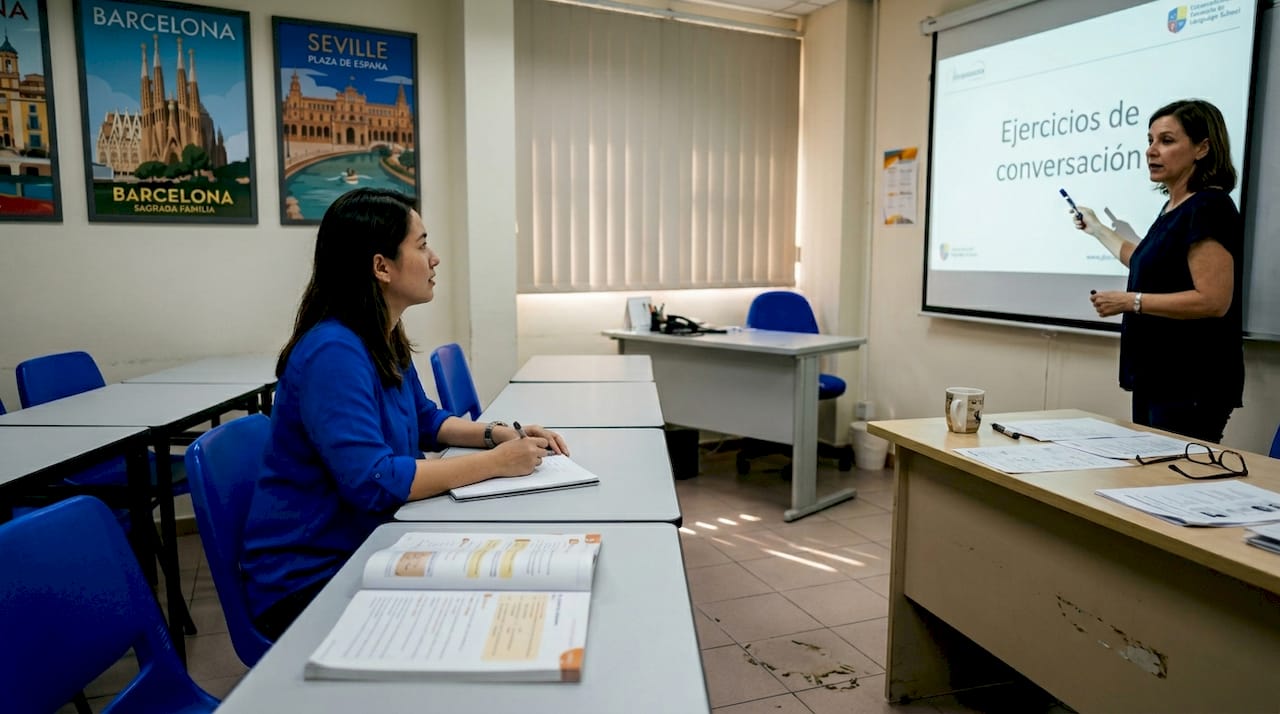
Online classes genuinely shine for intermediate learners who already have a foundation. They preserve the live interaction with a teacher while removing the commute, which for Singapore’s professionals can easily add 30 to 45 minutes each way. Schools that apply native teacher standards and small class sizes to their virtual sessions deliver results comparable to face-to-face instruction.
Self-study tools like apps are best used as supplements, not primary learning methods. They are excellent for vocabulary building and daily review but cannot replicate the spontaneous, unscripted pressure of real conversation. Using them alongside a formal class, however, can meaningfully accelerate your vocabulary acquisition between sessions.
Here is how to structure your learning approach based on your lifestyle:
- If you work standard office hours: Enroll in an evening or weekend class for structured instruction, and use an app for 15 to 20 minutes of daily vocabulary practice during your commute.
- If you travel frequently for work: Choose an online live class that you can attend from anywhere in the region, backed by recorded sessions you can review when you miss a week.
- If you are preparing for a DELE exam: Prioritize in-person classes with DELE-aligned curricula, and add dedicated grammar workbooks in your self-study time.
- If you are a casual learner: A relaxed weekend group class combined with a Spanish study plan for beginners gives you structure without overwhelming pressure.
Pro Tip: The fastest learners almost always combine two modes. Pair your formal class with a conversation group or language exchange partner, and you will progress noticeably faster than someone relying on classroom time alone. Structured input plus unstructured output is a powerful combination. You can also explore Spanish speaking activities designed specifically for the Singapore context.
Situational recommendations: find your best fit
Your ideal Spanish resource depends entirely on why you want to learn the language and how much time you can realistically commit. Here is a breakdown by learner type to help you match yourself to the right approach.
Working professionals need flexibility above everything else. Look for schools that offer evening slots starting at 7 PM or later, Saturday morning classes, and the ability to switch between online and in-person attendance. Focus your content on conversational Spanish and business communication rather than grammar-heavy academic study. Many professionals in Singapore use Spanish for client relationships in Latin America, so practical, industry-relevant vocabulary matters more than literary comprehension.
Exam candidates working toward DELE or SIELE certification need a school whose curriculum maps directly to exam objectives. This means timed writing practice, formal listening comprehension exercises, and speaking assessments that mirror the real exam format. Look for schools that have certified DELE exam preparation tracks, ideally taught by instructors who have administered or sat the exam themselves.
Travelers preparing for a trip to Spain, Mexico, Colombia, or another Spanish-speaking country benefit most from intensive short courses focused on survival Spanish. Restaurant ordering, navigation, transportation, and social phrases cover the vast majority of real travel situations. A four-week intensive class or a private tutorial series is often more effective than a semester-long group course for this goal.
Language enthusiasts who learn for the joy of it benefit most from a rich social environment. Seek out schools that host cultural nights, film screenings, and conversation practice sessions. Community-oriented learning keeps motivation high and creates friendships that extend your practice time far beyond the classroom.
Regardless of your profile, trial lessons are a safe way to assess class fit before you commit to a semester-long program. Attending one session with each shortlisted school gives you direct comparison data that no amount of online research can match.
If you want a broader view of structured options, Spanish classes in Singapore cover a range of formats and levels, from complete beginners to advanced conversationalists. For a comprehensive starting point that covers your options clearly, the guide on how to learn Spanish in Singapore is a practical first stop.
Our take: what most Spanish learners in Singapore overlook
Here is something we see consistently. Learners spend weeks researching which school has the most impressive credentials, then sign up, attend class for two months, plateau, and wonder what went wrong. The credential was fine. The teaching was solid. What was missing was everything that happens outside the classroom.
Spanish fluency is not a classroom outcome. It is a social one. The fastest improvers we have seen in Singapore are not always those in the most formally accredited programs. They are the ones who take their classroom foundation and immediately put it to work in messy, unscripted, real-world situations. That means attending language exchange events, joining Spanish-speaking WhatsApp groups, watching Spanish-language content on streaming platforms without subtitles, and hunting down native speakers willing to have a ten-minute conversation over coffee.
The obsession with accreditation can also lead learners to undervalue smaller, more community-driven programs where a native teacher running an intimate group of five students produces better spoken fluency outcomes than a larger institution running standardized courses. We are not saying credentials are irrelevant. They absolutely matter for exam preparation and professional recognition. But if your goal is genuine conversational confidence, the quality of your speaking practice time outweighs the name on the certificate.
We also find that many Singapore-based learners underestimate how much structure they actually need. Apps alone will not get you to conversational Spanish. But neither will passive classroom attendance without active self-study. The learners who reach a conversational level within 18 to 24 months almost always have a teacher they respect, a consistent schedule, and a conversation partner pushing them to communicate beyond their comfort zone.
For those who want to understand what awaits them structurally as they advance, exploring Spanish exam structure insights early in the process helps set realistic expectations and prevents the shock of hitting B2-level complexity without preparation.
Ready to start your Spanish journey?
You have done the research. You know what criteria matter, how the top schools compare, and which learning format fits your life. The next step is simply to begin.
At Spanish Explorer, we offer Spanish courses designed for Singapore’s busy learners, from total beginners to those preparing for DELE exams. Our classes are small, our instructors are certified native speakers, and our curriculum is built around real-world communication skills. Whether you prefer in-person sessions at our central business district location or the flexibility of Spanish classes online, we have a format that fits your schedule. The easiest way to find out if we are the right fit is to book a Spanish trial class and experience the approach firsthand. No pressure, just one session to see if it clicks.
Frequently asked questions
Which Spanish language school is best in Singapore?
Spanish World, Spanish Council, and Spanish Studio are the most frequently recommended providers in Singapore, each with distinct strengths in accreditation, community, and professional focus.
Are there courses recognized by Instituto Cervantes in Singapore?
No Instituto Cervantes campus currently operates in Singapore, but local schools fill the gap by maintaining comparable standards through native teachers, CEFR-aligned curricula, and accreditation connections where available.
What is a good class size for Spanish lessons?
Small classes capped at 8 students are the recommended benchmark, giving each learner significantly more speaking time and personalized feedback per session.
Should I try a trial Spanish lesson before enrolling?
Absolutely. Trial lessons assess class fit quickly and let you compare teaching styles, pacing, and atmosphere across different schools before spending money on a full term.
What is the fastest way to learn Spanish in Singapore?
Combining structured classes with consistent real-life conversation practice, such as language exchange groups or speaking partners, produces noticeably faster progress than classroom attendance alone.
Sorry, the comment form is closed at this time.