


TL;DR:
- Achieving conversational Spanish at CEFR B1 or B2 levels is attainable within one to two years with focused practice.
- Quality engagement through active speaking, immersion, and structured learning accelerates progress more than passive study hours.
Most people assume speaking Spanish fluently takes five or more years of intense study. That assumption stops a lot of learners before they even start. The truth is that reaching a genuinely useful conversational level is far more achievable than you think, often within one to two years of focused practice. The Common European Framework of Reference for Languages (CEFR) gives us a clear, measurable way to define what “conversational” actually means, and modern teaching methods have made the path to that goal faster and more practical. Whether you are an expat in Singapore, a student preparing for university abroad, or a professional looking to expand your career options, this guide maps out exactly what you need to know.
Table of Contents
- What does “conversational Spanish” mean?
- How long does it take to reach conversational Spanish?
- What are the proven methods for mastering conversational Spanish?
- Applying your Spanish: Real-life strategies in Singapore
- Why most Singapore learners underestimate conversational Spanish—and what actually works
- Take your Spanish further with expert support in Singapore
- Frequently asked questions
Key Takeaways
| Point | Details |
|---|---|
| Conversational benchmarks | B1/B2 levels let you handle daily, travel, and professional scenarios in Spanish. |
| Hours to fluency | Reaching conversational Spanish typically takes 360-650 study hours, with guided milestones. |
| Best learning methods | Story-based and interactive approaches like TPRS significantly boost fluency versus pure memorization. |
| Singapore learning tips | Leverage local communities, tech tools, and experienced teachers for faster, context-rich learning. |
What does “conversational Spanish” mean?
The word “conversational” gets thrown around loosely, so let’s anchor it to something concrete. The CEFR is the international standard used by language schools, universities, and employers worldwide to measure language ability. It runs from A1 (complete beginner) to C2 (near-native mastery). Conversational Spanish sits at the B1 and B2 levels, and the difference between them matters.
At B1, you can handle most travel situations, talk about familiar topics like work, family, and hobbies, and understand the main ideas in clear speech. Think ordering food at a restaurant in Madrid, asking for directions in Mexico City, or chatting with a Spanish-speaking colleague about a project. It is functional and practical. At B2, you move into professional and academic territory. You can interact fluently with native speakers without either party feeling strained, discuss complex topics, and understand nuanced arguments. This is the level you need if you want to work in a Spanish-speaking environment or study at a Spanish-language university.
The DELE exam in Singapore certifies both of these levels. According to the DELE Exam Guide, B1 typically requires around 360 to 400 study hours, while B2 demands roughly 560 to 650 hours. These are cumulative hours of quality learning, not just passive exposure.
| CEFR Level | What you can do | Study hours needed |
|---|---|---|
| B1 | Travel, daily topics, familiar conversations | 360 to 400 hours |
| B2 | Professional meetings, academic study, complex discussions | 560 to 650 hours |
For Singapore-based learners, this framework is especially useful because it connects directly to the DELE vs SIELE certification options available here. Knowing your target level from day one lets you study with purpose rather than drifting through vocabulary lists with no clear destination.
Real-world examples help make this concrete. A B1 speaker can walk into a tapas bar in Barcelona and hold a full conversation with the waiter. A B2 speaker can sit in a business meeting with a client in Buenos Aires and follow every point without asking for repetition. Both levels are genuinely useful. The key is knowing which one matches your personal or professional goals before you start.
How long does it take to reach conversational Spanish?
With a clear definition in hand, the next question is time. How long will it realistically take you to get there? The honest answer depends on three factors: the quality of your study sessions, the consistency of your practice, and how much real-world exposure you create for yourself.
The CEFR study hour benchmarks give us a solid baseline. B1 requires 360 to 400 hours, and B2 requires 560 to 650 hours. If you study for one hour a day, five days a week, you can reach B1 in roughly 18 months and B2 in about 26 months. Push that to two hours a day and you cut those timelines nearly in half.
| Goal | Study hours | At 1 hr/day (5 days/week) | At 2 hrs/day (5 days/week) |
|---|---|---|---|
| B1 (conversational basics) | 360 to 400 hours | About 18 months | About 9 months |
| B2 (professional/academic) | 560 to 650 hours | About 26 months | About 13 months |
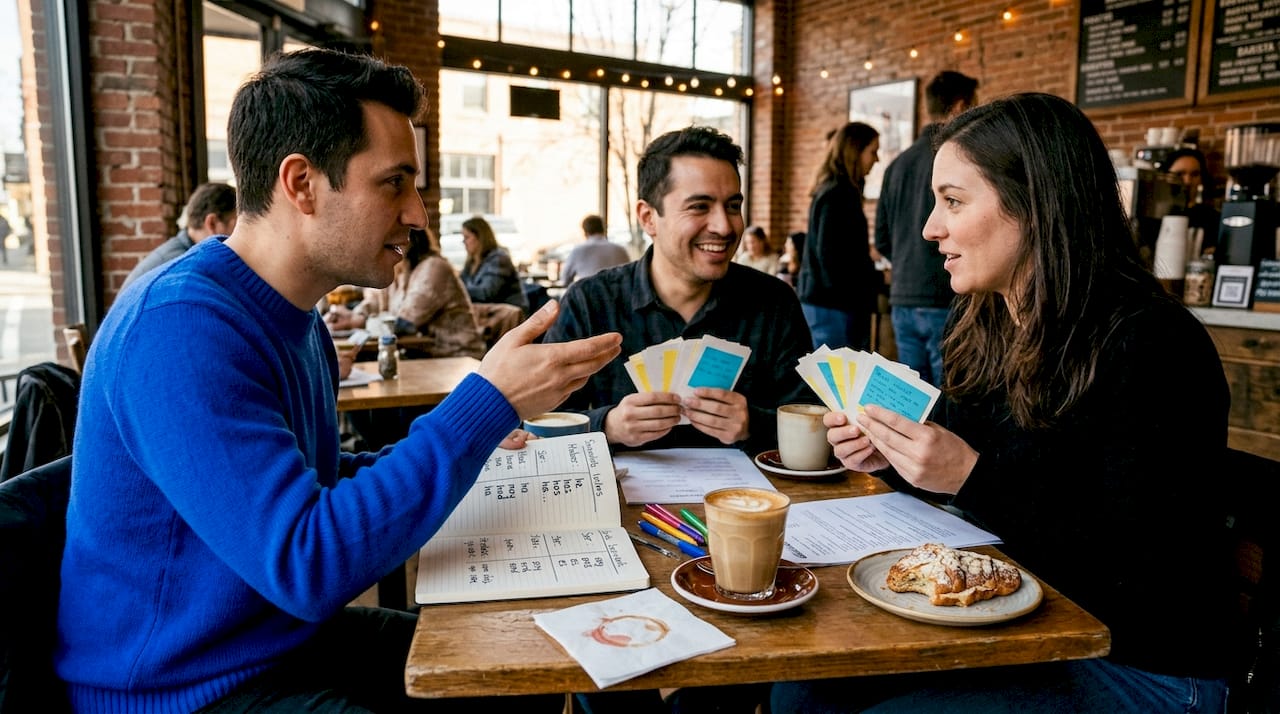
But here is the part most guides skip: hours logged do not automatically equal progress. A student who spends 400 hours passively re-reading grammar notes will not reach B1. A student who spends 300 hours in structured classes with active speaking practice very likely will. Quality of engagement matters more than raw time.
Instruction type also plays a huge role. Structured classes with a certified teacher accelerate progress because they give you immediate feedback, correct fossilized errors early, and push you into uncomfortable but productive territory. Online Spanish classes offer flexibility without sacrificing that structure, which matters for busy professionals and students in Singapore.
Immersion is the other major accelerator. Singapore’s expat community includes many Spanish speakers from Spain, Mexico, Colombia, and Argentina. Language exchange meetups happen regularly, and simply committing to one hour of real conversation per week adds up fast. The efficient study workflow you build around those conversations will determine how quickly the hours translate into real ability.
Pro Tip: Build Spanish into routines you already have. Listen to a Spanish podcast during your MRT commute. Change your phone language to Spanish. Cook dinner while watching a Spanish-language YouTube channel. These micro-exposures add up to dozens of extra hours per year without requiring extra time in your schedule.
Using DELE exams as milestones is a strategy that many successful learners swear by. Booking an exam six months out creates a concrete deadline that sharpens your focus and gives you a clear measure of whether your study approach is actually working.
What are the proven methods for mastering conversational Spanish?
Once you understand the time commitment, the next question is method. Not all approaches are equal, and some popular ones are surprisingly ineffective for building real conversational ability.
Traditional classroom instruction often relies heavily on grammar drills, translation exercises, and rote memorization. These build a foundation, but they rarely produce fluent speakers on their own. The brain learns language through meaningful, contextual use, not through repetition of isolated rules. That is where modern, evidence-backed approaches make a real difference.
TPRS (Teaching Proficiency through Reading and Storytelling) is one of the most researched methods in language acquisition today. It combines storytelling, reading, and physical response to create an immersive, context-rich learning experience. Rather than drilling verb conjugations in isolation, students encounter grammar naturally through engaging narratives. The results are striking:
“Empirical studies on TPRS show significant vocabulary and fluency gains, with students improving posttest scores by 22.5 points compared to control groups using traditional methods.”
That kind of improvement is not a small margin. It reflects a fundamental difference in how the brain processes and retains language when it is encountered in a meaningful story versus a grammar table.
Here is a practical breakdown of the most effective methods for Singapore learners:
- Structured group classes with a certified teacher provide feedback, accountability, and peer interaction. Certified Spanish teachers who use communicative and TPRS-based approaches give you the fastest path to fluency.
- Private tutoring lets you focus on your specific weak areas, whether that is pronunciation, professional vocabulary, or exam preparation.
- Language exchange apps like Tandem or HelloTalk connect you with native speakers for real-time conversation practice.
- Podcasts and audio content such as “Coffee Break Spanish” or “Notes in Spanish” train your ear for natural speech patterns.
- Vocabulary building through context rather than flashcard lists. Studying an everyday vocabulary list organized by situation (at the office, at the market, at a restaurant) is far more effective than alphabetical word lists.
Pro Tip: Start speaking from your very first week. Most learners wait until they feel “ready,” but that moment rarely comes through passive study. Even simple sentences spoken out loud, made up on the spot, activate the production circuits in your brain that reading and listening alone cannot reach. Explore practice ideas for conversational Spanish that you can apply right here in Singapore.
The evidence consistently favors active, contextual, production-focused learning over passive grammar study. The sooner you build your routine around speaking and listening rather than reading and memorizing, the faster your conversational ability will grow.
Applying your Spanish: Real-life strategies in Singapore
Knowing which methods work is one thing. Actually using Spanish in your daily life in Singapore is where the real gains happen. The good news is that Singapore’s environment is surprisingly well-suited for Spanish language practice if you know where to look.
Here is a practical action plan to get started:
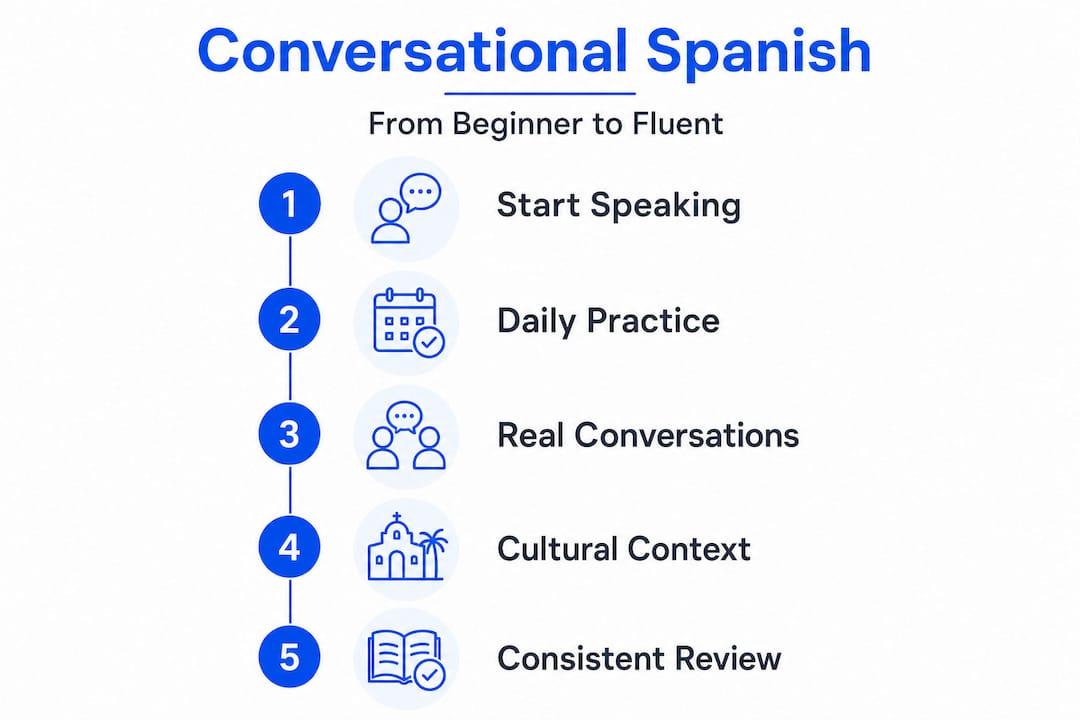
- Identify your specific goal. Are you learning for travel, career advancement, academic study, or personal enrichment? Your goal determines which vocabulary and situations to prioritize from the start.
- Connect with Spanish-speaking communities. Singapore has active expat groups from Spain and Latin America. Meetup.com and Facebook groups like “Spanish Speakers in Singapore” are good starting points. Regular conversation with native speakers is irreplaceable.
- Use technology strategically. Apps like Duolingo are useful for building basic vocabulary, but they are not enough on their own. Pair them with live conversation practice, either through a class or a language exchange partner.
- Track your progress with real conversations. Record yourself speaking Spanish once a month and compare recordings over time. This gives you objective evidence of improvement and keeps motivation high.
- Set exam milestones. Registering for a DELE exam creates a structured goal that organizes your study and gives you a recognized credential at the end.
For parents enrolling children, the same principles apply but the timeline is often faster. Children’s brains are highly receptive to language acquisition, and immersive, story-based methods work especially well for younger learners.
Expats who already speak English and another Asian language have a surprising advantage. Multilingualism makes your brain more flexible and better at pattern recognition, which speeds up Spanish acquisition. CEFR B1 and B2 proficiency enables practical interaction with native speakers and opens professional and academic doors that a tourist-level vocabulary simply cannot.
For a deeper look at how to structure your learning journey locally, the practical guide for learners covers Singapore-specific strategies in detail. You can also build your speaking confidence faster by working through Spanish phrases for everyday use organized around real situations you will actually encounter.
Why most Singapore learners underestimate conversational Spanish—and what actually works
Here is something most language guides will not tell you: the biggest barrier to conversational Spanish is not grammar or vocabulary. It is the gap between knowing Spanish and using Spanish under real pressure.
Most learners study until they feel comfortable, then try to have a real conversation and freeze. A native speaker talks faster than expected, uses slang, drops subject pronouns, and blends words together. Suddenly all those hours of textbook study feel useless. This is not a failure of intelligence. It is a failure of preparation for real language, not classroom language.
Cultural context is the missing piece. Spanish is not a monolithic language. Mexican Spanish, Castilian Spanish, and Colombian Spanish sound different, use different expressions, and carry different cultural assumptions. A learner who has only studied formal textbook Spanish will struggle in a real conversation with a Colombian colleague even at B2 level. Building exposure to multiple regional accents and informal registers from early in your learning journey is not optional. It is essential.
Singapore’s diversity is actually a hidden advantage here. The city has native Spanish speakers from at least a dozen different countries. Seeking out that variety deliberately, rather than sticking to one accent or one teacher, builds the kind of flexible listening comprehension that textbooks cannot provide. The conversation insights available from experienced instructors who have taught across different regional contexts can make a significant difference in how quickly you adapt.
Resilience when stuck is another skill that most guides ignore entirely. Every conversational learner hits moments where they cannot find the word, misunderstand a response, or lose the thread of a conversation. How you handle those moments determines whether you progress or plateau. Learners who push through, use circumlocution (describing what they mean when they lack the exact word), and keep the conversation going develop real fluency. Learners who stop and look up the word every time do not.
The most effective learners we see are not the ones who study the most. They are the ones who put themselves in uncomfortable situations early, make mistakes without embarrassment, and treat every real conversation as a training session rather than a test.
Take your Spanish further with expert support in Singapore
You now have a clear picture of what conversational Spanish requires, how long it takes, and which methods actually work. The next step is finding the right structure to support your progress.
At Spanish Explorer, we offer Spanish courses in Singapore designed around real communicative goals, from beginner group classes to advanced professional programs. Our curriculum is aligned with DELE standards, so every lesson moves you measurably closer to your target level. If you prefer a more personalized pace, our private Spanish classes let you focus on exactly what you need, whether that is exam preparation, business Spanish, or conversational fluency. For learners aiming at certification, our structured DELE exam preparation program gives you the practice, feedback, and confidence to perform at your best on exam day.
Frequently asked questions
Is conversational Spanish enough for travel in Spain or Latin America?
A CEFR B1 level covers the vast majority of daily travel needs, including ordering food, booking accommodations, asking for directions, and handling unexpected situations. Most travelers find B1 more than sufficient for a comfortable and enjoyable trip.
What’s the best way to practice conversational Spanish in Singapore if I don’t know any native speakers?
Join language exchange meetups, use apps like Tandem or HelloTalk to connect with native speakers online, or enroll in a group class where speaking practice is built into every session. Singapore’s expat community also includes many Spanish speakers from Spain and Latin America who are often open to language exchanges.
Are online classes as effective as in-person classes for improving conversational skills?
Online classes can be equally effective when they include live speaking practice, real-time feedback, and interactive activities. Methods like TPRS have shown strong fluency gains in both in-person and virtual formats, as long as the instruction is active and communicative rather than passive.
How do the DELE and SIELE exams relate to conversational Spanish?
Both DELE and SIELE certify Spanish proficiency across multiple levels, including the B1 and B2 benchmarks that define conversational ability. DELE is administered by the Instituto Cervantes and is widely recognized by universities and employers, while SIELE is a more flexible digital exam accepted across Latin America and Spain.
Sorry, the comment form is closed at this time.