


TL;DR:
- Many Singaporeans believe learning Spanish requires months of frustration before basic conversations, but it is actually an accessible language for English speakers to acquire.
- Focusing on pronunciation, high-frequency vocabulary, and essential grammar allows beginners to build confidence and communicate effectively in a short period.
Many Singaporeans assume that learning Spanish means months of frustration before even holding a simple conversation. That assumption is wrong. Spanish is actually one of the most accessible languages for English speakers to pick up, thanks to shared vocabulary roots and a phonetic spelling system that means words are pronounced nearly as they are written. With the right structure and a realistic starting point, beginners in Singapore can make genuine, measurable progress faster than they expect. This guide breaks down exactly what to learn, in what order, and how to stay consistent.
Table of Contents
- Why learn Spanish? Key benefits for Singaporeans
- Essential building blocks: Pronunciation, vocabulary, and grammar
- Structuring your learning: Recommended study paths for beginners
- Practical tips for success: Avoiding common pitfalls
- What most beginners miss when learning Spanish
- Ready to start? Explore your Spanish learning options in Singapore
- Frequently asked questions
Key Takeaways
| Point | Details |
|---|---|
| Start with pronunciation and core vocabulary | A strong foundation makes speaking and listening much easier when learning Spanish. |
| Follow a structured study plan | Progress steadily by setting achievable goals and using proven frameworks for beginners. |
| Practice daily with real resources | Consistent practice, even in short sessions, leads to greater retention and confidence. |
| Embrace mistakes as learning tools | Don’t fear errors—making them is essential to actual language growth. |
Why learn Spanish? Key benefits for Singaporeans
Having established the importance of a strong start, let’s explore why Spanish is a smart choice for learners in Singapore.
Spanish is the world’s second most spoken language by native speakers, with over 500 million people using it as their first language across 21 countries. For a city-state as globally connected as Singapore, that reach matters enormously. Whether you are navigating Latin American business markets, traveling through Spain, or simply enjoying Spanish cinema and literature, the language opens doors that other language choices simply cannot.
Professional advantages are real and growing. Singapore’s role as a regional business hub means that companies with ties to Latin American markets, especially in trade, finance, and technology, actively look for staff who can bridge language gaps. Speaking Spanish signals cultural awareness and initiative, two qualities that stand out in a competitive workforce. Even a conversational level can differentiate your resume in meaningful ways.
On a personal level, Spanish enriches your life in unexpected ways. Consider these benefits:
- Travel confidence: Spanish-speaking countries span Europe, Central America, South America, and parts of the Caribbean, giving you access to an extraordinary range of destinations where locals respond warmly to even basic Spanish.
- Cultural access: From Gabriel García Márquez’s novels to Pedro Almodóvar’s films, Spanish-language culture is rich and globally influential. Experiencing it in the original language is a completely different experience.
- Brain health: Language learning strengthens memory, improves focus, and studies suggest it can delay cognitive decline in later life.
- Community connection: Singapore has a growing community of Spanish speakers and learners, making it easy to find practice partners and social groups once you start.
“Learning Spanish is not just a language skill. It is a passport to relationships, opportunities, and perspectives that you cannot access any other way.”
The personal motivation you bring to learning matters as much as the method. Take a moment to identify your specific reason for starting. That clarity will carry you through the moments when progress feels slow.
Essential building blocks: Pronunciation, vocabulary, and grammar
With the motivation clear, it’s time to break down exactly which Spanish basics you should tackle first.
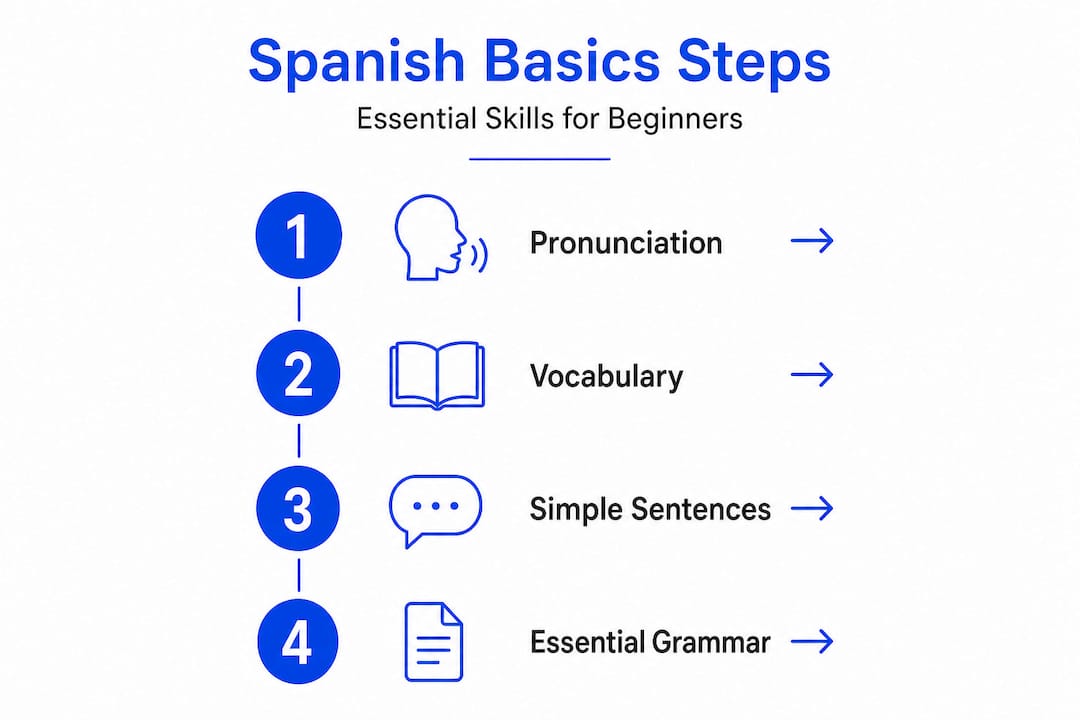
Most beginners make the mistake of diving into grammar charts before they can say a single word correctly. That approach creates confusion early. Instead, think of Spanish learning as building a three-story structure: pronunciation is the foundation, vocabulary is the first floor, and grammar is the framework that holds everything together.
Pronunciation: start here
Spanish pronunciation is genuinely beginner-friendly. Unlike English, where letters frequently change sound depending on surrounding letters, Spanish spelling is almost entirely consistent. Each vowel has exactly one sound. The letter “r” follows a clear set of rules. Once you learn the alphabet sounds, you can read almost any Spanish word aloud, even before you know what it means.
Spanish pronunciation and vocabulary are typically easier for English speakers compared to other languages, which makes the initial learning curve much gentler than most people expect. Focus first on the five vowel sounds (a, e, i, o, u) and practice rolling your “r” sounds early. Even a rough approximation builds muscle memory that improves over time.

Vocabulary: prioritize frequency
Not all words are equal. The most effective strategy is to learn high-frequency words first. Research consistently shows that the top 1,000 most common Spanish words account for over 85% of everyday conversation. You do not need to memorize 10,000 words to function in Spanish.
Start with daily Spanish vocabulary organized by theme: greetings, numbers, time, food, transportation, and common verbs. This thematic approach means you can immediately use what you learn in real situations, which reinforces memory far better than random word lists.
Pro Tip: Many Spanish words are nearly identical to English words because both languages share Latin roots. Words like “hospital,” “natural,” “animal,” “hotel,” and “final” mean exactly the same thing in both languages. These are called cognates, and there are thousands of them. Lean on this advantage early to build confidence.
Grammar: learn the rules that matter most
Spanish grammar has a reputation for being complex, largely because of verb conjugation and noun gender. But you do not need to master every tense to start communicating. Focus on the essential grammar rules that give you the most communicative power early on.
Here is a comparison of the key grammar areas and their practical priority for beginners:
| Grammar area | Difficulty level | Beginner priority | Practical impact |
|---|---|---|---|
| Present tense verbs | Medium | High | Use in almost every sentence |
| Noun gender (el/la) | Low to medium | High | Affects all descriptions |
| Adjective agreement | Low | Medium | Adds color to speech |
| Past tense (preterite) | Medium | Medium | Tells stories and events |
| Subjunctive mood | High | Low | Complex; learn later |
| Future tense | Low | Medium | Express plans easily |
The table above shows why beginners should not feel overwhelmed by Spanish grammar. Start with the top two rows and you will be able to hold basic conversations in weeks, not months.
Structuring your learning: Recommended study paths for beginners
Once you know what to learn, the next challenge is organizing your study routine for consistent progress.
A step-by-step study plan is not optional for adult learners. It is essential. Research confirms that structured study plans improve retention and steady progress for adult learners, which is why improvised, unstructured studying tends to produce frustrating results. Consistency beats intensity every time.
Here is a sample beginner curriculum for the first 12 weeks, broken into phases:
- Weeks 1 to 2: Focus exclusively on pronunciation and the alphabet. Learn 10 to 15 high-frequency vocabulary words per session. Practice speaking each word out loud.
- Weeks 3 to 4: Introduce greetings, introductions, and present-tense verb “ser” (to be) and “estar” (also to be, used differently). Practice short, complete sentences.
- Weeks 5 to 6: Add numbers, days of the week, and basic questions. Begin listening to simple Spanish audio for 10 minutes per day.
- Weeks 7 to 8: Expand vocabulary to food and daily routines. Introduce a second verb tense: present tense “tener” (to have) and “ir” (to go).
- Weeks 9 to 10: Practice simple reading exercises. Start writing short paragraphs about yourself and your daily life.
- Weeks 11 to 12: Review all content. Attempt a 5-minute spoken conversation with a partner or teacher. Identify gaps and set goals for the next phase.
How often should you study? Research and practical experience both point to the same answer: shorter, daily sessions beat long, infrequent ones. Aim for 30 to 45 minutes every day rather than a three-hour session on the weekend. This keeps vocabulary fresh in your memory and prevents the frustrating “I forgot everything” feeling.
| Study schedule | Sessions per week | Minutes per session | Estimated basic fluency |
|---|---|---|---|
| Minimal | 2 to 3 | 30 | 12 to 18 months |
| Moderate | 4 to 5 | 45 | 6 to 12 months |
| Intensive | Daily | 60+ | 3 to 6 months |
The structured teaching approach used in quality Spanish programs in Singapore reflects this understanding. Expert-designed curriculums balance speaking, listening, reading, and writing so no skill lags behind the others. That balance matters enormously in real-world conversations.
Pro Tip: Set one specific goal per week instead of a vague intention to “study more Spanish.” For example, “This week I will learn and correctly use 20 food vocabulary words in three original sentences.” Specific goals create a clear finish line, which makes it far easier to measure progress and stay motivated.
Practical tips for success: Avoiding common pitfalls
Now that you have a plan, let’s make sure you avoid the most common mistakes that trip up Singapore’s new Spanish learners.
The single biggest barrier to Spanish progress is not ability. It is perfectionism. Beginners who wait until they feel “ready” to speak often wait indefinitely. Language is a communication tool, not a performance. Every native speaker you meet will appreciate the effort, regardless of the grammatical errors you make.
Here are the most important habits to build from day one:
- Practice daily, even briefly. Ten minutes of review beats zero minutes of a cancelled study session. Use commute time, lunch breaks, or the ten minutes before bed to review flashcards or listen to Spanish audio.
- Speak out loud from the beginning. Reading and listening are passive skills. Speaking is active and transfers to real conversations. Record yourself and play it back. It feels awkward at first and then becomes one of the most useful tools you have.
- Join a community. Singapore has Spanish learner groups, conversation clubs, and cultural events. Speaking with other learners removes the pressure of speaking with native speakers while still giving you real practice.
- Use spaced repetition for vocabulary. Apps built on spaced repetition algorithms (which review words right before you would forget them) are dramatically more efficient than reading word lists.
“The learners who progress fastest are not the ones with the most natural talent. They are the ones who speak imperfectly, often, and without embarrassment.”
Avoiding information overload is equally important. Many beginners collect resources, apps, books, YouTube channels, and podcasts, and end up doing a little of everything without going deep on anything. Choose two or three top Spanish resources and stick with them. Depth beats breadth in language learning. Consistent practice and using targeted resources accelerates Spanish acquisition more than any single shortcut or hack.
Pro Tip: Keep a “mistakes journal.” Every time you make an error in speaking or writing, write it down along with the correct version. Reviewing this journal weekly turns mistakes into lessons rather than sources of embarrassment. It also reveals patterns in your errors that you can target specifically.
What most beginners miss when learning Spanish
Here is something that most language guides do not tell you: the gap between knowing Spanish and using Spanish is almost entirely psychological, not linguistic.
Most beginners spend months in what we call the “preparation loop.” They study vocabulary, they study grammar, they take notes, and they feel like they are not yet ready to have a real conversation. Then a year passes and they still feel unready. The truth is that you become ready by speaking, not by preparing to speak. Communication confidence is built through communication, not through more studying.
Another underestimated factor is dialect anxiety. Many beginners worry about whether to learn Latin American Spanish or the Spanish spoken in Spain. They fear choosing the “wrong” version. This anxiety is mostly unfounded. The differences between dialects are real but minor at the beginner level. A learner from Singapore who studies Latin American Spanish will be understood in Madrid, and vice versa. You can explore the specific differences between Latin American and Spain Spanish once you have a solid foundation, but at the start, choose whichever dialect your teacher or resources use and focus on that consistently.
We have also seen that the learners who make the fastest progress are the ones who treat mistakes as data points. When you say “yo tiene” instead of “yo tengo,” that error tells you exactly what to practice next. It is not a reflection of your intelligence or your ability to learn. Every mistake is evidence that you are trying, which is more than most people do.
The most important shift you can make as a beginner is to redefine what success looks like. Success on day one is not fluency. It is saying three correct sentences out loud. Success in month two is not perfect grammar. It is understanding a short conversation. Small, real wins compound into major progress over time.
Ready to start? Explore your Spanish learning options in Singapore
Armed with clear basics and practical tips, you can now choose the path that fits your learning needs.
Spanish Explorer offers structured Spanish courses in Singapore designed specifically for adult learners at every level, from total beginners to advanced speakers. Whether you prefer the energy of a group class, the focus of private lessons, or the flexibility of online Spanish classes, there is a format that fits your schedule and learning style.

Our Spanish language teachers are certified, fluent in both Spanish and English, and experienced in helping Singapore-based learners move from hesitant beginners to confident communicators. Classes are aligned with international DELE standards, so your progress is always measured against a recognized benchmark. Taking that first structured lesson is the single most effective thing you can do today to move forward.
Frequently asked questions
How long does it take to learn basic Spanish?
With consistent, structured lessons, most beginners in Singapore can hold basic conversations within 3 to 6 months. A clear structured study plan significantly speeds up this timeline by keeping practice targeted and regular.
What are the easiest Spanish words for beginners to learn?
Common greetings, daily objects, and verbs shared with English are the easiest for beginners to start with. Many of these overlap because of shared Latin roots, and the Spanish pronunciation guide can help you say them correctly from day one.
Are there major differences between Spanish spoken in Latin America and Spain?
Yes, but the basics are similar and beginners can communicate effectively regardless of dialect focus. A detailed breakdown of specific differences is available in the Latin American vs Spain Spanish guide for learners who want to dig deeper later.
Should I learn Spanish pronunciation before vocabulary?
Learning pronunciation and vocabulary together is the most efficient approach for beginners. Practicing new words aloud as you learn them reinforces both skills simultaneously and builds speaking confidence from the very start.
Sorry, the comment form is closed at this time.