


TL;DR:
- Professional Spanish emphasizes contextually appropriate register, domain-specific vocabulary, and intercultural competence in workplace settings. Mastery involves understanding regional variations, calibrating formality, and practicing real scenarios to achieve CEFR B2 or higher. Success depends on adaptive communication focused on outcomes, not just grammatical accuracy.
Many professionals in Singapore assume that “business Spanish” means adding formal grammar rules or swapping in technical vocabulary. It doesn’t. The real gap between someone who sounds fluent in Spanish and someone who actually gets results in a Spanish-speaking workplace is far more subtle. It comes down to register, intercultural behavior, and knowing which communication norms apply in which context. Get those wrong, and even grammatically perfect Spanish can damage a professional relationship or derail a deal.
Table of Contents
- What is professional Spanish communication?
- Key elements: Register, vocabulary, and intercultural competence
- Regional variation and adapting to local business culture
- Benchmarks and practical steps for professional proficiency
- Professional Spanish: What most guides miss (and what really works)
- Elevate your professional Spanish in Singapore
- Frequently asked questions
Key Takeaways
| Point | Details |
|---|---|
| Beyond textbook Spanish | Professional Spanish involves register, vocabulary, and cultural fit, not just grammar. |
| Adapt to region and context | Workplace Spanish norms differ by country and industry, so local adaptation is essential. |
| Target CEFR B2 or higher | Aim for B2 for most business roles, and C1 for specialized sectors such as law or medicine. |
| Intercultural competence matters | Effective workplace communication means understanding and applying cultural norms, not just words. |
| Specialized training unlocks success | Structured courses and feedback deliver the most rapid professional Spanish improvement. |
What is professional Spanish communication?
Professional Spanish is a distinct register that sits well above everyday conversational ability. Professional Spanish communication refers to the register-appropriate use of Spanish in workplace contexts, which means it combines domain-specific vocabulary, appropriate formality, and a working knowledge of workplace communication norms. It is not about speaking “correctly” in the academic sense. It is about speaking effectively in the professional sense.
Think about the difference between chatting with a colleague over lunch and drafting a contract email to a client in Mexico City. The vocabulary, sentence structure, level of formality, and even your greeting will all change. That shift is not just linguistic. It reflects an understanding of professional expectations, hierarchy, and relationship dynamics that are often invisible to anyone who learned Spanish only from textbooks.
Professional Spanish for business users covers all four core workplace skills: listening, speaking, reading, and writing. But it also demands intercultural competence, which is the ability to recognize and adapt to cultural norms so your communication lands the way you intend it to. Without this, you can be technically correct and still completely miss the mark.
Here is a direct comparison to make this concrete:
| Feature | General Spanish | Professional Spanish |
|---|---|---|
| Vocabulary | Everyday words and phrases | Industry and domain-specific terms |
| Formality level | Variable, often informal | Register-calibrated to context and relationship |
| Cultural awareness | Basic politeness | Intercultural competence across professional norms |
| Key situations | Social, travel, casual conversation | Meetings, negotiations, emails, presentations |
| Success measure | Being understood | Achieving workplace outcomes effectively |
Key skills that professional Spanish communication covers include:
- Register calibration (choosing between formal and informal speech)
- Domain vocabulary in your sector (finance, law, healthcare, trade)
- Written communication such as emails, reports, and proposals
- Listening and comprehension in fast-paced meetings or calls
- Intercultural competence to avoid missteps with business partners
Pro Tip: Never rely on textbook Spanish alone for business emails or client meetings. Real professional results come from appropriateness, not just accuracy. Consider workplace Spanish lessons that are built around real professional scenarios rather than abstract grammar drills.
Key elements: Register, vocabulary, and intercultural competence
Now that you have a working definition, let’s break down the three pillars of professional Spanish in detail. Each one plays a distinct role, and neglecting any one of them will limit your effectiveness in a Spanish-speaking business environment.
Register calibration is the most misunderstood element. In Spanish, you must choose between addressing someone as usted (formal) or tú (informal), and that choice signals respect, hierarchy, and relationship stage. Register calibration in professional Spanish centers precisely on this: choosing usted vs. tú based on your relationship and professional context. Use tú too quickly with a senior executive in Madrid, and you risk coming across as presumptuous. Use usted with a startup team in Bogotá, and you may seem stiff or out of touch.
“The most professional choice may depend on relationship stage and sector — there is no universal setting for formal Spanish, only context-sensitive judgment.”
Domain-specific vocabulary is your second pillar. A finance professional in Singapore needs to know the difference between factura (invoice) and presupuesto (budget estimate). A healthcare professional needs consentimiento informado (informed consent) to be second nature. General Spanish courses rarely teach this with the depth that professionals actually need. Sector-relevant vocabulary is not just useful, it signals to your counterpart that you are a credible peer and not just someone who passed a language class.
Intercultural competence is where professionals most commonly stumble. This is not about stereotyping cultures. It is about understanding that a Colombian business partner may expect a longer relationship-building phase before contracts are discussed, while a Spanish executive may appreciate directness in a way that feels blunt to someone from Singapore. These differences are real, they are documented, and they affect outcomes.
Understanding formal and informal Spanish greetings is one practical entry point. The way you open a meeting or an email in Spanish communicates far more than just politeness. It signals your cultural literacy and your professional intent.
To bring it all together, here are the main elements you need to develop for professional Spanish proficiency:
- Register choice: usted vs. tú (and when each is appropriate)
- Domain lexicon: industry-specific vocabulary in your sector
- Cultural fluency: understanding norms around hierarchy, directness, and relationship-building
- Proficiency benchmarks: targeting CEFR B2 for everyday professional use, C1 for high-stakes roles
- Written and verbal adaptability: adjusting your style across emails, calls, presentations, and negotiations
If you are building this skill set from the ground up, a practical Spanish guide for Singapore professionals can help you map your learning priorities to actual workplace situations.
Regional variation and adapting to local business culture
With the foundations in place, let’s explore why there is no single correct “professional Spanish” that works everywhere. This is a point that many learners completely overlook, and it can cause real problems when you start working across borders.
Spanish varies significantly across regions. Spain uses vosotros as the informal plural “you,” while Latin America uses ustedes for both formal and informal plural. In Argentina and Uruguay, vos replaces tú entirely in everyday speech, including in many professional settings. These are not small quirks. Using the wrong pronoun in the wrong region can signal that you are not familiar with local norms, which affects credibility.

Here is a quick reference for how regional norms affect professional interactions:
| Region | Informal plural | Formal singular | Informal singular | Business formality tone |
|---|---|---|---|---|
| Spain | vosotros | usted | tú | Moderate, direct |
| Mexico | ustedes | usted | tú | Formal, relationship-focused |
| Argentina/Uruguay | ustedes | usted | vos | Informal to moderate |
| Colombia | ustedes | usted | tú | Formal, hierarchical |
When you are preparing to engage a Spanish-speaking counterpart in a new region, follow these steps to adapt your communication effectively:
- Research your counterpart’s region before any meeting, call, or written communication.
- Identify the dominant pronoun form (particularly whether vos, tú, or usted is standard in their professional context).
- Study sector-specific norms for that region, including formality levels in written correspondence.
- Listen before you lead: in your first interaction, let your counterpart’s register guide yours.
- Ask a local contact or advisor if you are uncertain about norms around hierarchy or meeting structure.
For a deeper dive into how these differences play out, explore regional Spanish differences and how they affect professional use. If you are preparing for specific markets such as Spain, guides for working in Spain can offer useful country-level context.
Pro Tip: Before any client call or business negotiation with a Spanish-speaking partner, spend 20 minutes researching their country’s professional communication norms. This single habit separates professionals who build trust quickly from those who unintentionally create friction.
Benchmarks and practical steps for professional proficiency
Understanding these nuances leads to the question: how do you measure and develop truly professional Spanish communication? The answer starts with a framework you can actually track.
The Common European Framework of Reference for Languages, known as CEFR, is the international standard for measuring language proficiency. For professional use, CEFR-based proficiency targeting sets B2 as the threshold for independent workplace functioning, while C1 is required for high-stakes roles such as negotiation, legal drafting, or medical consultation. Think of B2 as the level where you can hold your own in a meeting without needing someone to simplify their language for you. C1 is where you can lead that meeting, read complex legal documents, and handle conflict resolution in Spanish without hesitation.
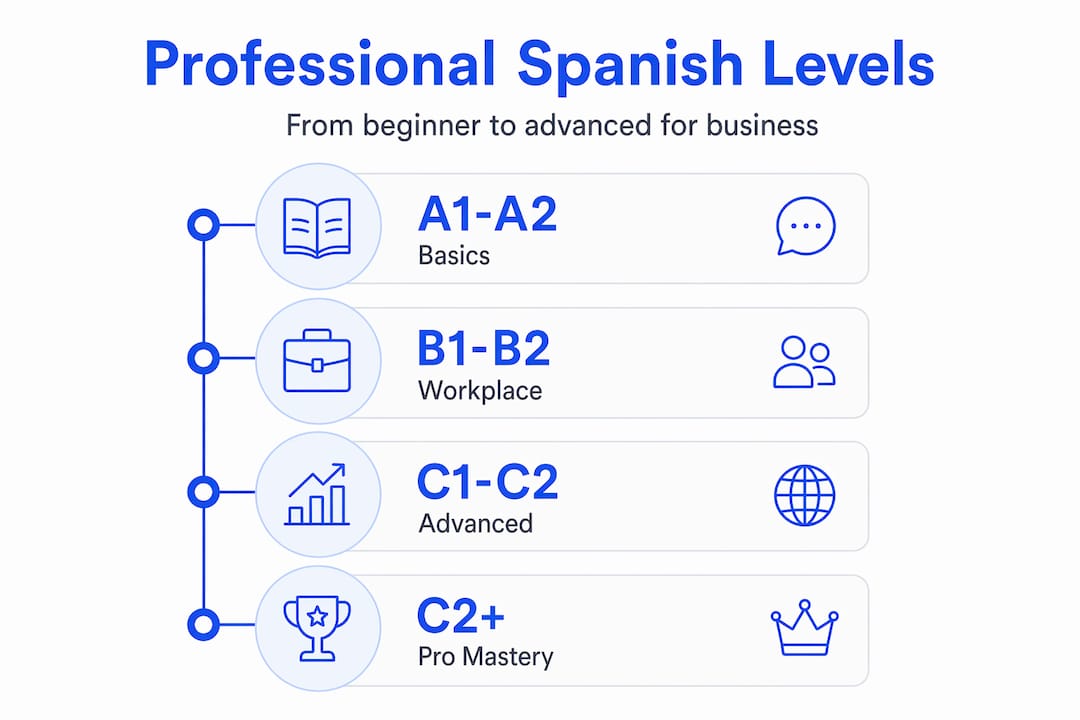
More than 70% of Singapore professionals targeting Spanish-speaking business markets set B2 or C1 as their explicit language goal. And that makes sense. Below B2, you will likely rely on others to fill communication gaps, which creates dependency and limits your credibility with partners.
Here are four concrete action steps to reach B2 or C1 for professional use:
- Get assessed first: take a formal placement test to identify exactly where you are now and what the gap to B2 or C1 looks like. Guessing your level wastes time.
- Design scenario-based learning: focus your study on the exact tasks you will face at work, including email drafting, telephone calls, presentations, and meeting facilitation. Generic grammar study alone will not get you there.
- Practice with targeted feedback: join a structured course or work with a tutor who can give you correction based on professional standards, not just comprehension. Fluency without accuracy in a legal or financial context can create serious problems.
- Formalize your achievement: once you reach B2 or C1, consider taking the DELE exam as formal certification. DELE (Diplomas de Español como Lengua Extranjera) is recognized by employers and academic institutions internationally and adds concrete credibility to your professional profile.
If you are working out the most efficient path forward, a clear learning workflow for Spanish can help you structure your time and resources around professional goals rather than generic progress.
Professional Spanish: What most guides miss (and what really works)
Let’s step back and ask: what do most language guides and courses get wrong about professional Spanish, and what should you actually focus on?
Most guides treat professional Spanish as an upgrade of general Spanish. Add formal vocabulary, apply grammar rules more precisely, and you are ready for the boardroom. But this misses the central truth: professional Spanish is not a more correct version of Spanish. It is a context-sensitive version of Spanish. The real skill is knowing when to shift registers, not just how to use them in isolation.
Here is the uncomfortable insight that most teachers avoid sharing. Being overly formal is just as damaging as being too casual in many Spanish-speaking business contexts. A rigidly formal speaker in a Mexican startup environment signals that they are out of touch. A casual speaker addressing a senior partner at a Spanish law firm signals disrespect. Neither outcome is about grammar. Both are about reading the room.
We see this pattern regularly with professionals who have studied Spanish for years. They arrive at meetings technically proficient and still create friction, because they apply a fixed register rather than adapting. The best business communicators we have worked with are not the ones with the highest grammar scores. They are the ones who listen carefully, adjust quickly, and prioritize the relationship outcome over the linguistic one.
There is also a widespread myth that achieving B2 or C1 proficiency automatically qualifies you for professional communication. It does not. Proficiency gets you in the door. Intercultural adaptability keeps you at the table. These are two different skills, and you need to develop both deliberately.
“Grammar perfection without cultural sensitivity produces technically accurate communication that achieves nothing. The goal is outcomes, not correctness.”
Pro Tip: Practice real-world scenarios in your actual industry and actively seek feedback from native professional speakers who can tell you not just what you said wrong, but why it landed poorly. That distinction is where the real development happens. A practical Spanish guide built for Singapore professionals can help you bridge that gap with relevant context.
Elevate your professional Spanish in Singapore
Ready to apply what you’ve learned? Here’s how you can accelerate your Spanish for business success in Singapore.
Professional Spanish skills develop fastest when the learning environment matches your actual workplace needs. Structured courses with experienced instructors, clear CEFR-aligned goals, and workplace-relevant scenarios make a measurable difference compared to self-study or general language apps.

At Spanish Explorer, our Spanish courses in Singapore are designed specifically for professionals who need real results, not just a passing grade. Whether you are preparing for client negotiations, international assignments, or formal certification, our qualified Spanish teachers bring both linguistic expertise and professional context to every lesson. If you are targeting formal recognition of your proficiency level, our DELE exam preparation program gives you the structured practice and certified instruction to achieve your target level with confidence. Start where you are, and build toward the professional Spanish skills that will genuinely advance your career.
Frequently asked questions
What is the difference between conversational and professional Spanish?
Professional Spanish communication requires register-appropriate use of language with domain vocabulary and cultural norms for workplace effectiveness, while conversational Spanish covers everyday social interactions without those constraints.
Which Spanish level do I need for business communication?
Most workplaces require at least CEFR B2, while legal, negotiation, or medical roles demand C1 or higher. CEFR-based proficiency benchmarks set B2 for independent workplace functioning and C1 for high-stakes professional roles.
How do I know which register to use in professional Spanish?
Check the professional relationship, the sector, and the regional context before deciding. Register calibration in Spanish centers on choosing usted vs. tú based on relationship stage and context, and formal usted is generally safest for first meetings or senior contacts.
Does professional Spanish change depending on country or region?
Yes, register and vocabulary norms vary significantly. Spanish differs across regions, with Spain using vosotros, Latin America using ustedes, and Argentina/Uruguay relying on vos, each with its own professional communication expectations.
How can Singapore professionals efficiently improve business Spanish?
Choose a structured course aligned to your workplace needs, practice real professional scenarios with targeted feedback, and aim for CEFR B2 or higher. Professional Spanish for business requires developing intercultural competence alongside language skills for communication that actually achieves results.
Sorry, the comment form is closed at this time.