


TL;DR:
- Personalized Spanish education focuses on developing real communication skills aligned with learners’ specific goals and proficiency levels. It employs frameworks like ACTFL’s standards and FACT criteria to ensure practical, measurable progress. Technology, especially AI, enhances flexibility and immediate feedback, but human instructors remain essential for cultural nuances and complex language use.
Many adult learners assume that personalized Spanish education simply means studying topics they enjoy, like Latin cuisine or travel. That assumption is the reason so many people spend months in classes and still struggle to hold a real conversation. True personalization is built around your measurable ability to communicate — listening, speaking, reading, and writing — in the situations that actually matter to you. Whether you are a professional in Singapore preparing for a client meeting in Madrid or a learner pursuing Spanish for personal growth, this guide breaks down how genuine personalization works and why it produces results that generic group classes rarely can.
Table of Contents
- Understanding personalized Spanish education
- AI-driven personalization: benefits and challenges
- Dimensions of proficiency-based personalized Spanish learning
- Applying personalized Spanish education to your goals in Singapore
- Why true personalization in Spanish education goes beyond preferences
- Get started with personalized Spanish education in Singapore
- Frequently asked questions
Key Takeaways
| Point | Details |
|---|---|
| Personalization means proficiency | Effective Spanish education personalizes around measurable real-world communication skills, not just topic preferences. |
| AI supports but doesn’t replace teachers | AI adapts content and gives immediate feedback but works best alongside knowledgeable instructors for career success. |
| Use ACTFL’s FACT criteria | Assess personalization by functions/tasks, accuracy, context/content, and text type for true communicative competence. |
| Set clear, achievable goals | Can-Do Statements help adult learners track progress and stay motivated by defining practical language targets. |
| Flexible learning options matter | Personalized programs for busy Singapore professionals include private, corporate, and online Spanish classes tailored to your needs. |
Understanding personalized Spanish education
Personalized Spanish education is not about letting you choose which vocabulary lists to memorize. It is about building your ability to perform real communication tasks at a level that matches where you are now and moves you toward where you need to be. That distinction matters enormously for adult learners who have specific, time-sensitive goals.
The most widely respected framework for measuring this kind of ability comes from the American Council on the Teaching of Foreign Languages. ACTFL’s proficiency approach defines measurable “what you can do” outcomes for real-world language use across speaking, writing, listening, and reading. So instead of asking “Have you finished Unit 6?”, a proficiency-focused teacher asks “Can you negotiate a service agreement in Spanish? Can you follow a fast-paced phone call with a native speaker?”
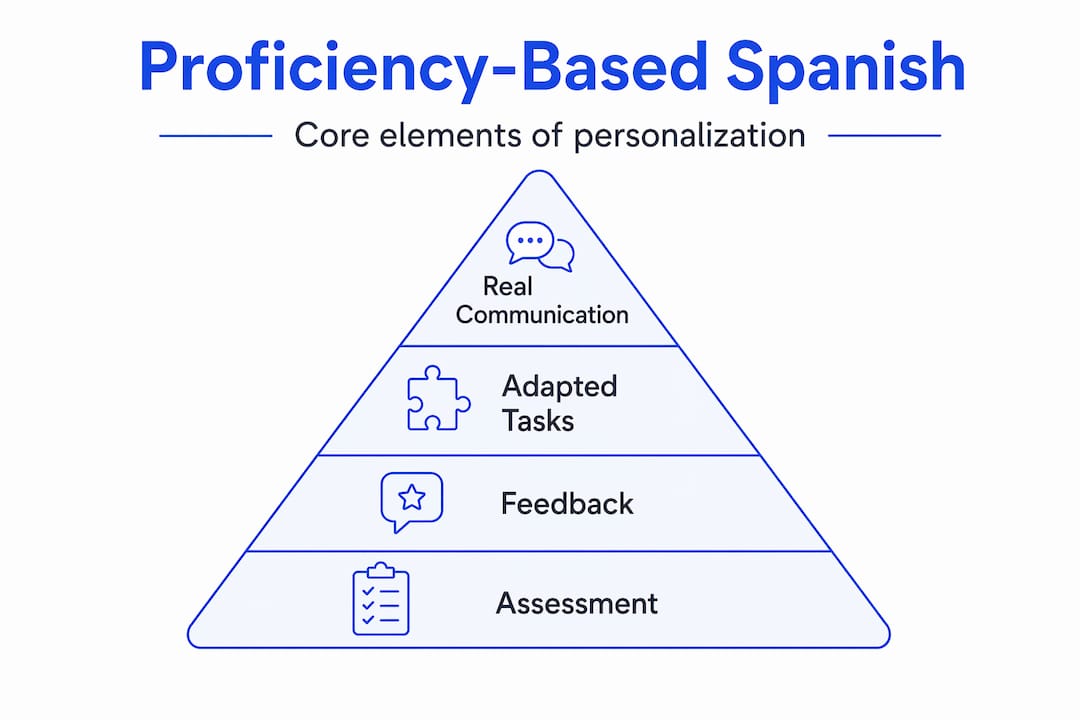
This matters for you as a Singapore professional because your goals are concrete. You might need to present quarterly results to a Spanish-speaking board, navigate small talk at a business dinner in Mexico City, or simply hold a confident conversation with a new colleague. Private Spanish classes for proficiency allow your instructor to build lessons around exactly those scenarios rather than progressing through a textbook chapter by chapter.
Here is what truly individualized Spanish teaching targets from day one:
- Your current proficiency level across all four skills, assessed before instruction begins
- Your real-world communication needs, such as formal presentations, travel conversations, or written correspondence
- Your pace, because adult learners absorb grammar and vocabulary differently depending on prior language background
- Your feedback loop, meaning how and how often errors are corrected to build accuracy without killing confidence
When a program checks all four of those boxes, you are getting tailored Spanish learning experiences. When it only asks what topics you like, you are getting something much thinner. Practical Spanish activities in Singapore show what proficiency-aligned practice actually looks like outside the classroom.
AI-driven personalization: benefits and challenges
Technology has made personalized language education more accessible than ever. AI-powered platforms can now analyze your responses in real time, detect patterns in your errors, and serve you the next appropriate lesson before a human teacher would even notice the gap. That is genuinely useful. But it is also only part of the picture.
AI systems that adjust difficulty and provide personalized real-time feedback significantly improve language proficiency, motivation, and engagement in short-term studies. A learner who gets immediate feedback on a mispronounced subjunctive verb form retains the correction far better than one who waits until next week’s class review.
The benefits AI brings to personalized foreign language education are real:
- Adaptive difficulty that responds to your performance, so you are neither bored nor overwhelmed
- Instant feedback on grammar, vocabulary, and even pronunciation in some platforms
- High engagement through interactive exercises that mirror game mechanics, keeping motivation up between formal lessons
- Flexible access so you can practice at 11 PM after a long day in the office without waiting for a scheduled session
That said, AI has meaningful limitations that every Singapore professional should know before relying on it alone. AI systems can misinterpret ambiguous responses, particularly in speaking tasks where context and cultural register matter. A business apology phrased too casually might pass an AI’s check but land badly with a Spanish-speaking counterpart. Human instructors catch those nuances.
There is also the question of content depth. AI-driven platforms tend to recycle similar exercise formats, which builds pattern recognition but may leave gaps in complex grammar or real-world conversational flow. A structured fluency approach with teacher support bridges that gap by combining the efficiency of adaptive technology with the judgment of an experienced instructor.
Pro Tip: Use AI tools for daily vocabulary review and listening practice, then bring specific errors or patterns to your next instructor session. That combination moves faster than either approach alone.
Dimensions of proficiency-based personalized Spanish learning
Understanding how does personalized Spanish work at a granular level requires a practical framework. ACTFL provides one through its FACT criteria, which stands for Functions/Tasks, Accuracy, Context/Content, and Text Type. ACTFL defines proficiency personalization by focusing on functional tasks, contextual topics, linguistic accuracy, and text types to ensure real-world communication success.
Think of FACT as a checklist you can apply to any Spanish program you are evaluating. Here is what each dimension means in practice:
| FACT dimension | What it means | Example for a Singapore professional |
|---|---|---|
| Functions/Tasks | The communication activities you need to perform | Delivering a product pitch, asking for clarification in a meeting |
| Accuracy | Correct vocabulary, grammar, and cultural register | Using formal usted vs. casual tú appropriately |
| Context/Content | The topic areas and settings you will actually use | Business negotiations, airport travel, social dinners |
| Text Type | Complexity of language from single words to extended paragraphs | Moving from simple questions to full negotiation dialogues |
To put this into action, follow these four steps when evaluating or designing your own Spanish education plan:
- List the communication tasks you need most. Be specific. “Survive a client dinner in Colombia” is more useful than “improve my Spanish.”
- Map those tasks to FACT dimensions. What function does each task require? What level of accuracy? Which context?
- Find the gap between your current proficiency and what those tasks demand. A quick proficiency assessment with a qualified instructor makes this concrete.
- Check whether the program you are considering addresses all four dimensions. If a provider’s personalization only touches on Context/Content (your favorite topics) and ignores Functions/Tasks and Text Type, you are not getting what is advertised.
Reviewing Spanish courses in Singapore through this FACT lens will quickly reveal which options are genuinely built for your goals and which are repackaged group syllabi with a personalization label attached.
Applying personalized Spanish education to your goals in Singapore
Strategy matters as much as the curriculum itself. Even the best adaptive Spanish learning strategies will underperform if you are not deliberate about how you engage with them. Here is a framework built specifically for busy professionals in Singapore.
Start with outcome-based goal setting. Vague goals like “get better at Spanish” produce vague results. Instead, anchor your goals to specific professional or personal milestones. “I want to lead a 10-minute project update call in Spanish by Q3” gives you and your instructor something to build toward.
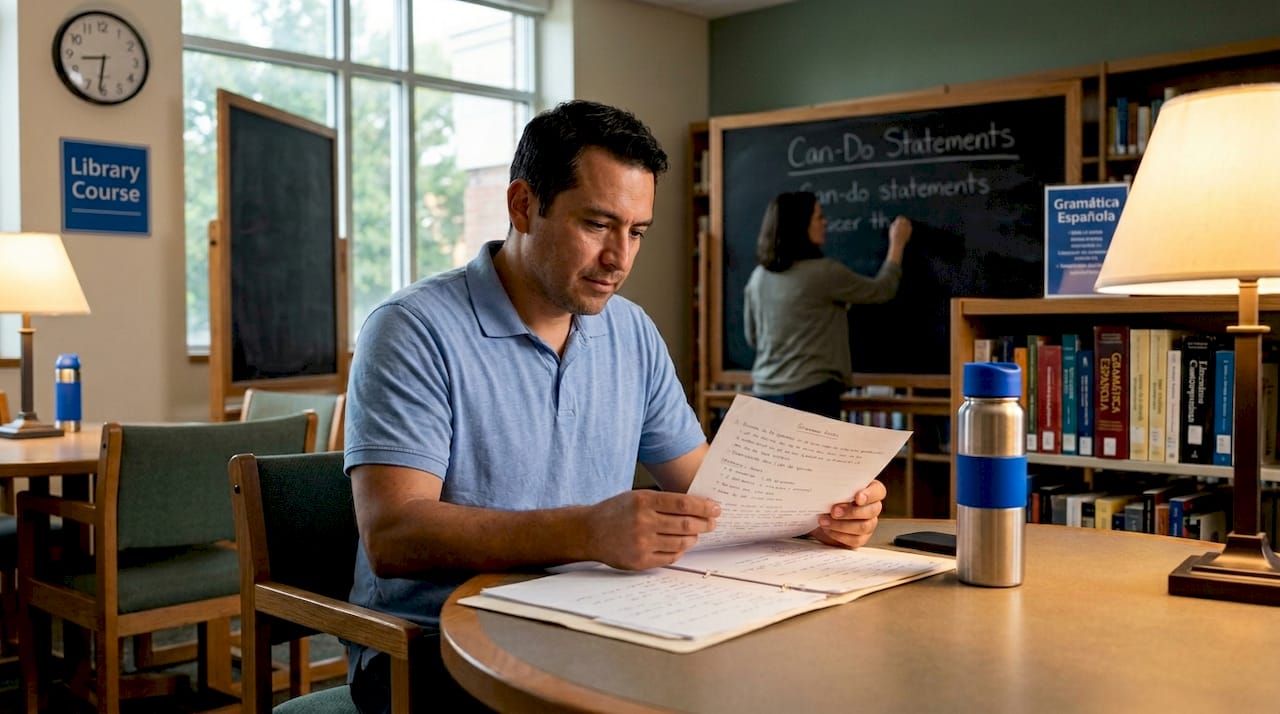
NCSSFL-ACTFL Can-Do Statements help learners set clear, achievable targets, track progress, and become self-regulated language learners. These statements describe what you can actually do with the language at each stage, like “I can introduce myself and my company in Spanish” or “I can write a formal email requesting a meeting.” Use them as monthly checkpoints rather than waiting for a formal exam.
Key principles for applying personalized language education effectively:
- Practice in real contexts. If your goal is business Spanish, role-play actual meeting scenarios, not textbook dialogues about going to the market.
- Choose programs that adapt in real time. Static curricula, even well-structured ones, cannot respond to what you specifically struggled with in last Tuesday’s session.
- Blend AI and human instruction. AI handles repetition and accessibility; human instructors handle nuance, cultural context, and the mistakes that matter most in professional settings.
- Review your Can-Do Statements monthly. If you have not moved to a new statement in four weeks, something in your approach needs to change.
A personalized Spanish lessons guide can help you map out a learning plan that fits both your schedule and your professional objectives. For learners managing full workweeks, an efficient Spanish learning workflow makes the difference between consistent progress and a course that stalls after month two.
Pro Tip: Block 20 minutes every weekday for focused Spanish practice rather than trying to squeeze in two-hour weekend sessions. Frequency builds fluency far faster than intensity alone.
Why true personalization in Spanish education goes beyond preferences
Here is the uncomfortable truth most language programs will not tell you: many programs that claim to offer personalized language education are simply letting you pick topics you enjoy. That feels good. It does not necessarily make you a better communicator.
Learner satisfaction and learner progress are two different things. A course that lets you study Spanish through cooking videos every week might keep you engaged, but if you cannot navigate a vendor negotiation or follow a regional accent after six months, the personalization was decorative rather than functional.
Personalization is most useful when grounded in measurable proficiency outcomes rather than solely topic preference, ensuring communication readiness across listening, speaking, reading, and writing. That principle should be non-negotiable for any adult learner with real goals on the line.
The risk is particularly high for professionals. If you invest six months into a Spanish program before a regional posting or a major client relationship, discovering that your listening comprehension is still at a beginner level is not just disappointing. It can have real professional consequences. Demanding measurable outcomes from day one is not being demanding. It is being smart.
What does a genuinely outcome-focused program look like? It assesses your starting proficiency before the first lesson. It maps your goals to specific communication tasks. It uses the FACT criteria to build a curriculum with real-world context. And it tracks your progress against true personalized Spanish lessons benchmarks rather than just lesson completion counts.
Topic-based learning has a place as a motivational tool, not as a substitute for rigorous, proficiency-based structure. When you encounter a program that only asks what you are interested in, press harder. Ask what you will be able to do at the end. That question reveals everything.
Get started with personalized Spanish education in Singapore
You now understand what separates genuine personalized Spanish education from programs that simply dress up standard content. The next step is finding expert-led instruction that actually delivers on those principles.
Spanish Explorer offers Spanish courses in Singapore designed specifically for adult learners and professionals, with curricula aligned to DELE international standards and built around real communication outcomes. Whether your goal is career advancement, academic preparation, or personal enrichment, the school’s experienced, certified instructors teach with both Spanish and English fluency, so nothing gets lost in translation. Private Spanish classes let you move at your own pace with lessons shaped entirely around your goals, while online Spanish classes via Zoom keep your schedule flexible without sacrificing quality. Located above Tanjong Pagar MRT at 10 Anson Road, International Plaza, Spanish Explorer puts professional-grade Spanish instruction within easy reach for Singapore’s working professionals.
Frequently asked questions
What makes Spanish education personalized rather than generic?
Personalized Spanish education adapts content, tasks, and feedback to your specific proficiency level and real communication goals. ACTFL’s proficiency-based approach focuses on what learners can actually do with language in real contexts, not just what units they have completed.
How does AI improve personalized Spanish learning?
AI adapts learning difficulty and delivers instant, tailored feedback based on your performance, which increases both motivation and retention. AI-driven systems significantly improve proficiency and engagement by personalizing tasks and feedback to each learner.
Can I rely only on AI tools for learning Spanish?
AI tools are valuable for daily practice and immediate feedback, but the best results come from pairing them with a human instructor. AI works best supporting human instruction rather than replacing it, especially for nuanced professional communication.
How do I measure my progress in personalized Spanish education?
Use proficiency-based frameworks that specify what tasks you can perform at each stage. NCSSFL-ACTFL Can-Do Statements enable learners to set specific targets and actively reflect on their learning progress over time.
Is personalized Spanish education suitable for busy professionals in Singapore?
Absolutely. Personalized programs with private lessons, online class options, and proficiency-based content are built around your schedule and real-world goals, making them far more practical for working adults than fixed group syllabi.
Sorry, the comment form is closed at this time.