


TL;DR:
- Spanish is a globally significant language with over 635 million speakers, offering rich cultural, cognitive, and travel benefits. Learning Spanish provides direct access to diverse traditions, enhances brain function, and transforms travel experiences beyond superficial interactions. Practical engagement and consistent use foster authentic enrichment, making it a valuable skill for personal growth in Singapore and beyond.
Spanish is not a niche language, and it never was. With over 635 million speakers worldwide and a growth rate that keeps climbing, Spanish represents one of the most accessible gateways to genuine personal enrichment available to learners in Singapore today. Whether you are drawn to the rhythm of Latin music, planning a trip to Barcelona, or simply want to stretch your mind in a new direction, understanding why Spanish is important for personal enrichment goes far beyond the obvious. This guide covers the cultural, cognitive, travel, and entertainment dimensions that make Spanish uniquely rewarding for adult learners here.
Table of Contents
- The global reach of Spanish and its value for cultural enrichment
- Cognitive and brain benefits of learning Spanish for personal growth
- Enhancing travel and communication: Spanish as a practical enrichment tool
- Immersing in Spanish-language music and entertainment for deeper cultural enrichment
- Rethinking Spanish learning: Beyond language substitutes to authentic enrichment
- Start your personal enrichment journey with Spanish Explorer in Singapore
- Frequently asked questions
Key Takeaways
| Point | Details |
|---|---|
| Spanish’s global importance | Spanish is the third most spoken language worldwide, connecting learners to a vast cultural community. |
| Cognitive benefits | Learning Spanish can improve specific brain functions, especially with sustained practice and in older adults. |
| Travel and communication | Spanish greatly enhances independent living and meaningful interactions in Spanish-speaking regions. |
| Media immersion | Knowing Spanish deepens enjoyment of music and cultural content by unlocking original meanings. |
| Beyond translation apps | Active language learning offers richer cognitive and cultural rewards than relying solely on technology. |
The global reach of Spanish and its value for cultural enrichment
Most people underestimate just how big the Spanish-speaking world is. It is not one country and one culture. It is a constellation of over 20 nations, each with distinct traditions, cuisines, music, and histories, all connected by a shared language.
Spanish exceeds 635 million speakers globally, including more than 530 million native speakers, making it the third most spoken language on the planet. That number is still climbing. Enrollments in Spanish have grown 20% over the past decade, a clear signal that global interest in Spanish as a cultural enrichment language is accelerating, not fading.
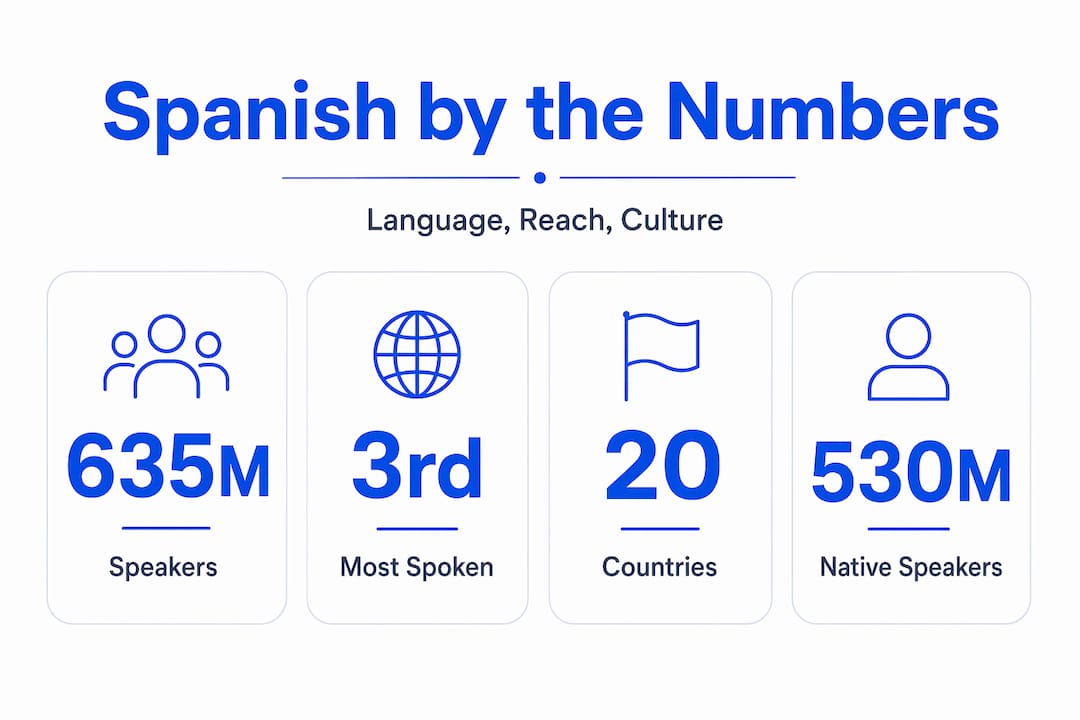
For Singapore learners, this scale matters. It means that every cultural investment you make in Spanish pays dividends across an enormous range of destinations, media, and people. Understanding why learn Spanish is partly about understanding just how much of the world you gain access to.
What Spanish cultural access actually looks like
Learning Spanish is not just about ordering food without pointing at a menu. It gives you direct entry into:
- Literature: Reading Gabriel García Márquez or Isabel Allende in the original Spanish reveals layers of meaning that no translation fully preserves.
- Film: Latin American cinema and Spanish films like Pan’s Labyrinth carry cultural weight that subtitles flatten.
- History: Understanding the colonial and indigenous histories of the Americas becomes richer when you can read primary sources and local perspectives in Spanish.
- Traditions: Celebrations like Día de los Muertos or La Tomatina are experienced differently when you understand the language and context surrounding them.
Here is a snapshot of the Spanish-speaking world by region:
| Region | Key countries | Cultural highlights |
|---|---|---|
| South America | Argentina, Colombia, Peru | Tango, magical realism, Andean heritage |
| Central America | Mexico, Guatemala, Costa Rica | Ancient Mayan sites, biodiversity, cuisine |
| Europe | Spain | Flamenco, architecture, Baroque art |
| Caribbean | Cuba, Dominican Republic | Salsa, Afro-Latino culture, colonial history |
That breadth is the real case for Spanish as a cultural enrichment language. No other single language opens so many distinct cultural doors at once.
Cognitive and brain benefits of learning Spanish for personal growth
The personal growth through Spanish is not just emotional or social. There are real, measurable effects on the brain, though the picture is more specific than most popular articles suggest.

A 2025 study on multilingual experience found that learning and using another language improves visuospatial working memory, particularly in older adults. This is the mental capacity you use to track objects in space, navigate unfamiliar environments, and hold visual information in your mind while solving problems. It is not a universal cognitive superpower, but it is a meaningful and well-documented benefit for sustained language learners.
Equally important: learning a language produces cognitive engagement that AI translation simply cannot replicate. Using Google Translate is passive. Learning Spanish is active. Your brain builds new memory pathways, practices sustained attention, and develops sensitivity to patterns across two linguistic systems simultaneously.
Key cognitive benefits of sustained Spanish learning
- Improved working memory: Holding vocabulary, grammar rules, and meaning in mind at once trains your memory system.
- Sharper attention: Switching between languages strengthens your ability to filter irrelevant information and stay focused.
- Better task management: Bilinguals often show advantages in tasks requiring mental flexibility and switching between competing goals.
- Delayed cognitive decline: Some research suggests sustained multilingualism may delay the onset of cognitive symptoms in aging, though effects vary by individual.
Pro Tip: The cognitive benefits are strongest when you practice Spanish regularly and in real contexts, not just through apps or flashcards. Conversation classes with a qualified instructor give your brain the kind of active, unpredictable challenge that builds the sharpest mental gains.
You can unlock benefits of Spanish at any age, but committing to consistent use is what separates learners who feel the difference from those who just accumulate vocabulary they never deploy.
Enhancing travel and communication: Spanish as a practical enrichment tool
If you have ever traveled through Europe or Latin America relying entirely on English, you already know the wall you hit. You can get by in tourist zones. But you are always slightly outside the experience, watching rather than participating.
Outside international enclaves in Spain, English proficiency drops sharply. A neighborhood restaurant, a market vendor, a local bus driver, these everyday interactions happen in Spanish, and they are where the real travel experience lives. English-only travelers miss them entirely or depend on strangers to interpret their own journey.
The fix is not fluency. Reaching A2 to B1 proficiency in Spanish, which corresponds to handling routine conversations, asking for directions, negotiating prices, and chatting with locals, is enough to transform a tourist trip into a genuinely immersive experience. That level is achievable in months of structured study, not years.
Practical situations where Spanish changes everything
- Navigating public transport in cities like Seville, Bogotá, or Mexico City without using your phone as a crutch
- Building rapport with hosts, guides, or vendors who immediately engage more warmly once you speak their language
- Reading menus, signs, and local news with real comprehension instead of guessing
- Handling emergencies or unexpected situations with confidence instead of panic
Pro Tip: Focus your early Spanish learning on the 500 most common conversational words and phrases specific to travel scenarios. You will cover 80% of real-world travel interactions and feel the payoff almost immediately.
For Singapore learners who travel with Spanish, the advantage is not just convenience. It is the difference between a trip you consume and one you actually live.
Immersing in Spanish-language music and entertainment for deeper cultural enrichment
Here is something most language articles gloss over: entertainment is one of the strongest, most sustainable motivators for language learning. And Spanish entertainment right now is having a global moment.
Spanish-language music streaming doubled since 2020 and now accounts for a quarter of the top tracks on Spotify globally. That is not just reggaeton. Spanish music spans flamenco, bossa nova, salsa, bachata, rock en español, cumbia, and indie pop from artists across 20 countries.
When you learn Spanish, you stop hearing those songs as pleasant sounds with vague emotional effects. You start hearing them. The wordplay in a Rosalía lyric, the heartbreak in an old bolero, the social commentary in cumbia from Medellín. These layers are completely invisible without language comprehension.
The same applies to Spanish media benefits in film and television. Shows like Money Heist, Narcos, and Club de Cuervos land differently when you watch them in Spanish without subtitles. You catch the humor, the regional accents, the cultural references that do not survive translation.
Spanish entertainment by genre
| Medium | Examples | What Spanish unlocks |
|---|---|---|
| Music | Rosalía, Juanes, Celia Cruz | Lyrical depth, regional dialects, historical context |
| Television | Money Heist, Elite | Humor, subtext, character nuance |
| Film | Roma, Pan’s Labyrinth | Emotional tone, cultural symbolism |
| Literature | García Márquez, Borges | Untranslatable wordplay, original voice |
| Podcasts | Radio Ambulante, No Hay Tos | Listening fluency, everyday speech patterns |
Entertainment is not a shortcut to fluency. But it is one of the best ways to maintain motivation while building genuine comprehension and cultural appreciation simultaneously.
Rethinking Spanish learning: Beyond language substitutes to authentic enrichment
Here is the uncomfortable truth that most enthusiastic language articles skip: the benefits of learning Spanish are not automatic. They are conditional.
Cognitive gains from multilingualism are task-specific and vary significantly by age, level of sustained engagement, and how you actually use the language. If you download an app, complete 15 minutes of exercises three times a week, and never hold a real conversation, you are unlikely to see meaningful cognitive improvement. The brain benefits come from real use, not from having technically “studied” a language.
This is why the importance of Spanish for self-improvement is so often oversold with sweeping claims and undersold in terms of what actually produces results. The learners who get the most from Spanish are not the ones who learn it fastest. They are the ones who connect it to something personal: a trip they are planning, music they already love, family connections, a professional relationship they want to deepen.
AI and language learning are often framed as competing forces, but that framing misses the point entirely. Translation technology handles the transactional layer of communication. It does not help you feel at home in a foreign country, understand a joke, read the room in a business meeting, or appreciate the emotional register of a song. Those are human experiences that require human investment.
The most enriching path through Spanish is one built around multilingual enrichment insights grounded in your real motivations. Not a checklist of cognitive benefits someone else promises. Not a vague goal of “being better at languages.” A specific reason you return to it week after week, class after class, conversation after conversation.
That consistency is what turns Spanish from a hobby you dabble in to a lens you actually see the world through.
Start your personal enrichment journey with Spanish Explorer in Singapore
If reading this has made you want to start, the next move is simpler than you think.

Spanish Explorer is Singapore’s dedicated Spanish language school, offering Spanish courses in Singapore designed specifically for adult learners pursuing personal enrichment, travel readiness, and cultural connection. Whether you prefer a structured group class in the central business district or the flexibility of online Spanish classes from home, there is an option that fits your schedule and your goals. Every session is led by experienced Spanish teachers who are fluent in both Spanish and English and understand what adult learners in Singapore actually need. This is not a children’s program or a test-prep course. It is practical, conversational, and built around real-world use from day one.
Frequently asked questions
Why is learning Spanish valuable for personal enrichment in Singapore?
Spanish connects you to a major global language community of over 635 million people, opening doors to cultural experiences, travel, and cognitive growth that few other languages match from a Singapore starting point.
Does learning Spanish provide cognitive benefits beyond just communication?
Yes. Sustained Spanish learning can improve specific brain functions, particularly visuospatial working memory, though the strength of these benefits depends on age, the tasks involved, and how consistently you use the language in real contexts.
Is knowing English enough for traveling or living in Spanish-speaking countries?
No. English alone is insufficient for independent daily life in most Spanish-speaking regions, where Spanish dominates everyday interactions well beyond tourist zones and international neighborhoods.
How does learning Spanish enhance enjoyment of music and entertainment?
Knowing Spanish lets you grasp lyrics, humor, and cultural references that subtitles miss entirely. With Spanish music representing a quarter of top global streaming tracks, language skills genuinely transform how you experience that content.
Can technology replace the need to learn Spanish for personal enrichment?
No. Translation apps handle basic information exchange but cannot replicate the cognitive and cultural engagement that comes from actively learning and using Spanish, which is where the real personal enrichment happens.
Sorry, the comment form is closed at this time.