


TL;DR:
- Investing in Spanish training enhances brain health, delays dementia, and increases professional value beyond technical skills. It also boosts salaries by 5-20%, expands industry opportunities, and reduces workplace risks and attrition. Structured adult learning leverages existing knowledge for faster fluency and measurable career and operational benefits.
Most people think of Spanish training as a nice-to-have, something to pick up casually before a vacation. That framing leaves serious money and opportunity on the table. The real question is why invest in Spanish training when you could spend that time on a technical certification or industry course. The answer is that Spanish does something no coding bootcamp can: it reshapes your brain, multiplies your professional value, and opens markets that represent over 500 million native speakers. This article breaks down exactly what you gain, backed by data.
Table of Contents
- Key Takeaways
- Why invest in Spanish training: the cognitive case
- Career and salary advantages of Spanish skills for business
- How Spanish training reduces business risk
- Practical steps for investing in Spanish training now
- My honest take on why this investment pays off
- Start your Spanish training with Spanish Explorer
- FAQ
Key Takeaways
| Point | Details |
|---|---|
| Career salary boost | Bilingual professionals earn 5-20% more than monolingual peers in many industries. |
| Cognitive health protection | Long-term bilingualism delays dementia onset by 4-5 years and sharpens executive brain functions. |
| Corporate risk reduction | Localized language training cuts reportable incidents by 15-40% within 12-18 months. |
| Adults learn faster than expected | English speakers can correctly guess 40-60% of new Spanish vocabulary using shared cognates. |
| Motivation drives results | Adult learners with personal or career-driven goals achieve fluency faster and retain it longer. |
Why invest in Spanish training: the cognitive case
Before you get to the career numbers, consider what happens inside your brain when you commit to learning Spanish. The importance of Spanish training goes well beyond communication skills. Research shows that bilingualism delays dementia symptoms by 4-5 years compared to monolingual adults, a finding that holds across multiple studies and population groups. That is not a minor footnote. That is a measurable impact on quality of life.
The protective effect comes from what neuroscientists call cognitive reserve. Every time a bilingual person switches between languages, suppresses the wrong word, or monitors comprehension in a second language, the brain is doing serious executive work. This constant mental workout strengthens attentional control, working memory, and task-switching ability. Those are the exact same skills that make professionals sharper in meetings, faster at analyzing problems, and more effective under pressure.
Here is what makes this particularly relevant for adult learners:
- Attentional control improves as you practice holding Spanish grammar rules in mind while still speaking fluently, training your brain to filter distractions.
- Task-switching speed increases because bilinguals constantly manage two language systems, which builds mental agility transferable to any professional context.
- Metacognitive awareness grows as adults reflect on how they learn, a skill that compounds into faster acquisition of any new subject.
- Cognitive flexibility gained from juggling two languages translates directly into better problem-solving and strategic thinking at work.
Pro Tip: Schedule 20 minutes of Spanish practice immediately before a complex work task. The cognitive warm-up from language switching primes your brain for focused, high-quality thinking.
The mental health benefits of why you should learn a second language are not abstract. They are documented, reproducible, and accumulate over time. The earlier in adulthood you start, the more cognitive reserve you build.

Career and salary advantages of Spanish skills for business
The professional case for Spanish language investment is equally strong. Spanish is the most in-demand second language in the U.S. job market, appearing in 86% of bilingual job postings. Bilingual employees earn 5-20% more than monolingual peers. In practical terms, if you currently earn $80,000, a 10% bilingual premium means an extra $8,000 a year, every year.
But the money is only part of the picture. Spanish proficiency uniquely helps professionals serve diverse stakeholders, reducing friction in multicultural teams and opening client relationships that monolingual colleagues simply cannot build. In industries such as healthcare, finance, legal services, and logistics, the ability to communicate directly with Spanish-speaking clients or partners moves you from a generalist into a specialist with a distinct edge.
| Career Benefit | Without Spanish | With Spanish |
|---|---|---|
| Salary positioning | Market baseline | 5-20% above baseline |
| Job pool access | General postings | 86% of bilingual postings |
| Client reach | English-speaking markets | 500M+ Spanish-speaking market |
| Leadership eligibility | Standard track | Multicultural team leadership roles |
| Hiring differentiation | Technical skills only | Technical plus language differentiator |
Spanish training also influences how you are perceived in hiring and promotion decisions. Spanish proficiency influences candidate selection and leadership track eligibility, particularly for roles that involve cross-border teams, international clients, or regulated environments with diverse workforces. Combining sector-specific Spanish vocabulary with general proficiency signals both adaptability and cultural intelligence, two attributes that hiring managers consistently rank above raw technical knowledge.
For professionals targeting global roles, the advantages of Spanish classes compound over time. The skills you build at an intermediate level already unlock most everyday business conversations. You do not need perfect fluency to demonstrate value; you need enough command to build rapport, handle negotiations, and follow a meeting without an interpreter.
How Spanish training reduces business risk
Corporate leaders often struggle to justify language training to finance teams because the ROI feels intangible. It is not. Localized language training yields a 15-40% reduction in reportable incidents within 12-18 months in regulated industries. That is a concrete, auditable number that finance teams can model against training costs.
The mechanism is straightforward. When employees receive safety, compliance, and operational training in a language they actually understand, they retain more information, make fewer procedural errors, and report hazards earlier. Misunderstood instructions are a primary driver of workplace incidents in multilingual environments. Fixing that gap through proper Spanish training pays for itself quickly.
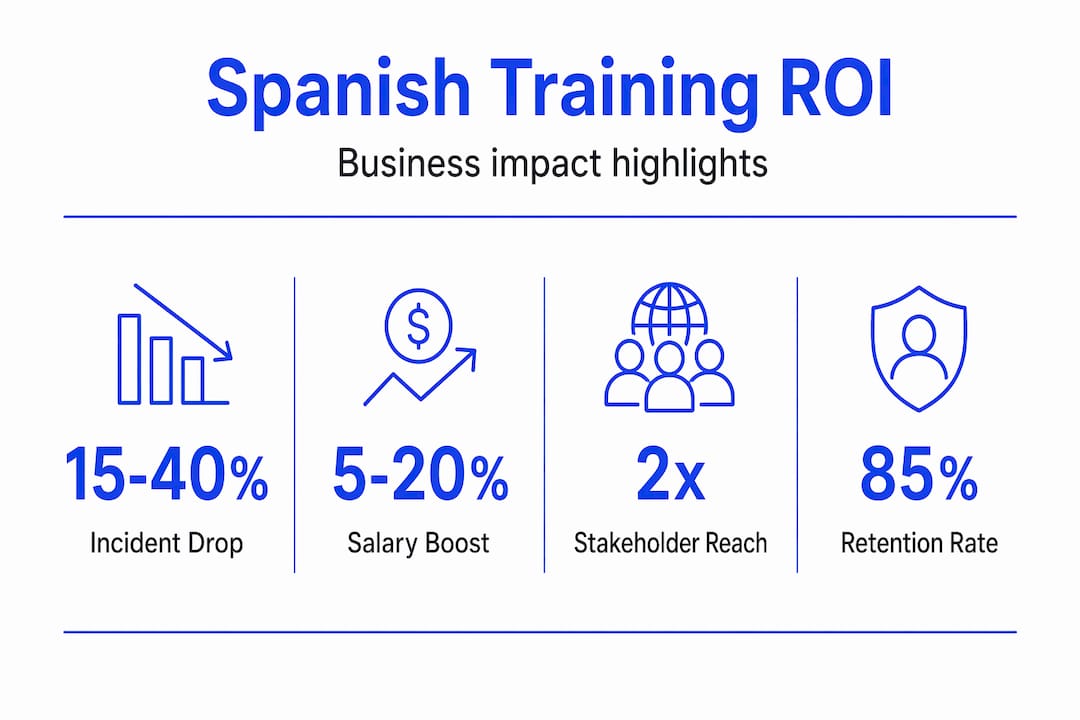
| ROI Dimension | Metric | Timeframe |
|---|---|---|
| Incident reduction | 15-40% fewer reportable incidents | 12-18 months post-training |
| Attrition reduction | 2-point reduction in voluntary attrition | Within first year |
| Productivity gain | Measurable output increase | 6-12 months |
| Engagement lift | Higher retention and team cohesion | Ongoing |
The engagement and retention benefits are equally significant. Training employees in their native language signals respect and investment, which directly lowers voluntary turnover. For companies managing large frontline workforces, even a small attrition reduction translates into substantial cost savings when you account for recruitment, onboarding, and lost productivity.
Pro Tip: When presenting a Spanish training proposal to a finance team, lead with risk reduction and attrition data rather than language proficiency metrics. ROI measurement frameworks show that finance discounts productivity gains by 40-50%, but accepts risk avoidance and turnover cost savings at full face value.
How Spanish training helps at the corporate level is not just about making workers feel included. It is about creating measurable operational improvements that show up in quarterly reports.
Practical steps for investing in Spanish training now
Knowing the reasons to learn Spanish is useful. Knowing how to do it efficiently is what actually gets results. Adult learners have real advantages that are rarely talked about in standard language learning advice.
Adults who speak English already have an enormous head start. English-Spanish cognates allow learners to correctly guess 40-60% of new vocabulary from the start. Words like communication, professional, international, and strategy are nearly identical in Spanish. That means your existing vocabulary is already a foundation, not a liability.
Here is how to structure your investment for maximum efficiency:
- Choose the right format for your lifestyle. Online Zoom classes work well for professionals with unpredictable schedules. Private lessons accelerate progress if you have specific business vocabulary goals. Group classes build conversational confidence and cost less per hour.
- Align your goals with your motivation. Intrinsic motivation is the strongest predictor of adult language learning success. If your goal is career advancement, focus your early vocabulary on your industry. If it is personal enrichment, start with topics you genuinely enjoy discussing.
- Practice deliberately, not casually. Passive exposure like watching TV helps, but deliberate practice with structured feedback accelerates proficiency. Work with certified instructors who can correct patterns before they become habits.
- Set milestone-based goals, not time-based ones. “I want to hold a 10-minute business call in Spanish within six months” is a better goal than “I want to study Spanish for six months.” Specific outcomes keep motivation high and progress measurable.
- Integrate Spanish into existing routines. Label items in your workspace in Spanish, switch your phone’s language setting, or schedule a weekly conversation practice session with a language partner. Small daily touchpoints build fluency faster than weekend study marathons.
For professionals in Singapore looking to unlock Spanish benefits for career or business use, the combination of structured classes and consistent self-practice is the fastest route from beginner to workplace-ready.
My honest take on why this investment pays off
I have worked with adult language learners for years, and the pattern is consistent: the professionals who gain the most from Spanish training are not necessarily the fastest learners. They are the ones who go in with a clear reason.
What I have found is that most people underestimate themselves as adult learners. The myth that children learn languages faster than adults is misleading. Children have more time. Adults have more context, stronger analytical skills, and a much larger vocabulary in their first language to draw from. When adult learners stop apologizing for their age and start using their existing knowledge as a tool, they move quickly.
The other thing I want to challenge is the idea that Spanish training is a passive benefit, something you gain just by showing up to class. The professionals I have seen get real career mileage from Spanish are the ones who bring specific scenarios to their training: how to open a negotiation with a Latin American partner, how to discuss compliance requirements with a bilingual team, how to conduct a client needs assessment in Spanish. When you push your training toward real-world application from day one, the return on your investment accelerates.
My honest advice: commit to a structured program, tie your goals to something concrete in your professional life, and do not wait until your Spanish is “good enough” to use it. Use it imperfectly and improve in practice. That is how adults actually get fluent.
— Paul
Start your Spanish training with Spanish Explorer

Spanish Explorer offers adult Spanish courses in Singapore built specifically for conversational and professional use. Whether you prefer flexible online classes via Zoom, focused private sessions tailored to your business goals, or corporate group training for your team, every program is taught by certified, bilingual instructors who understand what working adults need. The school is located above Tanjong Pagar MRT at 10 Anson Road, Level 22, International Plaza, making it easy to fit a class into your workday. Explore the full range of Spanish courses for adults and find the format that fits your schedule and goals.
FAQ
Why invest in Spanish training as a working adult?
Spanish training delivers measurable career benefits including a 5-20% salary premium and access to a much broader bilingual job market, alongside cognitive advantages that protect brain health over time.
How long does it take to reach business-level Spanish?
Most working adults with consistent structured practice reach conversational business proficiency within 6-12 months, especially when training is focused on industry-specific vocabulary from the start.
What format of Spanish class works best for professionals?
Private lessons accelerate progress toward specific business goals, while online Zoom classes offer the scheduling flexibility that most working professionals need. Many find a combination of both most effective.
Can adults really learn Spanish as effectively as younger learners?
Yes. Adults leverage English-Spanish shared vocabulary to guess 40-60% of new words correctly, giving them a significant acquisition advantage that younger learners without that vocabulary base do not have.
How does Spanish training benefit companies, not just individuals?
Corporate Spanish training reduces reportable incidents by 15-40% and lowers employee attrition, producing returns that finance teams can measure directly against training costs within the first 12-18 months.
Sorry, the comment form is closed at this time.