


TL;DR:
- Most learners approach learning Spanish without a structured framework, causing slow progress. Understanding CEFR levels, course formats, and certification options helps learners set realistic goals and accelerate fluency. Combining conversational practice with formal study and focusing on practical outcomes ensures meaningful language mastery.
Most people treat learning Spanish like flipping a switch. They sign up for an app, follow a few lessons, and wonder why they still can’t hold a real conversation six months later. The problem is not effort. It’s the absence of a structured framework. To explain Spanish language pathways properly, you need to understand how proficiency is defined, how course formats differ, and what each stage actually demands from you. This article walks through the CEFR framework, the Spanish language learning paths available to adult learners, certification options, and the strategies that separate learners who plateau from those who genuinely progress.
Table of Contents
- Key takeaways
- Explaining Spanish language pathways using CEFR
- Common Spanish course formats and learning paths
- Comparing DELE and SIELE certifications
- Strategies to move through Spanish proficiency levels
- My take on designing a Spanish pathway that actually works
- Start your Spanish pathway with Spanish Explorer
- FAQ
Key takeaways
| Point | Details |
|---|---|
| CEFR defines your roadmap | Use the A1 to C2 framework to set skill-based goals, not just hours spent studying. |
| Course formats vary widely | Formal sequences, conversational tracks, and online self-study each serve different needs and should be combined. |
| Certifications signal real skill | DELE and SIELE each suit different goals; understanding the difference helps you choose the right exam. |
| The B1-B2 jump is the hardest | Expect a vocabulary and fluency leap at intermediate levels and plan your pathway to address it directly. |
| Thinking in Spanish matters | Shifting from translating in your head to processing in Spanish is what unlocks real conversational speed. |
Explaining Spanish language pathways using CEFR
The single best tool for understanding Spanish language learning paths is the Common European Framework of Reference for Languages, or CEFR. Unlike textbook chapters or course numbers, the CEFR defines skill benchmarks based on what you can actually do with the language at each stage. That distinction matters enormously when you are choosing a course or setting a career-related goal.
Here is a practical breakdown of what each level means:
| CEFR Level | Label | What you can do | Approximate study hours |
|---|---|---|---|
| A1 | Beginner | Introduce yourself, order coffee, handle basic questions | 0 to 80 hours |
| A2 | Elementary | Describe your environment, discuss familiar topics | 80 to 200 hours |
| B1 | Intermediate | Hold conversations on everyday topics, manage travel | 200 to 400 hours |
| B2 | Upper-Intermediate | Express viewpoints, follow complex discussions | 400 to 600 hours |
| C1 | Advanced | Use Spanish flexibly for professional and academic purposes | 600 to 800 hours |
| C2 | Mastery | Communicate with near-native ease across any context | 800 to 1,000+ hours |
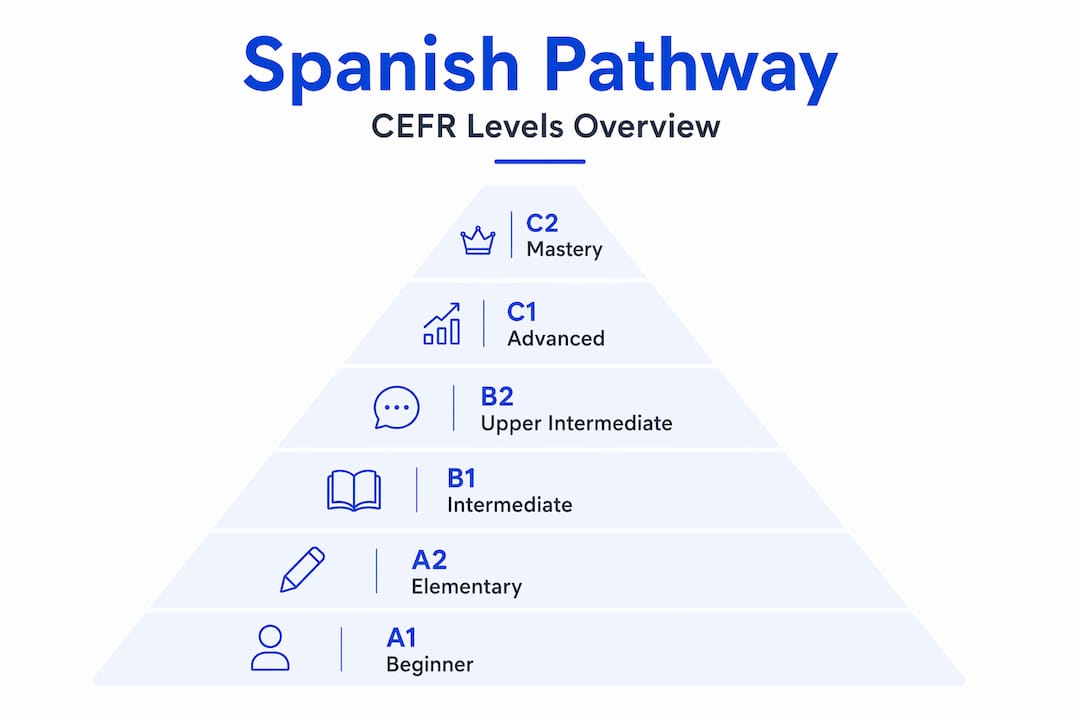
Notice that A1 represents basic interactions such as ordering food and simple greetings, while C2 sits near native competency with over 1,000 study hours involved. This range explains why “learning Spanish” means something completely different depending on where you are starting and where you need to go.
What makes CEFR especially useful is that it frames progress around functional outcomes rather than time in a classroom. A professional who needs Spanish for client meetings targets B2. Someone preparing for a Latin American posting at work targets C1. Once you understand where you are and where you need to be, you can select the right course format, materials, and certification track without wasting time on content that is either too easy or too far ahead.
Pro Tip: Before enrolling in any Spanish course, take a free online CEFR placement test to pinpoint your level. This single step prevents you from sitting through material you already know and paying for it.
To explore how proficiency levels translate to real-world skills for adults, the Spanish proficiency levels guide from Spanish Explorer breaks down each stage in practical, career-relevant terms.
Common Spanish course formats and learning paths
Adult learners benefit most when they understand the different formats available and how those formats complement each other. No single pathway works in isolation.

Structured course sequences are the most familiar format. Programs like Spanish I through IV build reading, writing, listening, and speaking skills progressively across multiple semesters. These courses are strong for grammar foundations and vocabulary retention. The downside is that they are often slower to produce speaking confidence because the classroom focus remains heavily on receptive skills.
Conversational Spanish tracks address exactly that gap. These are purpose-designed programs that treat speaking as the primary goal rather than a byproduct of grammar study. Dedicated conversational certificates have learners using the language from the first session. For professionals in Singapore who need Spanish for business meetings or client interactions, this track is often the more practical priority.
Online and self-paced learning has matured significantly. University libraries and open educational databases now curate structured OER materials for Spanish that include grammar guides, audio content, and practice sets aligned specifically for English speakers. These work well as supplements to live instruction, particularly for reviewing grammar rules between classes. For a practical workflow that combines these tools effectively, the guide on learning Spanish online is worth reading.
Cultural and immersive learning sits at a different level entirely. Integrating language with cultural study deepens functional competency because learners encounter how language operates in real social contexts, not just textbook scenarios. You develop intuition for tone, formality, and register that purely grammar-based learning never builds.
Pro Tip: Do not treat conversational practice as a reward for finishing grammar lessons. Run both in parallel from the start. Speaking early, even badly, accelerates your retention of everything you study.
Comparing DELE and SIELE certifications
If you want formal recognition of your Spanish proficiency, whether for a job application, a visa requirement, or professional credibility, understanding the two major certification options is worth your time.
DELE and SIELE are both managed by Instituto Cervantes, but they work very differently. Here is a direct comparison:
| Feature | DELE | SIELE |
|---|---|---|
| Structure | Level-specific exam (A1 to C2) | Score-based, no fixed level |
| Format | In-person, written and oral | Online, flexible |
| Scheduling | Fixed annual test dates | Flexible scheduling |
| Result | Pass or fail at a specific level | Numeric score approximating CEFR |
| Best suited for | Academic admission, immigration, formal credentials | Professional validation, flexible testing |
DELE is the exam you want when a specific credential is required, such as an immigration authority asking for a B2 certificate. It is unambiguous and internationally recognized. SIELE is more appropriate when you want to demonstrate Spanish ability in a professional context without committing to a pass/fail format, which reduces pressure and allows for scheduling around a busy work calendar.
For professionals in Singapore targeting career-related Spanish use, the DELE vs SIELE comparison article by Spanish Explorer walks through exactly which exam fits which career scenario. Both certifications are available through Spanish Explorer’s exam preparation programs.
Strategies to move through Spanish proficiency levels
Understanding the structure of Spanish language learning paths is one thing. Actually moving through them requires deliberate practice at each stage.
The most common stall point is the jump from B1 to B2. The reason is statistical. At B1, you manage everyday conversations with roughly 2,500 active words. To reach B2, vocabulary nearly doubles to around 4,000 words to support spontaneous, fluent communication. That is not just more vocabulary. It changes how quickly you can process and respond, which is the core of real conversation.
Here are the strategies that work:
- Build speaking into every week, not just occasionally. Even 20 minutes of structured conversation practice per week compresses the timeline to fluency more than hours of passive listening. Look at speaking practice ideas that fit a Singapore-based schedule.
- Use content at your CEFR level, then push one level above. Scheduling progression from receptive to productive skills across your study week improves outcomes. Read or listen at your level to build confidence. Then write or speak slightly above it to stretch your capacity.
- Stop translating. Start thinking. The moment you stop translating mentally and begin processing directly in Spanish, your response speed in conversation accelerates noticeably. Practices like internal monologue in Spanish or narrating your day mentally in Spanish train this shift faster than most textbook exercises.
- Audit your skills separately. Many learners read at B2 but speak at B1. Identify your weakest skill and dedicate specific sessions to it rather than practicing what you are already comfortable with.
For a structured approach to moving through levels faster, the steps to learn Spanish fast guide from Spanish Explorer offers a realistic framework built around the CEFR progression.
My take on designing a Spanish pathway that actually works
I have worked with adult learners long enough to notice a clear pattern. The ones who progress fastest are not the ones who study the most. They are the ones who structure their learning around what they need to say, not what the next chapter covers.
Most grammar-heavy programs build knowledge. That is not the same as building fluency. In my experience, the learners who plateau at B1 and stay there for years are usually those who skip conversational practice entirely. They understand Spanish reasonably well. They just cannot produce it under pressure without a long pause to translate in their head.
The fix is not more grammar. It is dedicated speaking time that runs as a separate strand alongside your formal course. Treat conversational Spanish as its own subject, not as homework. What I have learned from working with professionals is that giving themselves permission to speak imperfectly early on is the single biggest unlock. Once the fear of making errors drops, progress accelerates significantly.
The other thing I would tell you directly: be realistic about what each CEFR level actually enables. B2 takes sustained effort over 400 to 600 hours. Anyone promising fluency in 90 days is selling something, not teaching something. Setting honest goals tied to CEFR outcomes means you can track real progress and stay motivated through the longer stretches that language learning genuinely requires.
— Paul
Start your Spanish pathway with Spanish Explorer
Spanish Explorer offers structured adult Spanish courses in Singapore and online, designed around CEFR-aligned progression from beginner through advanced levels. Whether you are starting from zero or picking up where you left off, courses are built to develop speaking and listening skills alongside grammar and reading.

For professionals targeting business Spanish, Spanish Explorer provides corporate training and private classes tailored to your industry context and schedule. For those preparing for formal certification, exam preparation programs cover both DELE and SIELE tracks with experienced instructors who know exactly what each exam demands. You can explore the full range of Spanish courses for adults or get started with private Spanish classes designed around your specific goals and availability. Lessons run in person at 10 Anson Road, Level 22, International Plaza (above Tanjong Pagar MRT) and via live Zoom sessions for flexible access. Reach out to Spanish Explorer to discuss your level, your goals, and the pathway that fits your timeline.
FAQ
What does explain Spanish language pathways mean?
Explaining Spanish language pathways means outlining the structured routes learners take from beginner to advanced proficiency, including course formats, CEFR levels, and certification options that align with personal or professional goals.
How long does it take to reach conversational Spanish at B2?
Reaching B2 typically requires 400 to 600 study hours beyond a B1 foundation, with the timeline shortening when conversational practice runs alongside formal coursework rather than after it.
What is the difference between DELE and SIELE?
DELE is a pass/fail exam at a fixed CEFR level administered in person on set dates, while SIELE is a flexible online test producing a score-based result. DELE suits formal credential needs; SIELE suits professional validation with scheduling flexibility.
Which Spanish pathway is best for working professionals?
A combination of structured group or private classes at your CEFR level paired with a dedicated conversational track produces the fastest results for professionals who need Spanish for real workplace communication.
Can I learn Spanish effectively online?
Yes. Live online classes with a qualified instructor combined with structured self-study materials aligned to your CEFR level replicate the outcomes of in-person learning when conversational practice is built into the format.
Sorry, the comment form is closed at this time.