


TL;DR:
- Effective Spanish communication involves practicing real conversations, understanding cultural cues, and focusing on high-frequency phrases. Consistent daily practice, exposure to native speech, and thinking directly in Spanish accelerate fluency, even without perfect grammar. Tailoring language use to casual or professional contexts and overcoming the fear of mistakes are essential for gaining confidence and trust.
Effective Spanish communication is defined as the practical ability to hold real conversations, be understood by native speakers, and respond naturally without freezing up. Knowing how to communicate in Spanish goes far beyond memorizing vocabulary lists. It requires targeted phrase work, consistent speaking practice, and an understanding of cultural cues that textbooks rarely cover. Tools like HelloTalk, Rosetta Stone, and structured courses at Spanish Explorer give learners a concrete path from silence to conversation. This guide delivers exactly what you need to start speaking, build confidence, and use Spanish in real professional and personal situations.
What essential phrases do I need to start communicating in Spanish?
Effective Spanish communication starts with a small, high-frequency vocabulary set. The 80/20 rule in Spanish learning states that 20% of language elements cover 80% of real conversations, which means prioritizing high-frequency verbs like ser, estar, tener, querer, and ir gives you immediate conversational range. This is not about learning every word. It is about learning the right words first.
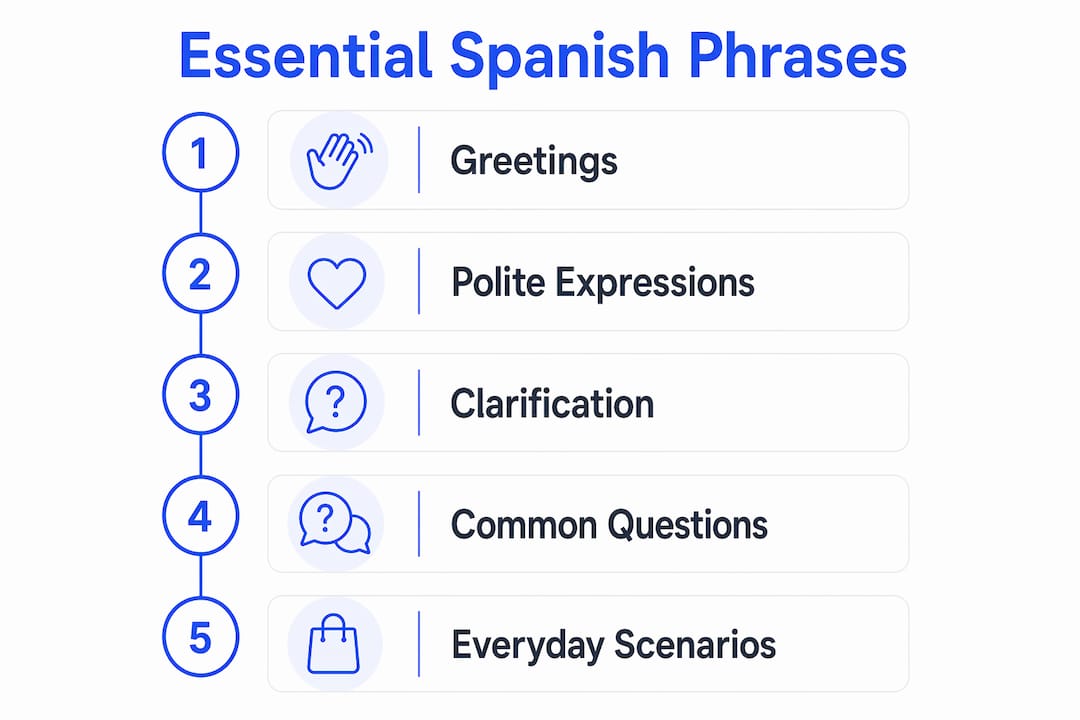
Greetings, polite expressions, and common questions form the backbone of any interaction. Phrases like ¿Cómo estás? (How are you?), ¿Dónde está…? (Where is…?), ¿Cuánto cuesta? (How much does it cost?), and ¿Puede repetir, por favor? (Can you repeat that, please?) cover a wide range of daily situations. Pairing these with connectors like pero (but), porque (because), and también (also) lets you build sentences that actually sound natural.
The table below maps essential phrases to common everyday scenarios, giving you a ready reference for your first real conversations.
| Scenario | Key phrases |
|---|---|
| Greetings and introductions | Hola, ¿cómo estás? Me llamo… Mucho gusto. |
| Ordering food or drinks | Quisiera…, ¿Tiene…?, La cuenta, por favor. |
| Asking for directions | ¿Dónde está…? ¿Cómo llego a…? A la derecha / izquierda. |
| Shopping and prices | ¿Cuánto cuesta? ¿Tiene una talla más grande? Solo estoy mirando. |
| Polite clarification | ¿Puede repetir? No entiendo. ¿Habla más despacio, por favor? |
For daily Spanish vocabulary, focus on learning phrases as complete units rather than isolated words. Your brain stores and retrieves full expressions faster than word-by-word constructions.
Pro Tip: Memorize phrases in full sentences from day one. Instead of learning the word “want” alone, learn “Quisiera un café, por favor.” Complete phrases activate real speech patterns and reduce hesitation when you need them most.
How can I practice Spanish speaking and listening to build confidence?

Consistent daily practice is the single most reliable path to conversational ability. Thirty to forty minutes of daily practice over four weeks moves learners from basic greetings to simple conversations. That is a short enough commitment to fit into a lunch break or commute, but long enough to build genuine momentum.
Listening is as critical as speaking. Native speech includes contractions and fast delivery that classroom audio rarely replicates. Podcasts like Coffee Break Spanish and YouTube channels featuring unscripted native conversations train your ear to process real-world Spanish, not just textbook-clean recordings.
Language exchange apps like HelloTalk connect you with native speakers globally for casual and structured practice. HelloTalk facilitates daily conversation practice with native speakers anytime, and the correction feature lets partners fix your phrasing in real time. This kind of feedback is more useful than any grammar exercise because it targets the exact mistakes you actually make.
Shadowing is one of the most underused techniques at the beginner and intermediate level. You listen to a native speaker and repeat their words simultaneously, matching rhythm, intonation, and pace. This trains your mouth to produce Spanish sounds naturally rather than constructing sentences word by word. Self-talk is equally powerful. Narrate your daily actions in Spanish: Estoy preparando el café. Voy al trabajo. Necesito comprar leche. It sounds strange at first, but it builds the habit of thinking directly in Spanish rather than translating from English, which is the core cognitive shift that separates beginners from fluent speakers.
Here is a practical daily practice sequence that moves from easy to more demanding:
- Morning warm-up (5 minutes): Review 10 phrases or vocabulary items from the previous day using a flashcard app like Anki.
- Listening input (10 minutes): Play a Spanish podcast or short video at natural speed during your commute or breakfast.
- Shadowing drill (10 minutes): Pick one 60-second audio clip and repeat it three times, matching the speaker’s pace exactly.
- Self-talk session (5 minutes): Narrate one daily task entirely in Spanish, out loud.
- Live exchange (10 minutes): Send a voice message or have a short text conversation with a HelloTalk partner.
Pro Tip: Record yourself speaking Spanish for two minutes on any topic, then send it to a native speaker for feedback. Most HelloTalk users respond within hours. Hearing your own speech played back reveals pronunciation habits you cannot catch while speaking.
What are common challenges when communicating in Spanish and how do I overcome them?
Perfectionism is the most common obstacle to Spanish fluency. Communicating the message matters more than perfect grammar, especially at the beginner stage. Waiting until your grammar is flawless before speaking means waiting indefinitely. Native speakers respond to effort and clarity, not textbook accuracy.
Vocabulary gaps feel paralyzing in the moment, but they do not have to stop a conversation. Circumlocution, which means talking around an unknown word using descriptions or synonyms, is a recognized and effective strategy. Simplifying thoughts and using synonyms or gestures keeps conversation flowing when vocabulary is missing. If you cannot remember the word for elevator, say la máquina que sube en el edificio (the machine that goes up in the building). Native speakers understand and often supply the word you needed.
Fast native speech and regional accents present a real comprehension challenge. Spanish spoken in Mexico, Colombia, Spain, and Argentina sounds noticeably different. The solution is exposure, not avoidance. Seek out audio from multiple Spanish-speaking regions early in your learning so your ear adapts to variation rather than locking onto one accent.
Here are the most common mistakes beginners make and how to avoid them:
- Translating word for word from English. Spanish sentence structure differs from English. Learn phrases as units, not translations.
- Avoiding speaking until grammar feels perfect. Speaking imperfectly builds fluency faster than studying silently.
- Ignoring listening practice. Reading and writing alone will not prepare you for real conversations.
- Giving up when not understood. Rephrase, gesture, or simplify. Miscommunication is a normal part of learning.
- Skipping polite expressions. Phrases like por favor, gracias, and disculpe signal respect and make native speakers more patient and helpful.
Pro Tip: When a native speaker talks too fast, use the phrase “¿Puede hablar más despacio, por favor?” (Can you speak more slowly, please?) without apology. Every Spanish speaker has heard this request from learners and will adjust without hesitation.
How to adapt your Spanish for professional and academic settings
Professional Spanish communication requires a different register than casual conversation. Workplace vocabulary and polite formal expressions directly improve professional interactions, from emails and presentations to client meetings and negotiations. Switching from tú (informal you) to usted (formal you) is the first and most visible shift. Using usted with clients, senior colleagues, and new contacts signals respect and cultural awareness.
Key phrases for professional contexts include Me gustaría discutir… (I would like to discuss…), ¿Podría enviarme la información? (Could you send me the information?), and Según el informe… (According to the report…). Academic settings add their own vocabulary around presentations, citations, and structured argument. Phrases like En primer lugar (In the first place), Por otro lado (On the other hand), and En conclusión (In conclusion) give your spoken and written Spanish a formal structure that professors and colleagues recognize immediately.
Structured courses combined with cultural immersion accelerate speaking confidence in professional settings faster than self-study alone. The table below compares the main learning formats available to working adults.
| Format | Best for | Key benefit |
|---|---|---|
| Group classes | Learners who want structured progression and peer interaction | Regular schedule and shared practice with classmates |
| Private classes | Professionals needing focused, personalized instruction | Curriculum tailored to your industry and pace |
| Online Zoom classes | Learners with demanding schedules or remote locations | Flexibility without sacrificing instructor quality |
| Corporate training | Teams requiring Spanish for client or partner communication | Industry-specific vocabulary and group role-play scenarios |
For professionals in Singapore, Spanish Explorer offers private Spanish classes and corporate training programs designed around real workplace scenarios. The instructors are certified, bilingual in Spanish and English, and experienced in adapting lessons to professional contexts.
Key takeaways
Communicating effectively in Spanish requires consistent daily practice, a focus on high-frequency vocabulary, and the willingness to speak before you feel ready.
| Point | Details |
|---|---|
| Start with high-frequency phrases | The 80/20 rule means 20% of vocabulary covers 80% of real conversations. |
| Practice 30 to 40 minutes daily | Four weeks of consistent daily practice moves you from greetings to simple conversations. |
| Use circumlocution for gaps | Describing unknown words with synonyms or gestures keeps conversations moving. |
| Think in Spanish, not English | Avoiding mental translation is the key cognitive shift toward fluency. |
| Match your register to the context | Switching between informal and formal Spanish is critical for professional and academic settings. |
Why consistency beats talent in Spanish communication
I have worked with hundreds of adult learners over the years, and the pattern is always the same. The learners who progress fastest are not the ones with the best memory or the most natural aptitude. They are the ones who show up every day and speak before they feel ready.
The fear of making mistakes is the single biggest barrier I see. Learners spend months studying grammar and vocabulary, then freeze the moment a native speaker responds at natural speed. The fix is not more study. It is more exposure to discomfort. Every awkward conversation you push through builds a tolerance for uncertainty that no textbook exercise can replicate.
What I find most undervalued is the role of cultural understanding. Knowing when to use usted versus tú, how to accept a compliment graciously in Spanish, or why small talk before business discussions matters in Latin American professional culture. These are not soft extras. They are the difference between being understood and being trusted.
My honest advice: commit to speaking Spanish daily, even for five minutes, before you feel confident. Confidence is not a prerequisite for speaking. It is the result of it.
— Paul
Start speaking Spanish with Spanish Explorer

Spanish Explorer, based at 10 Anson Road, Level 22, International Plaza, Singapore 079903 (above Tanjong Pagar MRT), offers structured adult Spanish courses built around real communication goals. Whether you want to hold casual conversations, present confidently in professional settings, or use Spanish for corporate work, the school’s certified instructors design lessons around your actual needs. Group classes, private sessions, and online Zoom learning are all available, giving you a format that fits your schedule. Explore the full range of Spanish language courses and find the option that matches where you are now and where you want to be.
FAQ
What are the most important basic Spanish phrases to learn first?
Focus on greetings, polite requests, and clarification phrases. Expressions like Hola, ¿Cómo estás?, Por favor, Gracias, and ¿Puede repetir? cover the majority of beginner interactions and signal respect to native speakers.
How long does it take to hold a basic conversation in Spanish?
Thirty to forty minutes of daily practice over four weeks is enough to move from basic greetings to simple conversations. Consistency matters more than session length.
Is grammar accuracy necessary to communicate in Spanish?
No, especially at the beginner stage. Communicating the message clearly matters more than grammatical perfection. Native speakers respond to effort and intent, not flawless conjugation.
What is the best app for Spanish speaking practice?
HelloTalk is one of the most effective tools for live practice because it connects learners with native speakers globally and provides real-time corrections on pronunciation and phrasing.
How is professional Spanish different from everyday Spanish?
Professional Spanish uses formal vocabulary, the usted register, and structured expressions suited to meetings, presentations, and written correspondence. Workplace vocabulary and polite formal expressions are the foundation of effective professional communication in Spanish.
Sorry, the comment form is closed at this time.