


TL;DR:
- Intermediate Spanish, at the CEFR B1 level, requires 200 to 400 study hours and a vocabulary of 2,000 to 2,500 words. Learners can communicate about familiar topics using multiple tenses and the subjunctive, moving from recognition to active expression. Progress beyond B1 involves expanding vocabulary, mastering complex grammar, and practicing real conversation for full independence.
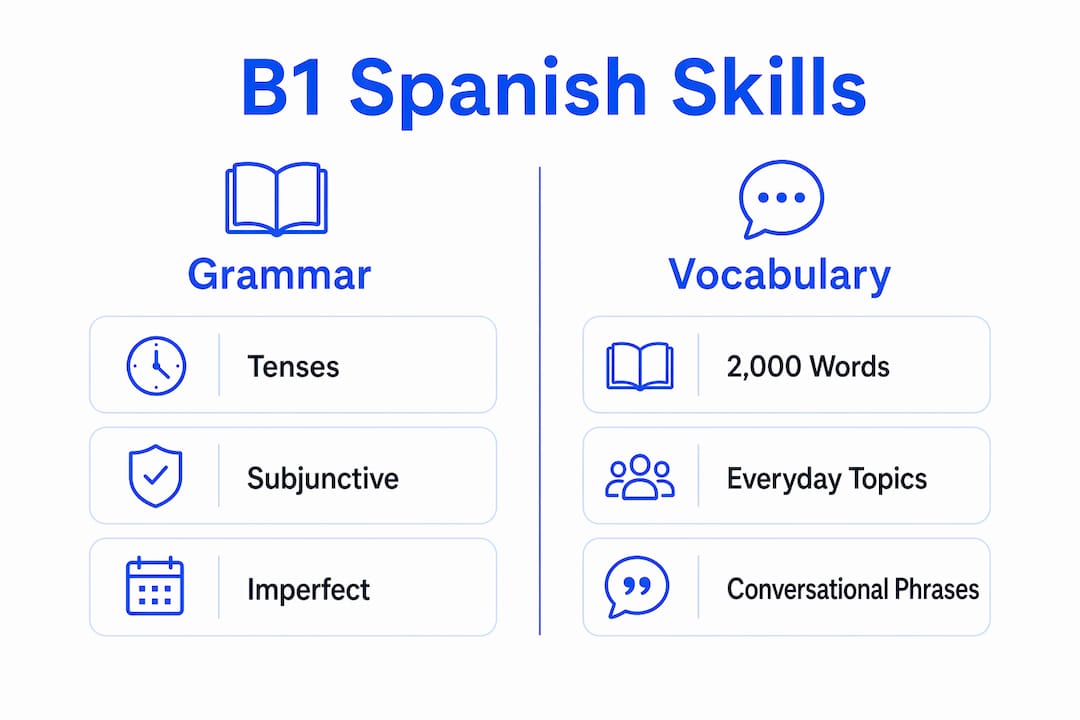
Intermediate Spanish is defined as the B1 level on the Common European Framework of Reference for Languages (CEFR), where learners can communicate independently on familiar topics using a vocabulary of roughly 2,000 to 2,500 words and multiple verb tenses including the subjunctive. Reaching this stage typically requires 200 to 400 hours of focused study. It represents the clearest turning point in your language journey: you move from reciting memorized phrases to actually constructing your own thoughts in Spanish. For adult learners in Singapore and beyond, understanding exactly what this level demands is the fastest way to stop guessing and start progressing.
What is intermediate Spanish and what defines the B1 level?
Intermediate Spanish, formally known as CEFR B1, is the proficiency stage where learners shift from passive recognition to active, independent communication. The B1 syllabus covers handling daily interactions, discussing past experiences, and expressing opinions with growing grammatical accuracy. This is the level where you stop sounding like a tourist and start sounding like someone who actually lives in the language.
The vocabulary benchmark at B1 is specific and measurable. You need an active working vocabulary of approximately 2,000 to 2,500 words, which sounds modest until you realize that most beginner learners plateau around 800 to 1,000 words. The gap between A2 and B1 is not just about knowing more words. It is about using those words flexibly across different tenses, contexts, and sentence structures.
Grammar at this stage expands significantly. You are expected to use the present, preterite, imperfect, and future tenses with reasonable accuracy, and you begin working with the subjunctive mood for expressing wishes, doubts, and emotions. This grammatical range is what separates someone who can order food from someone who can explain why they prefer one restaurant over another.
The Spanish language proficiency levels framework makes clear that B1 is not fluency. It is conversational independence. You can manage travel, navigate daily life, and hold a real conversation, but you will still encounter gaps and need repairs in complex discussions.
What are the core skills at the intermediate Spanish level?
The intermediate Spanish level is defined by a specific set of communicative competencies that go well beyond basic survival phrases. B1 learners can hold conversations on familiar topics with some gaps but are not yet fully fluent. Here is what that looks like in practice:
- Speaking: You can discuss your opinions, describe past experiences, make plans, and express preferences. Topics like travel, work, family, and current events are within reach.
- Listening: You can follow clear, standard speech on familiar subjects when the speaker is not rushing. News broadcasts and structured conversations become accessible.
- Reading: You can read simple connected texts such as short articles, emails, and straightforward narratives. You do not need to look up every third word.
- Writing: You can write simple connected texts, express opinions in writing, and use linking devices like sin embargo, además, and por lo tanto to connect ideas.
- Grammar: You actively use multiple past tenses, the future tense, and begin applying the subjunctive in triggered contexts such as after verbs of emotion or doubt.
- Vocabulary: Your active vocabulary sits between 2,000 and 2,500 words, with a broader passive recognition range.
One practical test of B1 ability: can you tell a story about something that happened to you last week, explain how you felt about it, and say what you plan to do differently next time? If you can do that in Spanish with reasonable accuracy, you are operating at the intermediate level. The key Spanish communication skills that matter most at this stage are narrative ability, opinion expression, and the capacity to ask and answer follow-up questions naturally.
How does intermediate Spanish compare with beginner and advanced levels?
Understanding where B1 sits on the full proficiency scale helps you set realistic goals and avoid the frustration of measuring yourself against the wrong standard. The table below maps the three most relevant CEFR levels for adult Spanish learners:
| CEFR Level | Label | Active Vocabulary | Grammar Focus | Conversational Ability |
|---|---|---|---|---|
| A2 | Elementary | 800 to 1,000 words | Present, basic past | Simple phrases, limited topics |
| B1 | Intermediate | 2,000 to 2,500 words | Multiple tenses, intro subjunctive | Familiar topics, some gaps |
| B2 | Upper Intermediate | 4,000+ words | Full subjunctive, conditionals | Fluent on abstract topics |
The jump from B1 to B2 is widely considered the hardest transition in Spanish learning. Moving from B1 to B2 requires nearly doubling your active vocabulary from 2,500 to 4,000 words while simultaneously mastering abstract language, cultural nuance, and complex grammar structures. Many learners spend more time at B1 than at any other level precisely because the next step demands so much more.
There is also an important distinction between being conversational and being fluent. A B1 speaker is conversational. A B2 speaker is approaching fluency. Conflating the two leads to either overconfidence at B1 or unnecessary discouragement when you realize fluency requires considerably more work. Setting your sights on B1 first, then B2, is the most effective sequencing for adult learners.
Pro Tip: If you are unsure whether you are at A2 or B1, try narrating a two-minute story about your weekend entirely in Spanish without switching to English. A2 learners will stall on past tense constructions. B1 learners will get through it, even imperfectly.
What challenges do learners face at intermediate Spanish?
The intermediate plateau is real, and it has a specific cause. Intermediate learners tend to overuse the present tense and revert to simpler grammatical forms under pressure, which limits their ability to express nuance and advance toward B2. Recognizing this pattern is the first step to breaking out of it.
Here are the most common challenges at this stage, along with concrete strategies to address each one:
-
Present tense dependency. Most learners default to the present tense because it feels safe. The fix is deliberate practice with the preterite and imperfect in the same session. Tell the same story twice: once in the present, once in the past.
-
Subjunctive avoidance. The subjunctive mood feels abstract until you understand its triggers. Subjunctive mastery requires recognizing emotion, doubt, and wishes as cues. Practice sentences like Espero que vengas (I hope you come) and Dudo que sea verdad (I doubt it’s true) until the pattern becomes automatic.
-
Vocabulary stagnation. Learners often stop acquiring new words once they can get by. Push your active vocabulary past 2,500 words by learning words in thematic clusters: business vocabulary one week, travel vocabulary the next.
-
Listening comprehension gaps. Native speakers talk fast and use regional expressions. Start with structured podcasts like Coffee Break Spanish or Español con Juan, then gradually move to unscripted conversations.
-
Fear of making mistakes. This is the single biggest barrier at intermediate level. Errors are not failures. They are data. Every time you use the wrong tense and get corrected, you are building the neural pathway that makes the right form automatic.
Pro Tip: Record yourself speaking Spanish for two minutes each day on a topic you have not prepared. Play it back after one week. The patterns you hear yourself repeating incorrectly are exactly what to focus on in your next study session.
Effective methods and resources to learn intermediate Spanish
Advancing through the intermediate Spanish level requires more than passive exposure. The most effective approach combines targeted grammar practice, vocabulary expansion, and real conversation with feedback. Here is what actually works:
- Graded readers: Books written specifically for B1 learners expose you to natural sentence structures without overwhelming vocabulary. Publishers like Anaya ELE and Difusión produce Spanish graded readers calibrated to CEFR levels.
- Structured grammar exercises: Focus specifically on the subjunctive, the preterite versus imperfect distinction, and the conditional tense. These three areas define the difference between B1 and B2 performance.
- Conversation practice with tutors or native speakers: Feedback is non-negotiable at this stage. Platforms like iTalki connect you with native Spanish tutors for structured conversation practice. A tutor who corrects your errors in real time accelerates progress faster than any app.
- Podcasts and audio content: Notes in Spanish and Español con Juan are designed for intermediate learners and use natural speech at a manageable pace. Listening daily for 20 minutes builds comprehension faster than most grammar textbooks.
- Writing practice with correction: Write short paragraphs in Spanish and get them corrected. Focus on using linking devices and multiple tenses in every piece you write.
- Consistent study hours: The 200 to 400 hours required to reach B1 do not need to be completed in a rush. Thirty focused minutes daily over 18 months is more effective than intensive cramming.
The Spanish language pathways for adults that produce the best results combine structured instruction with regular speaking practice. Self-study alone rarely gets learners past the intermediate plateau because there is no mechanism for catching and correcting the errors that become habits.
Key takeaways
Intermediate Spanish is the B1 CEFR level, requiring 200 to 400 study hours, a 2,000 to 2,500 word active vocabulary, and the ability to use multiple tenses including the subjunctive to communicate independently on familiar topics.
| Point | Details |
|---|---|
| B1 defines intermediate Spanish | CEFR B1 requires 200 to 400 study hours and an active vocabulary of 2,000 to 2,500 words. |
| Core skills span four areas | B1 learners speak, listen, read, and write on familiar topics with growing grammatical accuracy. |
| B1 to B2 is the hardest jump | Moving to upper intermediate nearly doubles required active vocabulary and adds abstract language use. |
| Subjunctive is non-negotiable | Mastering subjunctive triggers for emotion, doubt, and wishes is what separates B1 from A2 performance. |
| Consistent practice beats intensity | Thirty focused minutes daily over 18 months outperforms short bursts of cramming for reaching B1. |
Why the intermediate stage deserves more respect than it gets
Most learners treat B1 as a waiting room on the way to fluency. That framing is wrong, and it causes real damage to motivation. In my experience working with adult Spanish learners, the intermediate stage is where the language actually becomes yours. Before B1, you are borrowing phrases. At B1, you start constructing original thoughts.
The learners I have seen advance fastest through intermediate Spanish share one habit: they stop waiting until they feel ready to speak and start speaking before they feel ready. The subjunctive does not become natural through study alone. It becomes natural through using it badly a hundred times until it clicks. The same applies to the preterite versus imperfect distinction, which trips up nearly every learner at this stage.
There is also a mindset shift that separates learners who break through the intermediate plateau from those who stay stuck. The ones who advance stop measuring themselves against native speakers and start measuring themselves against their own output from three months ago. That comparison is always motivating. The other one rarely is.
If you are currently at A2 and wondering whether B1 is worth the effort, consider this: B1 is the level at which Spanish becomes genuinely useful in professional and social contexts. It is the level at which you can advance toward fluency with a clear roadmap rather than vague aspiration. Do not rush past it. Master it.
— Paul
Take your intermediate Spanish further with Spanish Explorer
Spanish Explorer offers adult Spanish courses in Singapore designed specifically for learners moving through and beyond the intermediate level. Whether you prefer group classes, private instruction, or online Zoom sessions, the curriculum is built around practical communication skills that translate directly to real conversations.

The school’s adult Spanish courses cover the grammar, vocabulary, and speaking practice that intermediate learners need most, including subjunctive training, past tense accuracy, and structured conversation work. Experienced instructors deliver lessons in both Spanish and English, giving you the support to push past the B1 plateau without losing confidence. For learners who want a more tailored approach, private Spanish classes allow you to focus exactly where your gaps are. Spanish Explorer is located at 10 Anson Road, Level 22, International Plaza, Singapore 079903, right above Tanjong Pagar MRT.
FAQ
What is intermediate Spanish in CEFR terms?
Intermediate Spanish corresponds to the B1 level on the CEFR scale. It requires approximately 200 to 400 study hours and an active vocabulary of 2,000 to 2,500 words.
What grammar does intermediate Spanish cover?
B1 Spanish grammar includes the present, preterite, imperfect, and future tenses, plus an introduction to the subjunctive mood for expressing emotions, doubts, and wishes.
How long does it take to reach intermediate Spanish?
Reaching B1 from a beginner level typically requires 200 to 400 hours of focused study, depending on your learning method and consistency of practice.
What comes after intermediate Spanish?
The next stage after B1 is B2, or upper intermediate Spanish, which requires doubling your active vocabulary to around 4,000 words and mastering abstract language and cultural nuance.
Is B1 Spanish enough for professional use?
B1 Spanish is sufficient for basic professional interactions such as introductions, simple negotiations, and email correspondence, but B2 is the standard most employers consider professionally functional.
Sorry, the comment form is closed at this time.