


TL;DR:
- Spanish proficiency enhances cognitive skills, literacy, and learning environments, leading to better academic outcomes. Dual-language programs outperform English-only instruction, while translanguaging deepens understanding and affirms identity. Despite strong evidence, institutions often undervalue Spanish’s critical role, risking long-term social and academic benefits.
Spanish proficiency is one of the most measurable academic advantages a student can develop, with research linking bilingual Spanish-English education to stronger cognitive performance, deeper literacy skills, and better outcomes across multiple academic metrics. The role of Spanish in academic success goes well beyond language class. A four-year randomized trial by American University found that dual-language students consistently outperform their English-only peers. Bilingualism also sharpens executive function, builds vocabulary depth, and creates more equitable learning environments. For students and educators, these findings reframe Spanish not as an elective subject but as a core academic investment.
How does spanish bilingualism shape academic cognitive skills?
Bilingualism enhances cognitive executive functions such as multitasking, creative thinking, and problem-solving. These are not soft skills. They are the same mental capacities that drive performance on standardized tests, research tasks, and complex academic writing.
When students learn Spanish alongside English, their brains constantly manage two language systems. That mental workout strengthens the prefrontal cortex regions responsible for attention control and task-switching. A 2026 industry analysis linking Spanish learning to cognitive skill enhancement confirms that bilingual students show measurable gains in these areas compared to monolingual peers. The implication is direct: stronger executive function means better focus during exams, more efficient studying, and greater adaptability in academic environments.
Spanish also builds intercultural competence. Research shows that bilingual education advances intercultural awareness, though explicit global citizenship education often needs more curricular support. Students who develop this awareness tend to engage more confidently in group projects, international academic programs, and cross-cultural discussions.
Here are the core cognitive skills that Spanish bilingualism develops:
- Attention control: Managing two languages trains the brain to filter distractions and stay focused on tasks.
- Working memory: Holding vocabulary and grammar rules from two languages simultaneously strengthens short-term memory capacity.
- Mental flexibility: Switching between Spanish and English builds the ability to shift between problem-solving strategies.
- Creative thinking: Exposure to two linguistic frameworks opens multiple pathways for generating and expressing ideas.
- Conflict resolution: Bilingual students develop stronger skills in managing competing information, which transfers to academic argumentation.
Pro Tip: If you are an adult learner building Spanish for academic or professional goals, pair vocabulary study with tasks that require active recall, such as summarizing a Spanish article in English. This forces both language systems to work together and accelerates cognitive gains.
Do dual-language spanish programs outperform english-only instruction?
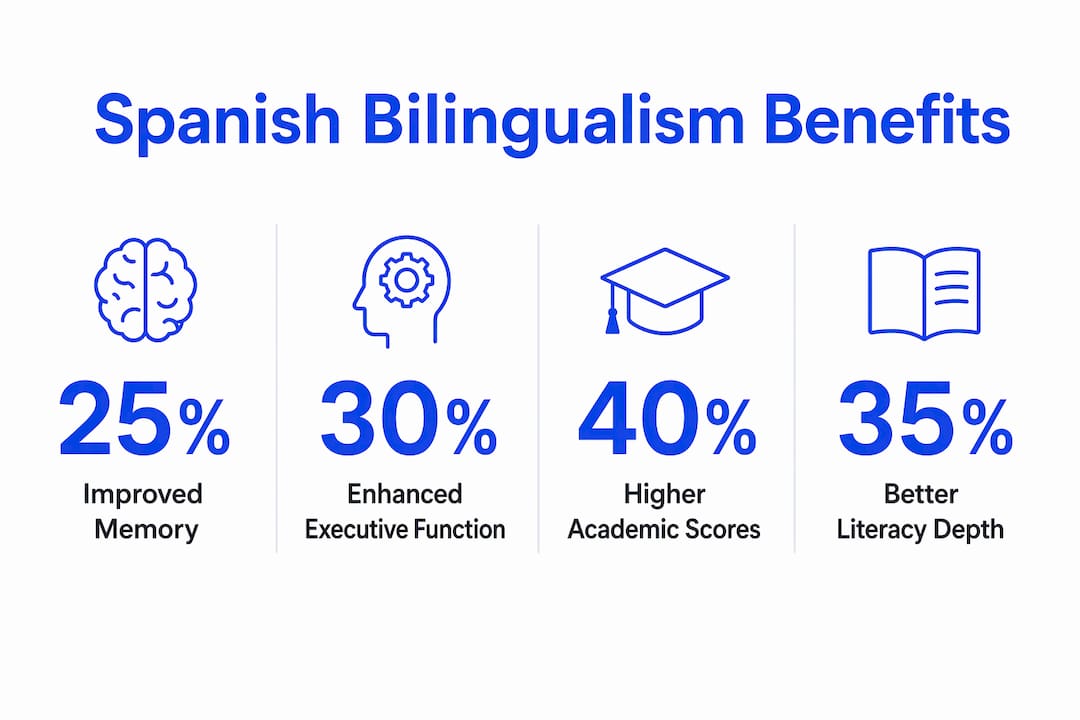
Dual-language Spanish-English programs produce stronger academic results than English-only instruction across multiple outcome measures. The evidence is not anecdotal. It comes from one of the most rigorous study designs in education research.
American University’s four-year randomized trial tracked students across dual-language and English-only classrooms and found consistent, significant performance improvements in the bilingual group. That consistency over four years rules out novelty effects and points to structural academic advantages built into bilingual learning environments. The same research also found that dual-language programs reduce peer victimization, creating safer and more supportive classrooms. A stable social environment directly supports academic concentration and long-term attainment.
The table below compares key outcome measures between dual-language and English-only programs based on the available research:
| Outcome Measure | Dual-Language Program | English-Only Program |
|---|---|---|
| Academic performance over 4 years | Consistent, significant improvement | Standard progression |
| Peer victimization rates | Measurably reduced | Higher baseline rates |
| Cognitive executive function | Enhanced through bilingual management | Limited bilingual stimulation |
| Vocabulary depth | Stronger across both languages | Single-language vocabulary only |
| Intercultural competence | Actively developed | Rarely addressed |
The social-emotional finding deserves more attention than it typically receives. Reduced peer victimization means fewer disruptions to learning, stronger student engagement, and a classroom culture where academic risk-taking feels safer. These conditions compound over time. Students in dual-language settings do not just learn more Spanish. They learn better across the board.
What role does spanish proficiency play in academic literacy?
Spanish proficiency builds academic literacy through vocabulary depth and morphosyntactic awareness, two skills that research identifies as critical for reading efficiency and academic comprehension. Understanding this distinction matters for both students and educators.
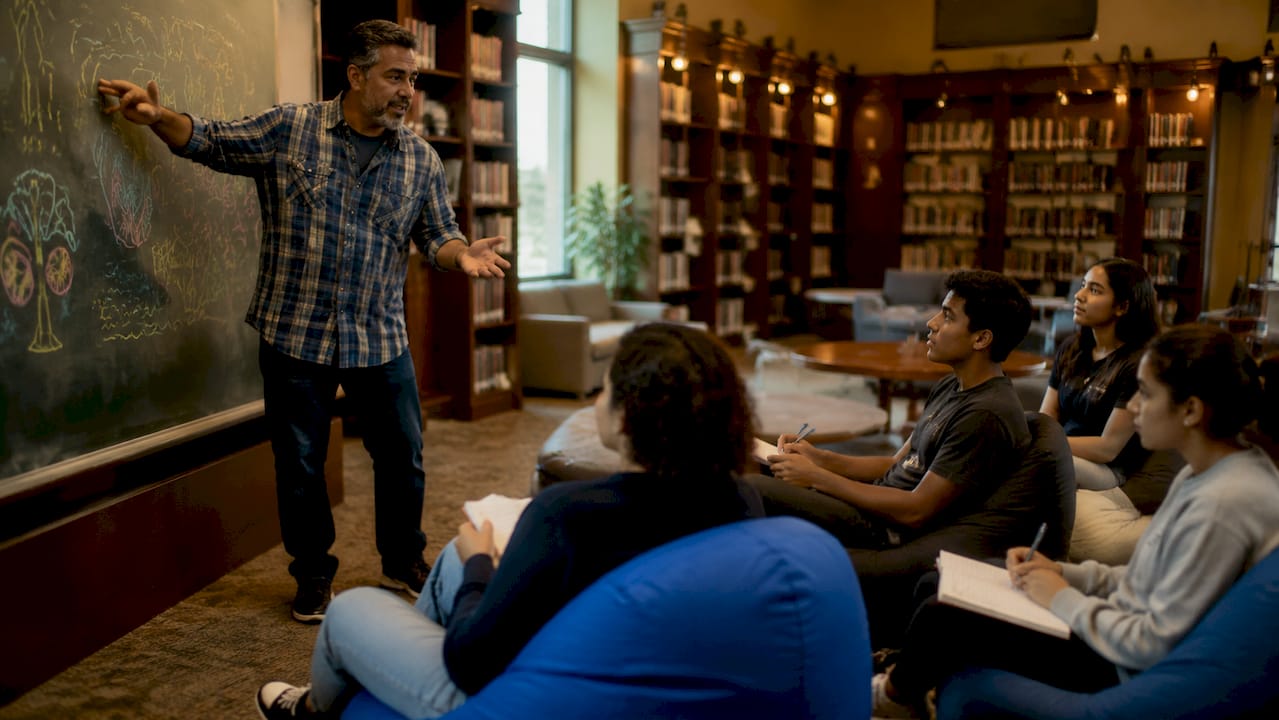
Most reading instruction focuses on decoding, the ability to sound out words. But advanced academic comprehension in Spanish requires deep vocabulary knowledge and morphosyntactic understanding that goes well beyond basic decoding. Research using Structural Equation Modeling on Spanish schoolchildren confirmed that vocabulary and morphology are the essential bridges between reading fluency and reading efficiency. Fluency means reading quickly. Efficiency means reading quickly and understanding deeply. Academic success depends on the second.
These literacy skills also transfer. A student who develops strong Spanish vocabulary habits learns to analyze word roots, recognize grammatical patterns, and infer meaning from context. Those same habits improve performance in English academic reading, because both languages share Latin-based roots across a significant portion of academic vocabulary.
The key literacy skills that Spanish language study develops include:
- Morphosyntactic awareness: Recognizing how word endings and sentence structures signal meaning, which sharpens grammar comprehension in both languages.
- Vocabulary depth: Moving beyond surface definitions to understand connotation, register, and academic usage.
- Semantic inference: Using context clues to decode unfamiliar academic terms, a skill that transfers directly to standardized test reading sections.
- Metalinguistic reflection: Thinking consciously about how language works, which strengthens writing precision and analytical reading.
For educators, this means Spanish instruction should go beyond conversation drills. Integrating academic text analysis, vocabulary mapping, and morphology exercises into Spanish courses produces literacy gains that extend across the curriculum. You can explore how this applies in practice through a detailed look at academic Spanish skills for students and educators.
How does translanguaging strengthen spanish academic benefits?
Translanguaging is a pedagogical approach where students use both Spanish and English fluidly within a single learning activity, rather than keeping the two languages in separate silos. It is not code-switching for convenience. It is a deliberate instructional strategy that deepens conceptual understanding.
An ethnographic case study published in the American Journal of Qualitative Research found that translanguaging pedagogies foster deeper learning and affirm students’ cultural identities in English-medium classrooms. When a teacher says “you can continue in Spanish, I understand,” that moment does more than accommodate a student. It signals that the student’s full linguistic identity has academic value. That affirmation reduces anxiety, increases participation, and produces stronger engagement with complex material.
The research also identifies equity tensions. In classrooms where English dominates institutionally, translanguaging can inadvertently reinforce that hierarchy if not applied with clear intentionality and equity awareness. Teachers must actively design tasks that position Spanish as equally legitimate, not just as a scaffold to be removed once English proficiency improves.
For adult learners, the translanguaging principle applies outside formal classrooms too. Using Spanish to think through a problem, then articulating the solution in English, builds conceptual flexibility that strengthens both languages simultaneously.
Pro Tip: Educators implementing bilingual teaching practices should design at least one activity per lesson where Spanish is the primary language of analysis, not just translation. Ask students to explain a concept in Spanish first, then compare how the English version differs. That comparison itself becomes a learning event.
What challenges threaten dual-language spanish program sustainability?
Dual-language Spanish programs face real financial and institutional pressures that can undermine their long-term viability. Budget decisions are the most immediate threat, and they often underestimate the true cost of cutting these programs.
A 2026 case study from Springfield, Oregon illustrates this clearly. When the Springfield school board adopted a budget that cut Spanish dual-immersion programs, the community pushed back hard. The board’s per-student cost calculation ignored the equity losses, the institutional knowledge built by bilingual staff, and the long-term academic benefits that research consistently documents. Budget decisions cutting dual-language programs based on short-term cost metrics ignore the hidden equity and institutional costs borne by the entire school community.
For educators and administrators who want to protect or build dual-language programs, here is a practical advocacy framework:
- Document academic outcomes. Collect and present data on student performance, literacy gains, and social-emotional indicators specific to your program.
- Quantify equity impact. Show how the program serves English language learners and underrepresented communities who benefit most from bilingual instruction.
- Build community coalitions. Engage parents, local businesses, and alumni who can speak to the program’s value beyond test scores.
- Connect to labor market data. Between 2010 and 2015, demand for bilingualism doubled in U.S. job postings across media, engineering, and finance. That trend has continued. Framing bilingual education as workforce preparation strengthens the case with budget-focused decision-makers.
- Propose phased models. If full dual-language programs face resistance, advocate for hybrid models that preserve Spanish instruction time and bilingual staffing.
Key takeaways
Spanish bilingualism produces measurable academic advantages through cognitive development, literacy depth, and supportive learning environments that compound over time.
| Point | Details |
|---|---|
| Cognitive gains are real | Bilingualism strengthens executive function, memory, and mental flexibility, all of which improve academic performance. |
| Dual-language programs outperform | A four-year American University trial shows consistent academic gains for Spanish-English students over English-only peers. |
| Literacy goes beyond decoding | Vocabulary depth and morphosyntactic awareness are the critical skills that drive academic reading efficiency in Spanish learners. |
| Translanguaging deepens learning | Intentional use of both languages in instruction affirms student identity and builds stronger conceptual understanding. |
| Program sustainability requires advocacy | Budget cuts to dual-language programs carry hidden equity costs that short-term cost analyses consistently miss. |
Why i think we are still underestimating spanish bilingualism’s academic power
The research on Spanish bilingualism and academic success is compelling. But most institutions still treat Spanish as a supplementary subject rather than a core academic driver. That gap between evidence and practice is the most frustrating pattern I see.
The cognitive science is clear. The longitudinal data from American University is clear. Even the labor market data, showing that bilingual demand doubled in U.S. job postings between 2010 and 2015, points in one direction. Yet schools continue to cut dual-language programs when budgets tighten, treating them as luxuries rather than infrastructure.
What I find most underappreciated is the social-emotional dimension. A classroom where students feel their full linguistic identity is valued produces better academic outcomes. That is not a soft finding. It is a structural one. When students stop managing the anxiety of linguistic exclusion, they redirect that cognitive energy toward learning.
For adult learners, the implication is equally direct. Spanish proficiency is not just about conversation fluency. It is about building the cognitive habits, the vocabulary depth, and the cross-cultural awareness that make you a stronger thinker in any academic or professional setting. The benefits of studying Spanish in 2026 extend far beyond the classroom, and the earlier you commit to structured learning, the more compounding advantage you build.
— Paul
Build your spanish proficiency with spanish explorer
Spanish Explorer offers structured adult Spanish courses in Singapore designed for learners who want real results, whether your goal is conversational fluency, professional communication, or academic preparation. Courses are available as group classes, private lessons, and online sessions via Zoom, giving you the flexibility to learn on your schedule.
Every course is taught by certified, experienced instructors who are fluent in both Spanish and English. That means you get clear explanations, practical feedback, and a learning environment where progress is measurable. If you are ready to invest in a skill that delivers cognitive, academic, and career returns, explore the full range of adult Spanish courses at Spanish Explorer. For a more personalized path, private Spanish lessons let you move at your own pace with a dedicated instructor. Spanish Explorer is located at 10 Anson Road, level 22, International Plaza, Singapore 079903, right above Tanjong Pagar MRT.
FAQ
How does spanish proficiency improve academic performance?
Spanish proficiency strengthens executive function, vocabulary depth, and morphosyntactic awareness, all of which directly support reading efficiency and academic comprehension. A four-year randomized trial by American University confirmed that dual-language Spanish-English students outperform English-only peers across multiple academic metrics.
What is translanguaging and why does it matter for students?
Translanguaging is a teaching strategy where students use both Spanish and English fluidly within a single lesson to deepen conceptual understanding. Research shows it also affirms students’ cultural identities, which reduces anxiety and increases academic engagement.
Are dual-language spanish programs worth the investment?
Yes. Beyond academic performance gains, dual-language programs reduce peer victimization and create more equitable learning environments, both of which support long-term attainment. The hidden costs of cutting these programs consistently exceed the short-term savings.
How does spanish vocabulary knowledge help with academic reading?
Vocabulary depth and morphosyntactic awareness are the critical factors that move students from basic reading fluency to genuine reading efficiency. Research using Structural Equation Modeling confirms these skills are more predictive of academic comprehension than decoding ability alone.
Is spanish bilingualism valuable for adult learners outside school?
Absolutely. Between 2010 and 2015, demand for bilingual Spanish-English skills doubled in U.S. job postings across media, engineering, and finance. The cognitive and communication advantages of Spanish proficiency apply equally to adult learners pursuing career advancement or continued education.
Sorry, the comment form is closed at this time.