


TL;DR:
- Workplace language immersion embeds Spanish into daily work tasks for practical fluency and cultural understanding. It relies on role-specific, real-time practice aligned with CEFR standards to improve communication and business outcomes. Successful programs integrate feedback, foster psychological safety, and connect language goals to measurable business goals.
Workplace language immersion is a training method that embeds a target language, such as Spanish, directly into employees’ daily professional activities to build practical fluency and cultural understanding. Unlike traditional classroom instruction, this approach treats language as a working tool rather than a subject to study in isolation. Proficiency frameworks like the Common European Framework of Reference for Languages (CEFR) provide the measurement backbone, while personalization, active use, and psychological safety drive results. Organizations that adopt corporate language immersion report stronger cross-cultural communication, faster onboarding, and measurable gains in business performance.
What is workplace language immersion and how does it work?
Workplace language immersion is defined as the practice of using a target language as the primary communication medium during regular job tasks, rather than reserving it for dedicated study sessions. The core principle is simple: language acquisition accelerates when learners use the language to accomplish real work, not just to practice it.

Immersive methods integrate language as a working tool in realistic workplace scenarios with real-time feedback, which is why active applied learning boosts knowledge retention by up to 75% compared to passive methods. That gap is significant. A professional who practices Spanish by drafting a client proposal, leading a team meeting, or responding to a supplier email retains far more than one who completes a vocabulary exercise.
The mechanics rely on three principles. First, language use is embedded in existing workflows, so there is no separate “study time” that competes with work demands. Second, content is tailored to the learner’s role, meaning a finance manager practices Spanish in the context of budget reviews, not generic travel phrases. Third, feedback is immediate, whether from a live instructor or a structured peer review, so errors become learning data rather than embarrassing moments.
Contextualized practice in client presentations, collaboration, and writing leads to faster skills transfer than any textbook-based approach. This is the defining advantage of workplace language training over generic language courses.
Pro Tip: Start with the three or four job tasks your team performs most often in Spanish, such as client calls, written reports, or vendor negotiations. Build your immersion program around those tasks first, and proficiency will follow naturally.
What frameworks and standards underpin effective immersion programs?
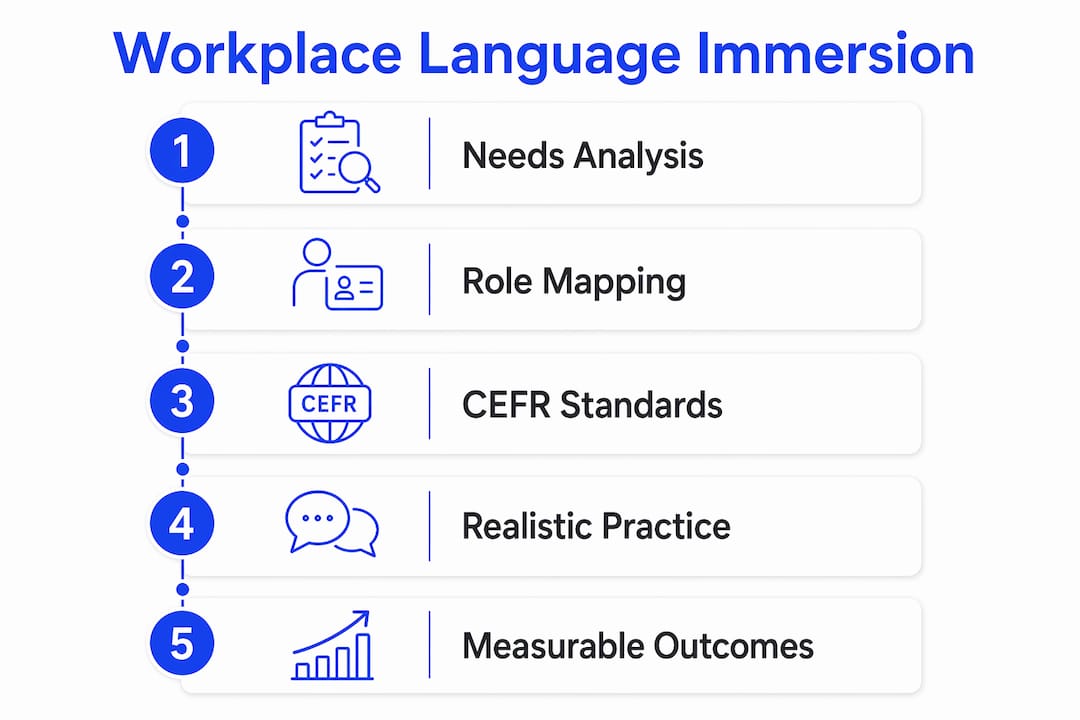
The CEFR is the gold standard for measuring language proficiency in workplace immersion programs. It defines six levels from A1 (beginner) to C2 (mastery) and gives organizations a shared language for setting goals, tracking progress, and evaluating return on investment. Aligning a corporate Spanish program to CEFR levels means you can set a concrete target, such as moving your sales team from A2 to B1, and measure whether the program delivered.
Corporate language programs aligned with CEFR and role-specific outcomes reduce translation costs and improve retention. The cost reduction is a direct consequence of employees handling more communication independently, without relying on translators or bilingual colleagues as intermediaries.
Effective programs also use blended delivery formats. The table below summarizes the most common frameworks and delivery approaches used in workplace immersion design.
| Framework or format | What it does | Best used for |
|---|---|---|
| CEFR proficiency levels | Measures and benchmarks language ability from A1 to C2 | Setting program goals and tracking progress |
| Role-specific content mapping | Aligns learning tasks to actual job responsibilities | Maximizing relevance and reducing time to competency |
| Blended delivery (digital + live) | Combines self-paced modules with scheduled instructor sessions | Scaling programs across teams and time zones |
| Continuous exposure model | Embeds language use into daily workflows rather than weekly lessons | Building long-term retention and fluency |
| Real-time feedback loops | Provides immediate correction during live practice | Accelerating error correction and confidence |
High-performing companies link language milestones like CEFR levels directly to business goals for measurable impact. This is not just good practice. It is the difference between a program that produces fluent employees and one that produces employees who completed a course.
Pro Tip: When designing your program, map each CEFR level target to a specific business outcome. For example, reaching B1 in Spanish might correspond to independently managing a Latin American client account. That connection keeps both learners and managers invested.
What are the key benefits and measurable business outcomes?
The language immersion benefits for organizations extend well beyond improved grammar scores. Language immersion builds cultural fluency and the confidence to communicate in professional contexts like meetings and negotiations. Employees report enhanced cross-cultural competence that directly supports business growth and global market expansion.
“Employees who develop genuine Spanish fluency through immersion do not just communicate better. They build trust with Spanish-speaking clients and partners in ways that no translation service can replicate. That trust is a business asset.”
The business case for corporate language immersion is concrete. Here are the top outcomes organizations consistently report:
- Faster onboarding for international roles. Employees with role-specific Spanish skills integrate into Latin American or Spanish-speaking markets more quickly, reducing the ramp-up period for new assignments.
- Reduced miscommunication costs. Fewer errors in client-facing communication translate directly to fewer costly misunderstandings, contract disputes, and relationship repairs.
- Stronger cross-cultural collaboration. Teams that share a working language, even partially, coordinate more effectively across borders and time zones.
- Higher employee engagement. Personalized learning journeys tied to career advancement motivate employees to invest in their own development, which reduces turnover.
- Measurable proficiency gains. Combining personalized learning with industry-relevant content accelerates proficiency progress by up to 4.5 times compared to generic training. That speed matters when business timelines are tight.
The diversity and inclusion dimension is equally important. Building Spanish proficiency across a workforce signals respect for Spanish-speaking colleagues, clients, and communities. That signal strengthens your organization’s reputation in markets where relationship-building is central to doing business.
How to implement and sustain a corporate Spanish immersion program
A successful implementation starts with a needs analysis. Map the specific linguistic demands of each job role before selecting any content or platform. A customer service team needs different Spanish skills than a legal or finance team, and a program that ignores that distinction wastes time and budget.
Once you have mapped the linguistic tasks to job roles, structure the program around two delivery modes. Asynchronous digital modules handle foundational vocabulary and grammar at the learner’s own pace. Synchronous live sessions, led by a qualified instructor, handle the nuanced work: negotiation practice, cultural context, and real-time conversation. Balancing synchronous live sessions with AI-driven self-study maximizes learning efficiency, with human interaction focused on cultural and negotiation nuances that technology cannot replicate.
Psychological safety is a critical success factor that most organizations underestimate. Employees need explicit permission to make mistakes in Spanish during work tasks. Without that permission, they default to English the moment a conversation gets difficult, and the immersion effect collapses. Leaders who model language risk-taking, by attempting Spanish in team meetings even imperfectly, set the tone for the entire organization.
Sustaining momentum requires measurement. Success measurement should go beyond linguistic proficiency scores to tracking business KPIs like reduced miscommunication and faster onboarding. Review both sets of metrics quarterly and share results with participants. Visible progress is the most powerful engagement tool available.
Common pitfalls to avoid when rolling out a workplace language immersion program:
- Treating immersion as an add-on. If Spanish practice is optional or disconnected from real work tasks, participation drops within weeks.
- Skipping role-specific content. Generic modules frustrate professionals who need industry vocabulary, not tourist phrases.
- Neglecting cultural training. Language fluency without cultural understanding produces technically correct but contextually awkward communication.
- Measuring only test scores. Proficiency levels matter, but business outcomes are what justify continued investment.
- Underestimating manager involvement. Managers who do not reinforce Spanish use in daily work undermine even the best-designed program.
Pro Tip: Assign a language champion in each team, someone who encourages Spanish use in informal settings like team lunches or Slack channels. Informal practice outside structured sessions accelerates fluency faster than additional formal lessons.
Key Takeaways
Workplace language immersion works because it embeds Spanish directly into professional tasks, supported by CEFR-aligned goals, role-specific content, and a culture that treats mistakes as learning data.
| Point | Details |
|---|---|
| Immersion beats passive learning | Active applied learning boosts retention by up to 75% compared to passive instruction methods. |
| CEFR alignment drives results | Linking proficiency levels to business goals makes programs measurable and justifies ongoing investment. |
| Blended delivery scales programs | Combining digital self-study with live instructor sessions serves both individual and organizational needs. |
| Psychological safety is non-negotiable | Employees must feel safe making mistakes in Spanish or they will avoid using the language at work. |
| Measure business KPIs, not just scores | Track outcomes like reduced miscommunication and faster onboarding alongside language proficiency data. |
Why most workplace language programs fall short, and what actually works
I have seen organizations invest in language training and walk away disappointed, not because the content was poor, but because they confused a language course with a language immersion program. Those are two different things.
A course teaches Spanish. An immersion program makes Spanish the medium through which work gets done. The distinction sounds subtle, but it changes everything about how you design, deliver, and measure the program.
The most common misconception I encounter is that immersion requires intensity, long hours, and isolation from normal work. That model belongs in a language school, not a corporate environment. The most effective workplace language skills development happens in short, frequent bursts embedded in the workday, not in marathon sessions that exhaust learners and disrupt operations.
Technology has a real role here, but it is a supporting role. AI-driven tools handle vocabulary and repetition well. They cannot replicate the judgment, cultural sensitivity, and real-time responsiveness of a skilled human instructor. Organizations that cut live instruction to save costs consistently report slower proficiency gains and higher dropout rates.
My honest recommendation for any organization hesitant to commit: start with one team, one set of job tasks, and one clear CEFR target. Measure the business outcome after three months. The results will make the case for broader rollout better than any proposal document ever could.
— Paul
Spanish Explorer’s corporate Spanish programs for professionals
Spanish Explorer offers corporate Spanish courses and private classes designed specifically for working professionals in Singapore. Programs are built around real business communication needs, from client-facing conversations to written correspondence, and are delivered by certified instructors fluent in both Spanish and English.
Online Zoom classes make it straightforward for teams to participate regardless of schedule or location, while customized corporate training aligns directly with your organization’s communication goals. Whether your team needs conversational Spanish for relationship-building or professional Spanish for business negotiations, Spanish Explorer structures the program around your actual work context. Classes are also available at the training center at International Plaza, 10 Anson Road, Level 22, Singapore, right above Tanjong Pagar MRT. Explore the full range of corporate Spanish courses or book a private class tailored to your role and goals.
FAQ
What is workplace language immersion?
Workplace language immersion is a training approach that embeds a target language, such as Spanish, into employees’ daily professional tasks rather than treating it as a separate subject. The goal is to build practical fluency through real work use, supported by role-specific content and structured feedback.
How does language immersion differ from a standard language course?
A standard course teaches language as content. Immersion uses language as the medium for completing actual work tasks, which produces faster retention and more transferable skills.
What does CEFR have to do with workplace language training?
CEFR provides a standardized scale from A1 to C2 that organizations use to set proficiency targets, track progress, and link language milestones to specific business outcomes like managing client accounts independently.
How long does it take to see results from a corporate immersion program?
Programs that combine personalized content with industry-relevant practice can accelerate proficiency progress by up to 4.5 times compared to generic training, meaning measurable CEFR level gains are achievable within a few months.
What is the biggest mistake organizations make with language immersion?
The most common mistake is treating immersion as optional or disconnected from real work. When Spanish practice is not embedded in daily job tasks, participation drops and proficiency gains stall.
Sorry, the comment form is closed at this time.