

TL;DR:
- DELE and SIELE serve different purposes, formats, and recognition levels.
- Proper preparation with structured courses and authentic materials is essential for success.
- The exam results are milestones; continuous practice and cultural engagement improve long-term fluency.
Many Singaporeans preparing for Spanish certification assume DELE and SIELE are basically the same thing. They are not. These two exams serve different goals, follow different formats, and suit different types of candidates. Choosing the wrong one can cost you time, money, and confidence. This guide cuts through the confusion by explaining what each exam involves, what examiners actually look for, and how to prepare in a structured, practical way. Whether you are aiming for academic admission, a work visa, or personal achievement, you will leave this article knowing exactly which path fits your goals.
Table of Contents
- Understanding Spanish language proficiency assessment
- Key features of the DELE and SIELE exams
- What Spanish examiners really assess
- Preparing for Spanish language assessment in Singapore
- The real challenge: Beyond passing the Spanish exam
- Get expert support for your Spanish certification
- Frequently asked questions
Key Takeaways
| Point | Details |
|---|---|
| Choose the right test | Understand whether DELE or SIELE fits your long-term goals before registering. |
| Know what is assessed | Both DELE and SIELE evaluate all four language skills using CEFR standards. |
| Local exam prep matters | Using Singapore-based preparation courses greatly increases your success and confidence. |
| Practice real tasks | Mock exams and past papers prepare you for the exact formats and expectations of each exam. |
Understanding Spanish language proficiency assessment
Spanish proficiency assessment is not just about passing a test. It is a formal measure of your ability to use Spanish across real-life situations, evaluated against a globally recognized standard. For candidates in Singapore, this matters because employers, universities, and immigration authorities rely on these certifications to verify your skills objectively.
The foundation of all major Spanish assessments is the CEFR, or Common European Framework of Reference for Languages. This scale runs from A1 (absolute beginner) to C2 (mastery level), and it provides a shared language for describing what a speaker can do at each stage. Every reputable Spanish certification maps directly to this scale.
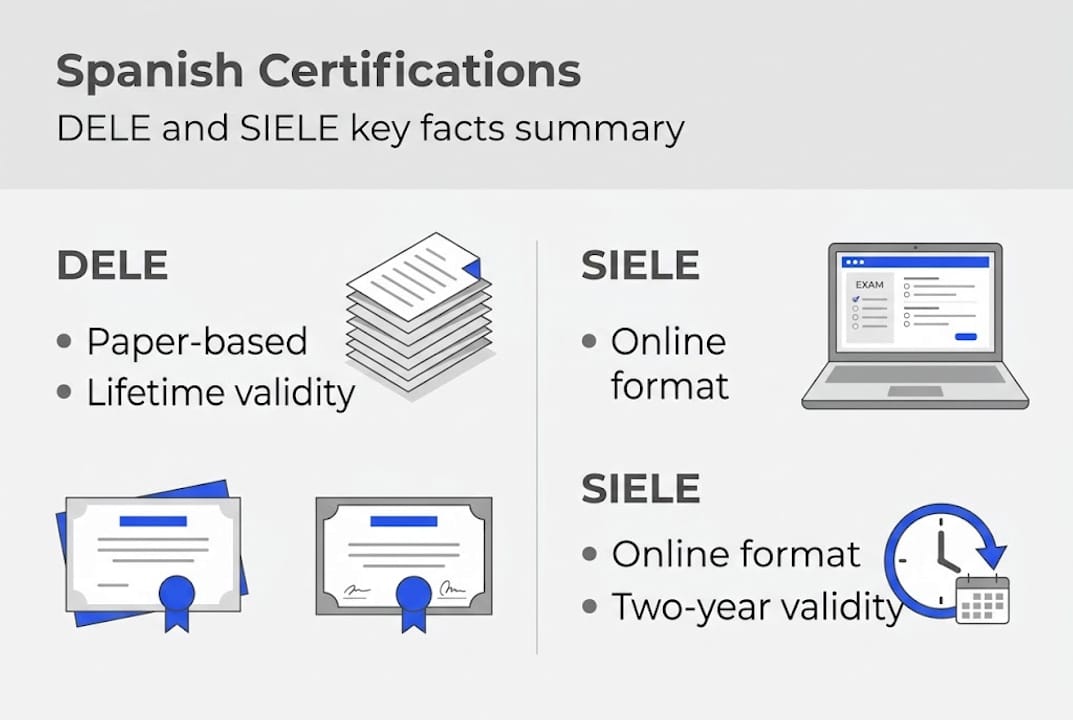
The two main certifications recognized in Singapore are DELE and SIELE. DELE is aligned to the CEFR A1-C2 levels and is administered by Instituto Cervantes, the official global body for Spanish language promotion. SIELE, on the other hand, is a collaborative certification developed by Instituto Cervantes alongside major Latin American universities, designed to reflect a broader range of Spanish varieties.
In Singapore, your options for sitting these exams are specific. DELE exams are offered at NUS Centre for Language Studies, and SIELE at Spanish Language School, making it important to plan your registration well in advance since seats fill quickly. You can also explore the DELE vs SIELE comparison to understand which fits your situation before committing.
Here is a quick overview of why these certifications matter:
- Academic admission: Many universities in Spain and Latin America require DELE B2 or C1 for enrollment.
- Immigration and citizenship: Spain’s citizenship process officially accepts DELE A2 as proof of language integration.
- Career advancement: Multinational companies operating in Spanish-speaking markets increasingly request formal certification.
- Personal benchmarking: Certification gives you a clear, credible measure of where you actually stand.
Globally, DELE is recognized in over 100 countries, while SIELE is gaining rapid acceptance across Latin America and Europe as a flexible, digital alternative.
Key features of the DELE and SIELE exams
Now that you know the main exams, let’s look at how DELE and SIELE truly differ in their format, recognition, and what that means for your plans.
| Feature | DELE | SIELE |
|---|---|---|
| Format | Paper-based | Computer-based |
| Scoring | Pass/fail per level | Scored 0-1000, no fail |
| Flexibility | Fixed exam dates | More flexible scheduling |
| Validity | Lifelong | 5 years |
| Best for | Academic, citizenship | Employment, quick results |
DELE is pass/fail with grouped scoring while SIELE is multilevel with no fail. This is a critical distinction. With DELE, you must score at least 60% overall and a minimum of 30% in each skill group to pass. If you fall short in one group, you fail the entire level, even if your overall performance was strong. SIELE simply gives you a score that maps to a CEFR range, so there is no binary pass or fail outcome.
This structural difference shapes which exam suits your goals:
- Choose DELE if you need a permanent, prestigious certificate for university admission, Spanish citizenship applications, or formal academic recognition. The DELE exam structure is rigorous and respected precisely because of its strict pass criteria.
- Choose SIELE if you need results quickly for a job application, a short-term visa, or if you want to test your level without the risk of an outright fail.
- Consider your timeline: DELE has fixed exam windows, so missing a registration deadline can delay your plans by months.
Pro Tip: One of the most common and costly mistakes candidates make is registering for a DELE level without confirming their current CEFR level first. Skipping a level, say jumping from A2 to B2 without proper assessment, almost always leads to failure. Use a placement test or consult a certified instructor before choosing your DELE level to avoid wasting an exam attempt.
What Spanish examiners really assess
Understanding the differences in exam types is useful, but it is also crucial to know exactly what you will be assessed on when you sit for these tests.
Both DELE and SIELE evaluate four core language skills: reading, listening, writing, and speaking. However, the weight and complexity of each skill shift significantly as you move up the CEFR scale.
| Skill | DELE component | SIELE component |
|---|---|---|
| Reading | Comprensión de lectura | Reading module |
| Listening | Comprensión auditiva | Listening module |
| Writing | Expresión e interacción escritas | Writing module |
| Speaking | Expresión e interacción orales | Speaking module |
At lower levels like A1 and A2, tasks focus on recognizing familiar words and producing simple sentences. At B1 and B2, you are expected to handle unfamiliar situations and express opinions clearly. B2 descriptors require fluent interaction on a wide range of topics, which means you need genuine conversational stamina, not just memorized phrases. At C1 and C2, examiners look for discourse-level control, nuance, and the ability to handle complex, abstract ideas.
Here are the most common pitfalls candidates face, and what separates those who pass from those who do not:
- Ignoring authentic materials: Studying only textbooks leaves you unprepared for real spoken Spanish, which is faster and less structured.
- Underestimating the writing component: Many candidates focus on speaking but neglect formal written tasks like essays and formal letters.
- Not understanding grading rubrics: Examiners use specific criteria for each task. Knowing what they look for changes how you approach every answer.
- Insufficient oral practice: The speaking section is often where candidates lose the most points, especially at B2 and above.
“The oral exam is not just about speaking Spanish. It is about demonstrating that you can manage a conversation, respond to unexpected questions, and recover naturally when you make a mistake.” This mindset shift is what separates prepared candidates from those who freeze under pressure.
If you want to build the skills that actually matter in the exam room, start by preparing for Spanish exams with a structured course that mirrors real exam conditions.
Preparing for Spanish language assessment in Singapore
With the assessment framework clear, it is time to turn insight into action. Here is how to prepare the smart way in Singapore.
The first step is always an honest assessment of your current level. Many candidates overestimate their readiness, particularly those who have studied casually or used apps as their main learning tool. A formal placement test or a session with a certified instructor gives you a realistic baseline and helps you set a realistic exam timeline.
Preparation is key for navigating different task formats, and prep courses are available in Singapore. Structured courses are far more effective than self-study alone because they expose you to the exact task types, timing conditions, and grading criteria used in real exams.
Here are the most effective preparation strategies for Singapore candidates:
- Enroll in a DELE-aligned course: Look for programs taught by certified instructors who know the exam format inside out.
- Use past papers regularly: Familiarity with real exam tasks reduces anxiety and improves time management during the actual test.
- Join a conversation group: Speaking practice with peers simulates the interactive pressure of the oral exam.
- Supplement with authentic media: Spanish podcasts, films, and news programs train your ear for natural speech patterns.
- Track your progress by skill: Identify weak areas early and allocate more practice time there rather than repeating what you already do well.
If your schedule is tight, Spanish classes online offer the same structured preparation with more flexibility. Singapore residents may also be eligible to offset course fees through SkillsFuture Spanish courses, making professional exam prep more accessible.
Pro Tip: Do not wait until two weeks before the exam to start using mock papers. Integrate timed practice from the beginning of your prep cycle. Candidates who practice under real exam conditions from the start consistently outperform those who cram at the end.
The real challenge: Beyond passing the Spanish exam
Here is something most exam guides will not tell you: passing DELE or SIELE does not automatically make you a fluent, confident Spanish speaker. The certificate proves you met a standard on a specific day. What happens after that is entirely up to you.
We have seen candidates achieve B2 and then lose much of that fluency within a year because they stopped using Spanish in any meaningful way. The exam is a milestone, not a destination. Real communication ability comes from sustained practice, cultural exposure, and genuine engagement with the language over time.
The candidates who make the most lasting progress are those who treat the exam as one part of a longer journey, not the finish line. Speaking practice in Singapore through conversation groups, language exchanges, and community events keeps your skills sharp long after the test is over.
Rushing through CEFR levels to get a higher certificate faster is also a trap. A B2 certificate earned through solid, genuine preparation opens far more doors than a C1 certificate earned through shortcuts and memorization. Examiners and employers notice the difference quickly.
Get expert support for your Spanish certification
If you are serious about earning your Spanish certification, the right preparation makes all the difference. At Spanish Explorer, we offer professionally structured Spanish courses in Singapore designed specifically around DELE exam standards, taught by certified instructors who understand exactly what examiners look for.

Whether you are still deciding between DELE and SIELE, need DELE vs SIELE advice before registering, or are ready to move straight into exam prep, we can guide you from your current level to certification with confidence. Explore our DELE exam registration support and find out how a structured, expert-led program can get you there faster and with less stress.
Frequently asked questions
Which Spanish proficiency test should I take: DELE or SIELE?
DELE is preferred for permanent certification and carries higher prestige for academic or immigration purposes, while SIELE is the better choice if you need flexibility and faster results for job or visa applications.
How are DELE and SIELE exams structured?
DELE is paper-based with lifelong validity and requires passing each level with strict score thresholds, while SIELE is fully computer-based, adaptable in timing, and returns a score across CEFR levels rather than a pass or fail result.
Where can I take Spanish proficiency exams in Singapore?
You can sit for the DELE at NUS Centre for Language Studies and the SIELE at authorized Spanish language schools in Singapore, so confirm registration deadlines well ahead of your target exam date.
What defines a pass for DELE exams?
To pass a DELE level, you need at least 60% overall and a minimum of 30% in each skill group, meaning a strong performance in one area cannot compensate for a weak result in another.
Sorry, the comment form is closed at this time.