


TL;DR:
- Setting clear CEFR goals and using high-ROI tools accelerates learning in Singapore.
- Focusing on essential vocabulary and practical grammar enables rapid conversational fluency.
- Combining input with active speaking practice and structured exam prep ensures fast progress.
Learning Spanish fast while juggling a full-time job, family commitments, or an upcoming DELE exam feels like an impossible equation. Yet thousands of learners in Singapore reach conversational fluency far sooner than they expect, not by studying harder but by studying smarter. The difference comes down to clear goals, the right tools, and a daily routine that builds real skills instead of just memorizing lists. This article walks you through every step, from setting realistic targets to choosing the best local courses and exam strategies, so you can stop guessing and start speaking.
Table of Contents
- Set realistic goals and prepare the right tools
- Master the essential vocabulary and grammar patterns first
- Immerse in input and speak from day one
- Choose the fastest courses and exam strategies in Singapore
- Our perspective: Why structure beats immersion when learning Spanish fast
- Next steps: Learn Spanish fast with proven local courses
- Frequently asked questions
Key Takeaways
| Point | Details |
|---|---|
| Set clear goals | Identify why and how quickly you want to learn Spanish, then choose the right CEFR level to target. |
| Focus on high-frequency vocabulary | Mastering the top 1000 Spanish words lets you understand most everyday conversations. |
| Practice speaking regularly | Active output and daily immersion speed up fluency more than studying alone. |
| Use structured courses for exams | Accelerated progress is most reliable when you combine courses, mock tests, and expert guidance. |
Set realistic goals and prepare the right tools
The biggest mistake new learners make is treating Spanish as one giant mountain. It is not. It is a series of checkpoints mapped to the Common European Framework of Reference for Languages, or CEFR, a scale that runs from A1 (complete beginner) all the way to C2 (near-native). Knowing which checkpoint you are targeting changes everything about how you prepare.
For most people in Singapore, A2 covers everyday travel and social situations, B1 is enough for most workplaces, and B2 or above is required for university admission or skilled migration. Each level has a known time cost. A1 takes 2-4 weeks, A2 around 2-3 months, and B1 needs 4-6 months of daily 30-60 minute practice. Full professional proficiency demands roughly 600-750 hours in total.
| CEFR level | What you can do | Estimated hours | Daily practice ||
|—|—|—|—|
| A1 | Introduce yourself, basic phrases | 60-80 hours | 2-4 weeks |
| A2 | Handle travel, simple conversations | 150-200 hours | 2-3 months |
| B1 | Discuss work, opinions, familiar topics | 300-400 hours | 4-6 months |
| B2 | Follow complex discussions, write fluently | 500-600 hours | 10-12 months |
Once your target level is clear, you need tools that give you the best return on your time. Here are the highest-ROI resources to build into your routine:
- Spaced repetition software (SRS): Apps like Anki automate the review of vocabulary at the exact moment you are about to forget it.
- High-frequency word lists: Work through the top 1,000 Spanish words before anything else.
- Structured courses: Effective Spanish learning approaches at a school aligned with CEFR standards keep you accountable and progressing.
- Essential learning tools: Self-study platforms for grammar, listening, and reading fill gaps between classes.
- Practice exams: Past DELE and SIELE papers test your real level, not just your self-assessment.
Pro Tip: Spend your first week on the 200 most common Spanish words and ten basic sentence frames. Research consistently shows these alone cover roughly 80% of everyday conversation, giving you confidence fast.
Master the essential vocabulary and grammar patterns first
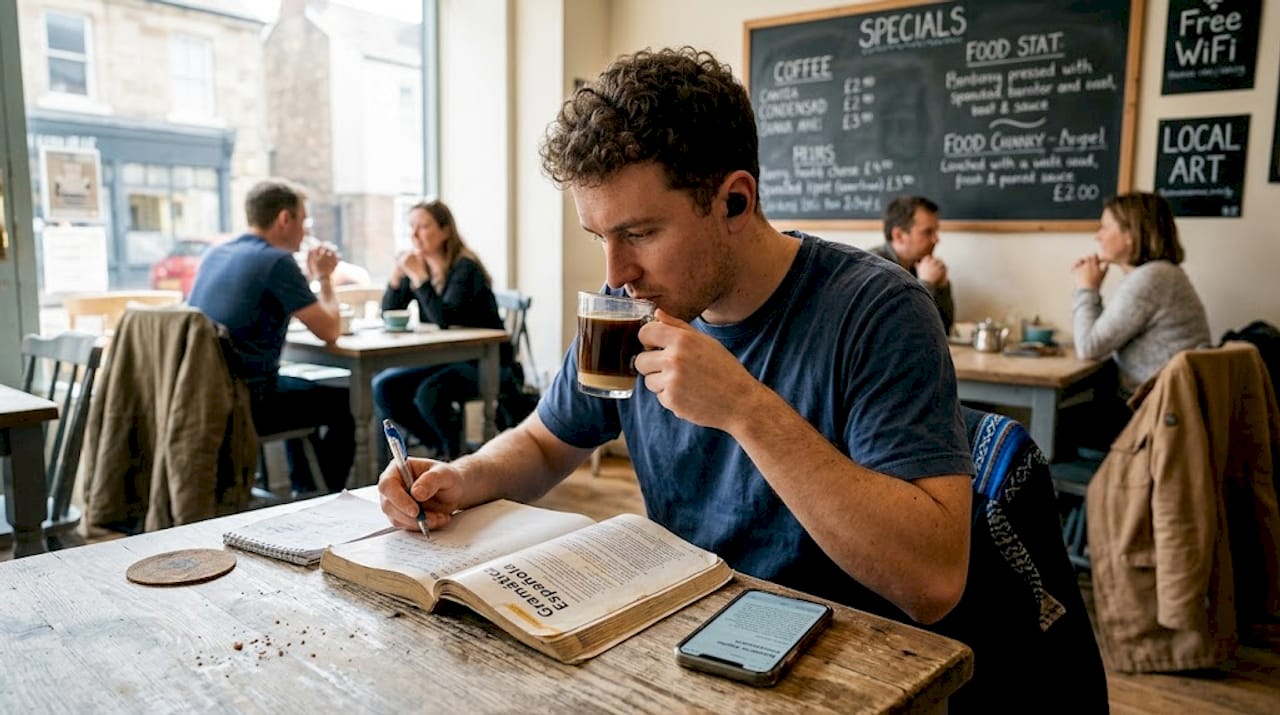
With solid goals and the right materials, your next step is to zero in on what gives the fastest real-world results. Vocabulary is the engine of communication, but only the right vocabulary. Random acquisition, picking up words from songs, movies, or whatever you happen to encounter, is slow and unpredictable. Top 1,000 words cover 80-85% of everyday speech, and spaced repetition systems like Anki maximize how fast those words stick.
| Approach | Speed to conversational use | Retention after 1 month | Exam relevance |
|---|---|---|---|
| Frequency word lists + SRS | Fast (weeks) | High | Directly useful |
| Random vocabulary acquisition | Slow (months) | Low | Unpredictable |
The gap in that table is not small. Learners using frequency-first methods regularly reach A2 in the time it takes random-method learners to feel settled at A1.
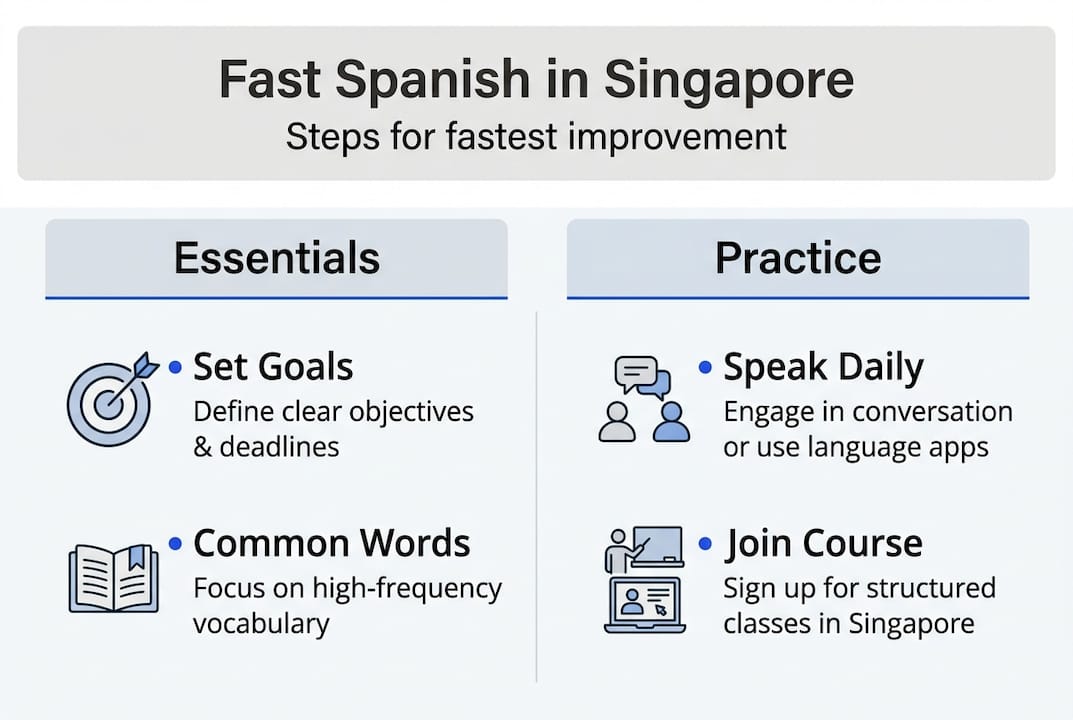
Grammar is the other half of the equation. You do not need to master every tense before speaking. You need a small, powerful toolkit: present tense conjugations, basic question forms (¿Qué? ¿Dónde? ¿Cuándo?), and connectors like pero (but), porque (because), and y (and). These patterns let you construct and decode sentences immediately.
Here is a simple daily routine that builds on active learning strategies to lock in vocabulary and grammar together:
- Open your SRS app and review all due flashcards (10-15 minutes).
- Study one new grammar pattern with three example sentences in context.
- Write five original sentences using today’s new words and the pattern.
- Read a short graded text and underline unfamiliar words for your next card deck.
- Review your mastering Spanish basics notes to reinforce what your instructor covered in class.
One underused advantage for English speakers is that Spanish and English share thousands of cognates, words that look and sound similar and mean the same thing, like hospital, hotel, and natural. Using English as a bridge to decode Spanish patterns speeds up comprehension without creating long-term dependence.
Immerse in input and speak from day one
Memorizing words quickly is only useful if you put them into action and immerse yourself in real Spanish right away. Many learners wait until they feel “ready” to speak. That feeling almost never comes on its own. Research on early speaking practice consistently shows that combining comprehensible input, content you understand about 80% of, with immediate speaking practice from day one dramatically accelerates progress.
Build these habits into your daily routine:
- Podcasts for beginners: Español con Juan and Coffee Break Spanish are designed for gradual exposure.
- YouTube channels: Look for channels that subtitle in both Spanish and English for early stages.
- Graded readers: Short story books written for A1-B1 learners make reading feel achievable.
- Language exchange apps: Tandem and HelloTalk connect you with native Spanish speakers who want to practice English.
- Singapore Spanish community events: Groups like the Singapore Spanish network and cultural events at the Centro Español host informal meetups where real conversation happens.
Pro Tip: After each listening session, pause the audio and narrate what you just heard out loud in Spanish. Even a messy attempt rewires your brain to produce output rather than just receive it. You can also record yourself for 60 seconds each morning describing your plans for the day. Playback is genuinely revealing.
“Interaction is the catalyst. Immersion alone is slow without structured output.”
For Spanish speaking practice ideas tailored to Singapore learners, small-group conversation classes create the low-stakes environment where risk-taking accelerates fluency. Pairing those sessions with practical speaking activities you can do independently between classes closes the gap even faster. Use comprehension improvement strategies to measure whether your reading and listening are keeping pace with your speaking.
Choose the fastest courses and exam strategies in Singapore
Maximizing real-world practice pays off most when paired with the right local resources and strategic preparation for recognized certifications. Singapore has several credible options, but they differ significantly in structure, speed, and exam focus.
| School or platform | Format | Exam focus | Best for |
|---|---|---|---|
| Lingua-Learn.sg | Online, one-to-one and group, CEFR-aligned | General CEFR progress | Flexible learners |
| Spanish Council | Private lessons | DELE preparation | Fast-track exam prep |
| Spanish Language School | Group classes | DELE and SIELE | Structured progressors |
| Spanish Explorer | Group, private, corporate | DELE vs SIELE exam guide, exam counseling | All learner types |
For certification, choosing between DELE and SIELE matters. DELE is paper-based, recognized for life, and typically required for university admission and immigration. SIELE is digital, valid for five years, and better suited to professional or corporate use. Private lessons give the fastest results per hour of study, and intensive workshops compress months of progress into weeks.
Here is a proven exam preparation sequence:
- Take a diagnostic test to confirm your current CEFR level and identify weak areas.
- Enroll in a course or private program aligned to your target exam level.
- Practice one timed past paper per week from week four onward.
- Schedule at least two full mock exams before your test date.
- Review your mocks with your instructor and focus the final two weeks on weak sections only.
Most learners in Singapore need 8-12 weeks of focused prep to sit a DELE or SIELE exam with confidence. The mock exam step is the one most people skip and the one that most directly predicts real exam performance. Check the available Spanish online class options to combine in-person and remote practice without losing momentum.
Our perspective: Why structure beats immersion when learning Spanish fast
Let’s address a core myth that often holds people back. The popular idea that you just need to “surround yourself with Spanish” and fluency will follow is not wrong exactly, but it is dangerously incomplete.
Immersion alone is slow without structure. People who move to Spanish-speaking countries and still struggle after years of living there are proof of that.
What actually accelerates progress is deliberate practice inside a framework. When you combine targeted grammar work with spaced vocabulary review and structured output, each session compounds on the last. Passive immersion without that scaffolding produces recognition, you can follow a conversation, but not production, you freeze when it is your turn to speak.
For learners in Singapore who have a specific goal, a DELE certificate for a university application, Spanish for a regional role in a multinational, or simply confident travel through Latin America, structure is not optional. It is the mechanism.
“People in Singapore can reach conversational fluency in months, not years, if they blend input with active, structured learning.”
At Spanish Explorer, we see this gap every week. Students who join after months of app-only study are often surprised how quickly they accelerate once they have structured Spanish courses and a certified instructor guiding their output. The tools are the same. The framework makes the difference.
Next steps: Learn Spanish fast with proven local courses
Everything covered in this article, goal-setting, vocabulary priority, daily immersion, and exam strategy, works best when anchored in a structured learning environment with expert guidance.
At Spanish Explorer, our Spanish courses in Singapore are designed to match your pace and purpose, whether that means group classes for social learners, private coaching for fast-track exam prep, or flexible online Spanish classes for busy professionals. If certification is your goal, our dedicated DELE exam preparation program covers everything from diagnostic testing to mock exams with certified instructors. Spots in our accelerated programs fill quickly. Secure your place now and start your Spanish journey with a clear path and real support.
Frequently asked questions
How long does it take to learn Spanish fast in Singapore?
With 30-60 minutes of focused practice daily, reaching conversational level (A2/B1) typically takes 2-6 months. A2 takes 2-3 months and B1 around 4-6 months of consistent daily study.
Is immersion enough to learn Spanish quickly?
Immersion builds recognition, but immersion alone is slow without grammar study and speaking practice. Combining all three is what produces fast, lasting results.
What is the fastest way to prepare for DELE or SIELE?
Enroll in an intensive course with mock tests included. 8-12 weeks of targeted prep with regular mock exams is the standard timeline for confident exam performance in Singapore.
Which vocabulary should I learn first for the fastest progress?
Start with the top 1,000 high-frequency Spanish words. These cover 80-85% of speech in everyday conversation, giving you the highest return for your study time.
Sorry, the comment form is closed at this time.