

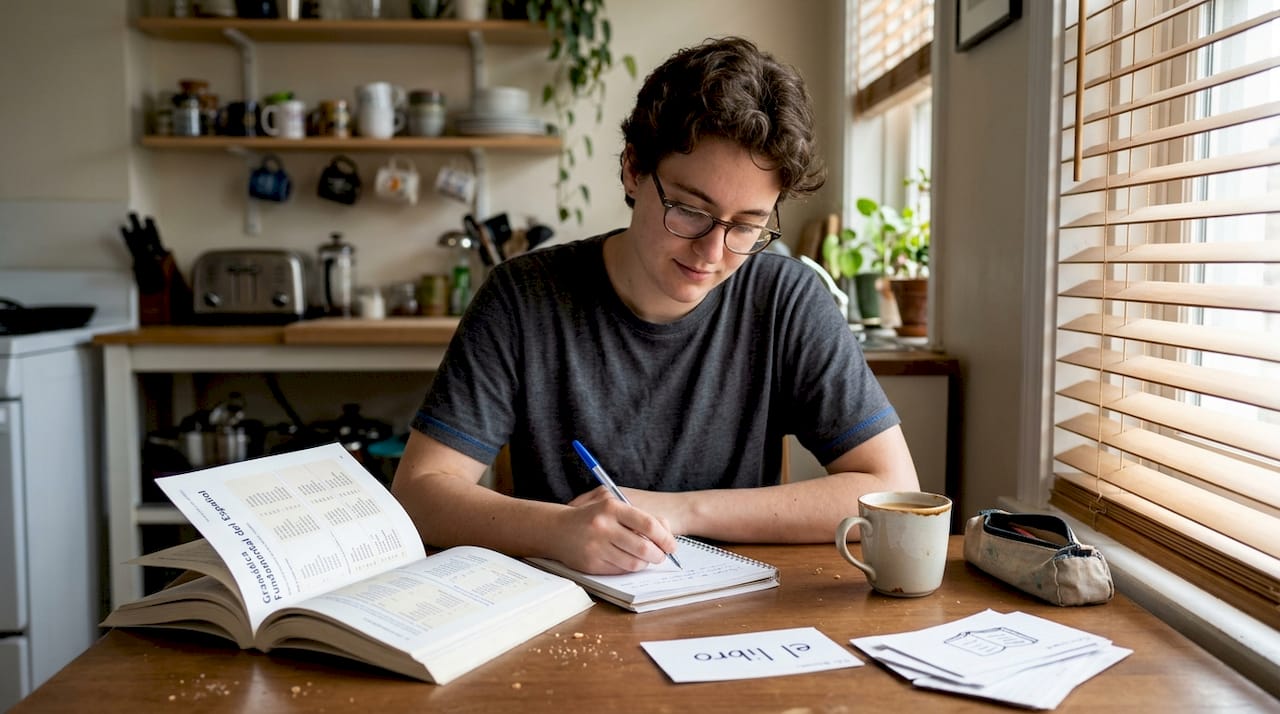
TL;DR:
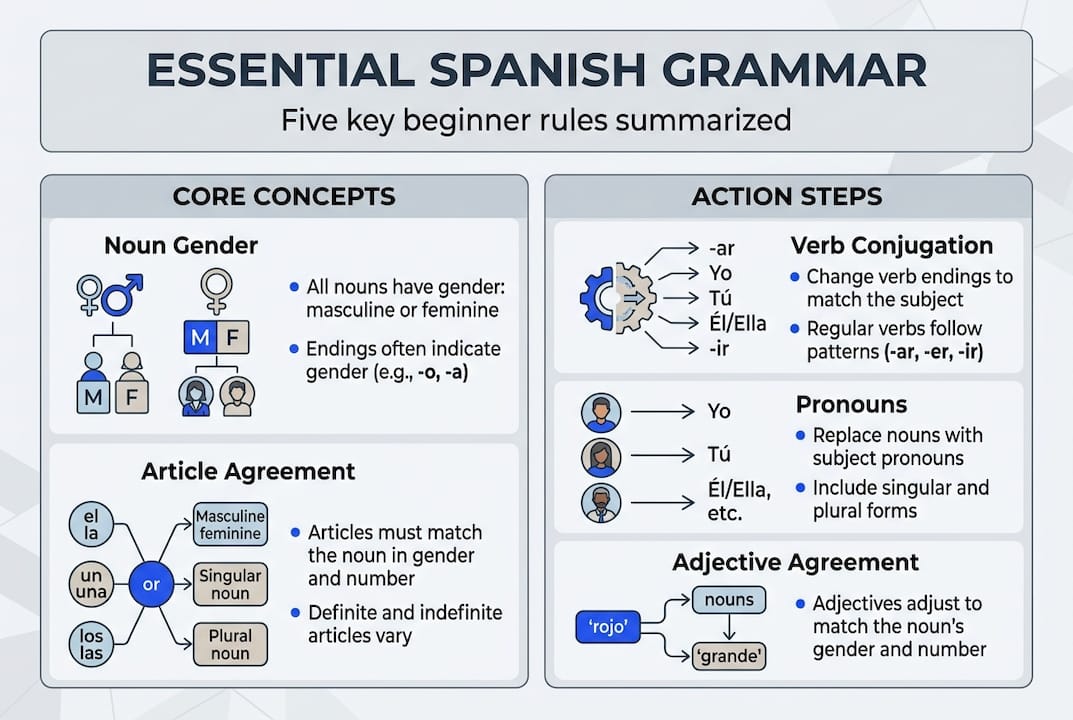
- Spanish grammar differs from English, emphasizing noun gender, article agreement, and verb conjugation.
- Key concepts include when to use ser versus estar based on permanence and temporary states.
- Mastery requires practice with exceptions, real content, and personalized knowledge beyond basic rules.
Most beginners assume Spanish grammar is just English grammar with Spanish words swapped in. That assumption leads to sentences like “Yo soy cansado” when you should say “Yo estoy cansado,” or calling a hand “el mano” when it’s actually “la mano.” These small errors are not signs of failure. They’re signs that nobody walked you through the real building blocks first. This guide covers the core grammar rules every beginner needs: noun gender, articles, subject pronouns, verb conjugation, adjective agreement, and the famous ser vs. estar distinction. Work through each section and you’ll have a solid, practical foundation to build on.
Table of Contents
- Core building blocks: Nouns, articles, and gender
- Making sense of subject pronouns
- Verbs and present tense: Conjugation essentials
- Adjectives, agreement, and position
- Ser vs. estar and putting it all together
- What most guides miss about mastering Spanish basics
- Next steps: Build your Spanish skills with expert guidance
- Frequently asked questions
Key Takeaways
| Point | Details |
|---|---|
| Nouns and articles | Spanish nouns have gender and require matching articles for clarity. |
| Verb conjugation | Mastering present tense conjugation is essential for forming basic sentences. |
| Adjective agreement | Adjectives must match the gender and number of the nouns they describe. |
| Ser vs estar | Use ‘ser’ for permanent qualities and ‘estar’ for temporary states and locations. |
| Practice and exceptions | Learning exceptions and practicing in context is key to long-term fluency. |
Core building blocks: Nouns, articles, and gender
Spanish grammar starts with something English simply doesn’t have: noun gender. Every noun in Spanish is either masculine or feminine, and that gender affects almost every other word in the sentence around it. Beginner Spanish grammar covers core elements like noun gender, number, and definite and indefinite articles that must agree in gender and number with their nouns.
The general pattern is straightforward. Nouns ending in -o are usually masculine (el libro, the book), and nouns ending in -a are usually feminine (la mesa, the table). But Spanish loves exceptions. “La mano” (the hand) ends in -o yet is feminine. “El día” (the day) ends in -a yet is masculine. “La foto” is short for fotografía, so it keeps the feminine gender. These exceptions are worth memorizing early because they appear constantly in daily Spanish vocabulary.
Articles in Spanish work like “the,” “a,” and “some” in English, but they change form to match the noun’s gender and number.
| Type | Masculine singular | Feminine singular | Masculine plural | Feminine plural |
|---|---|---|---|---|
| Definite (“the”) | el | la | los | las |
| Indefinite (“a/some”) | un | una | unos | unas |
Forming plurals follows a simple pattern. If the noun ends in a vowel, add -s (libro → libros). If it ends in a consonant, add -es (ciudad → ciudades). There’s one fun spelling rule: nouns ending in -z change that z to c before adding -es. So lápiz (pencil) becomes lápices. The Spanish Grammar Essentials resource is a good place to cross-reference these patterns as you practice.
One important exception worth flagging early is “el agua” (water). The noun agua is feminine, but it takes the masculine article el in the singular because starting with a stressed “a” sound creates an awkward double vowel. In the plural, it returns to feminine: las aguas. You’ll also find this pattern with differences between Latin American vs Spain Spanish, since some regional vocabulary shifts article use slightly.
Common beginner pitfalls with gender and articles:
- Assuming all -a endings are feminine (el día, el mapa)
- Forgetting to change both the article and adjective when a noun becomes plural
- Using “el” or “la” interchangeably without checking the noun first
- Mixing up unos and unas when referring to a group of mixed-gender nouns
Pro Tip: Always learn a new noun together with its article. Don’t memorize “libro.” Memorize “el libro.” This habit locks in gender automatically and saves you enormous confusion later.
Making sense of subject pronouns
With nouns and articles understood, the next step is knowing who or what the sentence is about. Enter subject pronouns.
Subject pronouns in Spanish are: yo (I), tú (you, informal), él/ella/usted (he/she/you formal), nosotros/as (we), vosotros/as (you all, Spain), ellos/ellas/ustedes (they/you all). The list looks manageable, but there’s a twist that trips up English speakers almost immediately.
Spanish is what linguists call a “pro-drop” language. Because verb endings already tell you who the subject is, you can drop the pronoun entirely. “Yo soy” and “Soy” both mean “I am.” Native speakers drop the pronoun constantly in casual speech. English never does this, which is why it feels odd at first.
The formal versus informal distinction also matters right away. Tú is for friends, family, and peers. Usted is for strangers, older people, and professional settings. In Latin America, ustedes covers all plural “you” situations. In Spain, vosotros is the informal plural. Understanding this early prevents awkward social situations.
Must-know subject pronouns at a glance:
- Yo = I
- Tú = you (informal)
- Usted = you (formal, abbreviated Ud.)
- Él / Ella = he / she
- Nosotros / Nosotras = we (mixed or all-male / all-female)
- Ellos / Ellas = they (mixed or all-male / all-female)
- Ustedes = you all (used in Latin America for both formal and informal)
“The beauty of Spanish subject pronouns is that the verb itself carries most of the information. Once you internalize verb endings, pronouns become optional emphasis tools rather than grammatical requirements.” — Spanish Grammar Essentials
A solid Spanish study plan will guide you through pronoun practice systematically, connecting pronouns to verb conjugation so the two skills reinforce each other from the start.
Verbs and present tense: Conjugation essentials
Once you understand who the subject is, the next step is expressing what they do. Spanish verbs follow three patterns based on their infinitive endings: -ar (hablar, to speak), -er (comer, to eat), and -ir (vivir, to live).
The present indicative tense uses regular -ar/-er/-ir conjugations, and key irregular verbs include ser, estar, tener, ir, and hacer.
| Pronoun | hablar (-ar) | comer (-er) | vivir (-ir) | ser (irreg.) | estar (irreg.) |
|---|---|---|---|---|---|
| Yo | hablo | como | vivo | soy | estoy |
| Tú | hablas | comes | vives | eres | estás |
| Él/Ella | habla | come | vive | es | está |
| Nosotros | hablamos | comemos | vivimos | somos | estamos |
| Ellos | hablan | comen | viven | son | están |
Irregular verbs feel intimidating, but here’s the reassuring truth: a small set of high-frequency irregulars covers most of what you’ll say every day. Focus on ser, estar, tener (to have), ir (to go), and hacer (to do/make) first. Everything else can follow. Try BBC Bitesize Spanish for extra conjugation practice with clear explanations.
A simple process for learning conjugation patterns:
- Start with the infinitive and identify whether it ends in -ar, -er, or -ir.
- Remove the infinitive ending to find the verb stem (habl-, com-, viv-).
- Add the correct ending for each subject pronoun from the pattern above.
- Practice one verb completely before moving to the next.
- Drill irregular verbs separately and use them in real sentences daily.
Pro Tip: Use the verb “tener” to build your first real sentences. “Tengo hambre” (I’m hungry), “Tienes razón” (You’re right). Practical phrases beat abstract drills every time. You can explore Spanish grammar techniques for adults to find methods that match your learning style.
Adjectives, agreement, and position
Getting verbs right is key, but describing things accurately is just as important. Spanish adjectives don’t sit still the way English adjectives do. They change to match the gender and number of the noun they describe.
The adjective pequeño (small) becomes pequeña with a feminine noun, pequeños with a masculine plural noun, and pequeñas with a feminine plural noun. Most adjectives follow this four-form pattern. Adjectives agree in gender and number with their nouns and usually follow the noun in standard Spanish sentence structure.
Position matters too. In English, adjectives almost always come before the noun: “the big house.” In Spanish, the default is after the noun: “la casa grande.” But moving an adjective before the noun can shift its meaning entirely. “Un gran hombre” means “a great man” (a person of significance), while “un hombre grande” simply means “a big man” (physically large). That one switch changes the entire message.
Some adjectives are invariable, meaning they never change form regardless of gender or number. Many color words behave this way. “Rosa” (pink) stays rosa whether describing una camisa (a shirt) or unos zapatos (shoes). You can practice with Spanish adjectives through themed vocabulary exercises to make these patterns feel natural.
Most common adjective mistakes beginners make:
- Placing the adjective before the noun when it should follow (unless intentional for meaning)
- Forgetting to change the adjective ending when the noun becomes plural
- Using the same form of an adjective for both genders
- Treating invariable adjectives like they need to agree
Pro Tip: When you’re unsure where to put an adjective, place it after the noun and match its ending to the noun’s gender and number. That’s the safe, standard choice 90% of the time. Combining this with Spanish pronunciation tips will help your sentences not only be grammatically correct but sound natural too.
Ser vs. estar and putting it all together
Now that you’ve seen how adjectives and agreement work, let’s tackle one of the trickiest parts for beginners: “ser” versus “estar.” Both mean “to be” in English. That’s the problem. In Spanish, they are not interchangeable, and choosing the wrong one changes your meaning in ways that range from funny to confusing.
Ser is for permanent traits and identity; estar is for location and temporary states.
| Use ser for | Examples | Use estar for | Examples |
|---|---|---|---|
| Identity and origin | Soy estudiante, Soy de México | Location | Estoy en casa |
| Permanent traits | Ella es alta | Emotions/feelings | Estoy cansado |
| Nationality, profession | Él es médico | Physical states | El café está frío |
| Time and dates | Hoy es lunes | Ongoing actions | Estamos comiendo |
The most frequently confused scenario involves adjectives. “Es aburrido” means he IS a boring person (a personality trait, ser). “Está aburrido” means he IS bored right now (a temporary feeling, estar). Same adjective, completely different meaning depending on the verb.
How to choose the right form step by step:
- Ask: Am I describing something permanent or defining? If yes, use ser.
- Ask: Am I describing a location, emotion, or temporary condition? If yes, use estar.
- Check for adjectives that change meaning with each verb (like aburrido, listo, malo).
- When describing origin or material, always use ser.
- When describing the result of a change or process, use estar.
“Think of ser as ‘the noun’ and estar as ‘the moment.’ If the idea could be on a permanent label, use ser. If it belongs in a snapshot of right now, use estar.” — basic Spanish grammar rules
You can practice ser and estar through everyday expressions like stating your age, which combine both verbs in practical, memorable ways.
What most guides miss about mastering Spanish basics
Most beginner grammar guides give you the rules and send you on your way. What they rarely tell you is that the rules alone won’t make you fluent. Real mastery comes from noticing the exceptions in context and making them part of your active vocabulary.
Edge cases like noun gender exceptions, apocope (buen before a noun, bueno after), and irregular plurals are where most beginners quietly fall apart. They memorize the table, then freeze when “la foto” or “el agua” shows up in a real sentence.
The most effective learners treat exceptions as highlights, not obstacles. Keep a small notebook. Every time you encounter a word that breaks a rule, write it down with its article. That notebook becomes your personal grammar reference built from real experience.
Authentic content accelerates everything. Reading simple Spanish stories, watching short videos, and having real conversations forces your brain to retrieve grammar rules under natural pressure. That retrieval practice, not passive re-reading of tables, is what builds lasting fluency. Spanish learning strategies backed by research point consistently toward comprehensible input as the most efficient path forward. Apps help with repetition, but they work best alongside real communication practice, not as a replacement for it. Start small, stay consistent, and treat every grammar edge case as a milestone rather than a mistake.
Next steps: Build your Spanish skills with expert guidance
Understanding the building blocks of Spanish grammar is one thing. Using them confidently in real conversation takes structured practice and expert feedback.

At Spanish Explorer, our Spanish courses are designed specifically to take beginners from grammar confusion to genuine communication ability. Our certified Spanish teachers know exactly where learners struggle and guide you past those sticking points efficiently. Whether you prefer a classroom setting or the flexibility of a Spanish class online, we offer options that fit your schedule and goals. Every lesson is aligned with DELE international standards, so your progress is recognized and measurable from day one.
Frequently asked questions
What are the five most important beginner Spanish grammar rules?
Beginner Spanish grammar covers noun gender, article agreement, verb conjugation, subject pronouns, and adjective agreement as the five essentials every new learner should master first.
Can you learn basic Spanish grammar in a month?
Many learners reach A1-A2 proficiency, covering core grammar patterns, in about a month with daily focused practice and consistent study sessions.
Do I need to memorize all Spanish grammar rules for speaking?
Memorizing key rules helps, but comprehensible input practice and real conversation are more effective than drilling tables alone when building fluency and confidence.
Are there exceptions to Spanish gender and plural rules?
Yes. Common exceptions include “el agua” (feminine noun with masculine article for euphony), “la foto” (short for fotografía), and words like “lunes” that don’t change in the plural form.
What is the difference between “ser” and “estar”?
Ser is used for permanent traits, identity, and origin; estar is used for locations, emotions, and temporary physical or mental states.
Sorry, the comment form is closed at this time.