


TL;DR:
- Private Spanish lessons provide personalized, focused instruction tailored to individual goals, learning styles, and schedules. They enable faster progress through immediate feedback and customized content, especially for learners with specific deadlines or applications. Combining private lessons with group classes or online options can optimize fluency and confidence efficiently.
Most people assume that signing up for a language class and showing up each week is enough to become fluent. It rarely is. The learners who make real, lasting progress are the ones whose lessons match their goals, schedule, and learning style precisely. Private Spanish lessons do exactly that, offering a structured yet fully personalized path to fluency that generic group formats simply cannot replicate. Whether you are preparing for a DELE exam, need business Spanish for a new role, or simply want to hold your own on a trip to Madrid, this guide breaks down everything you need to know.
Table of Contents
- Defining a private Spanish lesson
- Private vs group Spanish classes: Which is right for you?
- How private lessons boost your Spanish fluency
- Choosing the right teacher for your private lesson
- What to expect in a private Spanish lesson
- Our take: Why private lessons deliver results most methods can’t
- Ready to start? Explore leading private Spanish classes in Singapore
- Frequently asked questions
Key Takeaways
| Point | Details |
|---|---|
| Personalized learning | Private Spanish lessons are tailored to your goals, needs, and schedule for maximum efficiency. |
| Faster progress | One-on-one instruction helps you overcome challenges and advance more quickly than in group settings. |
| Expert instructors | Working with qualified teachers ensures authentic and effective Spanish language practice. |
| Flexible options | Lessons accommodate all proficiency levels and can be held online or in person in Singapore. |
Defining a private Spanish lesson
With the need for personalized education clear, let’s break down exactly what a private Spanish lesson means and its core characteristics.
A private Spanish lesson is a one-on-one instruction format where a certified instructor works exclusively with you during every session. Unlike a classroom setting where a teacher splits attention among ten or fifteen students, private Spanish courses dedicate every minute of the lesson to your progress. The teacher addresses your specific errors, speaks at your pace, and builds a curriculum around your actual goals rather than a generic syllabus.
What makes this format powerful is how much it can be shaped. One-on-one instruction tailored to the student’s needs means no two students follow the same path, even if they start at the same level. A student preparing for a university application and a professional who needs Spanish for client meetings will receive completely different lesson content, vocabulary, and practice exercises.
Here is what typically defines a private Spanish lesson:
- One-on-one format: The instructor’s full focus is on you throughout the session.
- Customized curriculum: Topics, vocabulary, and exercises are matched to your goals.
- Flexible scheduling: Lessons are booked around your calendar, not a fixed school timetable.
- All proficiency levels covered: From absolute beginner to advanced speaker seeking refinement.
- Direct, immediate feedback: Errors are corrected in the moment, which builds faster accuracy.
Pro Tip: Before booking your first private lesson, write down three to five specific goals you want to achieve. Whether it is ordering food confidently, presenting in Spanish at work, or passing a DELE exam, clear goals allow your instructor to design sessions that deliver visible results faster.
Private vs group Spanish classes: Which is right for you?
Now that we know what makes a private lesson unique, it helps to see how this option compares side by side with group classes.
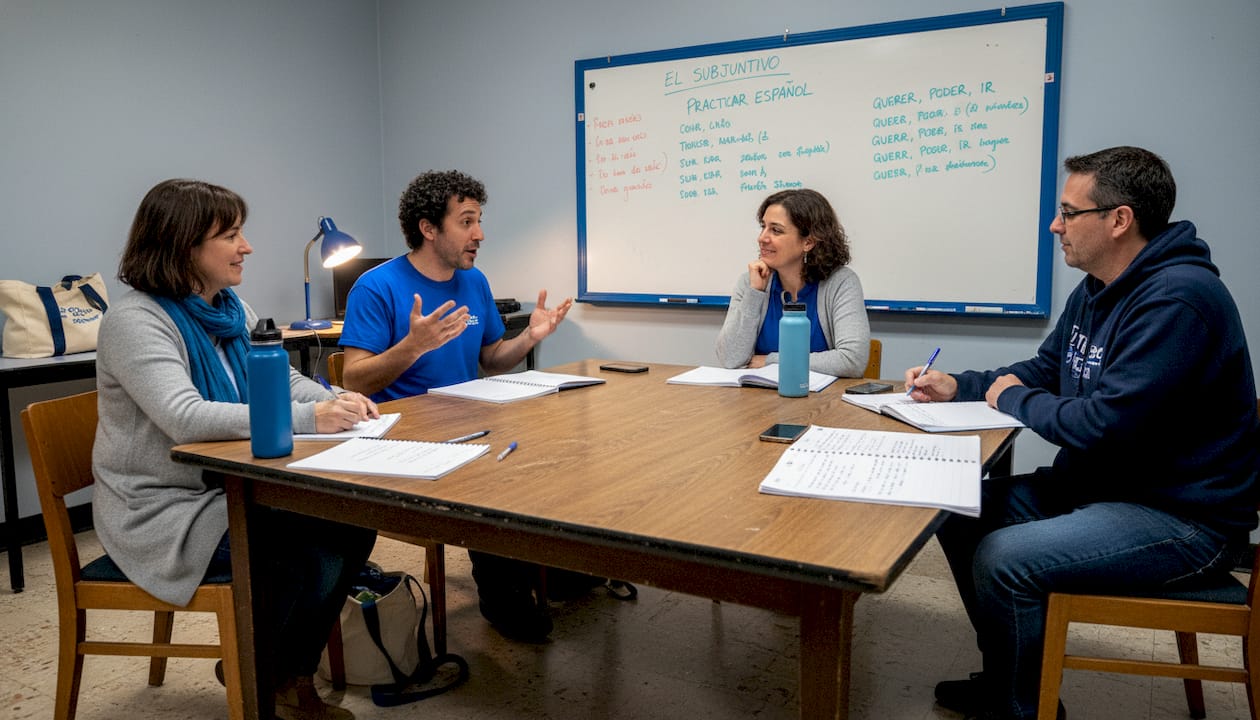
Both formats have genuine value, but they serve different types of learners and different purposes. Group classes offer peer interaction, while private lessons deliver individualized attention, and that distinction matters more than most people realize. Understanding which Spanish class is right for you comes down to your timeline, budget, learning personality, and specific goals.
Group classes create a social learning environment that many students find motivating. You practice with peers, hear different accents and usage patterns, and build confidence in a lower-stakes conversational setting. Reading about group Spanish class benefits shows how peer collaboration can reinforce vocabulary and grammar in ways that feel natural and enjoyable. Additionally, SkillsFuture-supported Spanish courses are available for group formats in Singapore, making them a more affordable entry point for many learners.
Here is a clear breakdown to help you decide:
| Attribute | Private lessons | Group classes |
|---|---|---|
| Cost | Higher per session | Lower per session |
| Flexibility | Very high, schedule is yours | Fixed timetable |
| Customization | Fully personalized | Standardized curriculum |
| Progress speed | Generally faster | Steady, socially supported |
| Feedback quality | Immediate and specific | Shared among all students |
| Social interaction | Limited | High |
| Best for | Specific goals, exam prep, busy schedules | General fluency, social learners, budget-conscious learners |
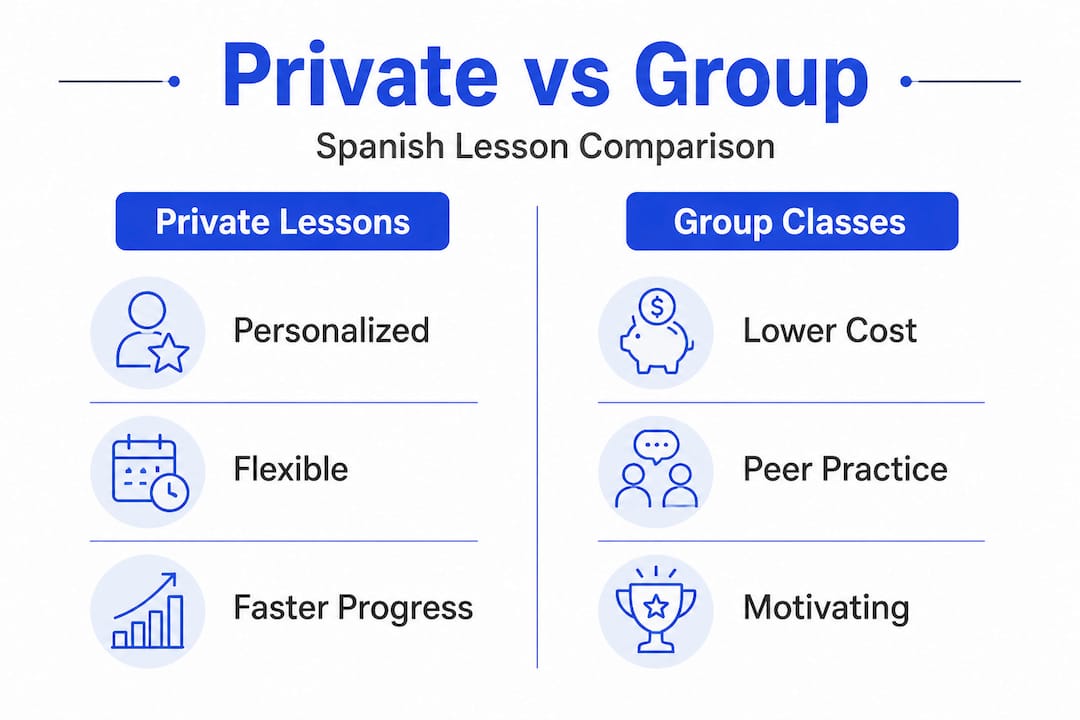
The key insight here is that these formats are not competing products. They serve different moments in a learner’s journey. Many successful Spanish speakers in Singapore start with group classes to build vocabulary confidence, then switch to private lessons when they need targeted improvement or have a specific deadline approaching.
Pro Tip: Group classes are excellent for building motivation and general vocabulary, but if you have a presentation, exam, or trip coming up in the next two to three months, private lessons will accelerate your speaking confidence far more efficiently.
How private lessons boost your Spanish fluency
While comparing formats sets the stage, let’s explore how the private format specifically accelerates Spanish proficiency.
The most immediate difference learners notice is the feedback loop. In a group setting, a teacher might correct a student’s pronunciation once and move on to keep the class flowing. In a private session, your instructor can stop, explain the exact reason for the error, drill the correct form several times, and then integrate it into a short conversation so the correction sticks. This kind of targeted loop is what makes personal coaching help learners achieve goals faster by addressing weaknesses directly rather than working around them.
Context is another powerful factor. A private lesson for a finance professional in Singapore might focus on vocabulary for investor meetings, reading financial news in Spanish, and practicing formal email phrases. A student preparing for a gap year in South America needs conversational slang, regional vocabulary, and informal listening comprehension. These are completely different courses, and a private instructor can deliver both without compromise.
If you are exploring flexible options, online Spanish class options are also available, making it even easier to fit private lessons into a demanding Singapore schedule without commuting to a physical location.
Here is a step-by-step overview of how a typical private learning journey unfolds:
- Initial consultation: You and your instructor discuss your goals, current level, and timeline.
- Placement and assessment: A short evaluation identifies your strengths and the gaps to address first.
- Custom curriculum design: Your instructor maps out a lesson sequence tailored to your needs.
- Progressive sessions: Each lesson builds on the previous one, with topics and difficulty adjusted in real time.
- Milestone check-ins: Regular progress reviews keep you on track and allow course corrections as needed.
- Conversational fluency goal: You reach the point where you can use Spanish confidently in your target context.
Students following a consistent private lesson schedule often progress noticeably faster than those in group settings, because every session moves at exactly the right speed for them. There is no waiting for the class to catch up, and there is no falling behind because the pace moved too quickly.
Choosing the right teacher for your private lesson
Understanding the teacher’s role is critical next. Here’s how to choose a partner in your Spanish journey.
Your instructor is not just someone who corrects grammar. In a private setting, the teacher becomes a genuine partner in your learning, which means the relationship, communication style, and teaching approach all matter. Qualified native or near-native teachers deliver authentic language practice that goes well beyond textbook exercises, because they bring cultural nuance, idiomatic expression, and real-world usage into every session.
When evaluating an instructor, look for these qualities:
- Formal certification: DELE-trained or similarly credentialed instructors understand how language acquisition works and structure lessons accordingly.
- Relevant experience: A teacher who has worked with business learners, exam candidates, and beginners brings versatility that is hard to replace.
- Bilingual fluency: In Singapore, having a teacher who is fluent in both Spanish and English allows for precise explanations without confusion.
- Adaptability: The best instructors continuously adjust pacing, tone, and content based on how you respond in each session.
- Cultural knowledge: Language is inseparable from culture. A teacher who understands Latin American and Iberian contexts enriches your learning far beyond grammar rules.
“Every learner who walks into a private lesson brings a different story, a different goal, and a different starting point. The most rewarding part of teaching privately is designing something that fits that individual exactly, because when the material clicks, progress happens fast.”
This kind of teaching philosophy makes a real difference. When you work with experienced Spanish teachers who understand how to customize instruction, the sessions feel less like a class and more like a guided conversation where you happen to be improving rapidly.
What to expect in a private Spanish lesson
With the right teacher, here’s what you can expect from the experience of a private Spanish lesson in Singapore.
A well-structured private lesson is not just free-form conversation. It follows a purposeful flow that balances input, practice, correction, and consolidation. Lessons commonly include placement tests, speaking drills, and tailored resources that keep progress measurable and visible over time.
Here is a typical lesson structure you might experience:
| Lesson phase | Duration | What happens |
|---|---|---|
| Warm-up and review | 5-10 minutes | Recap of previous lesson, quick vocabulary check |
| New content introduction | 10-15 minutes | New grammar, vocabulary, or topic explained in context |
| Guided practice | 15-20 minutes | Exercises, role plays, or listening tasks with instructor feedback |
| Free speaking practice | 10-15 minutes | Conversation on relevant topics to build fluency and confidence |
| Feedback and homework | 5-10 minutes | Instructor highlights key areas, assigns targeted exercises |
Beyond the lesson structure itself, here are the tools and resources you can typically expect your instructor to use:
- Structured textbooks aligned with DELE or CEFR proficiency standards.
- Multimedia resources including audio clips, video segments, and news articles in Spanish.
- Conversation prompts and role plays designed around your personal or professional context.
- Online platforms for self-study between sessions, reinforcing what was covered in class.
- Progress tracking tools that show where you started and how far you have come.
Exploring an efficient learning workflow can also help you understand how to make the most of time spent between sessions, because private lessons are most effective when the learner stays engaged outside the classroom as well.
Our take: Why private lessons deliver results most methods can’t
After walking through formats, outcomes, and expectations, here is a candid view based on our experience guiding Singaporean learners.
Here is something most language schools will not say out loud: the majority of learners who feel stuck after months of classes are not struggling because Spanish is too hard. They are stuck because the format they are using was never designed for them. Group lessons are built for the average learner in the room, which means if you are faster, slower, more academically focused, or more conversationally driven than that average, the class is not fully working in your favor.
What we have observed consistently at Spanish Explorer is that busy professionals and students in Singapore achieve fluency far more quickly through private coaching than through any other approach. This is not a marketing claim. It reflects what happens when a lesson is rebuilt from scratch around one person’s goals, schedule, and learning style instead of being inherited from a standardized syllabus.
The most common thing we hear from learners who switch to private lessons is surprise. Surprise at how quickly speaking confidence builds. Surprise at how much more vocabulary sticks when it is tied to real conversations they actually need to have. Surprise at how different the experience feels compared to classroom learning.
One counterintuitive insight worth sharing: many learners believe they need more material to improve. In reality, focused repetition and context-specific practice with a skilled instructor does more for fluency than any amount of vocabulary lists or grammar drills done in isolation. Private lessons force that focus in a way that self-study and group classes rarely can.
If you want to learn Spanish in Singapore and you are serious about making real progress, the private format deserves serious consideration, especially if you have a timeline, a specific professional application, or a personal milestone you are working toward.
Pro Tip: Combine private lessons with occasional group sessions or language exchange meetups. Private lessons build precision and speaking confidence, while group interaction builds social ease and the ability to follow fast, natural conversations.
Ready to start? Explore leading private Spanish classes in Singapore
After seeing the difference private lessons can make, it is time to take the next step.
At Spanish Explorer, our private Spanish classes are designed for exactly the kind of learner this article describes: someone with clear goals, a real schedule, and a need for instruction that adapts to them rather than the other way around. Our team of qualified Spanish teachers brings both formal certification and genuine passion for the language, which makes every session feel purposeful and engaging.
We offer flexible lesson packages in Singapore’s central business district, as well as online options that bring expert instruction directly to you. Whether you are just starting out or looking to push your fluency to the next level, our team will work with you to build a learning plan that fits your life. Reach out today to book a consultation or trial session and experience firsthand what truly personalized Spanish instruction feels like.
Frequently asked questions
How long does it take to see progress with private Spanish lessons?
Many students notice meaningful improvement within three to four weeks of consistent private instruction, because personalized instruction accelerates progress by targeting exactly what each learner needs most. Results depend on session frequency and how actively you practice between lessons.
Are private Spanish lessons suitable for total beginners?
Absolutely. Private lessons adapt to all proficiency levels, which means a complete beginner receives a pace and structure that would overwhelm a group class, but feels perfectly natural in a one-on-one format.
Can I choose the topics I want to focus on in private lessons?
Yes, that is one of the primary advantages of going private. You can set lesson priorities around academic preparation, business communication, or travel needs, since the curriculum targets your specific goals from the very first session.
Do private Spanish lessons cost more than group classes?
Private lessons do typically carry a higher per-session cost, but they offer individualized attention and flexible scheduling that group formats cannot match. For learners with a specific deadline or goal, the investment often pays off through faster, more targeted progress.
Are online private Spanish lessons available in Singapore?
Yes. Online private classes are available in Singapore, allowing you to work with a certified instructor from any location without needing to commute, making consistent practice far easier for busy learners.
Sorry, the comment form is closed at this time.