


TL;DR:
- A Spanish placement test is a diagnostic assessment that evaluates your current skills in grammar, vocabulary, reading, listening, and sometimes writing to determine the appropriate course level. It helps you start at the right proficiency level, saving time and money, and aligning with international frameworks like CEFR. Preparing honestly and practicing with online tools ensures accurate results, enabling personalized learning and effective progress.
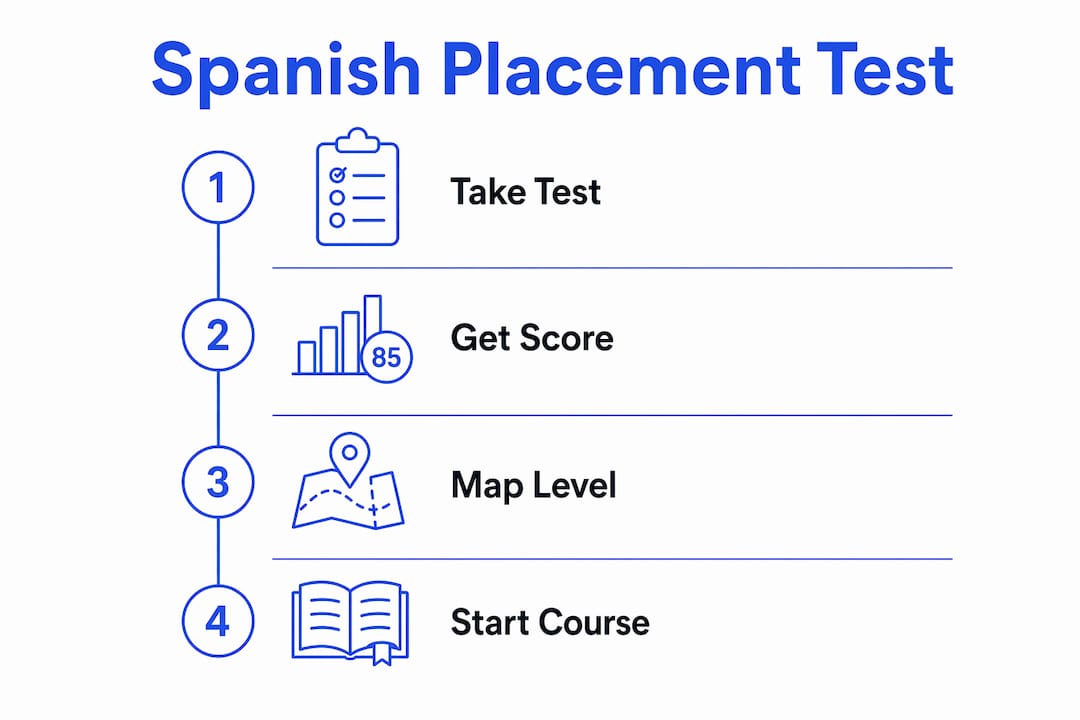
A Spanish placement test is a diagnostic assessment that measures your current Spanish language skills to determine which course level fits you best. The test evaluates grammar, vocabulary, reading comprehension, and listening, and sometimes includes a writing component. Most placement tests run 10–60 minutes and deliver results immediately. Whether you are a complete beginner or a professional with years of conversational experience, this assessment gives you and your instructor a clear, honest starting point.
What is a spanish placement test and why does it matter?
A Spanish placement test is the first step in any structured language learning program. It tells you exactly where your skills stand before you invest time and money in a course. Without it, you risk enrolling in a class that is either too easy to challenge you or too advanced to follow.
The test functions as a diagnostic tool, not a pass-or-fail exam. Your score does not reflect your intelligence or potential. It reflects your current exposure to Spanish, which is exactly the information a good instructor needs to place you correctly. Schools like Spanish Explorer use placement results to match adult learners with the right group class, private lesson, or corporate training program from day one.
Placement exams enable course skipping and personalized recommendations. That means if you already have solid conversational Spanish from travel or work, you skip the basics entirely and start where you actually belong.
What does a spanish placement test include?
Most Spanish language assessments follow a consistent structure across institutions. Here is what you can expect:
- Vocabulary: Multiple-choice or fill-in-the-blank questions testing word recognition and usage in context.
- Grammar: Questions covering verb conjugation, sentence structure, and tense usage from present simple to subjunctive.
- Reading comprehension: Short passages followed by questions that test your ability to extract meaning from written Spanish.
- Listening comprehension: Audio clips with questions that assess how well you understand spoken Spanish at natural speed.
- Writing (optional): Short written responses or paragraph tasks, usually reserved for advanced-level placement.
Tests are often computerized and range from 5–40 minutes, depending on the institution and the depth of assessment required. Computerized formats also allow for adaptive testing, where the difficulty of each question adjusts based on your previous answer. Adaptive tests adjust difficulty dynamically, delivering faster and more precise placement than fixed-format tests.
One category worth knowing about is the heritage language assessment. The Avant SHL test is designed specifically for heritage Spanish speakers, those who grew up hearing or speaking Spanish at home. It measures vocabulary, grammar, reading, writing, and speaking with a focus on both spoken fluency and academic literacy. This differs significantly from a standard foreign language placement test, which assumes no prior exposure.

Pro Tip: If you grew up speaking Spanish at home but never studied it formally, ask your school whether they offer a heritage speaker assessment. A standard test may underplace you by ignoring your listening and speaking strengths.
How do placement results align with proficiency frameworks?
Spanish placement tests do not just produce a raw score. They map your results to a recognized proficiency framework, most commonly the Common European Framework of Reference for Languages, known as the CEFR. CEFR levels A1 to C2 guide appropriate course placement across institutions worldwide.
Here is how those levels translate into practical terms:
| CEFR Level | Description | Typical Course Placement |
|---|---|---|
| A1 | Beginner | Introductory Spanish for adults with no prior exposure |
| A2 | Elementary | Basic conversation and everyday vocabulary |
| B1 | Intermediate | Conversational Spanish for travel and social contexts |
| B2 | Upper Intermediate | Business Spanish and complex discussions |
| C1 | Advanced | Near-fluent communication for professional use |
| C2 | Mastery | Full fluency, equivalent to an educated native speaker |
The CEFR’s six levels standardize proficiency internationally, which means your placement result from one school translates cleanly to another. For adult learners in Singapore pursuing Spanish for professional advancement, this alignment matters. A B2 placement at Spanish Explorer means the same thing as a B2 placement at any CEFR-aligned institution globally.
One distinction that often confuses learners is the difference between a placement test and a proficiency exam. A placement test is internal and diagnostic. Its only purpose is to guide your course enrollment. A proficiency exam, such as the DELE, is a formal, high-stakes certification. Proctored proficiency exams require formal scheduling and student status, while placement tests are typically free and available on demand. Understanding Spanish language pathways for adults helps you decide which type of assessment serves your goals.
What are the real benefits of taking a placement test first?
Skipping a placement test and guessing your level is one of the most common and costly mistakes adult learners make. Here is why taking the assessment first pays off:
- You start at the right level immediately. No wasted weeks reviewing material you already know or struggling with content that is too advanced.
- You save money. Correct placement means fewer courses to reach your target level.
- Your motivation stays high. Learners placed correctly report faster progress and greater confidence in early lessons.
- You get a personalized learning path. Your placement score tells your instructor exactly which gaps to address, making private lessons far more targeted.
- You may skip levels entirely. Placement exams enable course skipping for learners who already have partial knowledge from prior study or work experience.
For professionals pursuing Spanish for business communication, correct placement is especially important. Starting at B1 when you actually belong at A2 creates gaps in foundational grammar that surface later in high-stakes conversations. Starting at A2 when you are already at B1 wastes your time and your employer’s investment.
Pro Tip: Take the placement test on a day when you are rested and focused. Your result should reflect your real ability, not a tired or rushed performance. An accurate result leads to a better course match.
How to prepare for a spanish placement test
Preparation for a Spanish language level test is less about cramming and more about showing up as your authentic self. That said, a few targeted steps help you perform at your actual best.
- Review the test format in advance. Ask the school or check their website for a breakdown of sections. Knowing whether the test includes listening or writing removes surprises on the day.
- Practice with free online tools. Platforms like Talkpal offer quick and accurate practice tests that mirror real placement test formats. Use them to identify your weak areas, not to memorize answers.
- Brush up on core grammar. Focus on verb tenses you use regularly: present, past, and future. These appear in every placement test regardless of level.
- Listen to Spanish daily in the week before. Podcasts, news clips, or short videos in Spanish sharpen your listening comprehension without requiring formal study.
- Do not overthink adaptive questions. In an adaptive test, a harder question after a correct answer is a good sign. Answer honestly rather than second-guessing the algorithm.
- Avoid common mistakes. Do not rush through reading passages. Do not leave answers blank if you can make an educated guess. Do not try to perform above your level by guessing at advanced grammar you are unsure of.
The goal is an accurate result, not a high score. A placement test that puts you in the wrong level helps no one. For a deeper look at how curriculum formats for adult learners vary by level, reviewing that before your test gives you a clearer picture of what each course tier involves.
Key takeaways
A Spanish placement test is the most efficient tool for matching your current skills to the right course level, saving time, money, and frustration from the start.
| Point | Details |
|---|---|
| Placement tests are diagnostic | They measure current skills to guide enrollment, not to pass or fail you. |
| CEFR alignment matters | Results map to A1–C2 levels, making your placement transferable across institutions. |
| Adaptive formats are faster | Computerized adaptive tests adjust difficulty in real time for more precise results. |
| Preparation should be honest | Practice to show your real level, not to inflate your score and land in the wrong class. |
| Placement differs from certification | A placement test guides course choice; a proficiency exam like DELE earns formal credentials. |
Why most adults get more from placement tests than they expect
I have worked with adult Spanish learners long enough to know that most people walk into a placement test with the wrong mindset. They treat it like a job interview, something to perform well in rather than something to be honest about. That instinct backfires every time.
The learners who get the most out of their placement results are the ones who answer each question based on what they actually know, not what they wish they knew. I have seen professionals with years of casual Spanish exposure place at A2 because their grammar foundation was never formalized. That is not a failure. That is useful information. It tells them exactly where to build.
What surprises most adult learners is how quickly they progress once they are placed correctly. A well-matched course feels challenging but achievable. You build momentum in the first few weeks instead of spending months catching up or coasting. That momentum is what separates learners who reach conversational fluency from those who plateau.
My honest advice: use your placement result as a starting point for a real conversation with your instructor. Ask what the result means for your specific goals, whether that is business Spanish, travel confidence, or professional certification. The test gives you a level. What you do with that level is where the real learning begins. Reinforce your skills with real conversational practice from day one, not just after you feel ready.
— Paul
Start your spanish journey at the right level with spanish explorer
Spanish Explorer offers adult Spanish courses across all proficiency levels, from complete beginners to upper-intermediate professionals. Every learner is matched to the right class based on their placement result, so you never waste a session on material that is too easy or too advanced.
Whether you prefer group classes, private one-on-one lessons tailored to your exact level and goals, or corporate training for your team, Spanish Explorer has a format that fits. Classes are available in person at 10 Anson Road, International Plaza (above Tanjong Pagar MRT), and online via Zoom. Explore the full range of adult Spanish courses and book a trial class to find your level today.
FAQ
What is a spanish placement test used for?
A Spanish placement test is a diagnostic tool that measures your current grammar, vocabulary, reading, and listening skills to place you in the correct course level. It is not a certification exam and does not affect any formal credentials.
How long does a spanish placement test take?
Most Spanish placement tests last between 10 and 60 minutes, depending on the format and institution. Computerized adaptive tests tend to be shorter because they narrow your level quickly.
Are spanish placement test results available immediately?
Yes. Computerized placement tests deliver results immediately after completion, allowing you to enroll in the right course without delay.
What is the difference between a placement test and a proficiency exam?
A placement test guides your course enrollment and is typically free and informal. A proficiency exam like the DELE is a formal, high-stakes certification that requires scheduling and carries official recognition.
Do i need to prepare for a spanish placement test?
Light preparation is helpful. Review core grammar tenses, practice listening with Spanish audio, and take a free online practice test to get comfortable with the format. The goal is an accurate result, not the highest possible score.
Sorry, the comment form is closed at this time.