 Spanish
ACTFL and CEFR are compatible in practice but not identical: official, test-by-test link studies allow CEFR labels to be assigned to specific ACTFL assessments, with one-directional and test-specific limits. Both are authoritative frameworks for describing language proficiency, but neither reduces cleanly to the other. The sections below map out where the correspondences hold, where they break down, and what that means for learners, teachers, and anyone reporting scores.
TL;DR:
- Official link studies connect specific ACTFL tests to CEFR levels, but these mappings are test-specific and not automatically interchangeable.
- ACTFL emphasizes performance in real communication modes, while CEFR organizes ability around discrete skills with detailed can-do descriptors.
- A linked ACTFL Advanced Mid score roughly equates to CEFR B2 in some productive skills, but this is not a universal or fixed equivalence.
- Both frameworks serve different institutional needs: ACTFL for US-based performance assessment, CEFR for European curriculum and certification standards.
- When reporting scores, always specify the original test and linking method, avoiding the assumption that one framework’s levels directly translate to the other’s.
Table of Contents
- ACTFL vs CEFR at a Glance
- How ACTFL and CEFR Structure Proficiency Differently
- What the Official Correspondences Say, and Where They Stop
- Which Framework Should You Use?
- Reporting Scores and Designing Rubrics Across Two Systems
- Where ACTFL and CEFR Came From
- How Widely Each Framework Is Recognized
- Common Misunderstandings When Comparing the Two
- A Practitioner’s View on Using Both Frameworks
- Practical Spanish Training Built Around Real Proficiency Goals
- Sources
- FAQ
ACTFL vs CEFR at a Glance
ACTFL describes what a speaker can actually do in real communication, scored through performance in speaking, writing, listening, and reading. CEFR describes language ability through can-do statements organized around six broad levels, from A1 to C2, and used widely for curriculum design and certification across Europe and beyond.
Some official mapping examples exist, but they come with a catch: they are derived from specific test pairings, not a universal conversion chart.
- ACTFL Advanced Mid corresponds approximately to a mid-level B2 CEFR in some linked productive skills assessments.
- Receptive skills (listening and reading) map differently than productive skills (speaking and writing) in the same linking studies.
- No single “ACTFL equals CEFR” table applies across every test or context.
The correspondences come from official ACTFL–CEFR linking work, and they explicitly warn against treating the results as a blanket conversion. According to Assigning CEFR Ratings to ACTFL Assessments, CEFR ratings can be assigned to ACTFL assessments only after empirical linking, and the resulting alignment runs one direction: from a specific ACTFL test to a CEFR label, not the reverse.
How ACTFL and CEFR Structure Proficiency Differently
The two frameworks are built on different logic, and that difference shapes everything from lesson planning to how a score gets reported.
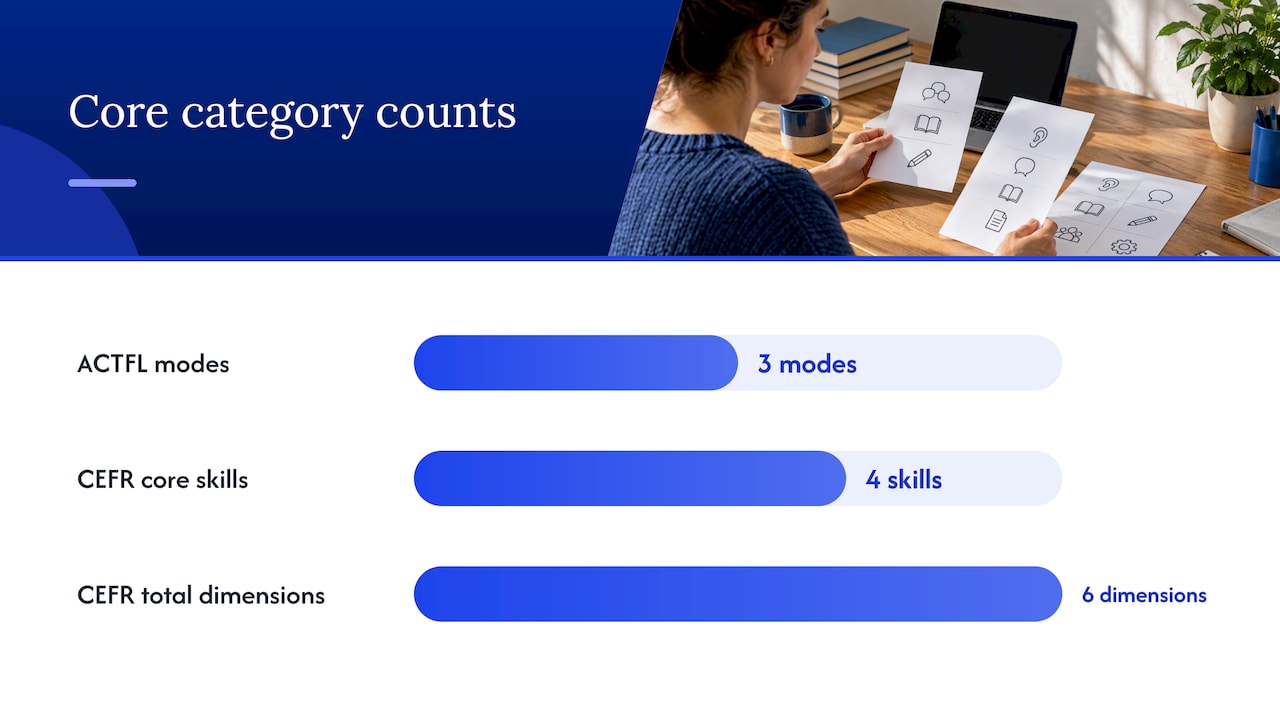
ACTFL organizes proficiency around three communicative modes: interpersonal (two-way interaction), interpretive (understanding authentic material), and presentational (one-way communication to an audience). Within each skill, ACTFL uses a range from Novice through Distinguished, with sublevels (Low, Mid, High) at several stages. The ACTFL Proficiency Guidelines Overview describes this as performance-based, meaning raters assess what a speaker can sustain under real conditions.
CEFR, by contrast, splits ability into distinct skills (listening, reading, speaking, writing) and adds dimensions ACTFL does not use directly, including mediation and plurilingual competence. The Council of Europe’s CEFR level descriptions lay out can-do statements at each of the six levels, giving curriculum writers a granular, skill-specific reference point.
- ACTFL’s mode-based structure suits rubrics built around interaction and spontaneous performance.
- CEFR’s skill-by-skill can-do statements suit syllabus design that targets specific abilities in sequence.
- A course built for CEFR outcomes will look different from one built for ACTFL outcomes, even when teaching the same content.
The Goethe-Institut’s comparison of CEFR and ACTFL scales notes that both frameworks are action-oriented but frame ability differently: one through communicative modes, the other through discrete skills and descriptors.
What the Official Correspondences Say, and Where They Stop
The most cited reference point for cross-framework comparison is the ACTFL–CEFR linking work, and it is worth being precise about what it actually claims.
- Linking studies allow a CEFR rating to be assigned to a specific ACTFL assessment once validation procedures confirm the match.
- The resulting correspondence is one-directional: it tells you what CEFR label fits a given ACTFL score, not what ACTFL level a CEFR score implies.
- Productive skills (speaking, writing) and receptive skills (listening, reading) are mapped separately because they do not align the same way.
One documented correspondence places ACTFL Advanced Mid near a mid-B2 level CEFR for productive skills, according to Assigning CEFR Ratings to ACTFL Assessments. This reflects a specific test-linking exercise, not a universal equivalence.
This matters for anyone writing a résumé or a program brochure. Claiming “ACTFL Advanced equals CEFR B2” as a fixed fact overstates what the linking studies support. The correspondence holds for the linked test, under the linking method used, and should be presented that way rather than as a universal equivalence. Certificates and CVs that report a mapped score should name the original test and note that the CEFR label was assigned through a specific linking study, not derived automatically.
Which Framework Should You Use?
The right framework depends on who is asking and why.
- Choose CEFR when you are working within European or international credentialing systems, teaching toward CEFR-referenced exams, or building a curriculum meant to transfer across countries.
- Choose ACTFL when you are in a US-based institutional setting, need to assess spontaneous oral performance, or are evaluating workplace-ready communication skills.
- Use both when your program serves mixed audiences: report the native score from whichever test was administered, and add the linked CEFR label only where a validated linking study supports it.
For internal goal-setting, the NCSSFL-ACTFL Can-Do Statements give teachers and learners concrete, checkable targets that work alongside either framework.
Pro Tip: When reporting a mapped score to a learner or employer, name the original test and the linking method in the same sentence, not just the resulting label.
Reporting Scores and Designing Rubrics Across Two Systems
Teachers and assessors who work across both frameworks face a practical question: how do you write a rubric or a score report that respects what each framework actually measures?
- Write can-do objectives that match the skill being tested, using CEFR descriptors for skill-specific goals and ACTFL modes for interaction-based tasks.
- Align classroom tasks to performance descriptors rather than forcing every activity into a single framework’s language.
- Label any combined report clearly: state which test produced the raw score and which linking method, if any, produced a secondary CEFR or ACTFL label.
A methodology note on a score report does not need to be long. A single line naming the test, the linking study, and its limitations gives a hiring manager or academic office enough context to interpret the result honestly rather than treating it as an exact match.
Pro Tip: Avoid the phrase “equivalent to” when describing a mapped score. “Assigned a corresponding rating of” is more accurate and less likely to overstate the claim. Readers who want a fuller breakdown of what each level actually requires can see how CEFR levels break down for adult learners.
Where ACTFL and CEFR Came From
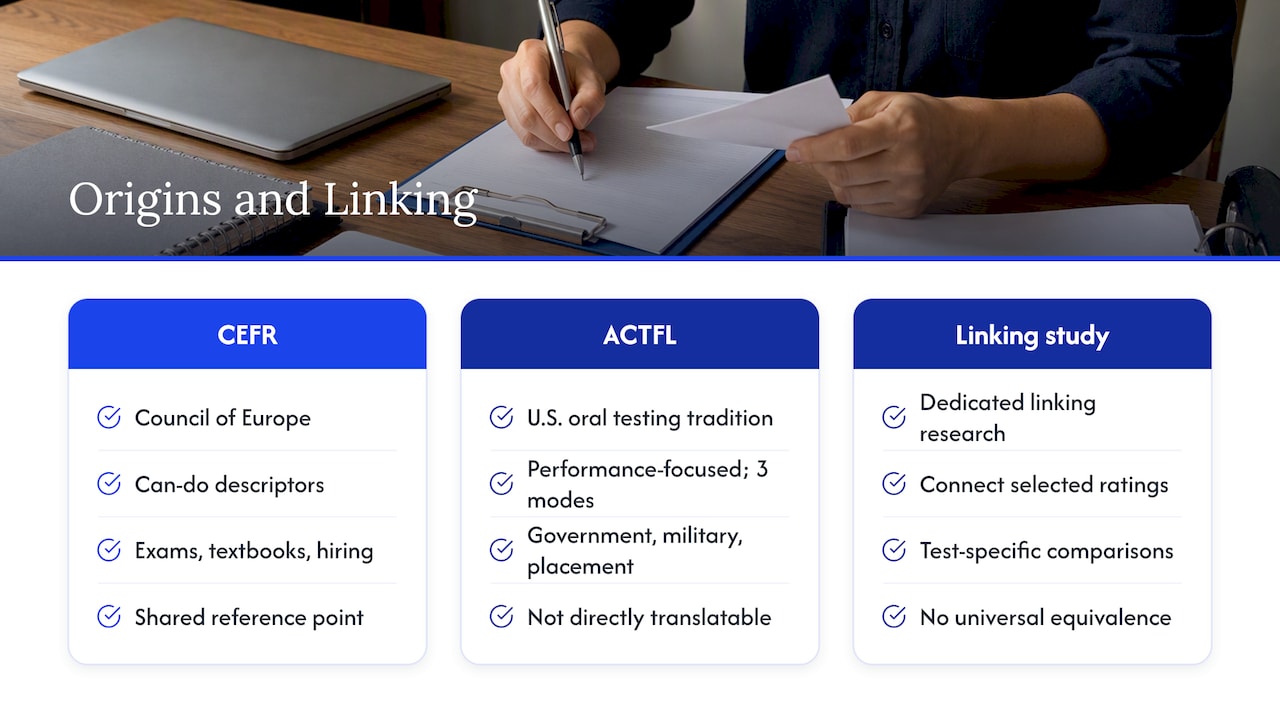
CEFR grew out of decades of work by the Council of Europe, aimed at giving language education across member states a shared reference point for describing ability. Its can-do descriptors were designed to work across languages and educational systems, which is why CEFR became the default reference for exams, textbooks, and hiring criteria across much of Europe and beyond.
ACTFL’s guidelines developed separately, rooted in a US tradition of oral proficiency testing that prioritized performance over grammar knowledge alone. The framework’s emphasis on the three communicative modes and its Novice-to-Distinguished scale reflect a different institutional need: assessing what a speaker can actually do in real interaction, often for government, military, or educational placement purposes in the United States.
The two frameworks were not built to translate into each other. They solved different problems for different systems, which is part of why later attempts to connect them required dedicated linking studies rather than a simple lookup table. Understanding that separate origin helps explain why the correspondence work is careful, incremental, and test-specific rather than sweeping.
How Widely Each Framework Is Recognized
CEFR functions as a common reference across much of Europe and has been adopted well beyond it, shaping exam design, textbook leveling, and hiring language requirements in many countries. Its six-level scale (A1 through C2) is often the first framework language programs cite when describing course outcomes.
ACTFL guidelines carry particular weight in US educational and government contexts, where oral proficiency interviews and performance-based assessment are common for placement, certification, and workplace evaluation. Institutions built around a US curriculum tradition tend to default to ACTFL’s modes and sublevels.
Neither framework has fully displaced the other internationally, and that is by design: each was built for a different institutional context. A learner or employer operating across both systems benefits from knowing which framework a given credential or course actually references, rather than assuming one is simply the global standard.
Common Misunderstandings When Comparing the Two
The biggest source of confusion is treating the ACTFL-CEFR correspondence as a fixed conversion chart rather than a set of test-specific findings.
A few recurring misunderstandings show up in practice:
- Assuming a CEFR label assigned to one ACTFL test applies automatically to a different ACTFL test or a different skill.
- Reading “one-directional” as a technical footnote rather than a real constraint on what the mapping can claim.
- Treating a course or textbook simply as “CEFR B2 level” when it was actually built around ACTFL descriptors, or the reverse.
The Goethe-Institut’s scale comparison points to a structural reason for the confusion: both frameworks describe action-oriented ability, but they carve up that ability differently, one by communicative mode, the other by discrete skill. That difference means a learner can be strong on one framework’s descriptors and only roughly comparable on the other’s, even at what looks like the same level number.
A Practitioner’s View on Using Both Frameworks
Treat the ACTFL-CEFR link studies as a translation aid, not a conversion rate. When a mapped score matters to a learner or employer, name the test, the method, and the limits in plain language rather than quoting a single tidy label. Programs that build toward can-do statements first tend to handle either framework more honestly.
— Paul
Practical Spanish Training Built Around Real Proficiency Goals
Understanding ACTFL and CEFR matters less than what you do with that understanding, and for adult learners the practical question is usually how to build real speaking ability, not just a framework label; for helpful strategies, see Learn Spanish for Travel: Essential Phrases and Tips. The school offers adult courses focused on conversational and business Spanish, taught by native Spanish speakers fluent in English, with a curriculum that maps learning outcomes to the same skill areas discussed above.

- Conversational Spanish classes for adults, delivered online over Zoom for flexible scheduling.
- Business Spanish and corporate training programs for teams that need workplace-ready communication skills.
- A low-cost trial class for readers who want to test the teaching approach before committing to a full course.
Spanish Explorer’s classes run from its training center at 10 Anson Road, Level 22, International Plaza, right above Tanjong Pagar MRT, with online options for learners who prefer Zoom sessions. If you want to see how proficiency goals translate into an actual course structure, book a trial class and ask about the specific can-do targets each level covers.
Sources
- Assigning CEFR Ratings to ACTFL Assessments
- Council of Europe — CEFR level descriptions
- CEFR-ACTFL scales comparison — Goethe-Institut
FAQ
What is the difference between ACTFL and CEFR levels?
ACTFL measures performance across three communicative modes on a Novice-to-Distinguished scale, while CEFR describes ability skill by skill on a six-level A1-to-C2 scale. Official linking studies can assign a CEFR label to a specific ACTFL assessment, but the two scales are not built the same way and do not convert automatically.
Is ACTFL internationally recognized?
ACTFL guidelines are most established in US educational and institutional settings, particularly for oral proficiency testing and workplace assessment. Outside the United States, CEFR tends to be the more commonly referenced framework, though official linking studies allow specific ACTFL scores to carry a corresponding CEFR rating.
What ACTFL level is B2?
There is no single fixed answer, because the correspondence depends on the specific test and skill being linked. One documented example from official linking research places ACTFL Advanced Mid at roughly CEFR B2.2 for productive skills, but this figure applies to that linked assessment, not as a universal rule.
What CEFR level is considered fluent?
CEFR does not use the word “fluent” as a formal label; C1 and C2 are generally treated as the levels associated with advanced, near-native command of a language. The Council of Europe’s level descriptions define C1 and C2 through can-do statements covering complex, nuanced communication rather than a single fluency cutoff.
Recommended
Start Learning Spanish Today
Book a trial class and see how quickly you can progress with a professionally trained native-speaker teacher guiding the way.
Book a Trial Class