 Spanish
There is no cutoff that closes the door on Spanish, and there is no single best age to learn Spanish either. If you want conversational fluency or workplace-ready Spanish, the right time to start is now. What determines your outcome is not your birth year, it is how many guided hours you put in, how you study, and whether you stay motivated long enough to reach A2 or B1 level.
TL;DR:
- Adults can reach functional Spanish proficiency within 350 to 600 guided hours, depending on their schedule and learning pace.
- Guided hours, consistent weekly practice, and tailored instruction predict progress more reliably than age or initial ability.
- Adults’ main challenges are practical barriers like limited incidental exposure and pronunciation slowdowns, not biological incapacity.
- Authentic speaking practice and regular input are essential for workplace Spanish, especially for communication skills beyond grammar and vocabulary.
Table of Contents
- What the research actually says about age and language learning
- How adult learners differ from younger learners
- Guided hours and realistic timelines for reaching A2 and B1
- Choosing a course format and building a weekly study plan
- What working adults get wrong about learning Spanish later in life
- Get a personalized guided-hours estimate and study plan
- Sources
- FAQ
What the research actually says about age and language learning
Large-sample studies on second language acquisition show a real but gradual pattern: ultimate attainment (how close a learner gets to native-like mastery) tends to decline as starting age rises, with the steepest drop-off appearing after early adolescence. That finding gets misread constantly. It describes ceiling effects for native-like accents and instinctive grammar, not whether an adult can hold a real conversation or run a meeting in Spanish. A large dataset analysis of age effects found that adults still make substantial gains and reach functional proficiency, even when perfect native-like attainment becomes less likely.
Functional proficiency and native-like attainment are different goals. Nobody needs to sound like a native speaker to close a sale, order confidently, or hold a client call in Spanish. That is where the CEFR and ACTFL frameworks matter: both describe language ability by what a learner can actually do, not by how they sound or when they started.
- Native-like attainment measures how closely an adult learner’s accent and intuition match a native speaker, a goal that gets harder with a later starting age.
- Functional proficiency measures whether you can communicate effectively in real situations, which adults reach regularly regardless of when they began.
- CEFR and ACTFL translate both goals into concrete levels (A2, B1, B2) and skill descriptors that schools and employers use to set expectations.
ACTFL’s performance descriptors reinforce this: predictable outcomes depend on time-on-task and instructional continuity, not the age at which someone begins.
How adult learners differ from younger learners
Adults bring real advantages to language study that children do not have. You already understand grammar concepts, you can set explicit goals, and you can direct your own study time with a level of discipline a ten-year-old simply cannot match. The barriers adults face are practical, not biological: less incidental exposure (no playground immersion), a fixed schedule around work, and a pronunciation ceiling that closes slowly but rarely closes completely.
- Analytical thinking lets adults grasp grammar rules explicitly instead of absorbing them by trial and error.
- Goal-setting means adults can structure study around a deadline: a work trip, a certification, a relocation.
- Reduced incidental exposure is the main practical barrier: adults do not get hours of background immersion the way children in a Spanish-speaking household do.
- Pronunciation improves more slowly for adults, though it rarely blocks comprehension once vocabulary and structure are solid.
The tactics that work best for adults are explicit grammar instruction, spaced repetition for vocabulary, frequent speaking practice from week one, and an accountability structure (a class schedule, a tutor, a study partner) that keeps momentum going when work gets busy. Recent work on older adult learners found that motivation and tailored instruction predicted L2 growth more reliably than age itself, with intensive daily practice producing measurable gains within months.
Pro Tip: If you stall at the intermediate plateau, the fix usually is not more grammar drills. Add more unguided authentic input (podcasts, shows, native conversation partners) and push your weekly speaking hours up.
Guided hours and realistic timelines for reaching A2 and B1
Guided hours are the clearest predictor of how fast you will progress, and they mean structured, teacher-led instruction with correction and homework, not passive exposure to Spanish media. According to research on guided learning hours across CEFR levels, reaching A2 typically takes about 180 to 200 guided hours, and reaching B1 typically takes 350 to 600 guided hours, depending on the learner and the language pair.
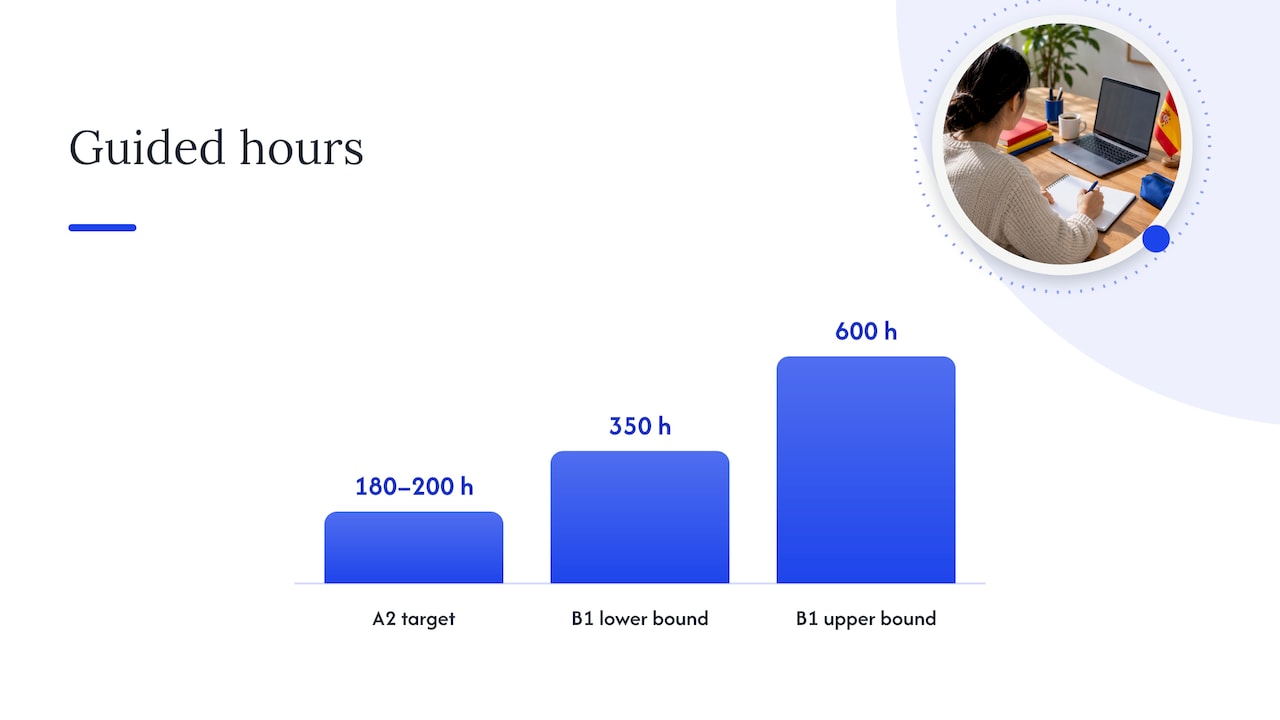
350 to 600 guided hours stand between most adult beginners and conversational B1 Spanish, a range wide enough to fit a working professional’s schedule or a fast-tracked intensive course, according to CEFR hours research.
Three schedules show how that translates into real timeframes:
- 3 guided hours a week puts A2 around 14 to 16 months out and B1 around two and a half to four years out, a realistic pace for a busy professional adding Spanish around a full workload.
- 6 guided hours a week roughly halves those timelines, landing A2 in about 7 to 8 months and B1 in roughly 14 to 24 months.
- 10 or more guided hours a week, closer to an intensive or immersive schedule, can bring B1 within 8 to 14 months for a highly motivated learner.
These numbers cover guided hours only: classroom time, structured homework, and corrected practice. Watching Spanish shows or scrolling a Spanish social feed adds real value, but it does not count toward these totals the way an instructor-led session does. The B1 level guide breaks down what that level actually looks like in daily conversation and workplace settings.
Choosing a course format and building a weekly study plan
Format matters almost as much as hours once you know your target level. Group classes are cost-efficient and give you built-in speaking partners, but the pace is set by the group. Private classes move faster and target your specific gaps (workplace vocabulary, presentation skills), at a higher cost per hour. Online or hybrid formats fit around a work calendar without commute time, and corporate training lets an employer build Spanish directly into a team’s schedule.
- Group classes suit learners who want steady progress, built-in practice partners, and a lower cost per hour.
- Private classes suit learners on a deadline who need lessons targeted to a specific goal, like a client presentation or a relocation.
- Online or hybrid classes suit learners juggling a packed calendar who still want live, guided instruction.
- Corporate training suits teams and companies that want to build Spanish skills across departments on one schedule.
Before committing to any option, check a few things: whether the teacher is a qualified, native-fluent instructor, whether the syllabus maps to CEFR levels, how many students sit in each class, how progress gets assessed, and how many guided hours per week the course recommends for your goal.
A workable weekly plan for a working adult looks like this:
- One or two guided lessons (live, instructor-led, with correction).
- Structured homework that reinforces that week’s grammar and vocabulary.
- At least one dedicated speaking session, whether with a tutor, a partner, or a conversation group.
- Regular authentic input: a podcast, a show, or a short article in Spanish, consumed for enjoyment as much as study.
The importance of structured guided hours shows up clearly here: the plans that stick are the ones with a fixed weekly rhythm, not the ones that depend on finding free time.
What working adults get wrong about learning Spanish later in life
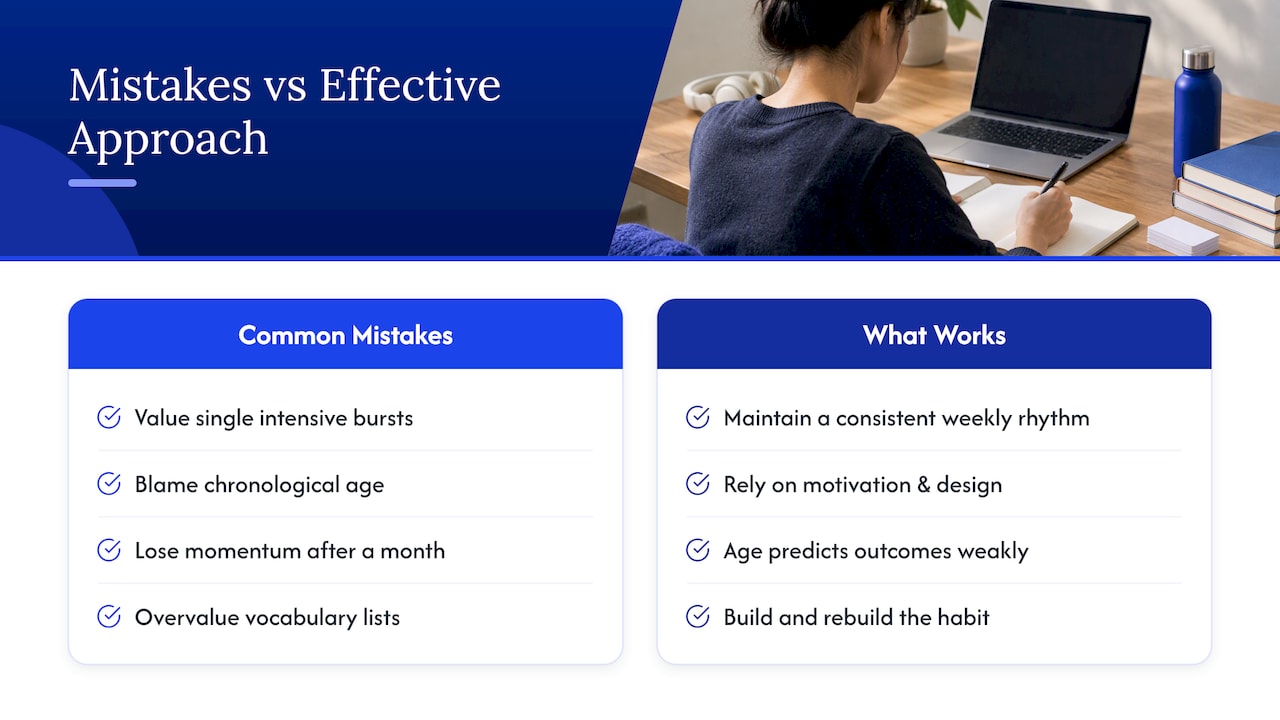
The most common mistake adult learners make is not underestimating their own ability, it is underestimating how much a consistent weekly rhythm matters compared to raw hours logged in a single burst. Motivation and instructional design predict adult language outcomes more reliably than chronological age, and that holds up across the research on adult and older learners. The learners who stall are rarely the ones who started “too late.” They are the ones who studied intensively for a month, lost momentum, and never rebuilt the habit.
Workplace-focused learners in particular tend to overvalue vocabulary lists and undervalue speaking practice. Reading comprehension and grammar accuracy climb fast with self-study, but the communication skills professionals actually need (thinking on your feet in a meeting, handling small talk with a client) only come from regular speaking practice under mild pressure. If your goal is workplace Spanish, structure your study time around talking, not just reading.
— Paul
Get a personalized guided-hours estimate and study plan
If you want to know exactly how many guided hours stand between you and conversational or workplace Spanish, a short placement assessment gives you a clearer answer than any general estimate. A Spanish Language Trial Class costs $45 and includes a level check, a suggested learning pathway, and a recommended weekly hours target based on your goals and schedule.

From there, Spanish Explorer runs its curriculum along CEFR-aligned levels, taught by native-fluent instructors who teach in both Spanish and English, with class options in person, online, or through corporate training for teams. If conversational Spanish is your goal, the Conversational Spanish course runs online over Zoom for $350 one-off, built for adults who want flexible weekly guided hours without a long commute. For a deeper track through Beginner Conversational Spanish or Elementary, Intermediate, or Business Spanish, private classes run from $1,280 to $2,080 depending on the level and format. Book the trial class first and you will walk away with a plan built around your actual timeline, not a guess.
Sources
- Academia
- Large-sample study on age effects in language learning — PubMed (2018)
- ACTFL Performance Descriptors for Language Learners
- Variability as a functional marker of second language development in older adult learners — Cambridge Core (2023)
FAQ
Is it too late to learn Spanish as an adult?
No. Adults reach functional conversational and workplace Spanish regularly, and large-scale research on age and language acquisition confirms adults make substantial gains even though native-like mastery becomes less likely with a later start. What matters most is guided hours and consistency, not your age.
How many hours does it take to reach conversational Spanish?
Reaching A2 typically takes about 180 to 200 guided hours, and reaching B1, the level most people mean by “conversational,” typically takes 350 to 600 guided hours. At 3 to 6 guided hours a week, that puts B1 within roughly one and a half to four years depending on your pace.
Does motivation matter more than age when learning Spanish?
Research on adult and older learners found that motivation and tailored instruction predicted language growth more reliably than chronological age. A consistent weekly study rhythm outperforms sporadic intensive bursts for almost every adult learner.
What is the difference between A2 and B1 Spanish?
A2 covers basic everyday exchanges like shopping, directions, and simple personal information. B1 covers holding a real conversation on familiar topics, handling most travel and workplace situations, and expressing opinions with reasonable fluency, as detailed in the B1 level guide.
Which Spanish course format is best for working professionals?
Online and hybrid formats tend to fit working professionals best since they remove commute time while keeping live, guided instruction. Private classes suit those on a tighter deadline who need lessons targeted to specific workplace goals.
Recommended
Start Learning Spanish Today
Book a trial class and see how quickly you can progress with a professionally trained native-speaker teacher guiding the way.
Book a Trial Class