 Spanish
The best websites to learn Spanish depend entirely on what you want to do with the language. Here is the short version:
- Best overall (structured + live): Spanish Explorer — teacher-led Zoom classes for adult conversational and business Spanish, with flexible private and group formats
- Best free grammar reference: Lawless Spanish — graded lessons, 1,200+ verb conjugation tables, quizzes, and cultural content
- Best free audio course: Language Transfer (Complete Spanish) — free teacher-student audio dialogues that build structural understanding fast
- Best for gamified daily habits: Duolingo — low commitment, wide reach, good for absolute beginners
- Best for structured app learning: Babbel — short, speech-focused lessons with a clear curriculum
- Best for conversation practice + community: Busuu — peer feedback and native-speaker corrections built in
- Best pronunciation reference: Forvo — native-speaker audio for individual words
- Best free university drills: University of Texas LAITS exercises — indexed proficiency exercises at no cost
- Best for real-world media immersion: FluentU — authentic Spanish video clips with interactive subtitles
Before committing to any paid plan, test a free tier or sample lesson first. Most platforms offer at least a trial week, and that is enough time to know whether the format clicks for you.
Table of Contents
- How do the best Spanish learning websites compare?
- Short reviews: what each site actually offers
- When is free enough, and when should you pay?
- Why live teacher-led lessons accelerate speaking ability
- Key Takeaways
- A practical take on making real progress
- Spanish Explorer online classes: a faster route to speaking confidence
- Useful sources
- FAQ
How do the best Spanish learning websites compare?
The table below maps each major option across the dimensions that actually matter for your decision: format, price, level coverage, and whether a teacher is involved.
| Website / Resource | Best for | Price model | Format | CEFR levels | Free tier / trial | Mobile app | Teacher-led? | Best learner type |
|---|---|---|---|---|---|---|---|---|
| Spanish Explorer | Conversational & business Spanish | Paid (group/private/corporate packages) | Live Zoom classes | A1–C1 | Sample class available | No dedicated app | Yes — certified instructors | Adult, professional, corporate |
| Lawless Spanish | Grammar reference & self-study | Free | Web lessons, verb tables, quizzes | A1–C2 | Fully free | No | No | Self-study, intermediate+ |
| Language Transfer | Audio-first structural learning | Free | Audio dialogues (podcast-style) | A1–A2+ | Fully free | Unofficial apps | No | Beginner, audio learner |
| Duolingo | Daily habit, beginner vocab | Freemium / subscription | Gamified app | A1–B1 | Free tier (ads) | Yes | No | Absolute beginner |
| Babbel | Structured app curriculum | Subscription / one-time | Short web + app lessons | A1–B2 | First lesson free | Yes | No | Beginner to intermediate |
| Rosetta Stone | Immersion-style learning | Subscription / lifetime | Immersive web + app | A1–B2 | 3-day trial | Yes | No | Visual/immersive learner |
| Pimsleur | Audio + speaking practice | Subscription / one-time | Audio-only lessons | A1–B1 | 1 free lesson | Yes | No | Commuter, audio learner |
| Rocket Spanish | Structured multi-skill course | One-time purchase | Audio + interactive lessons | A1–B2 | Free trial | Yes | No | Committed self-studier |
| SpanishDict | Dictionary + grammar reference | Free / premium | Web reference + lessons | A1–C2 | Free | Yes | No | All levels, quick reference |
| Memrise | Vocabulary via native video clips | Freemium / subscription | App-based video vocab | A1–B1 | Free tier | Yes | No | Vocabulary builder |
| FluentU | Immersion via authentic video | Subscription | Video + interactive subtitles | A1–C1 | Free trial | Yes | No | Intermediate, media learner |
| Busuu | Conversation + peer feedback | Freemium / subscription | App + web lessons | A1–B2 | Free tier | Yes | No | Conversation-focused |
| Lingodeer | Grammar-focused app | Freemium / subscription | Structured app lessons | A1–B1 | Free tier | Yes | No | Grammar-focused beginner |
| Ouino Spanish | Multi-skill desktop course | One-time purchase | Interactive web/desktop | A1–B1 | Free trial | Limited | No | Self-paced learner |
| SpanishPod101 | Audio + video lessons by level | Freemium / subscription | Audio/video podcast lessons | A1–C1 | Free trial | Yes | No | Beginner to advanced |
| Hotel Borbollón | Vocabulary in context | Free | Web-based vocab exercises | A1–B1 | Fully free | No | No | Vocabulary builder |
| Conjuguemos | Verb conjugation drills | Free / subscription | Web drills | A1–B2 | Free tier | No | No | Grammar driller |
| Spanish Language and Culture | Media + culture-based learning | Free | Curated web resources | A1–C2 | Fully free | No | No | Culture-focused learner |
| UT – Spanish Proficiency Exercises | Proficiency drills | Free | Indexed web exercises | A1–C1 | Fully free | No | No | Academic, self-study |
| Practical Spanish | Beginner travel phrases | Free | Web lessons | A1–A2 | Fully free | No | No | Traveler, absolute beginner |
| Forvo | Pronunciation reference | Free / premium | Audio word database | All levels | Free tier | Yes | No | All levels |
| CNN in Spanish | Advanced reading + listening | Free | News articles + video | B2–C2 | Fully free | Yes | No | Advanced learner |
| BBC Spanish | Beginner to intermediate media | Free | Video + audio lessons | A1–B1 | Fully free | No | No | Beginner, media learner |
| OER Collections | Structured low-cost study path | Free | Downloadable textbooks | A1–C1 | Fully free | No | No | Self-directed, budget learner |
| Eurolinguiste | Hybrid learning resource hub | Free | Aggregated links + guides | All levels | Fully free | No | No | Hybrid learner |
Statistic callout: Independent review roundups covering dozens of online Spanish courses consistently find that learners who combine a structured curriculum with regular speaking practice reach conversational ability significantly faster than those relying on self-study apps alone.
Short reviews: what each site actually offers
Spanish Explorer
Spanish Explorer runs live Zoom classes for adult learners focused on conversational and business Spanish. Classes are taught by certified, bilingual instructors and follow a CEFR-aligned curriculum from A1 through C1. The format is flexible: you can join a group class or book private sessions, and corporate training is available for teams. For learners who want real speaking practice with corrective feedback, this is the format that delivers it. No app, no gamification — just structured instruction with a real teacher.
Pros: Live teacher feedback; flexible private/group/corporate formats
Con: Paid enrollment required; no self-paced option
Lawless Spanish
Lawless Spanish is the best free grammar companion on the web. It covers conjugation tables for over 1,200 verbs, graded lessons from beginner to advanced, listening exercises, and cultural notes. It is not a course — there is no progress tracking or speaking component — but as a reference you return to constantly, nothing free comes close. Pair it with any speaking-focused resource and it covers your grammar gaps reliably.
Pros: Exhaustive verb tables; fully free; well-organized by level
Con: No speaking practice or structured course path
Language Transfer (Complete Spanish)
Language Transfer is genuinely one of the best free Spanish resources available, and most learners have never heard of it. The course is a series of audio dialogues between a teacher and a student, designed to help you construct Spanish sentences from first principles rather than memorize phrases. It covers roughly A1–A2+ and is completely free. The catch: it requires active listening, not passive background audio.
Pros: Free; builds structural intuition fast; no app needed
Con: Audio-only; no writing, reading, or speaking practice
Duolingo
Duolingo works well for building a daily habit and picking up beginner vocabulary. The gamified format keeps casual learners coming back, and the free tier is genuinely usable. It tops out around B1 for Spanish and does not develop real speaking ability on its own. Think of it as a warm-up tool, not a complete course.
Pros: Free tier; habit-forming; widely available
Con: Limited speaking depth; progress stalls at intermediate
Babbel
Babbel’s lessons are short (10–15 minutes), speech-focused, and follow a clear curriculum from A1 to B2. The first lesson is free; after that, it is a subscription. Independent reviewers consistently rank it among the better app-based options for structured learning because the lessons feel like actual instruction rather than a game.
Pros: Clear curriculum; speech recognition; structured progression
Con: Subscription cost; no live teacher
Rosetta Stone
Rosetta Stone uses a full-immersion approach: no English translations, just images and audio. It works well for visual learners who want to build intuition, but it can frustrate learners who want grammar explained. A 3-day trial is available before committing to a subscription or lifetime license.
Pros: Immersive method; lifetime purchase option; solid mobile app
Con: No grammar explanation; can feel opaque for beginners
Pimsleur
Pimsleur is audio-only and built for commuters. Each 30-minute lesson uses spaced repetition and active recall to build speaking confidence. It covers A1–B1 and offers one free lesson before requiring a subscription or one-time purchase. For learners who spend time in the car or on transit, it is one of the most practical formats available.
Pros: Hands-free; strong speaking focus; spaced repetition
Con: No reading or writing; expensive for full access
Rocket Spanish
Rocket Spanish is a one-time purchase course covering A1–B2 through a mix of audio lessons, interactive exercises, and cultural notes. It is one of the more thorough self-study options for learners who want a complete package without a recurring subscription. A free trial is available.
Pros: One-time cost; multi-skill coverage; detailed audio lessons
Con: Interface feels dated; no live teacher component
SpanishDict
SpanishDict is the go-to free reference for quick lookups: dictionary, conjugation tool, grammar guides, and example sentences. It also has structured lessons and a premium tier, but most learners use it as a companion to other courses rather than a standalone program. The mobile app is solid.
Pros: Free; excellent dictionary and conjugation tool; all levels
Con: Not a structured course on its own
Memrise
Memrise uses short clips of native speakers saying words and phrases, which makes vocabulary retention more natural than flashcard-only methods. The free tier covers the basics; a subscription unlocks the full library. It works best as a vocabulary supplement rather than a primary course.
Pros: Native-speaker video clips; engaging format; free tier
Con: Limited grammar instruction; not a full curriculum
FluentU
FluentU takes authentic Spanish videos (news clips, ads, music videos) and adds interactive subtitles with instant definitions and quizzes. It covers A1–C1 and is one of the few platforms that genuinely bridges the gap between textbook Spanish and real-world usage. A free trial is available before the subscription kicks in.
Pros: Real-world content; interactive subtitles; wide level range
Con: Subscription required; not beginner-friendly without prior study
Busuu
Busuu combines structured lessons with a community feature where native speakers correct your written and spoken submissions. That feedback loop is what sets it apart from most apps. The free tier is limited; a premium subscription unlocks the full curriculum and McGraw-Hill certificates.
Pros: Native-speaker feedback; structured curriculum; community
Con: Free tier is thin; feedback turnaround varies
Lingodeer
Lingodeer takes a grammar-first approach that is more explicit than Duolingo. It explains why sentences are structured the way they are, which appeals to learners who want to understand the language rather than just mimic it. Coverage runs A1–B1.
Pros: Grammar explanations; structured lessons; clean interface
Con: Smaller content library than Duolingo or Babbel
Ouino Spanish
Ouino is a one-time purchase desktop/web course covering A1–B1 through interactive exercises across vocabulary, grammar, pronunciation, and listening. It is less well-known than the major apps but offers a solid self-paced option for learners who prefer to own their course outright.
Pros: One-time purchase; multi-skill; no subscription
Con: Limited mobile support; smaller community
SpanishPod101
SpanishPod101 delivers audio and video lessons organized by level from A1 to C1. The lesson library is large, and the podcast format works well for commuters and supplemental learners. A free trial is available, though the subscription tiers can feel confusing.
Pros: Large lesson library; all levels; audio/video format
Con: Upsell-heavy; interface can feel cluttered
Hotel Borbollón
Hotel Borbollón is a free Spanish vocabulary site built around themed word sets and exercises. It is narrow in scope but genuinely useful for building topical vocabulary at A1–B1. No app, no community, just clean web-based practice.
Conjuguemos
Conjuguemos is a free (with optional subscription for teachers) verb conjugation drill site. It is exactly what it sounds like: fast, repetitive conjugation practice. Useful for cementing verb forms that other apps gloss over.
Spanish Language and Culture
The Berklee Library’s Spanish Language and Culture guide curates thousands of resources for grammar, vocabulary, and media-based learning. It is a research librarian’s curation, not a course, but it is one of the best free starting points for finding quality materials across every level.
University of Texas – Spanish Proficiency Exercises
The UT LAITS exercises are free, university-quality proficiency drills indexed by skill and level. They are particularly useful for learners preparing for proficiency assessments or wanting structured practice beyond what apps provide.
Practical Spanish
Practical Spanish covers beginner travel phrases and basic conversation in a simple, free web format. It is narrow by design and best suited for travelers who need functional phrases quickly, not learners building long-term fluency.
Forvo
Forvo is a pronunciation database where native speakers record individual words and phrases. It is the fastest way to hear how a specific word is actually pronounced in different Spanish-speaking regions. Free tier covers most needs; a premium tier removes ads and adds features.
CNN in Spanish and BBC Spanish
CNN en Español and BBC Spanish serve different ends of the spectrum. CNN en Español is authentic, fast-paced news content best suited for B2–C2 learners who want to maintain and extend advanced reading and listening skills. BBC Spanish offers structured beginner-to-intermediate video and audio lessons, closer to a free course than a news source. Both are free.
Pro Tip: For intermediate learners hitting a plateau, swap 20 minutes of app practice for a CNN en Español article with a dictionary open. The vocabulary density in real news forces faster growth than any drill.
Open Educational Resources (OER) collections round out the free options with downloadable textbooks and full curricula from institutions like the Open Textbook Library and COERLL. These are genuinely useful for learners who want a structured, textbook-style path without the cost.
When is free enough, and when should you pay?
Free resources are genuinely excellent for the first phase of learning. Duolingo, Language Transfer, Lawless Spanish, and the UT LAITS exercises together can take a motivated learner from zero to solid A2 without spending a dollar. OER textbooks add structured reading and writing practice that apps skip entirely.
The case for upgrading to paid:
- You have been studying for 8–12 weeks and still cannot hold a basic conversation
- You have hit the A2–B1 ceiling on your current app and progress has stalled
- Your goal involves speaking in professional or business contexts
- You need corrective feedback, not just exposure
A hybrid workflow that many learners find effective: use a free app (Duolingo or Babbel’s free tier) for daily vocabulary maintenance, Language Transfer audio for structural comprehension, and one weekly live session with a teacher for speaking practice. That combination covers the three pillars — input, structure, and output — without relying on any single platform to do everything.
The Eurolinguiste resource hub is a useful free starting point for finding podcasts, audio resources, and tutor marketplaces to build that kind of hybrid stack.
Why live teacher-led lessons accelerate speaking ability
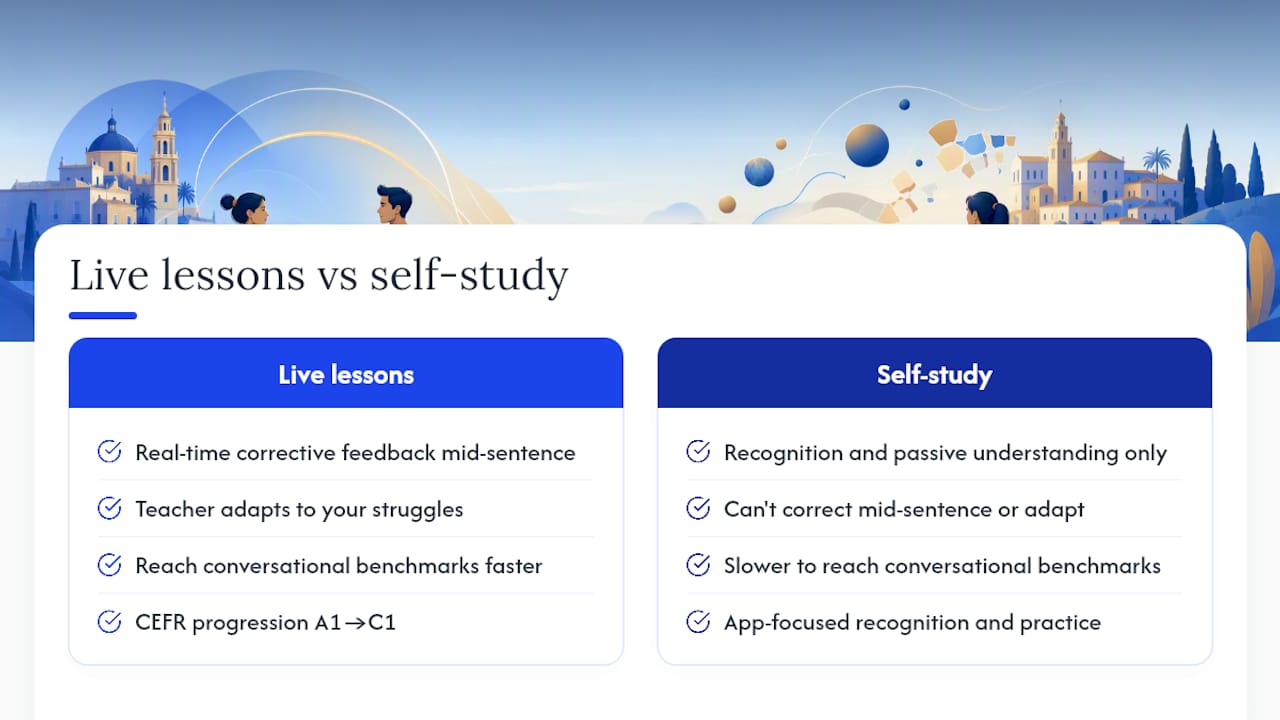
The fastest path to conversational fluency is not more vocabulary — it is more corrected speaking practice. Apps can build recognition and passive understanding, but they cannot tell you that your subjunctive is wrong mid-sentence or adjust the lesson because you are struggling with a specific sound. That feedback loop is what live instruction provides.
Research on audio-based and interactive language teaching consistently shows that learners who receive real-time corrective feedback from a qualified instructor reach conversational benchmarks faster than those relying on self-study alone. The mechanism is simple: errors get caught before they fossilize.
Spanish Explorer structures its online Zoom classes around exactly this principle. Lessons are taught by certified, bilingual Spanish instructors who can explain concepts in English when needed, then immediately practice them in Spanish. The curriculum follows CEFR progression from A1 through C1, so learners always know where they are and what comes next. Group classes keep costs manageable; private sessions move faster for learners with specific goals or tight schedules. Corporate training is available for teams that need business Spanish quickly.
For adult learners whose goal is real-world conversation or professional use, the structured course formats at Spanish Explorer cover what no app can: live practice, immediate correction, and a teacher who adapts to you.
Pro Tip: Before each live lesson, write down two or three sentences about something that happened that day. Use them as your opening in class. That small pre-lesson task forces you to produce language before the session starts, and your teacher’s corrections on those specific sentences stick far longer than drills.
Key Takeaways
The most effective approach to learning Spanish online combines free self-study tools for daily input with at least one live speaking session per week for corrective feedback and real conversation practice.
| Point | Details |
|---|---|
| Match tool to goal | Choose your platform based on your specific goal (travel, conversation, business) before considering price or popularity. |
| Free covers A1–B1 well | Duolingo, Language Transfer, Lawless Spanish, and UT LAITS exercises together provide solid free coverage through intermediate level. |
| Speaking needs a human | No app alone builds reliable spoken fluency; live teacher feedback is the fastest route past the A2–B1 plateau. |
| Hybrid workflows work | Combine a free app for daily vocab, audio lessons for structure, and one weekly live session for speaking practice. |
| Spanish Explorer for live classes | Spanish Explorer offers flexible online Zoom group, private, and corporate classes for adult conversational and business Spanish. |
A practical take on making real progress
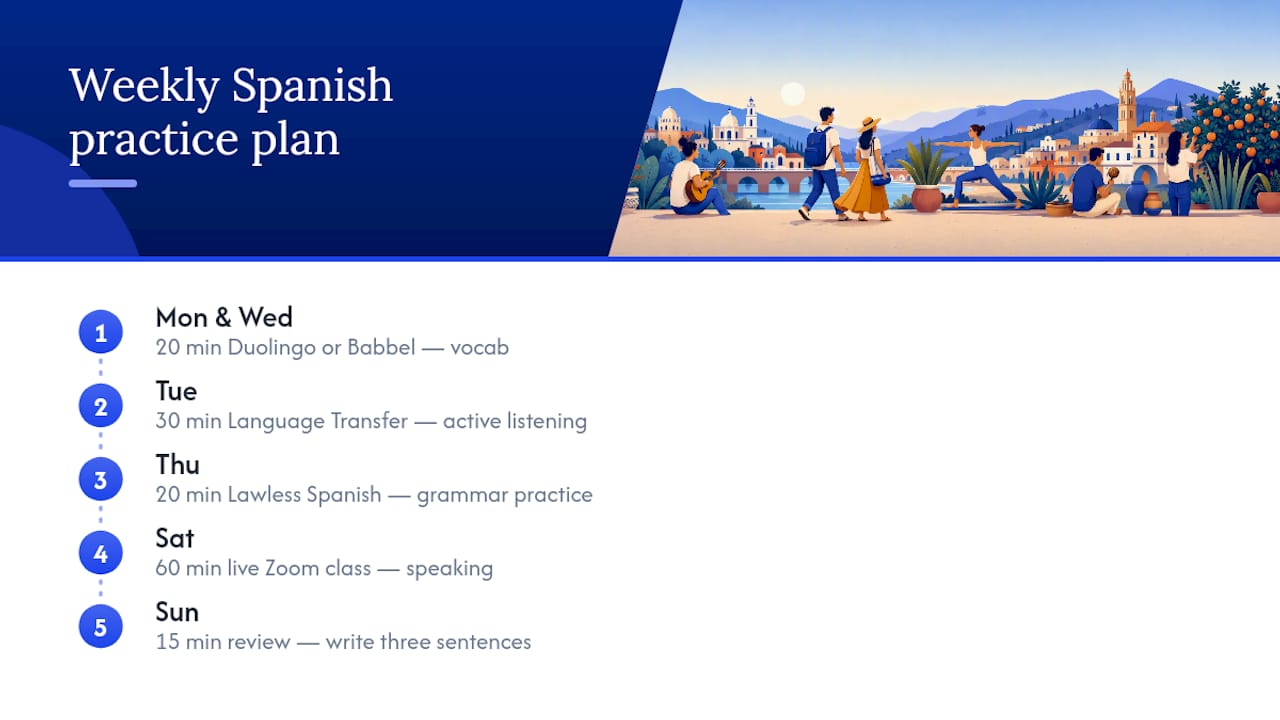
A balanced weekly plan is the single most underrated factor in language learning. Most learners either do too much at once and burn out, or do too little and stall. Here is a plan that works for a busy adult with about 4–5 hours per week:
Monday and Wednesday: 20 minutes of Duolingo or Babbel for vocabulary maintenance. Tuesday: one 30-minute Language Transfer audio session, active listening only. Thursday: 20 minutes on Lawless Spanish working through one grammar point you encountered that week. Saturday: one 60-minute live Zoom class with a teacher, focused on speaking and conversation. Sunday: 15 minutes reviewing what came up in Saturday’s class, writing three sentences using the new structures.
That is roughly 4.5 hours a week. It covers input, structure, and output without requiring heroic discipline.
Pro Tip: Track progress by conversation milestones, not vocabulary counts. “I held a 5-minute conversation about my job” is a more honest measure of progress than “I know 500 words.” Milestones tell you whether the method is working; word counts often just tell you that you have been busy.
Spanish Explorer online classes: a faster route to speaking confidence
Self-study apps and free resources are a solid starting point, but they hit a ceiling. When you are ready to actually speak Spanish — in conversation, in meetings, or with clients — live instruction is what moves the needle.
Spanish Explorer offers online Zoom Spanish classes for adult learners who want structured, teacher-led progress rather than another app. Classes run in group format for conversational Spanish, private sessions for faster individual progress, and corporate programs for teams that need business Spanish for professional use. All classes are taught by certified, bilingual instructors following a CEFR-aligned curriculum from A1 to C1. You get corrective feedback, real conversation practice, and a teacher who adapts to your pace — none of which any app provides.
Book a sample class or check available course formats at spanishexplorer.com.sg/spanish-courses to find the right fit for your schedule and goal.
Useful sources
- Finding OER for Teaching and Learning Spanish — University of Washington Libraries
- Spanish Language and Culture Resource Guide: Online Spanish Learning Resources — Berklee Library
- laits.utexas.edu — Spanish Proficiency Exercises (LAITS)
- Complete Spanish — Language Transfer
- Lawless Spanish — Online Spanish Learning
- 36 Best Online Spanish Courses (I Tested Them All) — Mezzoguild
- 21 Best (And Worst) Online Spanish Courses In 2026 — Autolingual
- Spanish Language Resources | Eurolinguiste
FAQ
What is the best free website to learn Spanish?
Lawless Spanish is the strongest free grammar reference, while Language Transfer is the best free audio course for building structural understanding. Combined, they cover most beginner-to-intermediate needs at no cost.
What is the 80/20 rule for learning Spanish?
The principle holds that everyday Spanish conversation uses a small core of high-frequency vocabulary and basic verb forms. Focusing on that core first — rather than memorizing rare words — produces conversational ability faster than a broad vocabulary approach.
What is better than Duolingo for Spanish?
For structured curriculum, Babbel or Rocket Spanish go deeper. For speaking fluency, live teacher-led classes like those at Spanish Explorer are more effective than any app, because corrective feedback in real conversation is what Duolingo cannot replicate.
Can you become fluent in Spanish in 3 months?
Reaching full fluency in 3 months is unrealistic for most adults starting from zero. Reaching functional A2–B1 conversational ability in 3 months is achievable with daily study and regular live speaking practice, particularly with a structured, teacher-led program.
Recommended
Start Learning Spanish Today
Book a trial class and see how quickly you can progress with a professionally trained native-speaker teacher guiding the way.
Book a Trial Class