 Spanish
TL;DR:
- An effective business Spanish communication workflow involves scenario-based training, cultural competence, and standardized phrases. It requires foundational language skills, clear guidelines, a shared glossary, and structured practice for key scenarios. Regular reviews and native speaker involvement maintain clarity, consistency, and cultural appropriateness across all professional interactions.
A business Spanish communication workflow is a structured process that defines how professionals plan, deliver, and follow up on interactions in Spanish across meetings, emails, negotiations, and presentations. Without this structure, even fluent speakers make costly errors in tone, formality, and cultural expectations. The good news is that building an effective workflow does not require native fluency. It requires the right frameworks, consistent terminology, and scenario-based practice. This guide gives business professionals and teams a clear path to communicating in Spanish with confidence and accuracy in any corporate setting.
What makes a business Spanish communication workflow effective?
An effective business Spanish communication workflow combines language accuracy, cultural competence, and repeatable processes. These three elements work together. Miss one, and the whole system breaks down.

Effective business Spanish workflows use scenario-based training focused on meetings, negotiation, writing, and leadership. That focus matters because generic language study does not prepare professionals for the specific demands of a boardroom or a client email. Vocabulary learned in isolation rarely transfers to high-pressure business situations.
Cultural competence is equally non-negotiable. Spanish-speaking business cultures place significant weight on hierarchy, formality, and relationship-building. A message that sounds direct and efficient in English can read as rude or dismissive in Spanish. Understanding these norms is not optional. It is the foundation of every interaction.
Business Spanish communication is less about vocabulary size and more about clarity and structured message flow. That insight reframes how professionals should invest their learning time. Knowing 5,000 words matters far less than knowing how to open a meeting, signal a transition, or close a negotiation politely.
Core components every team needs before building the workflow
Before any team can run a Spanish communication workflow, they need to establish four foundational elements. Skipping these steps creates inconsistency that compounds over time.
Language skills baseline. Every team member involved in Spanish communication needs a working knowledge of formal grammar, business vocabulary, and polite phrasing. This does not mean fluency. It means knowing the difference between informal and formal registers and when each applies.
Cultural etiquette standards. Teams need written guidelines on communication norms: when to use titles, how to address senior contacts, and what level of directness is appropriate in different Spanish-speaking markets. Latin American and Iberian business cultures differ in meaningful ways.
A centralized terminology glossary. Maintaining a centralized glossary of industry-specific terms is critical to workflow consistency in multinational teams. A shared glossary prevents one team member from using a term that contradicts what another team member wrote last week. It also speeds up onboarding for new staff.
Structured training hours. Typical workflow training modules require 20 hours of instruction covering core competencies including meetings, negotiations, presentations, and writing. That figure gives teams a realistic planning benchmark.
Pro Tip: Build your team glossary before training begins, not after. Populate it with the 50 most common terms in your industry, then add to it after every training session. This creates a living document that grows with your team’s experience.
How to implement a business Spanish communication workflow step by step
A well-built workflow covers four core communication scenarios: meetings, negotiations, presentations, and written correspondence. Each scenario has its own conventions, and each needs its own set of standard phrases and protocols.
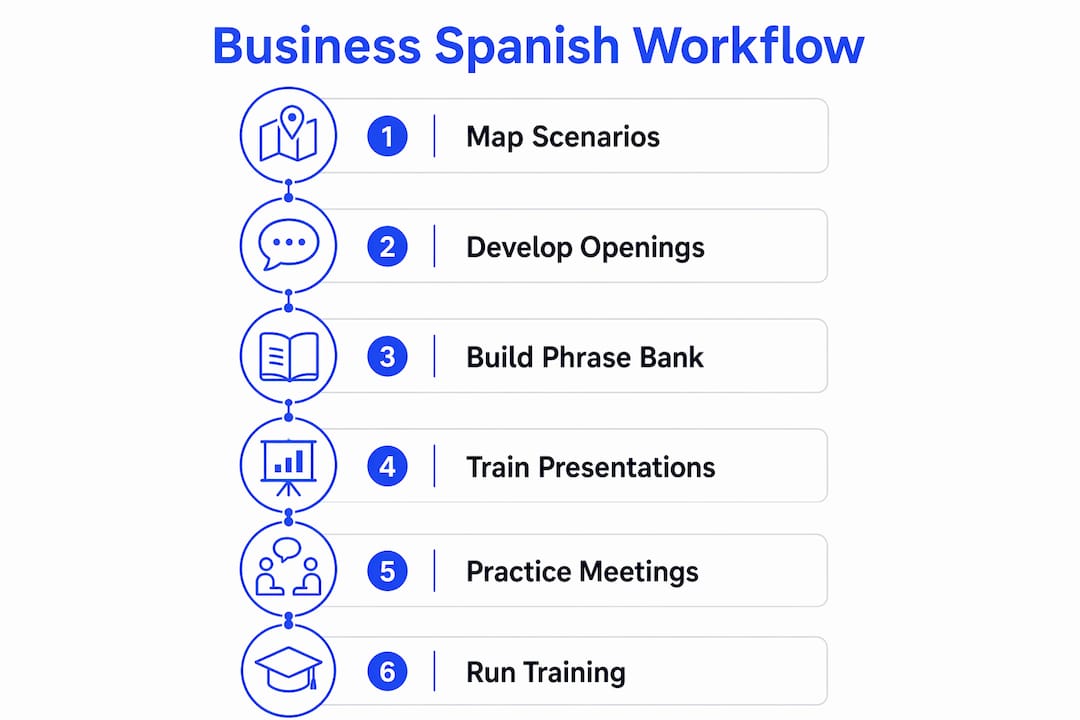
Step 1: Map your communication scenarios
List every situation where your team communicates in Spanish. Common scenarios include client calls, internal meetings, contract negotiations, email threads, and formal presentations. Rank them by frequency and business impact. Start building workflow protocols for the top three.
Step 2: Develop standardized openings and closings
Every communication type needs a standard opening and closing. Formal Spanish emails, for example, use titles and the “usted” form. Greetings start with “Estimado Sr./Sra.” followed by a colon, not a comma. Closings follow an equally formal pattern. Standardizing these removes guesswork and keeps tone consistent across the team.
Step 3: Build a phrase bank for each scenario
A phrase bank is a curated list of ready-to-use sentences for specific situations. For emails, include phrases like “Le escribo para…” to state purpose politely and directly. For meetings, include polite interruption phrases and summary confirmations. For presentations, include signposting language.
Step 4: Train on signposting for presentations
Signposting ideas in Spanish presentations with phrases like “primero veremos” improves comprehension for mixed audiences. Signposting tells the audience where you are in the argument and where you are going next. Without it, even a well-prepared presentation loses its audience.
Step 5: Practice meeting facilitation phrases
In meetings, polite interruptions and summarizing key points improve collaborative communication. Phrases like “Para confirmar, entonces el entregable queda para el viernes” confirm decisions clearly. Practicing these phrases in role-play scenarios before real meetings builds muscle memory.
Step 6: Run scenario-based training sessions
Scenario-based training is the most effective method for embedding these skills. Each session should simulate a real business situation, require participants to use the phrase bank, and end with a debrief on what worked and what did not.
Pro Tip: Record role-play sessions and review them with a native-speaking coach. Hearing your own phrasing played back reveals patterns you cannot catch in the moment, such as defaulting to informal register under pressure.
The table below summarizes the six workflow stages and their primary output.
| Workflow stage | Primary output |
|---|---|
| Map communication scenarios | Prioritized list of business situations |
| Standardize openings and closings | Approved phrase templates by scenario |
| Build phrase bank | Ready-to-use sentence library |
| Train on presentation signposting | Structured slide scripts with transitions |
| Practice meeting facilitation | Confirmed decision phrases and summaries |
| Run scenario-based training | Embedded skills and debrief notes |
What are the most common mistakes in Spanish business communication?
The most common mistakes in Spanish business communication fall into three categories: translation errors, register failures, and cultural missteps. Each one damages credibility in a different way.
Literal translation. Word-for-word translation from English to Spanish produces sentences that are grammatically correct but culturally wrong. Business Spanish requires a “neutral Spanish” to avoid confusion caused by regional slang and complex passive voice structures. A phrase that works in Mexico City may confuse a contact in Madrid or Buenos Aires.
Register failures. Using informal language with a senior client or a government contact signals a lack of professionalism. The polite plural “ustedes” and conditional phrases like “¿Podría enviarme…?” are not optional politeness. They are the expected standard in formal business Spanish.
Ambiguity in written communication. Vague emails create delays and misunderstandings. Clear message framing means specifying who does what, by when, and with what dependencies. A well-structured email leaves no room for interpretation.
Skipping human review on critical documents. Human review of translations is mandatory for legal and customer-facing materials. Automated tools lack the capacity to handle regional nuance and legal complexity reliably. This is not a cost-saving area.
“Avoid direct internal policy translations; adapt tone and constructions for the target audience’s cultural and linguistic norms.” This principle applies equally to emails, contracts, and meeting scripts.
Terminology drift. Over time, team members start using different words for the same concept. This creates confusion in client-facing materials. Periodic glossary reviews prevent this from happening.
Best practices for keeping your Spanish communication workflow sharp
A workflow that is built once and never updated becomes a liability. The best teams treat their Spanish communication process as a living system that improves with every interaction.
-
Schedule quarterly training refreshers. Business Spanish skills erode without practice. Short, focused sessions every three months maintain fluency and reinforce correct usage. Refreshers work best when they focus on scenarios the team has actually encountered since the last session.
-
Run communication audits. Review a sample of recent emails, meeting notes, and presentation scripts every six months. Look for register inconsistencies, outdated terminology, and phrases that have drifted from the approved glossary.
-
Update your glossary on a fixed schedule. Periodic review and update of terminology glossaries prevent terminology drift in multinational teams. Using platforms like Notion or Confluence helps maintain a shared vocabulary that every team member can access and contribute to.
-
Involve native speakers. Native-speaking coaches and language partners catch errors that non-native speakers miss. They also provide real-time feedback on cultural appropriateness, which no phrase bank can fully replicate.
-
Build in feedback loops. After every major Spanish communication event, collect structured feedback from participants. Ask what was clear, what was confusing, and what phrases felt unnatural. Feed that data back into the phrase bank and training modules.
-
Encourage cultural immersion. Cultural immersion in Spanish learning accelerates the internalization of communication norms that formal training alone cannot deliver. Watching Spanish-language business content, reading Spanish business news, and engaging with native speakers outside of training all contribute to faster, deeper learning.
Pro Tip: Assign one team member as the glossary owner each quarter. Rotate the role annually. This distributes ownership, keeps the glossary current, and builds Spanish language awareness across the whole team.
Key Takeaways
A business Spanish communication workflow succeeds when it combines structured scenario training, a maintained glossary, and cultural competence applied consistently across every interaction.
| Point | Details |
|---|---|
| Start with a glossary | Build a shared terminology list before training begins to prevent inconsistency from day one. |
| Train by scenario | Focus instruction on meetings, emails, negotiations, and presentations rather than general vocabulary. |
| Use formal register by default | Apply “usted,” titles, and conditional phrasing in all client-facing and senior-level communication. |
| Review and update regularly | Audit communication samples and refresh the glossary every quarter to prevent drift. |
| Human review is non-negotiable | Always have a qualified reviewer check legal and customer-facing documents before they go out. |
Why clarity beats vocabulary every time
I have worked with business teams across multiple industries who approached Spanish communication the same way: they hired someone with a high vocabulary score and assumed the job was done. It almost never was. The person could translate a document, but they could not run a meeting, soften a refusal, or signal a transition in a presentation without losing the room.
What actually moves the needle is structure. Teams that invest in professional Spanish training focused on real scenarios outperform teams that rely on general language ability every time. The difference shows up in client relationships, in contract negotiations, and in how quickly misunderstandings get resolved.
The detail most teams overlook is signposting. In English, we often assume the audience will follow our logic. In Spanish business settings, especially with mixed-language audiences, making the structure of your message explicit is not a stylistic choice. It is a professional obligation. The teams I have seen do this well are the ones who practiced it in training until it became automatic.
The other underrated factor is the glossary. I have seen multinational teams spend weeks resolving a contract dispute that started because two team members used different Spanish terms for the same deliverable. A two-hour glossary session at the start of a project would have prevented the entire problem.
— Paul
Spanish Explorer’s corporate Spanish programs for business teams
Spanish Explorer offers structured adult Spanish courses designed specifically for professionals and corporate teams in Singapore. Whether your team needs group training, private instruction, or live online sessions via Zoom, the programs are built around real business communication scenarios.

Instructors are certified, native-level Spanish speakers who deliver lessons in both Spanish and English, making it easy for teams to build skills without losing context. Courses cover the exact scenarios that matter in business: meetings, email writing, presentations, and negotiations. Every program is designed for working adults with limited time and high professional standards. Explore adult Spanish courses to find the format that fits your team’s schedule and goals. For teams that need a more personalized approach, private Spanish classes offer one-on-one instruction tailored to your specific industry and communication challenges.
FAQ
What is a business Spanish communication workflow?
A business Spanish communication workflow is a structured process that defines how professionals plan and deliver interactions in Spanish across emails, meetings, negotiations, and presentations. It combines standardized phrases, cultural guidelines, and scenario-based training to ensure consistent, professional communication.
How many training hours does a business Spanish workflow require?
Standard foundational training for a business Spanish communication workflow requires approximately 20 hours of focused instruction covering meetings, negotiations, presentations, and writing. This benchmark applies to professionals building core competency from an intermediate language base.
Why is a centralized glossary important for Spanish business communication?
A centralized glossary prevents terminology drift and keeps all team members using consistent language across client-facing and internal documents. Automated translation tools alone cannot maintain this consistency, especially for legal or technical materials.
What register should I use in formal Spanish business emails?
Formal Spanish business emails use the “usted” form, professional titles, and conditional phrasing to soften requests. Greetings follow the format “Estimado Sr./Sra.” followed by a colon, and the tone throughout should remain polite and structured.
How do I keep my team’s Spanish communication skills current?
Schedule quarterly training refreshers focused on real scenarios your team has encountered, run biannual communication audits, and update your shared glossary on a fixed schedule using a platform like Notion or Confluence. Involving a native-speaking coach in periodic reviews adds a layer of cultural accuracy that self-managed programs cannot replicate.
Recommended
- Professional Spanish for business: A complete guide
- Spanish Training for Professionals: Your Career Guide
- Your Spanish Language Practice Workflow for Real Fluency
Start Learning Spanish Today
Book a trial class and see how quickly you can progress with a professionally trained native-speaker teacher guiding the way.
Book a Trial Class