 Spanish
Group business Spanish packages in Singapore typically run S$350 to S$650, private lessons cost roughly S$60 to S$120 an hour, and corporate training is always quoted custom based on group size and content. A frequent example is a 20-hour business package priced around S$550, which works out to about S$27.50 per hour. Exact numbers shift with class size, instructor experience, and whether you learn online or in person.
TL;DR:
- Private lessons can cost between S$60 and S$120 per hour, with discounts available for block bookings, but prices vary widely by instructor experience and content.
- Group classes are the most affordable option, costing S$350 to S$650 per package, typically structured as weekly two-hour sessions over eight to ten weeks.
- A 20-hour business Spanish package usually costs around S$550, translating to approximately S$27.50 per hour, before additional fees for materials.
- Corporate training prices are highly variable and depend on group size, curriculum complexity, and whether industry-specific vocabulary is required.
- Comparing quotes requires converting total prices into per-hour rates and itemizing fees for materials and admin charges to avoid overestimating value.
Table of Contents
- Business Spanish Course Prices in Singapore by Format
- Real Package Examples and the Per-Hour Math
- What Makes One Business Spanish Quote Higher Than Another
- How to Budget for a Business Spanish Course
- What Spanish Explorer Offers Business Learners in Singapore
- Which Format Actually Makes Sense for You
- Ready to See What Business Spanish Costs for Your Schedule
- Sources
- FAQ
Business Spanish Course Prices in Singapore by Format
The price you pay depends less on “Spanish” as a subject and more on how the lesson is delivered. A one-on-one session with a native-speaking instructor costs more per hour than a seat in a group class, but it also compresses your learning timeline. Here’s how the main formats stack up in the Singapore market.
Group classes remain the most budget-friendly entry point. A typical business-focused group package falls in the S$350 to S$650 range per package or month, usually structured as weekly two-hour sessions over eight to ten weeks. You’re splitting the instructor’s time with five to ten other learners, which keeps the per-head cost down but limits how much personalized correction you get.
Private lessons sit at the other end. Rates in Singapore commonly land between S$60 and S$120 per hour, with block bookings (10 or 20 hours purchased upfront) often pulling the effective rate toward the lower end of that band. Tutor marketplaces show even wider variance. Some listings on platforms like Superprof advertise rates from S$15 an hour, though the site notes average rates cluster closer to S$30 to S$70 an hour once you filter for experience and business-specific content.
Semi-private or small-group arrangements (two to four learners) split the difference. You pay more per person than a full group class but less than solo tutoring, and you still get meaningful speaking time each session.
Online versus in-person is where the real savings hide. Zoom-based lessons routinely run cheaper per hour than in-person sessions, since instructors and schools skip the venue overhead. For professionals juggling client calls and site visits, that flexibility often matters as much as the discount.
Corporate training is the outlier: there’s no public rate card because pricing depends entirely on group size and curriculum complexity. A five-person sales team learning conversational phrases costs less to design and deliver than a 30-person finance department needing sector-specific vocabulary.
- Group business packages: S$350 to S$650 per package
- Private lessons: S$60 to S$120 per hour, lower with block bookings
- Tutor marketplace averages: roughly S$30 to S$70 per hour
- Corporate training: custom quote, no fixed public rate
Real Package Examples and the Per-Hour Math
Numbers only mean something once you convert them into a rate you can compare across providers. Here’s how three real Singapore market examples break down.
A widely cited example lists a 20-hour business Spanish package at S$550, structured as ten two-hour sessions, plus a separate materials fee of around S$50. Do the math and that’s S$27.50 per hour before materials, or about S$30 once you fold the fee in.
Pro Tip: Always ask whether the quoted price includes materials and registration. A “cheaper” package that adds S$50 to S$100 in fees afterward can end up costing more per hour than a package that quotes everything upfront.
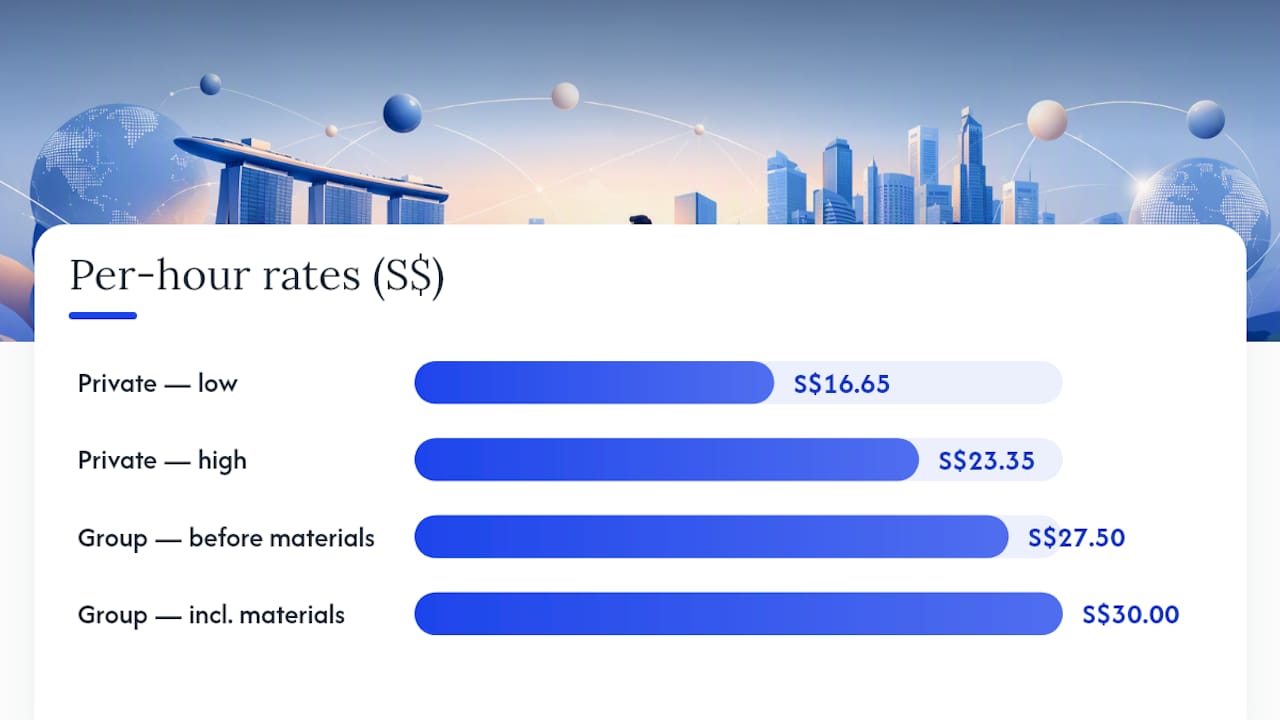
Private options tell a different story. Course broker listings show 20-hour private packages priced from roughly S$333 to S$467, which translates to S$16.65 to S$23.35 per hour. That’s surprisingly close to the group-package rate above, and it illustrates why headline prices alone can mislead you. Presenting every quote in per-hour terms is the only reliable way to compare a group package against a private one without getting fooled by the total figure on the invoice.
For corporate bookings, the standard structure is a per-person cost calculated from total instructor hours divided by headcount, then adjusted for any custom material development. A company booking a 20-hour program for eight staff members might see the per-person cost land somewhere between an individual private rate and a group rate, since the school is designing one curriculum but delivering it to a fixed group.
20-hour business package math: S$550 total ÷ 20 hours = S$27.50 per hour, before a typical S$50 materials add-on.
- Business package example: S$550 for 20 hours (10 x 2-hour sessions)
- Private package example: S$333 to S$467 for 20 hours
- Materials fees: often S$50 or more, billed separately
What Makes One Business Spanish Quote Higher Than Another
Two schools can quote wildly different prices for what looks like the same 20-hour package. The gap almost always comes down to five factors, and knowing them lets you ask sharper questions before you sign up.
- Instructor credentials. Native-speaking instructors with formal teaching training generally command higher hourly rates than non-native tutors, and that premium shows up directly in your invoice.
- Class size. Fewer students per session means more speaking time and correction for you, but it also means the instructor’s hourly rate gets split fewer ways, pushing your per-person cost up.
- Content customization. A course built around generic travel phrases costs less to develop than one covering your industry’s technical vocabulary, whether that’s finance terminology, legal contracts, or manufacturing jargon.
- Timing and location. Evening classes in the central business district typically carry higher overhead than daytime or off-peak sessions, and that gets reflected in pricing.
- Add-on fees. Materials, placement assessments, and administrative charges often sit outside the headline price, so a quote that looks cheap on paper can close the gap once these are added.
Pro Tip: When comparing two quotes, ask each provider to itemize materials and admin fees separately. A S$500 package with a S$100 materials fee is really a S$600 package, and you want to know that before you compare it against a S$550 all-in quote.
How to Budget for a Business Spanish Course
Start with the outcome, not the price tag. Decide what “done” looks like: can you hold a 10-minute client call in Spanish, or do you need to negotiate contracts and read technical documents? Conversational competency for basic workplace small talk generally needs fewer hours than genuine business fluency, which involves industry vocabulary, formal register, and listening comprehension at a faster native pace.
Once you have a target, estimate the hours. A rough planning method: multiply your weekly session length by the number of weeks until your deadline, then check that total against the package size you’re considering. Someone booking two hours a week for 10 weeks is budgeting for a 20-hour package, matching the S$550 example above almost exactly.
For busy professionals, cadence matters as much as total hours. Two hours weekly, split into two one-hour sessions, tends to retain better than one long weekly block, and it’s easier to protect on a packed calendar. If your timeline is tight (say, a client trip in six weeks), private lessons are usually worth the extra per-hour cost, since you can compress more practice into fewer calendar weeks without waiting for a group’s pace.
If you’re booking for a team, ask about multi-employee discounts upfront. Most corporate quotes have room to move once you commit to more than four or five seats, and bundling employees into one cohort almost always beats buying separate individual packages.
- Define your target outcome first: conversational versus true business fluency
- Estimate hours needed, then match against package size
- Choose private lessons when your timeline is short
- Ask about group discounts before finalizing a corporate quote
What Spanish Explorer Offers Business Learners in Singapore
Spanish Explorer runs its business Spanish and corporate training programs from its training centre at 10 Anson Road, Level 22, International Plaza, Singapore 079903, directly above Tanjong Pagar MRT, which makes it a realistic before-work or after-work stop for CBD professionals.
Classes are taught by native Spanish-speaking instructors who are also fluent in English, so grammar explanations and business vocabulary get covered in whichever language makes a concept click faster. The school runs several formats suited to working adults:
- Public group classes for professionals who want structured pacing alongside peers
- Private lessons for learners who need flexible scheduling or a faster timeline
- Online group courses delivered over Zoom for remote or hybrid schedules
- Corporate training designed around a company’s team size and industry vocabulary
If you’re unsure which format fits your budget and goals, a Spanish Language Trial Class at $45 is a low-commitment way to sit in on a lesson before booking a full package.
Which Format Actually Makes Sense for You
If your job mostly needs polite small talk with regional clients, a group class gets you there without overspending. If you’re prepping for a specific negotiation or a relocation in the next two months, private lessons earn back their higher hourly rate through speed. Teams should push for corporate training rather than sending staff to separate group classes. It’s almost always cheaper per person once you factor in the discount schools offer for booking a cohort. Whatever format you choose, run the per-hour math before you compare quotes. It’s the only number that tells you the truth.
— Paul
Ready to See What Business Spanish Costs for Your Schedule
The advantage of a centrally located school is that it removes the biggest excuse professionals have for skipping lessons: travel time eating into a lunch break or commute home.

If you want to test the fit before committing to a full package, book the Spanish Language Trial Class for $45 and see how a native-speaking instructor structures a business-focused lesson. Ready to move straight to a full course? Browse private and business Spanish course options to compare formats and schedules, or reach out for a corporate training quote if you’re booking for a team. Class sizes stay small by design, so spots for evening slots near the CBD fill up fast, and scheduling ahead gives you first pick of times that actually match your calendar.
Sources
FAQ
How much should I pay to learn Spanish in Singapore?
Expect S$350 to S$650 for a group business package, or S$60 to S$120 per hour for private lessons, with tutor marketplaces averaging closer to S$30 to S$70 an hour. A common 20-hour business package example runs S$550 plus a materials fee, or about S$27.50 per hour before that add-on.
What is the fee for business Spanish classes specifically?
Business-focused Spanish courses typically cost the same as general private or group Spanish lessons, since the price difference comes from format rather than content focus. A 20-hour business package commonly falls in the S$333 to S$550 range depending on whether it’s private or group-based.
Can I become fluent in three months of Spanish study?
Genuine fluency in three months is unrealistic for most working adults studying part-time, since real proficiency requires sustained vocabulary and grammar exposure over many months. You can reach solid conversational competency for workplace small talk in that window with consistent weekly practice, but business fluency covering contracts and technical vocabulary usually takes longer.
What is the 80/20 rule for learning Spanish?
It’s a useful prioritization tool rather than a strict formula, and definitions of the exact split vary by source.
Is corporate Spanish training priced differently from individual courses?
Yes. Corporate training is always quoted custom, since price depends on group size, curriculum complexity, and how much industry-specific vocabulary needs developing. There’s no fixed public rate the way there is for a standard group or private package.
Recommended
Start Learning Spanish Today
Book a trial class and see how quickly you can progress with a professionally trained native-speaker teacher guiding the way.
Book a Trial Class