 Spanish
Conversational Spanish is the practical skill of handling everyday exchanges: greetings, small talk, ordering food, asking directions, without needing textbook-perfect grammar. Beginners can hold basic social and transactional conversations after focused practice. The fastest way there is to learn a core set of essential high-frequency phrases and say them out loud, repeatedly, from day one.
TL;DR:
- Practicing a core set of high-frequency phrases daily, including greetings, introductions, ordering, and directions, accelerates conversational ability from the start.
- Regularly recording and listening to spoken responses helps solidify pronunciation and turns memorized lines into automatic reactions under pressure.
- Engaging in unrehearsed conversations with tutors or language partners is crucial for developing the real-world fluency reflected in CEFR B1 level communication.
- Using small, practical phrases like asking for repetition, clarification, or slower speech is more important than perfect grammar for sounding natural in conversations.
- Combining audio-based apps, live practice, and structured courses focused on speaking dramatically improves the speed and quality of conversational Spanish proficiency.
Table of Contents
- High-impact phrases you can use today
- What conversational ability actually looks like
- Daily and weekly routines that build real fluency
- Small phrases that keep a conversation alive
- Choosing the right practice resource for your stage
- Where classroom and online practice actually pay off
- Your next step toward speaking Spanish with confidence
- Where to read more on proficiency standards
- Sources
- FAQ
High-impact phrases you can use today
Grammar drills teach rules. Phrases teach you to talk. Start with lines you will actually use in the first minute of any conversation, then build outward.
- Greetings and closers: “Hola, ¿qué tal?” (informal, “hi, how’s it going?”) and “Buenas tardes, mucho gusto” (formal, “good afternoon, nice to meet you”) cover most first encounters.
- Introducing yourself: “Me llamo Ana, soy de Singapur” (“My name is Ana, I’m from Singapore”) pairs naturally with “¿Y tú, cómo te llamas?” for the informal you, or “¿Y usted?” in formal settings.
- Asking about someone: “¿A qué te dedicas?” (“What do you do?”) and “¿Qué te gusta hacer en tu tiempo libre?” (“What do you like doing in your free time?”) open small talk about work and hobbies.
- Ordering and paying: “Quisiera un café, por favor” (“I’d like a coffee, please”) is softer than “Quiero,” and “¿Me trae la cuenta?” asks for the check politely.
- Asking directions: “¿Dónde queda la estación?” (“Where’s the station?”) and “¿Está lejos de aquí?” (“Is it far from here?”) get you moving.
Pronunciation matters more than perfect vocabulary. Spanish vowels are short and consistent, so “qué” is always “keh,” never “kay.” Regional variants exist everywhere: “¿Qué tal?” works across Spain and Latin America, but “¿Cómo andas?” is more common in parts of South America. Our guide on how to communicate in Spanish breaks down more example dialogues by situation.
Pro Tip: Record yourself saying five phrases out loud every morning. Hearing your own voice say them out loud cements them faster than reading them silently ever will.
What conversational ability actually looks like
“Conversational” is not a fixed target, but the Common European Framework of Reference gives it a useful floor. At B1 level, learners can participate spontaneously in conversations on daily topics such as travel, hobbies, and work, without needing to rehearse every line first. That is a realistic, measurable goal for a committed beginner rather than a distant milestone.
Formal speaking assessments reflect the same priority. The ACTFL Oral Proficiency Interview evaluates functional performance in a 20 to 40 minute unrehearsed conversation, not knowledge of isolated grammar rules. The exam rewards consistency under real conditions, which is exactly what daily practice builds.
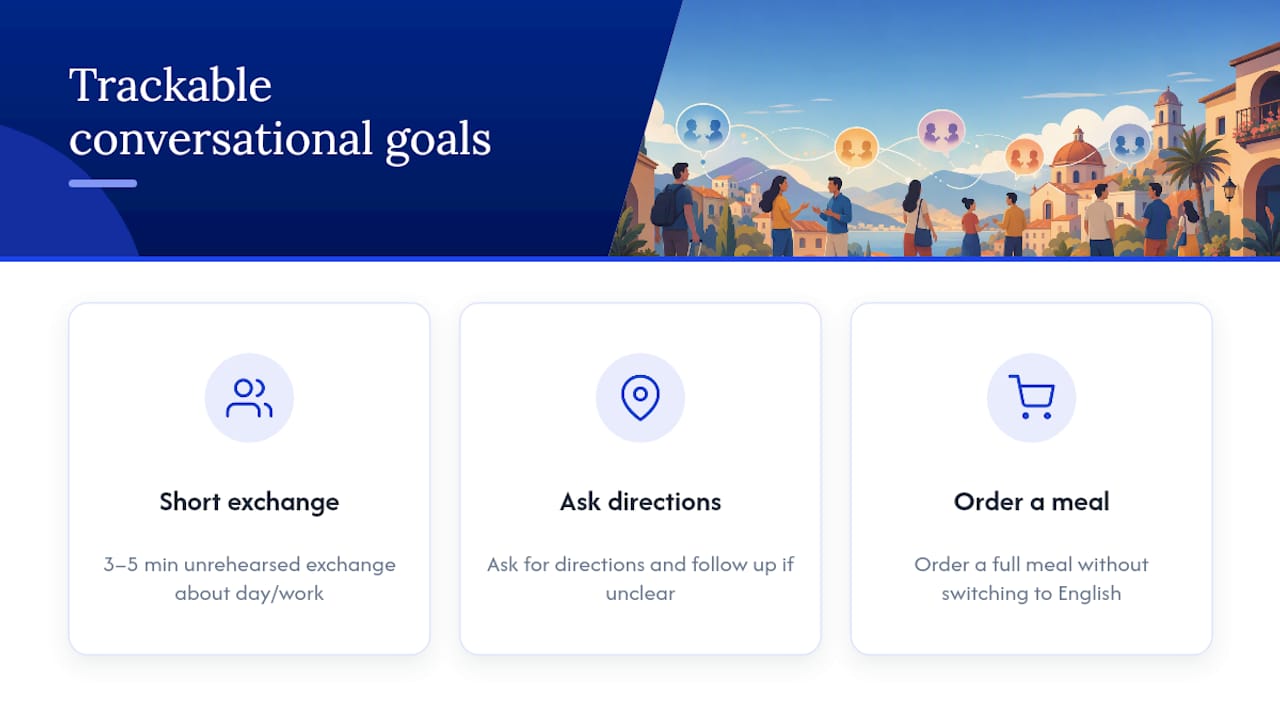
Concrete goals worth tracking: hold a 3 to 5 minute unrehearsed exchange about your day or your work, ask for directions and follow up when you do not understand the answer, and order a full meal without switching to English. Our breakdown of conversational Spanish levels and methods maps these targets against study time.
Daily and weekly routines that build real fluency
Phrases stay theoretical until you practice them under time pressure. A short, repeatable routine turns memorized lines into automatic responses.
- Listen to a short clip or podcast segment in Spanish for five minutes, focusing on tone and rhythm rather than every word.
- Drill aloud by repeating five to ten phrases from your bank, out loud, at conversational speed.
- Record a voice note describing your day or answering a prompt, even if it is imperfect.
- Review briefly by listening back once and noting one thing to fix tomorrow.
That loop takes 15 to 30 minutes and works best as scripted role-play in week one, semi-scripted prompts (answer a question you did not plan for) in week two, and fully unrehearsed conversation with a partner or tutor by week three or four. Shadowing native audio, spaced repetition for vocabulary, and regular voice-note exchanges with a study partner all reinforce the same skill from different angles. Our list of Spanish speaking practice ideas has more structured drills, and role-play templates for speaking practice work well for the scripted stage.
Pro Tip: Schedule one 20-minute tutor or exchange-partner session per week. Unrehearsed conversation with another person forces the recall that solo drilling cannot.
Small phrases that keep a conversation alive
Fluent-sounding Spanish is not about never getting stuck. It is about knowing what to say when you do. Research into interactional competence finds that higher-level speakers rely on a specific toolkit: softening requests, presenting counterpoints, and repairing misunderstandings smoothly, rather than simply knowing more words.
- Ask for repetition: “¿Puedes repetir, por favor?” or the more casual “¿Cómo?”
- Ask for a simpler word: “¿Hay otra forma de decir eso?” (“Is there another way to say that?”)
- Ask for slower speech: “¿Puedes hablar más despacio?”
- Buy thinking time: “A ver…” (“Let’s see…”) or “Bueno, pues…” work like “well…” in English.
- Paraphrase to confirm: “Entonces, quieres decir que…” (“So, you mean that…”) keeps the exchange moving even when you are unsure you understood correctly.
These small moves matter more than grammar accuracy for sounding natural, because they are what native speakers actually use to manage real conversations.
Choosing the right practice resource for your stage
Different tools solve different problems, and mixing them beats relying on one.
- Audio-first apps suit early vocabulary building and listening comprehension on the go.
- AI conversation buddies offer low-pressure repetition without the social stakes of a live partner.
- Structured online courses add accountability, a clear curriculum, and a teacher who corrects patterns you cannot hear yourself.
- Local group classes provide regular live interaction with peers at a similar level.
- Private tutors work best for fast, personalized correction and a schedule built around your goals.
When comparing a course or tutor, check for a speaking-first focus, regular live interaction rather than self-paced video only, alignment with CEFR goals, and homework built around actual practice, not just worksheets.
Where classroom and online practice actually pay off
Speaking-first teaching is the difference between knowing Spanish and being able to use it. Course formats that mix scripted role-play early on with unrehearsed conversation later, whether in a group, private, or online setting, are what convert a phrase bank into a skill you can rely on under real pressure. Structured feedback from a certified teacher catches pronunciation and pattern errors that self-study alone tends to miss.
— Paul
Your next step toward speaking Spanish with confidence
If you have the phrases and the routine but want faster, corrected progress, a structured course fills the gap self-study leaves open. Beginners focused on conversational skill tend to do best in an online conversational Spanish group setting, where regular live interaction forces the unrehearsed speaking that solo practice cannot replicate.

- A trial class lets you sample the teaching style and speaking format before committing to a full course.
- Private classes suit learners who want a schedule built entirely around their pace and goals.
- Group and online formats add the peer interaction that mirrors real conversation more closely than one-on-one practice alone.
Book a trial class to see how a speaking-first lesson runs and what a few weeks of structured practice can add to the routine you already have.
Where to read more on proficiency standards
For primary-source detail beyond this guide, the CEFR B1 descriptors define the conversational floor referenced above, the ACTFL OPI documentation explains functional speaking assessment, and the British Council’s interactional competence research covers pragmatic strategy in more depth.
Sources
- ACTFL OPI report (General information, 2023)
- British Council: assessing interactional and pragmatic competence
FAQ
What is the best way to learn conversational Spanish?
The most effective approach combines a small bank of high-frequency phrases with daily spoken practice, ideally through shadowing, voice notes, and regular unrehearsed conversation with a partner or tutor. Structured courses that prioritize speaking over grammar drills tend to build this skill faster than self-study alone.
What does conversational Spanish mean?
Conversational Spanish means being able to handle everyday spoken exchanges, such as greetings, small talk, ordering, and directions, without needing perfect grammar. Under the CEFR B1 descriptors, this includes participating spontaneously in conversations about daily topics like travel, hobbies, and work.
What is the 80/20 rule for learning Spanish?
The idea is that a relatively small set of high-frequency words and phrases covers most of what you need in everyday conversation, so focusing practice there gets you speaking faster than trying to learn everything at once. It is a practice priority, not a strict measured ratio.
What level of Spanish is conversational?
Conversational ability generally starts around CEFR B1, where learners can handle spontaneous exchanges on familiar topics without heavy preparation. Reaching that level typically takes consistent speaking practice over several weeks to a few months, depending on prior exposure to the language.
Recommended
Start Learning Spanish Today
Book a trial class and see how quickly you can progress with a professionally trained native-speaker teacher guiding the way.
Book a Trial Class