 Spanish
Corporate Spanish training in Singapore typically runs between $350 and $650 per participant per month for group programs, according to Spanish Explorer’s published corporate fee guide, while private coaching lands between $60 and $120 per hour. Online delivery usually costs less than on-site sessions once you factor in venue and travel. Corporate packages, though, are always custom quoted, so treat any number you see online as a planning range, not a fixed price, until a provider sends you a line-item proposal.
TL;DR:
- Corporate Spanish training in Singapore costs between $350 and $650 per participant per month for group programs, with private coaching priced from $60 to $120 per hour.
- Online group classes are generally the most affordable per learning hour, while on-site workshops offer greater customization and relevance at a higher cost.
- Pricing varies significantly based on class size, instructor experience, curriculum customization, delivery mode, and program length, with quotes often differing by up to 300%.
- Accurate budgeting requires calculating total costs, dividing by headcount, including all fees, and establishing KPIs before starting, as programs typically need 60 to 80 contact hours for basic competency.
- Vague requests lead to vague quotes; detailed specifications, including objectives, proficiency levels, schedule, delivery mode, and assessment needs, are essential for reliable, comparable proposals.
Table of Contents
- What Does Corporate Spanish Training Cost in Singapore?
- What Do Real Corporate Spanish Quotes Look Like?
- Why Do Spanish Training Quotes Vary So Much?
- How Do You Budget and Calculate ROI for Corporate Spanish Training?
- How Do You Request an Accurate Corporate Quote?
- How Spanish Explorer Prices Corporate Spanish Training
- What Procurement Teams Get Wrong About Language Training
- Ready to Get a Corporate Spanish Quote?
- Sources
- FAQ
What Does Corporate Spanish Training Cost in Singapore?
Pricing depends almost entirely on delivery format, and the four main options land at very different price points. Understanding the structure behind each one helps you spot a fair quote versus an inflated one.
Group classes are the budget anchor. Adult group sessions in Singapore run at roughly $25 to $45 per hour equivalent, according to Spanish Explorer’s group class pricing breakdown, and that per-hour figure drops further as class frequency increases, since fixed instructor costs get spread across more sessions. A weekly two-hour class over ten weeks costs less per hour than the same total hours crammed into four intensive weekends, because intensive formats often carry premium pricing for instructor availability.
Private lessons sit at the other end. Face-to-face 1:1 coaching in Singapore typically costs $60 to $120 per hour, based on market pricing gathered by Preply’s roundup of Spanish classes in Singapore. Bulk packages change that math fast.
Online Zoom group classes generally undercut in-person group rates by a noticeable margin, mostly because there’s no venue rental, no trainer travel time, and often a larger addressable pool of instructors to draw from. For distributed teams working across different office locations in Singapore, this format also solves a real logistics headache: nobody has to book a meeting room or coordinate desk coverage.
On-site corporate workshops, by contrast, generate the highest quotes in the market. Three factors drive that premium:
- Travel and setup time for the instructor, especially if your office sits outside the central business district
- Venue and equipment costs if the training needs a dedicated room, screen, or printed materials
- Customization work upfront, since a generic curriculum rarely fits a sales team negotiating contracts in Madrid the same way it fits a hospitality team greeting guests
A useful way to think about it: online group training buys you the lowest cost per learning hour, while on-site corporate workshops buy you relevance and convenience for a specific team, and you’re paying for that difference, not for better teaching.
What Do Real Corporate Spanish Quotes Look Like?
Numbers mean more when you see them applied. Here are three worked examples using typical Singapore market rates.
-
Small team blended package. A ten-person team books a twenty-hour group program mixing two online sessions per week over ten weeks, with a reasonable group rate leading to a total instructor cost and per participant cost before materials.
-
Medium team on-site weekly program. A department of 25 employees wants a weekly ninety-minute on-site class over twelve weeks, which comes to 18 hours of contact time. On-site delivery plus a custom vocabulary module for a specific industry (say, logistics or finance terminology) often adds a flat customization fee on top of the base rate. If the base group rate is at the higher end for on-site delivery and with an added curriculum-design fee, the total cost per seat adjusts accordingly.
-
Executive 1:1 coaching. A managing director preparing for an overseas posting books twenty hours of private coaching at a typical hourly rate, with a discount for prepayment, resulting in a total cost below two thousand dollars.
A few line items catch HR teams off guard when they arrive on the final invoice. Materials and workbooks sometimes carry a small per-participant fee if they’re not bundled into the headline rate. Instructor substitution policy matters too. Ask whether a sick trainer gets replaced at no extra cost or whether the session simply gets rescheduled. Cancellation terms also vary widely, so confirm the notice period before signing anything.
Why Do Spanish Training Quotes Vary So Much?
Two companies asking for “corporate Spanish training” can receive quotes that differ by 300%, and the gap almost always traces back to five variables.
- Class size and instructor ratio. A 1:6 class costs less per person than a 1:2 class, obviously, but many providers don’t disclose their target ratio until you ask directly.
- Instructor qualifications. Native-speaking instructors, and especially senior trainers with business-specific teaching experience, usually carry a rate premium over general-purpose language teachers.
- Curriculum customization. A generic conversational course costs less to deliver than one built around your company’s actual negotiation scripts, email templates, or client-facing scenarios.
- Delivery mode. Virtual sessions cut venue and travel costs entirely; on-site sessions add both, plus setup time.
- Program length and intensity. Longer programs with built-in assessments cost more per hour than a short conversational refresher, because assessment design and grading take instructor time that class hours alone don’t capture.
Pro Tip: Ask every provider for their student-to-instructor ratio in writing before comparing quotes. A “cheaper” quote at a 1:12 ratio often delivers less individual speaking practice than a pricier one at 1:6, and that gap shows up in fluency outcomes, not the invoice.
How Do You Budget and Calculate ROI for Corporate Spanish Training?
Budgeting a language program is simpler than most HR teams expect, once you break it into four steps.
- Convert the quote to a total cost. Take the per-hour or per-month rate and multiply by total hours or months to get one number: total program cost.
- Divide by headcount. Total cost divided by number of participants gives you cost per employee, which is the figure finance teams actually want to see.
- Add one-off fees. Curriculum design, materials, and any assessment fees belong in the total, not treated as afterthoughts once the invoice arrives.
- Set your KPIs before day one. Attendance rate, a post-training proficiency check, and a business metric tied to the skill (client call confidence, fewer translation requests, faster deal cycles with Spanish-speaking partners) all work as measurable outcomes.
On timeline, most language educators agree that meaningful workplace competency, enough to hold a basic business conversation and handle routine client interactions, needs somewhere around 60 to 80 contact hours, though this varies by starting level and how often the learner practices outside class. A once-weekly two-hour class alone would take close to a year to hit that mark, which is why many companies pair group sessions with self-study or short intensive blocks to compress the timeline.
If your company wants certified proof of proficiency at the end, options like SIELE’s scheduling system let you add a small assessment fee to the budget as a concrete end-of-program benchmark, rather than relying only on internal reviews.
How Do You Request an Accurate Corporate Quote?
Vague requests get vague quotes. Providers can only price what you describe, so a request that names specifics gets you numbers you can actually compare across vendors.
Include these details in your first email or RFP:
- Training objective (general conversational fluency, client-facing Spanish, negotiation vocabulary, etc.)
- Current proficiency level of participants, even a rough self-assessment
- Preferred schedule: days, times, and total duration in weeks
- Delivery mode preference: online, on-site, or a mix
- Headcount and whether it might grow mid-program
Then ask providers directly for instructor credentials, a sample syllabus, their assessment method, and their substitution policy if a trainer is unavailable. Request the quote broken into line items (base tuition, materials, customization, assessment) rather than one bundled number, since bundled quotes make it nearly impossible to compare two providers fairly. Most quotes stay valid for 30 to 60 days, and volume discounts for larger cohorts are almost always negotiable if you ask before signing rather than after.
How Spanish Explorer Prices Corporate Spanish Training
Spanish Explorer runs in-person, online Zoom, private, and corporate Spanish programs for companies across Singapore, with published corporate class fees in the $350 to $650 per month range. Corporate engagements typically include a custom syllabus, native Spanish-speaking instructors fluent in English, and regular progress reporting so HR can track participation without chasing instructors for updates. Full fee details, including the business Spanish fee breakdown, are published for review before you commit.
What Procurement Teams Get Wrong About Language Training
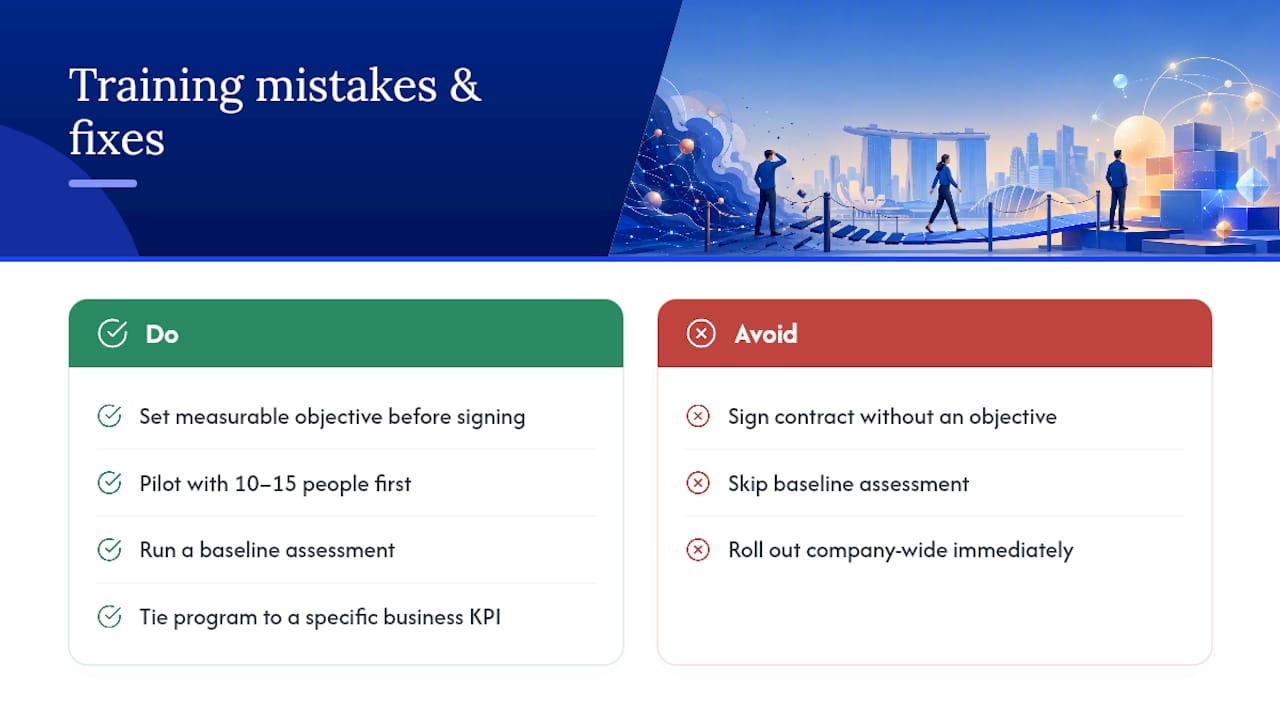
Most failed corporate language programs don’t fail because the instructor was weak. They fail because nobody set a measurable objective before the contract was signed, so six months later, no one can say whether the spend worked.
My advice: pilot with one small team, ten to fifteen people, before rolling out company-wide. It’s cheap insurance against a costly mismatch. The second common mistake is skipping a baseline assessment, so there’s nothing to compare progress against later. Tie every program to a specific business KPI, not a vague “improve communication” goal, and you’ll actually be able to defend the budget line next year.
— Paul
Ready to Get a Corporate Spanish Quote?
The corporate programs addressed here focus on providing HR teams with clear, comparable quotes instead of vague estimates over the phone. Spanish Explorer publishes its fee ranges openly, offers both online group lessons and in-person delivery, and builds each corporate syllabus around your team’s actual work, whether that’s client calls, negotiation, or general business fluency.
Requesting a quote is straightforward. Reach out through the course catalogue page with your headcount, preferred schedule, and objective, and expect a line-item proposal back within a few business days, no bundled guesswork included. If you want to test the teaching style with a smaller commitment first, private lesson and business Spanish packages start at $1,280 for a beginner conversational block. The training center sits at 10 Anson Road, Level 22, International Plaza, Singapore 079903, right above Tanjong Pagar MRT, for any company that wants an on-site consultation before committing.
Sources
FAQ
How much should I pay to learn Spanish in Singapore?
Individual group classes typically cost $25 to $45 per hour equivalent, while private lessons run $60 to $120 per hour, according to Spanish Explorer’s pricing data. Corporate group packages for companies usually fall between $350 and $650 per participant per month.
What is the most recognized Spanish certification?
SIELE and DELE are the two most widely recognized Spanish proficiency assessments internationally, each testing speaking, listening, reading, and writing. Companies planning certified outcomes for staff can check exam scheduling directly through SIELE’s reservation system.
What corporate training courses are available in Singapore?
Companies in Singapore can choose between on-site group workshops, online Zoom group courses, and private executive coaching, each priced differently based on format and customization. Spanish Explorer offers all three formats along with a dedicated corporate training track built around business vocabulary and client-facing scenarios.
Are there any free Spanish courses?
Free self-study apps and community meetup groups exist, but they rarely offer structured curriculum, progress tracking, or business-specific vocabulary that a workplace program needs. For companies wanting measurable results, a paid structured course with reporting, such as a trial class followed by a full program, generally delivers faster, more reliable outcomes than free resources alone.
Recommended
Start Learning Spanish Today
Book a trial class and see how quickly you can progress with a professionally trained native-speaker teacher guiding the way.
Book a Trial Class