 Spanish
TL;DR:
- The DELE exam is the official Spanish proficiency certification issued by Instituto Cervantes, essential for citizenship and academic applications in Spain. It assesses communicative skills across six levels aligned with CEFR standards, emphasizing real-life language use rather than grammar rules alone. Preparation involves targeted practice in all four skills, with a focus on structured oral tasks, and results typically take 2-3 months to be finalized.
The DELE exam is the official Spanish language proficiency certification issued by Instituto Cervantes on behalf of Spain’s Ministry of Education, and it is the primary credential recognized worldwide for validating Spanish ability across all four language skills. The role of DELE in Spanish proficiency goes far beyond a simple test score. It defines where a learner stands on the Common European Framework of Reference (CEFR) scale, from A1 beginner to C2 mastery, and carries legal weight for immigration, citizenship, and university admission. Whether you are an adult learner in Singapore pursuing professional goals or an educator guiding students toward certification, understanding the DELE’s structure and significance is the foundation of any serious Spanish learning plan.
What are the DELE exam levels and how do they measure spanish proficiency?

DELE assesses Spanish proficiency across reading, writing, listening, and speaking, aligned with CEFR levels A1 to C2, focusing on real-life communicative functions. That means the exam does not test grammar rules in isolation. It tests whether you can actually use Spanish to accomplish real tasks, like negotiating a contract, following a news broadcast, or writing a formal complaint.
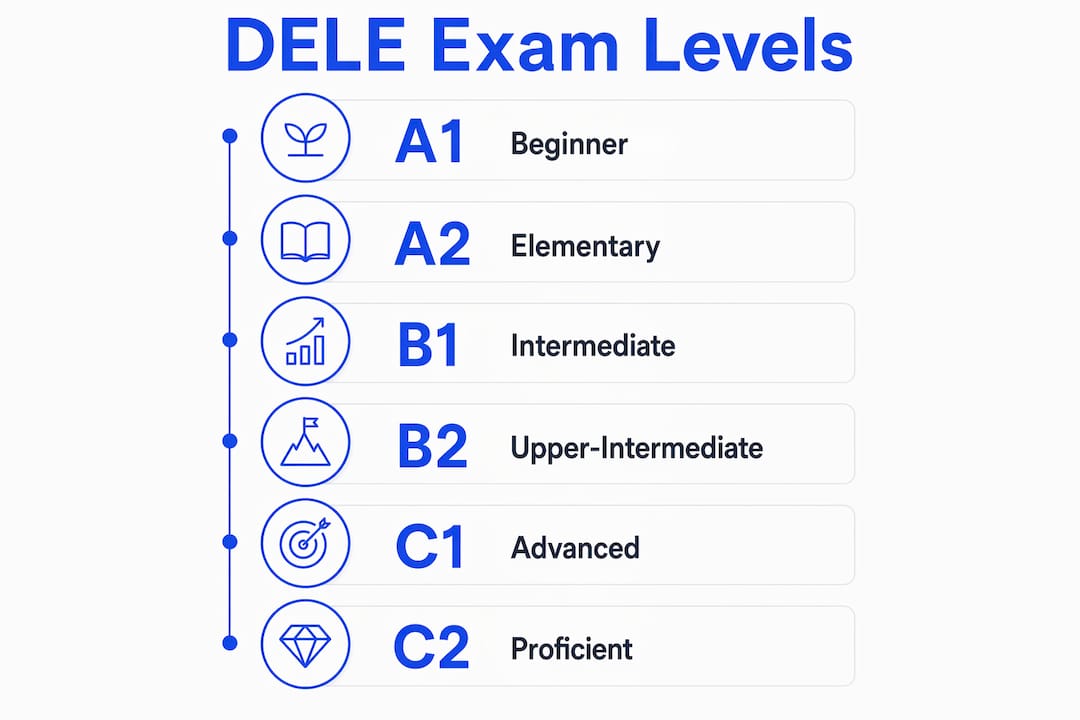
Here is what each level signals about a learner’s ability:
| DELE Level | CEFR Stage | Typical Use Case |
|---|---|---|
| A1 | Beginner | Basic greetings, simple personal information |
| A2 | Elementary | Travel, everyday transactions, residency applications |
| B1 | Intermediate | Independent travel, routine work communication |
| B2 | Upper Intermediate | University admission in Spain, professional fluency |
| C1 | Advanced | Complex academic and professional contexts |
| C2 | Mastery | Near-native fluency, academic research, diplomacy |
The A2 level is particularly significant for legal reasons, which the immigration section below covers in detail. The B2 level is the most common target for adults pursuing university study in Spain. Knowing which DELE level fits your goals before you begin studying saves months of misdirected preparation.
Each exam session tests communicative competence, not just vocabulary recall. A B1 candidate, for example, must demonstrate the ability to handle most situations that arise while traveling in a Spanish-speaking country and produce simple connected text on familiar topics. That is a meaningful, practical standard.
How does DELE impact spanish language learning and skill development?
The impact of DELE on Spanish learning is structural. Preparing for the exam forces learners to develop all four language skills simultaneously rather than focusing only on the areas they find comfortable. Most adult learners naturally gravitate toward reading and listening while neglecting writing and speaking. DELE preparation corrects that imbalance.
Effective DELE preparation involves systematic vocabulary building, focused study of all four language skills, and specialized oral exam task practice. That last point matters more than most candidates expect. The oral component is not a casual conversation. It is a structured, task-based assessment that evaluates register, pragmatic nuance, and logical argumentation.
Key ways DELE preparation shapes language development:
- Vocabulary building: Candidates must learn level-appropriate vocabulary in context, not just word lists. This builds the kind of active recall needed for real communication.
- Writing structure: DELE writing tasks require formal and informal registers, which trains learners to adapt their language to different audiences.
- Listening comprehension: Exam audio includes native-speed speech, regional accents, and varied contexts, pushing learners beyond classroom-pace input.
- Speaking fluency: Oral tasks require structured responses with clear argumentation, not just grammatically correct sentences.
The certification also functions as a powerful motivator. Having a fixed exam date creates accountability that open-ended language study rarely provides. Learners who prepare for DELE consistently report faster progress than those studying without a defined goal.
Pro Tip: Register for your DELE exam before you feel fully ready. The deadline pressure accelerates preparation in ways that self-paced study cannot replicate.
What legal and academic roles does the DELE exam play?
The legal significance of DELE is non-negotiable for anyone pursuing Spanish citizenship or residency. DELE A2 or higher is required by law for Spanish nationality and residency applications under Royal Decree 1155/2024. No other Spanish language exam substitutes for DELE in this context.
This distinction trips up many applicants. SIELE, another widely recognized Spanish exam, is accepted for some visa renewals but cannot be used for citizenship applications. Choosing the wrong exam means starting the process over, which costs both time and money.
| Purpose | DELE Accepted | SIELE Accepted |
|---|---|---|
| Spanish citizenship application | Yes (A2 minimum) | No |
| Residence permit renewal | Yes | Yes (from May 2025) |
| University admission in Spain | Yes (B2 common) | Varies by institution |
| Professional certification | Yes | Yes |
On the academic side, a common misconception is that passing DELE B2 guarantees university admission in Spain. DELE B2 satisfies language requirements but does not replace other admissions criteria. Each Spanish university sets its own standards for academic qualifications, entrance exams, and portfolio requirements. DELE is one piece of the application, not the whole picture. Prospective students can use resources like SchoolFinder Spain to compare institution-specific admission requirements alongside DELE level expectations.
Pro Tip: If your goal is Spanish citizenship, confirm with your immigration advisor that you are sitting the DELE exam specifically. Presenting a SIELE certificate at a citizenship appointment will not satisfy the legal requirement.
One more fact worth knowing: DELE certificates do not expire. Instituto Cervantes issues no official renewal process. That said, employers and universities understand that an older certificate reflects proficiency at a past point in time. A certificate from ten years ago may prompt questions about current ability, so recent certification carries more practical weight.
How does DELE compare to SIELE and other spanish certifications?
DELE and SIELE are both issued under the authority of Instituto Cervantes, but they operate on fundamentally different models. Understanding the difference prevents costly mistakes, especially for learners with legal or academic goals.
DELE uses a fixed-level, pass/fail structure. You register for a specific level, sit the exam, and either pass or fail that level. SIELE uses a score-based model across a single adaptive exam, producing a numeric result that maps to a CEFR range. That flexibility makes SIELE attractive for general professional use, but it creates a problem for legal applications where a specific DELE level is the stated requirement.
Key practical differences:
- Results timeline: DELE results take 2–3 months; SIELE results arrive in 3–4 weeks. For time-sensitive visa applications, this gap matters.
- Exam format: DELE is paper-based; SIELE is computer-based. Learners who are more comfortable with handwriting may prefer DELE’s format.
- Cost: DELE fees run approximately €135–€150 per exam sitting. Budget this alongside preparation costs and the 2–3 month wait before results arrive.
- Legal standing: DELE is required for citizenship; SIELE is not accepted as a substitute regardless of score.
For a detailed side-by-side breakdown of both exams, the DELE vs. SIELE comparison guide at Spanish Explorer covers recognition, formats, and legal acceptance in full.
The bottom line: if your goal is citizenship, residency, or a formal academic application, DELE is the only valid choice. If you need a flexible proficiency credential for a corporate role or personal milestone, SIELE is a faster and equally credible option.
What are effective strategies for passing the DELE exam?
A realistic preparation plan is the difference between passing and retaking. Most candidates underestimate how different DELE preparation is from general Spanish study. The exam rewards specific skills, and those skills require targeted practice.
Follow this preparation sequence:
- Choose your level first. Sitting an exam that is too advanced wastes your registration fee. Use a placement test or consult a certified instructor to confirm your current CEFR level before registering.
- Plan a 6–8 week focused study block. This is the recommended preparation window for candidates who already have a foundation at the target level. Starting from scratch requires significantly more time.
- Build vocabulary systematically. Work through level-specific word lists and practice using new vocabulary in writing and speaking tasks, not just recognition exercises.
- Practice oral exam tasks specifically. The DELE oral exam evaluates structured communicative competence, not casual conversation. Practice with timed tasks that require you to present an argument, describe a scenario, or respond to a prompt within a set format.
- Simulate full exam conditions. Time yourself on complete practice papers. Fatigue and time pressure affect performance, and simulated exams build the stamina needed for the real sitting.
- Budget for fees and results timing. Exam fees run €135–€150, and results take 2–3 months. If you need certification by a specific date, work backward from that deadline to set your exam registration date.
Pro Tip: Treat the oral exam as a separate skill set. Many candidates who score well on reading and writing underperform on speaking because they practiced grammar but not structured task delivery. Record yourself completing oral practice tasks and review the recordings critically.
For Singapore-based learners, the DELE exam preparation resources at Spanish Explorer provide localized guidance on registration timelines and exam readiness.
Key takeaways
The DELE exam is the only legally recognized Spanish proficiency certification for citizenship applications, and its structured format makes it the most effective tool for developing all four language skills simultaneously.
| Point | Details |
|---|---|
| DELE is legally mandatory | Only DELE, not SIELE, satisfies Spanish citizenship and residency requirements under Royal Decree 1155/2024. |
| Six CEFR-aligned levels | DELE levels A1 to C2 measure real communicative ability across reading, writing, listening, and speaking. |
| Certificates do not expire | DELE has no official expiry, but recent certification carries more practical weight with employers and universities. |
| Oral exam requires targeted prep | The speaking component tests structured argumentation and register, not casual fluency. |
| Plan for a 2–3 month results wait | Budget €135–€150 in fees and schedule your exam sitting well ahead of any application deadlines. |
Why DELE is more than just a test score
I have worked with Spanish learners at every level, and the most consistent mistake I see is treating DELE as a finish line rather than a checkpoint. Passing DELE B2 is a genuine achievement. It means you can operate in Spanish across complex, real-world situations. But the certificate is a snapshot, not a permanent measure of who you are as a speaker.
The oral exam is where most candidates get humbled, and I say that from watching it happen repeatedly. Learners who have studied Spanish for years, who read novels and watch films in Spanish, often freeze during the structured speaking tasks because they have never practiced that specific format. The DELE oral component requires you to organize an argument, manage your time, and respond to a prompt within a defined structure. That is a skill you have to train separately from general conversation.
The legal distinctions around DELE are also something I cannot stress enough. I have seen learners invest months preparing for SIELE because it seemed more flexible, only to discover at the immigration office that it does not satisfy the citizenship requirement. That is a painful and avoidable mistake. If Spanish nationality or residency is your goal, DELE is not optional. It is the only path.
My honest advice: integrate DELE preparation into your broader Spanish practice rather than treating it as a separate cramming exercise. The exam is designed to test real ability. If you are genuinely building your skills across all four areas, the certification follows naturally. The Spanish language pathways guide for adults at Spanish Explorer is a useful starting point for mapping how DELE fits into your longer-term language goals.
— Paul
How spanish explorer prepares you for DELE success
Spanish Explorer offers structured adult Spanish courses in Singapore designed to build the communicative skills DELE exams actually test. Whether you are targeting A2 for a residency application or B2 for professional advancement, the school’s curriculum aligns directly with CEFR standards and DELE exam requirements.

Experienced, certified instructors lead group classes, private sessions, and online Zoom lessons, giving you the flexibility to prepare on your schedule. Private classes are particularly effective for targeted DELE preparation, with focused attention on your specific weak areas. Explore the full range of Spanish courses at Spanish Explorer or book a private class tailored to your DELE level and timeline. The school is located at 10 Anson Road, Level 22, International Plaza, Singapore 079903, directly above Tanjong Pagar MRT.
FAQ
What is the DELE exam and who issues it?
The DELE exam is the official Spanish language proficiency certification issued by Instituto Cervantes on behalf of Spain’s Ministry of Education. It measures communicative ability across six CEFR levels from A1 to C2.
Is DELE required for spanish citizenship?
Yes. Under Royal Decree 1155/2024, DELE A2 or higher is legally required for Spanish nationality applications. SIELE is not accepted as a substitute for citizenship purposes.
Does a DELE certificate expire?
DELE certificates do not have an official expiration date. However, employers and universities may view older certificates as historical proficiency snapshots and request more recent proof of ability.
How long does it take to prepare for the DELE exam?
Most candidates at the target level need 6–8 weeks of focused preparation. Budget approximately €135–€150 in exam fees and plan for results to arrive within 2–3 months of the exam date.
Does passing DELE b2 guarantee university admission in spain?
No. DELE B2 satisfies the language requirement for many Spanish universities but does not replace other admissions criteria. Each institution sets its own academic qualification standards independently.
Recommended
- DELE Exam Singapore | Spanish Explorer
- DELE vs SIELE: Which Spanish Exam Should You Take?
- Blog – Spanish Language School
- Explain Spanish Language Pathways for Adults in 2026
Start Learning Spanish Today
Book a trial class and see how quickly you can progress with a professionally trained native-speaker teacher guiding the way.
Book a Trial Class