 Spanish
TL;DR:
- Language fluency levels measure how well someone can communicate and function in a language.
- The CEFR framework categorizes ability into six levels, from beginner to near-native proficiency.
Language fluency levels are standardized stages that measure how well a person can use a language to communicate, think, and function in real-world situations. The most widely recognized framework for explaining language fluency levels is the Common European Framework of Reference for Languages, known as the CEFR, which organizes ability into six clear levels used by educators, employers, and learners worldwide. For anyone studying Spanish in Singapore, whether for personal growth or professional advancement, understanding these stages removes guesswork from your learning path. Knowing where you stand tells you exactly what to study next and how long realistic progress takes.

What are the CEFR language fluency levels?
The CEFR organizes proficiency into six levels grouped into three bands: Basic User (A1 and A2), Independent User (B1 and B2), and Proficient User (C1 and C2). Each level is defined by “can-do” statements that describe what a learner can actually accomplish with the language, not just what grammar rules they know. This makes the framework practical and measurable.
Here is what each level looks like in practice:
| CEFR Level | Band | What you can do | Typical timeframe |
|---|---|---|---|
| A1 | Basic User | Introduce yourself, ask simple questions, understand slow speech | 0–3 months / 60–80 hours |
| A2 | Basic User | Handle routine transactions, describe your background, read short texts | 3–6 months |
| B1 | Independent User | Hold conversations on familiar topics, write simple connected text | 1–3 years |
| B2 | Independent User | Discuss complex topics, understand native-speed speech, write detailed reports | 2–4 years |
| C1 | Proficient User | Express ideas fluently and spontaneously, use language flexibly for social and professional purposes | 3–5 years |
| C2 | Proficient User | Understand virtually everything, summarize complex sources with precision | 5+ years / 300–400 hours of advanced study |
The jump from B2 to C1 is where most adult learners feel the biggest challenge. At B2, you can hold your own in most conversations. At C1, you can argue a position, catch humor, and navigate professional settings without strain.
Pro Tip: If you are learning Spanish for work in Singapore, B2 is the level most employers recognize as functional professional fluency. Targeting B2 first gives you a concrete, achievable milestone.
What are the five stages of second-language acquisition?
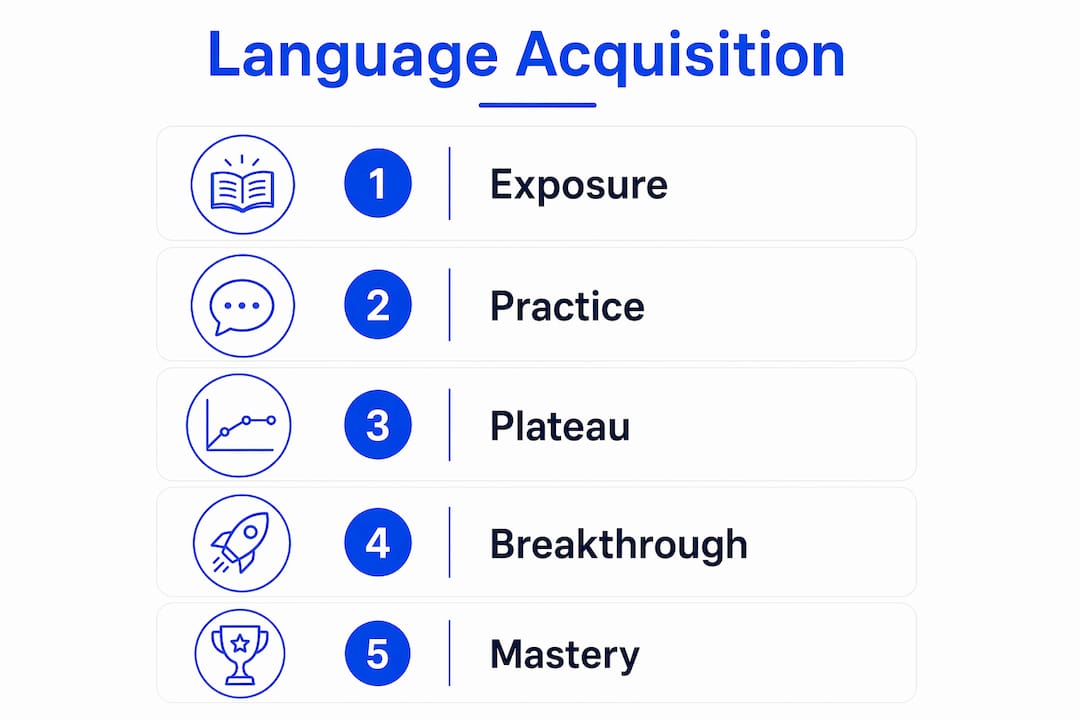
The CEFR describes what you can do at each level. The five stages of second-language acquisition describe how you get there. These stages, developed in applied linguistics research, map the psychological and communicative journey every learner takes.
-
Pre-production (0–6 months). This is the silent period in acquisition, where learners absorb input without producing much speech. It is often misread as a lack of progress. In reality, the brain is building a vocabulary foundation. Learners at this stage nod, point, and respond with single words.
-
Early production (6–12 months). Learners begin using short phrases and simple sentences. Errors are frequent and normal. The goal is communication, not perfection. A Spanish learner at this stage might say “Yo quiero café” and feel proud. They should.
-
Speech emergence (1–3 years). Sentences grow longer. Learners ask questions, tell short stories, and start self-correcting. Comprehension improves faster than speaking ability at this stage. This is where confidence begins to build.
-
Intermediate fluency (3–5 years). Learners produce complex sentences and express opinions. Social conversations feel natural. The hidden challenge here is that many learners plateau because they can get by socially but struggle with abstract or academic language.
-
Advanced fluency (5–7+ years). Learners reach near-native command. They understand idioms, follow fast native speech, and write with nuance. Academic language mastery at this stage requires consistent study and immersion, not just casual conversation.
The most important insight from this model is that intermediate learners plateau because transitioning from social to academic language demands a completely different set of skills. Learners who appear fluent in casual settings often lose confidence when the topic gets complex.
Pro Tip: If you feel stuck at intermediate Spanish, shift your practice from casual conversation to structured topics like business discussions, news summaries, or opinion writing. That gap between social and academic fluency closes fastest with deliberate, topic-focused practice.
How are language fluency levels assessed and certified?
Assessment is the bridge between knowing a framework exists and knowing where you actually stand. Two broad approaches exist: formal standardized tests and structured self-assessment tools.
The EF SET standardized test is a 50-minute assessment aligned directly with CEFR levels. It scores learners across bands from Very Low (A1/A2) to Very High (C1) proficiency. While EF SET measures English, its structure mirrors how Spanish proficiency tests are designed and scored, making it a useful model for understanding how any CEFR-aligned assessment works.
For Spanish specifically, formal certifications map directly onto CEFR levels and carry weight in professional settings. Language certification on a resume or LinkedIn profile signals verified ability, not just self-reported fluency. That distinction matters to employers and academic institutions.
The practical benefits of formal assessment include:
- Objective benchmarking. A test score removes the bias of self-perception. Many learners overestimate or underestimate their level.
- Professional credibility. Certification boosts professional profiles and differentiates candidates in competitive job markets.
- Targeted study. Knowing your exact level tells you which skills to focus on, saving months of unfocused practice.
- Motivation. Passing a level test creates a concrete achievement. That momentum carries learners through the harder intermediate stages.
- Progress tracking. Retesting every 6–12 months shows measurable growth, which is especially useful for corporate learners with performance goals.
Self-assessment tools, like the CEFR’s own “can-do” checklists, work well for informal tracking between formal tests. They are not a substitute for certified assessment when professional validation is the goal.
What is the difference between language fluency and proficiency?
Fluency and proficiency are related but distinct concepts, and confusing them leads to misaligned learning goals. Fluency describes smoothness and flow of speech. Proficiency describes accuracy, vocabulary range, and the ability to use the language across different contexts and registers.
A learner can be fluent without being highly proficient. Picture someone who grew up speaking Spanish at home but never studied it formally. They speak quickly and naturally, but they might struggle with written grammar, formal vocabulary, or professional communication. Their fluency is high. Their proficiency in formal registers is limited.
The reverse also happens. A learner who has studied Spanish grammar intensively for two years might write accurately and score well on reading tests, but freeze in real conversations because they lack the automatic recall that fluency requires. High proficiency, developing fluency.
The practical takeaway for learners:
- Fluency is your goal for conversational Spanish, travel, and social settings.
- Proficiency is your goal for business Spanish, academic writing, and formal communication.
- Most adult learners need both. The best learning programs develop them together, not in isolation.
Spanish Explorer’s adult Spanish courses are designed to build both dimensions simultaneously, using real-world communication tasks alongside structured grammar and vocabulary work.
How can learners use fluency level knowledge to guide their Spanish learning?
Knowing your level is only useful if you act on it. The CEFR and acquisition stage models give you a map. Here is how to use it.
Start with an honest self-assessment. Use the CEFR “can-do” statements to identify which tasks you can complete comfortably and which ones cause you to hesitate. That hesitation marks your current ceiling. Identifying your proficiency accurately shapes every instructional decision that follows.
Align your study methods with your stage. A1 learners need vocabulary input and listening practice. B1 learners need structured conversation and writing tasks. C1 learners need exposure to native-speed media, complex texts, and professional communication scenarios. Applying B1 methods to a C1 learner wastes time.
Practical steps to move forward:
- Set level-specific goals. “I want to hold a 10-minute conversation about my job in Spanish” is a B1 goal. “I want to present a business proposal in Spanish” is a C1 goal.
- Use cultural immersion. Cultural exposure accelerates fluency by building the contextual knowledge that textbooks cannot teach.
- Practice consistently. Conversational fluency takes 1–3 years with consistent effort. Advanced academic fluency takes 5–7 years. Consistency matters more than intensity.
- Celebrate milestones. Completing an A2 course, holding your first full conversation, or passing a level test are real achievements. Recognizing them sustains motivation through the harder stages.
- Choose the right course format. Group classes build conversational confidence. Private classes accelerate progress at any level by focusing on your specific gaps.
Key Takeaways
The CEFR and second-language acquisition stages together give learners the clearest, most practical map for measuring and improving Spanish ability at every stage.
| Point | Details |
|---|---|
| CEFR defines six levels | Levels A1 through C2 describe what you can do, not just what you know, making them practical benchmarks. |
| Acquisition has five stages | Pre-production through Advanced Fluency maps the psychological journey, with timelines ranging from months to years. |
| Fluency and proficiency differ | Fluency is smooth communication; proficiency is accuracy and range. Adult learners need both for professional Spanish. |
| Assessment drives progress | Formal certification provides objective benchmarking and professional credibility beyond self-reported ability. |
| Level knowledge guides study | Knowing your current level aligns your methods, goals, and course choices with where you actually are. |
Why I think most learners misread their own level
Most learners I have worked with either underestimate or overestimate where they stand, and both errors cost time. The underestimators stay in beginner courses long after they are ready to move on. The overestimators jump to advanced material and get frustrated when they cannot keep up.
The CEFR solves this, but only if you use it honestly. The “can-do” statements are not aspirational. They describe what you can do right now, under normal conditions, without preparation. If you need to rehearse a sentence three times before saying it, that skill is not yet at the level you think it is.
The other misconception I see constantly is the belief that fluency is a destination. Learners reach B2, feel proud, and stop pushing. But language learning is a lifelong process. Even C2 speakers expand their vocabulary and refine their register throughout their lives. Native speakers do the same. The goal is not to finish. The goal is to keep the gap between where you are and where you want to be small enough to stay motivated.
For Spanish learners in Singapore, the most useful mindset shift is this: treat your current level as a starting point for the next stage, not a grade on your effort. The framework exists to help you, not judge you.
— Paul
Spanish Explorer: courses matched to your fluency level
Spanish Explorer offers structured adult Spanish courses in Singapore designed for every stage of the CEFR framework, from complete beginners at A1 to professionals targeting B2 and beyond.
Whether you prefer group classes for conversational practice, private lessons for focused progress, or online classes via Zoom for flexibility around your schedule, Spanish Explorer matches your course format to your current level and your goals. Corporate programs are also available for teams building professional Spanish communication skills. The school is located at 10 Anson Road, Level 22, International Plaza, Singapore 079903, directly above Tanjong Pagar MRT.
FAQ
What are the six CEFR language proficiency levels?
The CEFR defines six levels: A1, A2, B1, B2, C1, and C2. They group into three bands: Basic User (A1–A2), Independent User (B1–B2), and Proficient User (C1–C2).
How long does it take to reach conversational Spanish fluency?
Conversational fluency typically takes 1–3 years with consistent study and practice. Advanced academic fluency requires 5–7 years, depending on immersion and engagement level.
What is the difference between fluency and proficiency in Spanish?
Fluency refers to the smoothness and flow of your speech. Proficiency covers accuracy, vocabulary range, and the ability to use Spanish across different contexts, including formal and professional settings.
How do I know which Spanish fluency level I am at?
Use the CEFR “can-do” statements to assess what you can do comfortably right now. A formal placement test or structured course assessment gives you the most objective result.
Why do learners plateau at intermediate Spanish?
Intermediate learners plateau because social conversation feels manageable, but abstract and professional language requires a different skill set. Deliberate practice on complex topics breaks through that ceiling.
Recommended
Start Learning Spanish Today
Book a trial class and see how quickly you can progress with a professionally trained native-speaker teacher guiding the way.
Book a Trial Class