 Spanish
TL;DR:
- The best Fluenz alternatives include Pimsleur for portable speaking practice, Lingoda and Spanish Explorer for live instructor feedback, and Babbel for structured learning at an affordable price. These options better support speaking and real-time practice compared to Fluenz’s explanation-heavy video format. The choice depends on your learning goals, with live classes being essential for interactive speaking improvement.
The best Fluenz alternatives right now are Pimsleur (audio-first speaking drills), Lingoda (live small-group classes), Babbel (structured subscription at a lower price point), and Spanish Explorer (instructor-led Zoom classes with bilingual teachers). If Fluenz’s explanation-heavy video format works for you but the price or limited speaking practice is the friction, one of these four covers the gap directly.
Quick picks by learner goal:
- Best for speaking on the go: Pimsleur’s audio-first drills build oral fluency suited for on-the-go learning.
- Best for live instruction: Lingoda or Spanish Explorer’s online Zoom classes put a real teacher in the room.
- Best budget or dabbling option: Duolingo is free, gamified, and low-commitment.
- Best structured paid alternative: Babbel sits between Duolingo’s lightness and Fluenz’s depth, with practical dialogues and grammar explanations.
Fluenz still makes sense if you want structured, explanation-driven lessons and prefer watching an instructor walk through grammar on video. The moment speaking practice becomes the goal, the alternatives below pull ahead.
Table of Contents
- How do the top Fluenz.com alternatives compare side by side?
- Detailed profiles: which platform actually fits your situation?
- How to choose the right Fluenz alternative for your learning style
- When does Fluenz still make sense, and when should you switch?
- How we compared these platforms
- Key Takeaways
- What the comparison taught me about language app marketing
- Spanish Explorer’s online Zoom classes are built for what Fluenz can’t do
- Where to check the latest pricing, trials, and specs
- FAQ
How do the top Fluenz.com alternatives compare side by side?
| Platform | Price model | Teaching method | Lesson format | Best for | Speaking practice | Languages | Trial / refund | Mobile & offline |
|---|---|---|---|---|---|---|---|---|
| Spanish Explorer | Per course / private | Live instructor | Live Zoom, private | Adults: conversational & business Spanish | Live classes, tutor feedback | Spanish | Contact school | App not required; Zoom-based |
| Pimsleur | Subscription / per level | Audio-first | Audio drills | On-the-go oral fluency | Voice prompts, speaking drills | 50+ | 7-day free trial | Yes, offline audio |
| Babbel | Subscription | Explanation-driven | Short video + text | Structured learners on a budget | AI conversation partner | 14 | 20-day money-back | Yes, offline lessons |
| Rosetta Stone | Subscription / lifetime | Immersion | Image + audio | Instinctive acquisition | Speech recognition | — | 30-day money-back | Yes, offline |
| Duolingo | Free / Plus subscription | Gamified | Micro-lessons | Casual / beginner | Speaking exercises (limited) | 40+ | Free tier always available | Yes, limited offline |
| Lingoda | Per class / sprint | Live instructor | Live group classes | Accountability + live practice | Live conversation | 20+ | Varies by sprint | Web-based |
| italki | Per lesson | Marketplace tutor | 1-on-1 video | Flexible speaking practice | Full live tutoring | 150+ | Per-tutor policy | Web / app |
| Preply | Per lesson / subscription | Tutor-led | 1-on-1 video | Personalized lesson plans | Full live tutoring | 50+ | First lesson guarantee | App available |
| Busuu | Subscription | Blended | Video + community | Social feedback + curriculum | Community corrections | 12 | 14-day free trial | Yes, offline |
| Fluenz | Per level / bundle | Explanation-driven | Video + exercises | Deep grammar study | Voice exercises only | 7 | 30-day money-back | Limited |
One-line verdict: third-party reviewers consistently map Pimsleur to audio practice, Duolingo to free casual study, and live-class platforms to sustained speaking progress. The right row depends on what you need most.
Detailed profiles: which platform actually fits your situation?
Pimsleur
Audio-first and built for commuters. Every lesson runs about 30 minutes and works entirely through spoken prompts and spaced recall, no screen required. The method forces you to produce language out loud from the first session, which is the core gap Fluenz leaves open.
- Pros: — Genuine speaking output from day one; works offline; 50+ languages available.
As Test Prep Insight notes, audio-first programs like Pimsleur typically cost less via subscription than video-plus-explanation platforms sold per level.
Babbel
Babbel sits in a practical middle ground: structured enough to explain grammar, light enough to finish a lesson in 15 minutes. Its AI conversation partner adds a speaking layer that Fluenz’s voice exercises don’t quite match for interactivity. Fourteen languages, a 20-day money-back guarantee, and a subscription price well below Fluenz’s per-level cost make it an easy first trial.
- Cons: — Depth thins out at upper-intermediate levels; fewer languages than Duolingo.
Rosetta Stone
Rosetta Stone teaches entirely through images and context, no English translation, no grammar rules spelled out. That works well for learners who find explicit grammar explanations a crutch, but it can frustrate anyone who wants to know why a sentence is structured a certain way. Speech recognition is built in, so you get pronunciation feedback on every response.
- Pros: Strong immersion methodology; speech recognition on every lesson; lifetime purchase option.
- Cons: No explicit grammar instruction; can be slow for intermediate learners who need targeted practice.
- Pricing: Subscription or lifetime license; 30-day money-back guarantee.
- Best for: Beginners who prefer instinctive acquisition over rule-based study.
Duolingo
Free, gamified, and genuinely useful for building a daily habit. Duolingo covers 40+ languages and its free tier never expires. The trade-off is depth: lessons are short, grammar explanations are thin, and speaking practice is limited to voice recognition exercises rather than real conversation. For serious acquisition, treat it as a warm-up tool, not a primary course.
- Pros: — Free; huge language selection; strong habit-building mechanics.
Lingoda
Lingoda runs live, scheduled group classes online with certified teachers. The class structure mirrors a real classroom: homework, feedback, and a fixed schedule that creates accountability most self-study apps can’t replicate. For intermediate learners stuck on a plateau, live online classes are commonly recommended over purely software-based approaches for speaking gains.
- Cons: — Fixed schedule requires commitment; per-class pricing adds up; fewer languages than app-based options.
italki
A marketplace, not a course. You browse tutors, read reviews, pick a price point, and book a session. That flexibility is the whole value proposition: 150+ languages, tutors ranging from community teachers to certified professionals, and no locked-in curriculum. The downside is that lesson quality varies widely by tutor.
- Pros: — Enormous tutor selection; per-lesson pricing; 150+ languages.
Preply
Similar to italki in format but with more emphasis on structured lesson plans and progress tracking. Preply tutors often build a curriculum across sessions rather than treating each lesson as standalone. The first-lesson guarantee reduces the risk of a bad tutor match.
- Pros: Structured tutor-led plans; progress monitoring; first-lesson guarantee.
- Cons: Per-lesson pricing can get expensive for daily practice; platform takes a cut that affects tutor rates.
- Best for: Learners who want private lessons with a consistent plan and measurable progress.
Busuu
Busuu blends a structured subscription course with community corrections from native speakers. You complete lessons, then submit writing or speaking exercises for feedback from real users. It’s a middle-tier option: more depth than Duolingo, less live interaction than Lingoda.
- Cons: — Only 12 languages; community response times vary; live interaction is limited.
Spanish Explorer
Spanish Explorer’s online Zoom classes are the clearest live alternative to Fluenz’s prerecorded video format. Classes are taught by bilingual Spanish-English instructors, structured around a curriculum built for adult conversational and business Spanish, and available as group or private sessions. Corporate training is also available for teams.
Where Fluenz delivers explanation through video and expects you to practice alone, Spanish Explorer puts a real instructor in the session who can correct your pronunciation, answer questions mid-lesson, and adjust the pace to where you actually are. That feedback loop is what converts comprehension into speaking confidence.
- Pros: Live instructor feedback; bilingual teaching staff; adult conversational and business focus; corporate training options.
- Cons: Scheduled classes require time commitment; Spanish only; not a self-paced app.
- Best for: Adults seeking structured live classes, corporate training, and targeted speaking practice with bilingual instructors.
How to choose the right Fluenz alternative for your learning style
Choose by learning method first, then filter by budget and language availability. That sequence matters because switching from one explanation-driven platform to another explanation-driven platform rarely solves a speaking plateau. The method has to change, not just the interface.
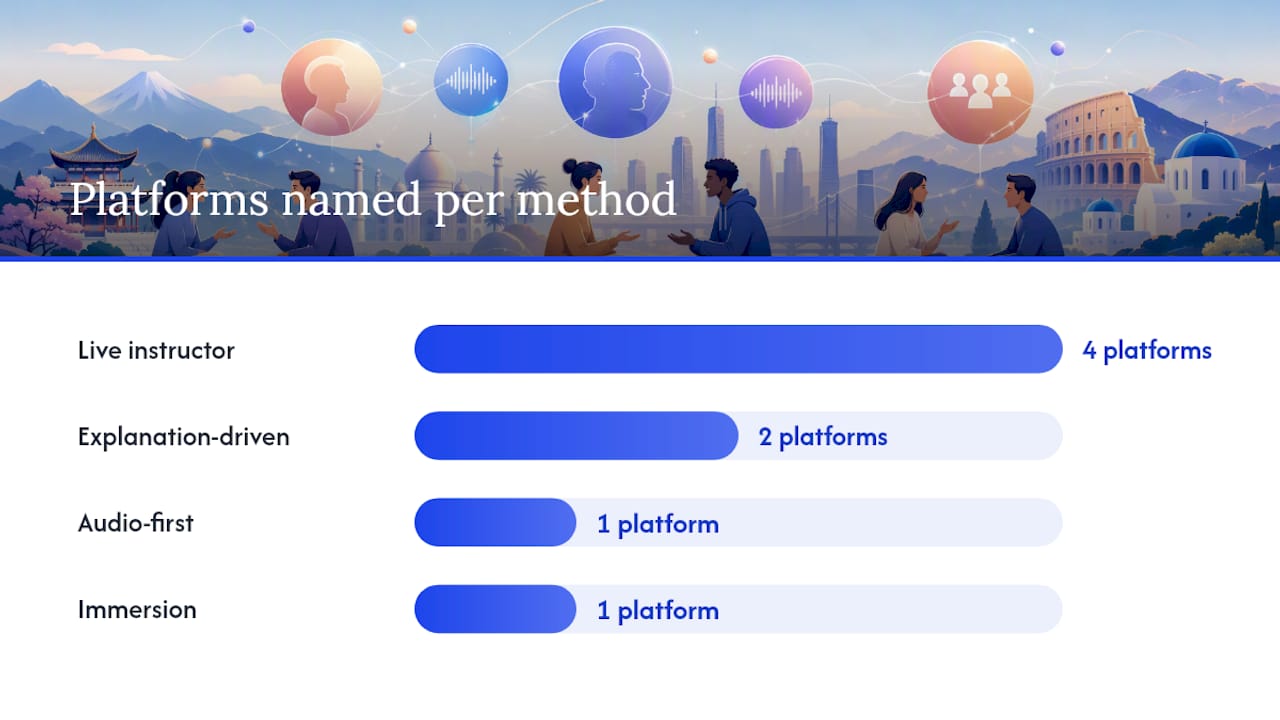
Four method categories to match against your style:
- Explanation-driven: You want grammar rules spelled out. Babbel and Fluenz both fit; Babbel costs less per month.
- Audio-first: You learn by hearing and repeating. Pimsleur is the clearest match.
- Immersion: You prefer context over rules. Rosetta Stone is built for this.
- Live instructor: You need real-time feedback and accountability. Lingoda, italki, Preply, and Spanish Explorer all deliver this, at different price points and structures.
Once you’ve matched the method, ask these questions during any trial period:
- Can I complete a timed speaking task and get feedback within the platform?
- How deep is the grammar track for my specific target language?
- Does the platform work offline if I study during a commute?
- What happens if I want a refund after the first week?
Red flags to watch: opaque per-level pricing with no trial, no speaking practice beyond basic voice recognition, and thin content for your target language beyond beginner level.
Pro Tip: Run a 7–10 day trial focused on three concrete speaking tasks: introduce yourself, describe your daily routine, and ask for directions. Measure how accurately and confidently you can complete each task on day 10 versus day 1. Improvement in those tasks is a more reliable signal than hours logged.
“When comparing platforms, prioritize testing concrete speaking tasks during the trial and measure improvement in accuracy and confidence rather than only time-on-task.” — Test Prep Insight
Offline access is worth testing specifically if you travel or commute. Some review sources note uncertainty around Fluenz’s offline capabilities, so run the same test on any alternative you’re evaluating: download a lesson, put your device in airplane mode, and confirm it plays.
When does Fluenz still make sense, and when should you switch?
Fluenz behaves like a virtual textbook with instructor-led videos and explicit grammar focus. That’s genuinely useful for a specific learner type. The question is whether that learner type is you right now.
Stay with Fluenz if:
- You prefer watching an instructor explain grammar on video before practicing.
- You’re a beginner who needs explicit structure before attempting conversation.
- Your target language is one of the seven Fluenz covers and you want depth over breadth.
Switch if:
- Speaking practice is the bottleneck. Fluenz’s voice exercises don’t replace real conversation feedback.
- You’ve hit an intermediate plateau. Live instruction is the standard recommendation for breaking through a plateau, not a different explanation-first app.
- Budget is the issue. Babbel’s subscription costs a fraction of Fluenz’s per-level pricing.
- You need a language Fluenz doesn’t cover. Its catalog tops out at seven languages.
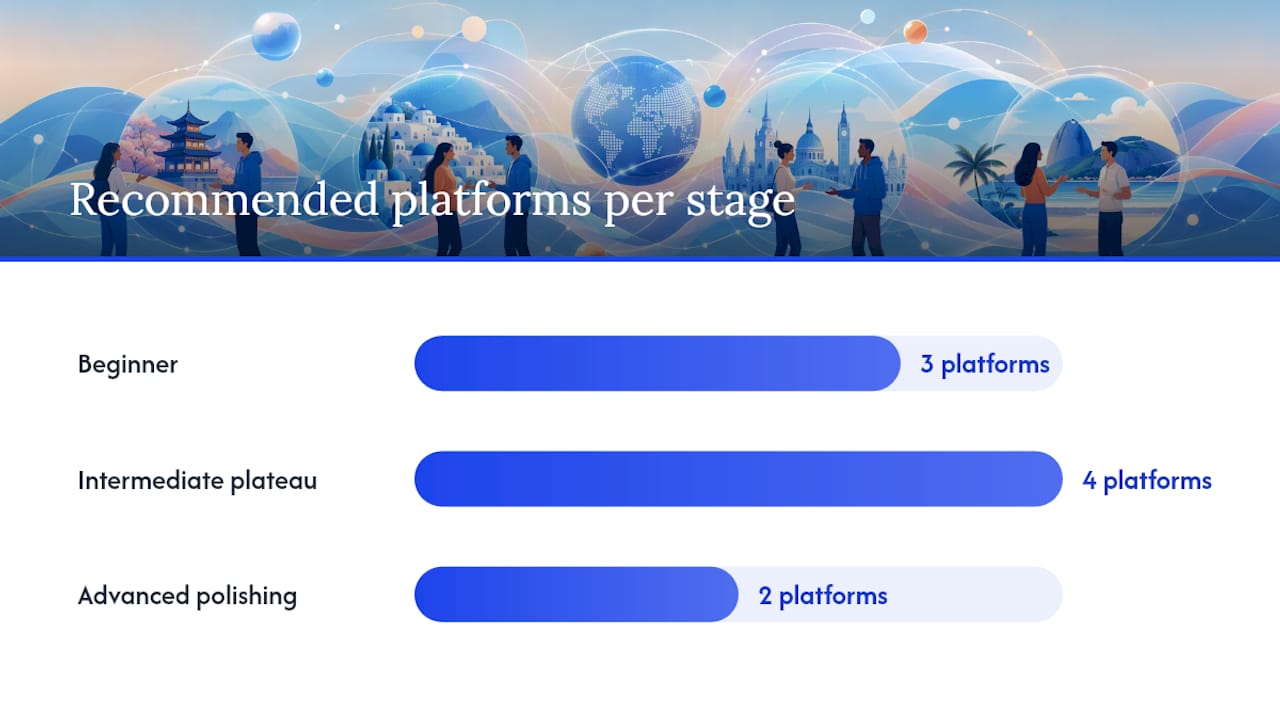
Learner stage matched to the right alternative category:
- Beginner: Babbel or Rosetta Stone for structure; Duolingo for free habit-building.
- Intermediate plateau: Lingoda, italki, Preply, or Spanish Explorer for live speaking practice.
- Advanced polishing: italki or Preply for targeted conversation with a specialist tutor.
Three concrete scenarios: a commuter with 30 minutes each way gets the most from Pimsleur’s audio drills. A business professional preparing for client meetings in Spanish needs live practice with a bilingual instructor, which is exactly what Spanish Explorer’s corporate and conversational classes are built for. A long-term studier working through multiple levels benefits most from a platform with a full multi-level curriculum for their target language, rather than a broad but shallow all-language app.
How we compared these platforms
The primary signals used in this comparison: lesson format, speaking practice availability, curriculum depth, pricing model, trial and refund policy, app and web usability, offline access, and instructor credentials where live classes exist.
| Signal | Positive score | Negative score |
|---|---|---|
| Speaking practice | Live tutors or instructor-led classes | Voice recognition only |
| Curriculum depth | Multi-level track for target language | Beginner-only or thin upper levels |
| Pricing transparency | Clear per-month or per-lesson rate, trial available | Per-level bundles with no trial |
| Trial / refund | 7–30 day trial or money-back guarantee | No trial, no refund |
| Offline access | Full lesson download confirmed | Web-only or unclear |
| Instructor credentials | Certified, bilingual, or verified profile | Unverified community tutors only |
| Mobile app | iOS and Android with offline mode | Web-only |
| Content update frequency | Regular curriculum updates noted | Static content, no update history |
Testing approach: sample lessons were completed across each platform’s free tier or trial window, covering at least three lesson types per platform (grammar, vocabulary, speaking). For marketplace platforms (italki, Preply), tutor profile depth and booking flow were evaluated. Hands-on comparison posts consistently flag lesson length, lesson format, and trial policy as the core decision signals, and those formed the backbone of this evaluation. Third-party review coverage from PCMag, Languavibe, and Test Prep Insight was used to cross-check UX issues and refund policies that vendor pages sometimes omit.
Key Takeaways
The clearest path to choosing a Fluenz alternative is matching the teaching method to how you actually learn, then testing speaking output during the trial rather than measuring time spent.
| Point | Details |
|---|---|
| Match method first | Choose explanation-driven, audio-first, immersion, or live instructor before comparing price. |
| Test speaking tasks | Complete three timed speaking tasks on day 1 and day 10 of any trial to measure real progress. |
| Live classes break plateaus | Intermediate learners stuck on a plateau need live instruction, not another self-study app. |
| Trial and refund matter | Prioritize platforms with a 7–30 day trial or money-back guarantee before committing. |
| Spanish Explorer for live structured practice | Adults wanting bilingual instructor feedback and a structured curriculum can book online Zoom classes with Spanish Explorer. |
What the comparison taught me about language app marketing
Most language app marketing sells the method as if it were the outcome. Rosetta Stone sells immersion; Pimsleur sells speaking; Duolingo sells habit. None of them sell fluency, because fluency is the result of consistent output practice over months, and no app can guarantee that.
The uncomfortable truth about Fluenz specifically: it is an excellent comprehension tool that leaves the hardest part of language learning, producing language under pressure, almost entirely to the learner. That’s not a flaw unique to Fluenz. It’s a structural limit of any prerecorded, self-paced course. The moment you need to respond to a real person in real time, the gap between what you’ve studied and what you can say becomes obvious.
That’s why the intermediate plateau is so common among self-study learners. They’ve consumed hundreds of hours of content and still freeze in conversation. The fix isn’t more content. It’s more output, preferably with someone who can correct you in the moment.
The platforms that actually close that gap are the ones with a real human on the other end: Lingoda, italki, Preply, and Spanish Explorer. The rest are preparation for conversation, not conversation itself. That distinction is worth more than any feature comparison table.
Spanish Explorer’s online Zoom classes are built for what Fluenz can’t do
Apps like Pimsleur, Babbel, and Rosetta Stone are solid preparation tools. But if speaking Spanish with confidence is the actual goal, prerecorded lessons only get you so far. Spanish Explorer’s online Spanish courses deliver what self-study platforms structurally can’t: a bilingual instructor who hears you, corrects you, and adjusts the lesson in real time.
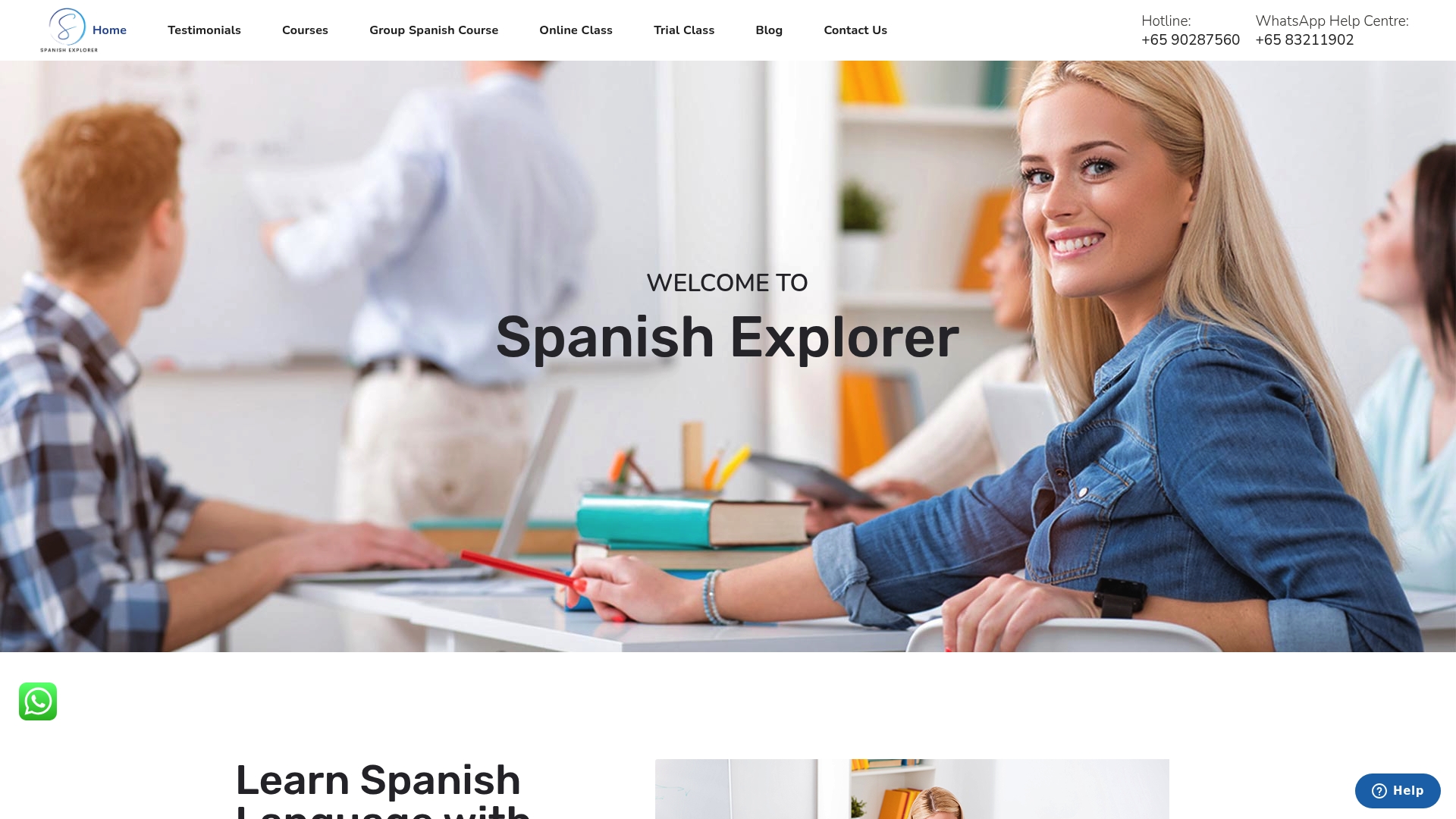
Classes run via Zoom for adult learners focused on conversational and business Spanish. Group sessions keep costs manageable; private Zoom lessons accelerate progress for learners with specific goals or tighter schedules. Corporate training is available for teams preparing for Spanish-speaking markets or clients.
The instructors are certified, bilingual in Spanish and English, and experienced with adult learners who arrive with grammar knowledge but limited speaking confidence. That combination, structured curriculum plus live feedback, is the specific gap Fluenz leaves open. If you’re ready to move from studying Spanish to actually speaking it, check available class schedules at Spanish Explorer and book a session.
Where to check the latest pricing, trials, and specs
Pricing and trial windows change frequently. Before committing to any platform, verify current rates and refund terms directly on the vendor’s site. These sources are worth bookmarking:
- PCMag’s Fluenz review covers lesson format, UX, and how Fluenz compares to alternatives in depth.
- Test Prep Insight’s Fluenz vs. Pimsleur comparison is one of the more thorough hands-on comparisons for audio-first vs. explanation-driven methods.
- Languavibe’s Fluenz review covers pricing structure and catalog depth with regular updates.
- Cornell Language Resource Center and Harvard’s language learning resources page list vetted tools for serious learners.
- Official vendor trial pages: Babbel (20-day money-back), Rosetta Stone (30-day), Pimsleur (7-day free trial), Duolingo (free tier, no expiry), Busuu (14-day free trial).
Always confirm whether your target language is fully covered at the level you need, not just listed. A platform that offers 40 languages but only beginner content for yours is not a useful alternative. And run the offline test before you travel.
FAQ
Is Fluenz worth it?
Fluenz is worth it for learners who want deep, explanation-driven video lessons and explicit grammar instruction. If speaking practice or budget is the priority, alternatives like Pimsleur, Babbel, or live-class platforms deliver better value for those specific goals.
How much does Fluenz cost?
Fluenz is sold per level or as a bundle rather than a monthly subscription, which makes it pricier upfront than subscription apps like Babbel or Duolingo. A 30-day money-back guarantee is offered. Check the current per-level pricing directly on fluenz.com, as rates are updated periodically.
How much does Fluenz’s Spanish Bootcamp cost?
Fluenz’s Spanish Bootcamp is an intensive in-person program with tuition listed per person per week on the Fluenz Bootcamp page. The figure changes, so verify the current rate before planning travel.
What is Fluenz?
Fluenz is a language learning platform that uses instructor-led video lessons and explicit grammar explanations to teach languages, covering seven languages including Spanish, French, and Mandarin. It positions itself as a virtual classroom rather than a gamified app.
Which Fluenz alternative is best for speaking practice?
For speaking practice, live-class platforms (Lingoda, Spanish Explorer) and tutor marketplaces (italki, Preply) outperform self-study apps because they provide real-time human feedback. Pimsleur is the strongest audio-only alternative for building oral fluency without a live instructor.
Recommended
Start Learning Spanish Today
Book a trial class and see how quickly you can progress with a professionally trained native-speaker teacher guiding the way.
Book a Trial Class