 Spanish
TL;DR:
- Group classes are highly effective for adult language learners because they foster peer accountability, real-time feedback, and frequent speaking practice. Research shows they have higher course completion rates and reduce cognitive load through collaborative tasks, enhancing fluency and motivation. Combining group classes with private lessons or self-study offers the best long-term retention and targeted error correction.
Group classes are the most effective social structure for adult language acquisition because they combine peer accountability, real-time feedback, and high-frequency speaking practice into a single learning environment. Solo study with apps like Babbel builds vocabulary, but it cannot replicate the pressure and reward of speaking in front of real people. The role of group classes in language learning goes beyond convenience. It activates psychological mechanisms that solo methods simply cannot trigger. Spanish Explorer, Singapore’s dedicated Spanish language school, sees this difference play out in every cohort.
How do group classes improve language learning outcomes?
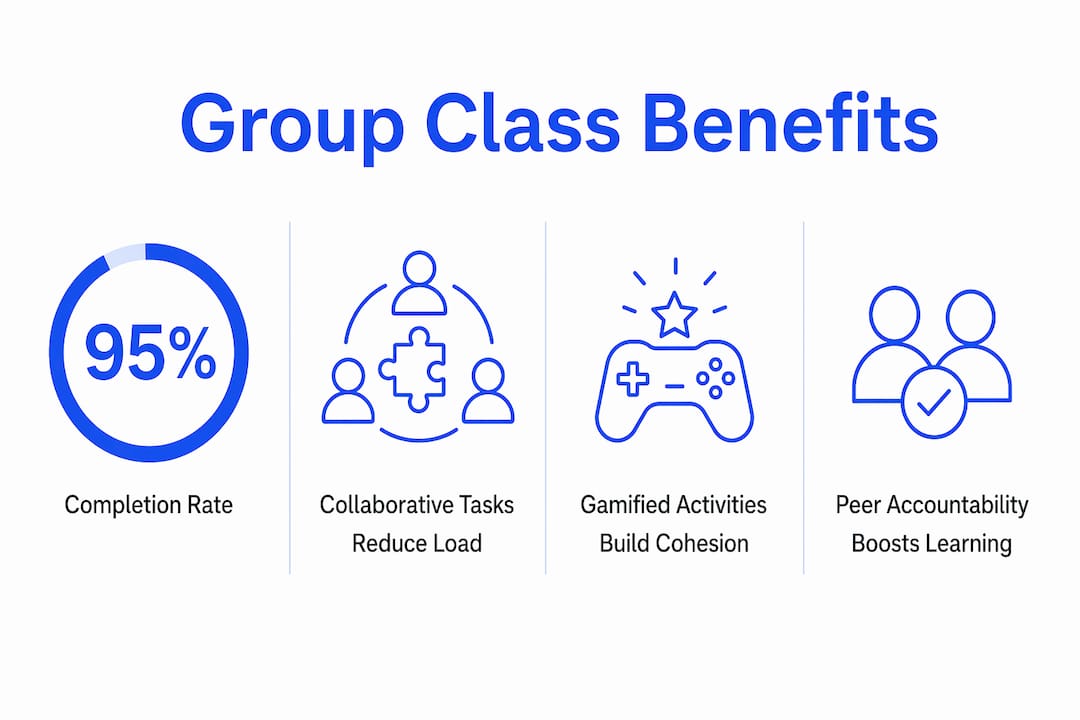
The evidence behind group language learning benefits is concrete and measurable. Participants in group programs complete structured courses at a 95% rate, compared to 76% for solo learners. That 19-point gap is not about content quality. It is about social accountability. When classmates expect you to show up, you show up.

A 2026 Springer study found that collaborative tasks reduce cognitive load in second language acquisition by allowing learners to pool resources and negotiate meaning together. Researchers call this the “Foreign Language Side Effect,” where processing a new language demands so much mental energy that comprehension suffers. Group work distributes that load across multiple minds.
A separate systematic review of 19 studies confirmed that gamified collaborative activities build social cohesion and peer interdependence, two factors that are especially critical for adult learners who need external motivation to maintain consistency.
| Research Finding | What It Means for You |
|---|---|
| 95% vs. 76% course completion rate | Group accountability keeps you enrolled and progressing |
| Reduced cognitive load in group tasks | Shared problem-solving makes complex grammar easier to absorb |
| Social cohesion from gamified activities | Peer bonds increase motivation beyond the classroom |
| Köhler Effect in group settings | Weaker performers raise their effort to match the group standard |
The Köhler Effect describes a well-documented behavioral pattern where individuals in a group work harder than they would alone, particularly when they perceive themselves as the weakest member. In a Spanish class, this means the beginner who struggles with verb conjugations pushes harder because the group’s momentum pulls them forward.
Pro Tip: Choose a group class where the proficiency range is narrow. A class where everyone is within one level of each other maximizes the Köhler Effect without leaving anyone behind.
Group classes vs. private lessons: which works better?
The honest answer is that both methods solve different problems. Group classes win on speaking volume, peer exposure, and motivation. Private lessons win on targeted error correction and personalized pacing. The question is not which is better. The question is which gap you need to close right now.
What group classes do better
Group settings generate more speaking opportunities per session than most learners realize. When a class of six practices a dialogue, each student hears five different versions of the same sentence. That repetition with variation is how the brain internalizes grammar patterns. Babbel’s analysis confirms that group classes create a feedback loop where learners improve by watching peers struggle and succeed with the same material.
Group classes also expose you to different accents, speech rhythms, and vocabulary choices within the same target language. In a Spanish class in Singapore, you might practice with classmates from different professional backgrounds, each using Spanish in a different context. That variety builds listening flexibility faster than any textbook exercise.
Where private lessons have the edge
Private lessons allow an instructor to focus entirely on your specific error patterns. If you consistently confuse the subjunctive mood or mispronounce the Spanish “r,” a private session can address that in 20 minutes. A group class cannot stop for one student’s recurring mistake without disrupting the flow for everyone else.
A hybrid learning approach that combines group classes for routine practice with private sessions for targeted grammar work produces the highest long-term retention. This is the structure that serious adult learners use most effectively.
Key differences at a glance:
- Group classes: Higher speaking volume, peer feedback, social motivation, lower cost per session
- Private lessons: Personalized error correction, flexible pacing, focused grammar targeting
- Hybrid approach: Group sessions maintain momentum; private sessions fix specific weaknesses
- Best for beginners: Group classes build confidence through shared struggle
- Best for intermediate learners: Hybrid model accelerates progress most efficiently
For a detailed breakdown of how private Spanish lessons complement group work, Spanish Explorer’s guide covers the practical decision points clearly.
How do peer dynamics affect group class effectiveness?
Group dynamics in language education can either accelerate or stall your progress, depending on how well the class is managed. The two most common problems are peer dominance and background clustering. Peer dominance happens when one or two confident speakers monopolize conversation time. Background clustering happens when learners from the same native language gravitate toward each other and default to their shared tongue.
Research on Indonesian EFL learners in an Australian university setting found that instructor-managed feedback scripts that preserve self-respect significantly improve group learning outcomes. The key word is “self-respect-preserving.” Adult learners stop speaking when they fear public embarrassment. A skilled instructor redirects errors without singling out the student, which keeps everyone willing to take risks.
What good group facilitation looks like
Effective facilitation includes three specific practices. First, the instructor assigns rotating roles so that quieter students take turns leading discussions. Second, the instructor uses structured pair work that changes partners each session, preventing background clustering. Third, feedback is delivered to the group as a pattern observation rather than as individual correction.
Pro Tip: Before enrolling in any group Spanish class, ask the school how they manage speaking time distribution. A school that cannot answer that question clearly has not thought carefully about group dynamics.
Social interdependence formed through collaborative language activities sustains adult learner engagement over time. That interdependence only develops when the group structure is diverse and equitable. A well-facilitated group class at Spanish Explorer, for example, uses structured activities that rotate participation and prevent any single learner from dominating the session.
For practical ideas on how Spanish speaking activities are structured in collaborative settings, the linked resource covers five formats that work well in adult group classes.
How can you maximize learning in a spanish group class?
Getting the most from cooperative language learning requires active strategy, not passive attendance. Showing up is the minimum. The learners who progress fastest treat each session as a performance opportunity, not a classroom exercise.
Here is a practical framework for maximizing group class outcomes:
-
Prepare before each session. Review vocabulary from the previous class for 10 minutes before you arrive. Preparation converts passive recognition into active recall, which is what speaking requires.
-
Speak first, correct later. The instinct to wait until you are sure you are right is the single biggest barrier to fluency. In a group class, mistakes are the curriculum. Emotional support and friendly competition in group settings push learners to attempt more than they would alone.
-
Use peer errors as learning signals. When a classmate makes a mistake and the instructor corrects it, that correction applies to you too. Treat every correction in the room as your own. This is the feedback loop that Babbel identifies as one of the core advantages of group learning over solo study.
-
Seek variety in your practice partners. If your class allows partner rotation, always choose someone you have not worked with recently. Different partners expose you to different vocabulary habits and pronunciation patterns.
-
Supplement with focused self-study. Use tools like Babbel or Anki for vocabulary drilling between sessions. Reserve group class time for speaking and listening practice, not memorization. A hybrid learning strategy that pairs group sessions with self-study produces measurably better retention than either method alone.
-
Track your speaking time. After each class, estimate how many minutes you actually spoke in Spanish. If the number is under 10 minutes in a 90-minute class, you are not getting full value. Raise your hand more, volunteer for role plays, and ask questions in Spanish.
Key takeaways
Group classes accelerate Spanish acquisition because they combine social accountability, peer feedback, and high-frequency speaking practice in ways that solo study and apps cannot replicate.
| Point | Details |
|---|---|
| Completion rates favor groups | Group learners complete courses at 95% vs. 76% for solo learners, driven by social accountability. |
| Cognitive load is shared | Collaborative tasks reduce the mental strain of processing a new language by distributing the work. |
| Peer dynamics require management | Instructor facilitation prevents dominance and keeps speaking time equitable across all learners. |
| Hybrid approach wins long-term | Combining group classes with private sessions or self-study produces the highest retention rates. |
| Active participation is non-negotiable | Tracking your speaking time and preparing before each session determines how fast you progress. |
Why group classes clicked for me as an adult spanish learner
I have spent years watching adult learners try to acquire Spanish through apps, textbooks, and weekly private sessions. The pattern is consistent. They build solid passive vocabulary. They can read menus and understand slow podcast episodes. Then they freeze the moment a native speaker talks to them at normal speed.
Group classes solve that specific problem in a way nothing else does. The pressure of speaking in front of peers, even friendly ones, activates a different kind of mental processing. You cannot pause and look up a word. You have to retrieve it, approximate it, or ask for help in Spanish. That retrieval pressure is exactly what builds fluency.
What surprises most learners is how much they learn from watching others. When a classmate attempts a sentence and gets the gender agreement wrong, and the instructor gently redirects, that correction lands for everyone in the room. It is a live demonstration of a rule you have read in a textbook but never seen fail in real time.
The limitation I always acknowledge is that group classes cannot fix your specific recurring errors at scale. A group instructor cannot stop every 10 minutes to address one student’s persistent confusion with the subjunctive. That is where private sessions earn their place. The learners I have seen make the fastest progress use group classes to build speaking confidence and volume, then use private coaching to target the gaps that group settings cannot address efficiently.
The social dimension is also underrated. Adult learners who form genuine connections with classmates practice outside of class. They message each other in Spanish, meet for coffee, and hold each other accountable between sessions. That informal practice time compounds over months and produces results that no structured curriculum alone can match.
— Paul
Learn spanish collaboratively at spanish explorer
Spanish Explorer’s group Spanish courses are structured specifically for adult learners who want to build real conversational ability, not just textbook knowledge. Classes are kept small to maximize speaking time per student, and instructors use facilitation methods that distribute participation equitably across every session.

For learners who want to address specific grammar gaps alongside their group work, Spanish Explorer also offers private class options that pair naturally with the group schedule. Both formats are available in person at International Plaza, above Tanjong Pagar MRT, and online via Zoom for learners across Singapore. If you are ready to practice Spanish with a community that holds you accountable, Spanish Explorer is the place to start.
FAQ
What is the main benefit of group classes for language learning?
Group classes provide social accountability and high-frequency speaking practice that solo study cannot replicate. Research shows group learners complete structured courses at a 95% rate, compared to 76% for solo learners.
Are group classes or private lessons better for learning spanish?
Group classes build speaking confidence and peer feedback skills faster, while private lessons target individual error patterns more precisely. A hybrid approach combining both methods produces the highest long-term retention.
How do group dynamics affect language learning progress?
Poorly managed group dynamics, such as peer dominance or background clustering, can limit speaking opportunities. Instructor-facilitated role rotation and structured partner work prevent these issues and keep participation equitable.
Can group classes help with speaking anxiety in spanish?
Group classes reduce speaking anxiety over time because the shared struggle normalizes mistakes. Emotional support and friendly competition in group settings push learners to attempt more than they would in solo practice.
How many people should be in a spanish group class?
Smaller groups of 6–10 learners give each student more speaking time and allow the instructor to monitor participation effectively. Classes larger than 12 tend to reduce individual speaking opportunities significantly.
Recommended
- Learn Spanish in Singapore | Spanish Language Centre
- What is a group Spanish class? Benefits and how to choose
- Spanish Courses in Singapore | Spanish Language Centre
- Spanish Courses in Singapore | Spanish Language Centre
Start Learning Spanish Today
Book a trial class and see how quickly you can progress with a professionally trained native-speaker teacher guiding the way.
Book a Trial Class