 Spanish
TL;DR:
- Engaging employees in Spanish learning requires a structured approach involving phased communication and manager support. Personalized curricula aligned with job roles and daily practice help sustain motivation and long-term commitment. Most programs fail without visible leadership involvement, cultural integration, and content relevance to real work situations.
Engaging employees in Spanish learning is defined as a structured, multi-layered effort that combines strategic communication, manager accountability, and role-relevant training to drive real participation and skill growth. Generic language programs fail because they treat all employees the same. The most effective corporate language training programs use phased communication timelines, empowered managers, personalized curricula, and daily practice habits to build lasting engagement. This guide gives HR professionals and managers a clear, step-by-step framework to launch and sustain Spanish learning for employees across any team size or industry.
How to engage employees in Spanish learning from day one
The foundation of any successful employee Spanish program is a deliberate communication plan that starts before the first lesson. A phased communication timeline begins two weeks before launch with a message from senior leadership explaining the strategic value of Spanish skills for the business. That message sets the tone. Employees take the program seriously when they see the CEO or department head endorse it directly.
During launch week, HR takes over the messaging and shifts the focus to personal benefits. This is where you explain what employees gain: career advancement, stronger client relationships, and confidence in cross-cultural settings. The key Spanish communication skills that matter most for professional growth should be front and center in this messaging.
Two weeks after launch, the communication strategy shifts again. Share peer success stories and early progress highlights to show that real employees are benefiting. This social proof is one of the most underused tools in corporate language programs.
Here is a practical three-phase communication sequence you can adapt:
- Two weeks before launch: Senior leadership sends a company-wide message explaining why Spanish matters for the business, naming specific markets, clients, or growth goals.
- Launch week: HR distributes a personal benefits overview, enrollment instructions, and a short FAQ. Use video, email, and a live Q&A session to reach different communication preferences.
- Two weeks post-launch and ongoing: Share learner testimonials, progress milestones, and monthly updates. Keep the program visible in internal newsletters and team meetings.
Pro Tip: Use at least three different formats in your launch communication. A short video from the CEO, a written email from HR, and a live Q&A session together reach employees who respond to different channels.
How does manager involvement affect language training outcomes?
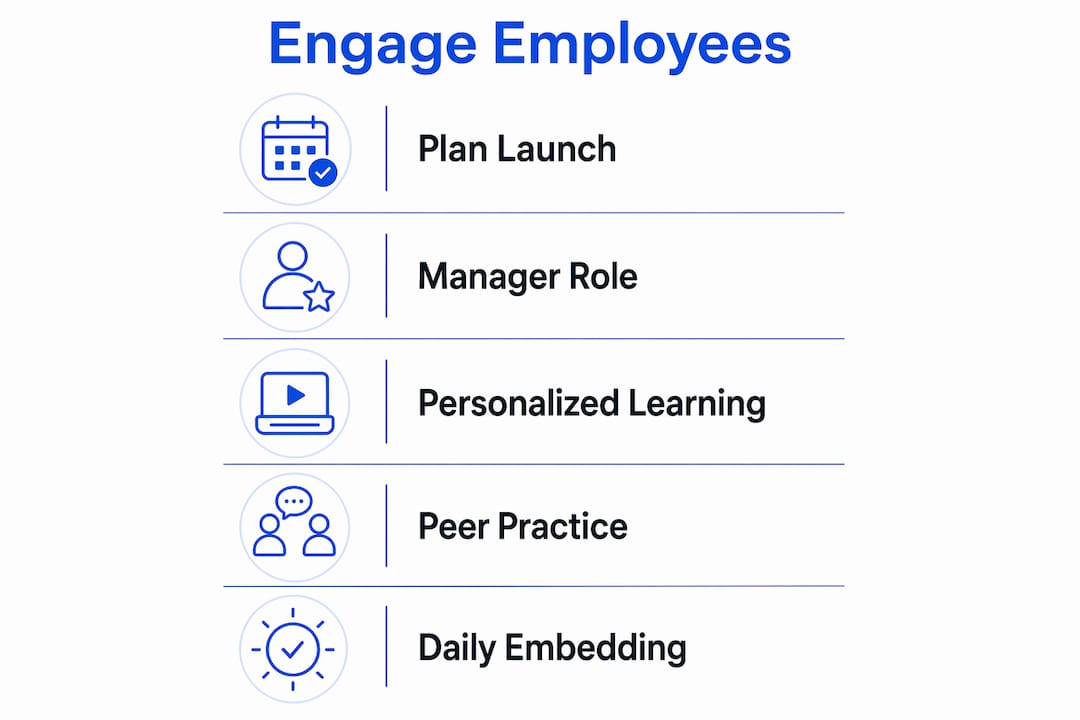
Manager involvement is the single biggest predictor of whether employees complete a language program. Active manager support, including brief weekly check-ins of about five minutes and creating small practice moments in team meetings, significantly increases both completion rates and motivation. Managers do not need to be Spanish speakers themselves. They need to show that learning matters.
Here are the most effective ways managers can support Spanish learners on their teams:
- Ask about progress in one-on-ones. A simple “How is your Spanish course going?” signals that the manager values the effort.
- Create low-stakes practice moments. Start a team meeting with a Spanish greeting or ask a learner to introduce a topic in Spanish for two minutes.
- Recognize improvement publicly. Acknowledge milestones in team meetings or on internal communication platforms like Microsoft Teams or Slack.
- Provide simple resources. Give managers a one-page guide with conversation starters, milestone markers, and recognition ideas so they do not have to figure it out alone.
- Connect learning to performance goals. Where relevant, include language development as part of an employee’s professional growth plan.
Pro Tip: Identify two or three enthusiastic early adopters on each team and designate them as language champions. These peers drive organic encouragement far more effectively than top-down mandates.
Designing Spanish training that employees actually want to complete
Generic courses lose employees fast. Personalized learning plans tied to an employee’s actual job tasks drive stronger engagement than one-size-fits-all curricula. The fix is straightforward: assess proficiency first, then build lessons around real work scenarios.

Start with a short language proficiency assessment to place employees at the right level. Then build the curriculum around their roles. A sales manager needs vocabulary for client negotiations. An operations coordinator needs language for vendor calls and logistics. A marketing professional needs skills for writing briefs and presenting to Spanish-speaking stakeholders.
The table below shows how training design changes based on role and goal:
| Employee role | Training focus | Delivery format |
|---|---|---|
| Sales and business development | Negotiation phrases, client greetings, pitch vocabulary | Group class with role-play scenarios |
| Operations and logistics | Vendor communication, scheduling, written instructions | Private lessons with written practice |
| Marketing and communications | Copywriting, presentations, cultural tone | Online Zoom sessions with feedback |
| HR and people management | Interview language, onboarding scripts, policy explanations | Blended group and self-study |
Flexible scheduling and microlearning also increase participation by letting employees fit short, frequent lessons into their workday without disrupting project deadlines. Mobile access removes the last barrier. When employees can complete a 15-minute lesson on their phone between meetings, the program becomes part of the day rather than an interruption to it.
Peer practice groups and buddy systems build confidence and community at the same time. Pairing a beginner with an advanced learner or a native speaker creates natural accountability. It also makes the learning social, which accelerates retention.
What are the best ways to embed Spanish into daily work?
Embedding Spanish into daily workflows is the most reliable way to normalize the habit and improve long-term retention. Daily language practice in authentic work tasks increases motivation because employees see immediate, real-world relevance. The goal is to make Spanish visible and usable, not confined to a classroom or app.
Practical ways to integrate Spanish into the workday include:
- Open meetings with a Spanish phrase. Rotate the responsibility so different team members lead the greeting each week.
- Assign mini-presentations in Spanish. Ask learners to summarize a project update or client brief in Spanish for two to three minutes before switching back to English.
- Run monthly language challenges. Set a team goal, such as learning 20 industry-specific words in a week, and track progress on a shared board.
- Organize conversation clubs. A weekly 30-minute informal lunch session where employees practice Spanish together builds community and accountability without formal structure.
- Use native speakers as mentors. If your team includes Spanish-speaking colleagues or clients, create structured opportunities for learners to practice with them.
Cultural content in language programs also matters. Understanding negotiation styles, meeting etiquette, and communication norms across Spanish-speaking markets makes employees more effective and keeps them interested in learning beyond vocabulary. Social interaction in language learning accelerates acquisition by creating real communicative pressure and emotional connection to the language.
Pro Tip: Create a dedicated channel on your internal messaging platform for Spanish practice. Employees can post a word of the day, share a phrase they used with a client, or ask quick grammar questions. Low effort, high visibility.
How do you measure and sustain long-term Spanish program engagement?
Measuring program success requires tracking both participation data and behavioral change. Participation rates and lesson completion tell you who is showing up. Behavioral change, such as employees using Spanish in client emails or meetings, tells you whether the program is working. Both matter.
Here is a practical framework for sustaining engagement over time:
- Track participation monthly. Monitor enrollment, lesson completion rates, and assessment scores. Flag employees who have gone inactive and follow up through their manager.
- Collect feedback every quarter. Use a short survey to ask what is working, what is not, and what employees want to learn next. Act on the results visibly so employees trust the feedback loop.
- Share success stories regularly. Monthly communications featuring learner stories and leader endorsements maintain motivation and reinforce the program’s value across the organization.
- Update learning materials twice a year. Stale content kills engagement. Refresh scenarios, add new vocabulary sets, and introduce new cultural topics to keep the program current.
- Celebrate milestones publicly. Recognize employees who complete a course level, pass a proficiency check, or use Spanish successfully in a real business context. Public recognition from senior leaders carries the most weight.
Setting clear Spanish learning goals at the start of the program gives employees a personal benchmark to work toward. Goals tied to career outcomes, such as leading a client call in Spanish or completing a business writing module, are more motivating than abstract proficiency targets.
Key Takeaways
Engaging employees in Spanish learning requires a structured combination of phased communication, manager accountability, personalized training, and daily practice integration to produce measurable results.
| Point | Details |
|---|---|
| Phased communication drives launch success | Start with senior leadership messaging two weeks before launch, then shift to personal benefits and peer stories. |
| Manager involvement increases completion | Weekly five-minute check-ins and public recognition from managers significantly improve participation rates. |
| Role-relevant training boosts motivation | Tailor curricula to job tasks and proficiency levels so employees see immediate, practical value in every lesson. |
| Daily integration normalizes the habit | Embedding Spanish into meetings, challenges, and conversation clubs makes learning part of the workday. |
| Measurement sustains long-term engagement | Track participation, collect quarterly feedback, and celebrate milestones to keep the program alive and improving. |
Why most corporate Spanish programs quietly fail after month two
I have seen this pattern more times than I care to count. A company launches a Spanish program with genuine enthusiasm, strong enrollment numbers, and a well-designed curriculum. By week six, participation has dropped by half. By month three, only the employees who were already motivated are still showing up.
The failure is almost never about the quality of the lessons. It is about what happens outside the classroom. When managers do not ask about progress, employees read that as permission to deprioritize it. When the program is mandatory but culturally invisible, employees complete the minimum and move on. When training content has no connection to real job tasks, the motivation to continue simply evaporates.
The programs I have seen sustain real engagement share three things. First, a visible senior leader who participates, not just endorses. Second, a small group of enthusiastic early adopters who make learning social and fun. Third, training content that employees can use the next day in an actual work conversation.
Voluntary participation consistently outperforms mandatory enrollment. That does not mean you should not encourage broad participation. It means the culture around the program matters more than the enrollment policy. Build the culture first, and the numbers will follow.
Start smaller than you think you need to. Run a pilot with one team, get the design right, collect strong success stories, and then scale. A well-run program with 20 engaged learners does more for your organization than a poorly supported program with 200 reluctant ones.
— Paul
How Spanish Explorer helps companies build engaged learners
Spanish Explorer’s corporate Spanish programs are built specifically for working professionals in Singapore who need real communication skills, not just classroom theory. Whether your team learns through online Zoom sessions, private lessons, or structured group classes, every program is taught by experienced, certified instructors fluent in both Spanish and English.
The corporate Spanish courses at Spanish Explorer are designed around your team’s actual roles, communication goals, and scheduling needs. Curricula are personalized from the first session, so employees build skills they can use immediately. Spanish Explorer is located at 10 Anson Road, Level 22, International Plaza, Singapore 079903, directly above Tanjong Pagar MRT, making in-person sessions easy to access for CBD-based teams.
Contact Spanish Explorer to discuss a corporate training plan that fits your team’s goals and timeline.
FAQ
How do you engage employees in Spanish learning from the start?
Launch with a senior leadership message two weeks before the program begins, explaining the business case for Spanish skills. Follow up during launch week with personal benefits and enrollment details from HR.
What role do managers play in employee language training?
Managers who ask about progress in one-on-ones and create small practice moments in meetings significantly increase completion rates. They do not need to speak Spanish themselves to be effective supporters.
Is voluntary or mandatory enrollment better for Spanish programs?
Voluntary participation consistently produces higher engagement than mandatory enrollment. Building a positive culture around the program through language champions and peer recognition drives broader participation organically.
How can companies embed Spanish practice into daily work?
Start meetings with a Spanish greeting, run monthly vocabulary challenges, and create a dedicated internal channel for daily practice. These low-effort habits normalize language use outside formal lessons.
How do you measure the success of a workplace Spanish program?
Track monthly participation rates, lesson completion scores, and behavioral changes such as employees using Spanish in client communications. Collect quarterly feedback and share learner success stories to sustain motivation.
Recommended
- How to structure workplace Spanish lessons for results
- Master an Efficient Workflow for Learning Spanish Online
- Spanish Training for Professionals: Your Career Guide
- How to Set Spanish Learning Goals That Stick
Start Learning Spanish Today
Book a trial class and see how quickly you can progress with a professionally trained native-speaker teacher guiding the way.
Book a Trial Class