 Spanish
TL;DR:
- Mastering Spanish presentations involves delivering clear, structured, and culturally appropriate content with confidence.
- Using signposting phrases, formal language, and a concise slide design ensures audience engagement and comprehension.
Mastering Spanish presentations is defined as the ability to deliver structured, culturally appropriate, and engaging content in Spanish with enough confidence to hold any professional audience. Whether you are pitching to a client in Madrid, presenting quarterly results to a Latin American team, or speaking at a business conference in Singapore, the same core skills apply. You need clear structure, precise language, purposeful visuals, and deliberate practice. Tools like PowerPoint, Google Slides, and Grammarly support the process, but they are secondary to knowing your audience and your message. This guide gives you a practical, step-by-step path to get there.
What are the essential components of an effective Spanish presentation?
Effective Spanish presentations follow a tripartite structure: a concise introduction, a body with 2–4 key points, and a conclusion that summarizes your message. This structure is not just a template. It is the framework that keeps your audience oriented from the first sentence to the last.
Structure and signposting phrases
Spanish audiences expect clear verbal signposts. Open with a formal greeting and a statement of purpose. Use phrases like “En primer lugar” to introduce your first point, “A continuación” to move between sections, and “Para concluir” to signal your closing. These phrases do the same job as road signs. Without them, your audience loses track of where you are in the argument.
Formal language matters throughout. Address your audience with “usted” in professional settings rather than the informal “tú.” Use polite verb forms and avoid slang entirely. A single informal phrase in a corporate setting can undercut the credibility you have spent the whole presentation building.
Slide design fundamentals
The 6×7 rule is the single most practical rule for slide design: no more than 6 lines of text per slide and no more than 7 words per line. That constraint forces you to speak your content rather than read it off the screen. Your audience came to hear you, not to read a document projected on a wall.
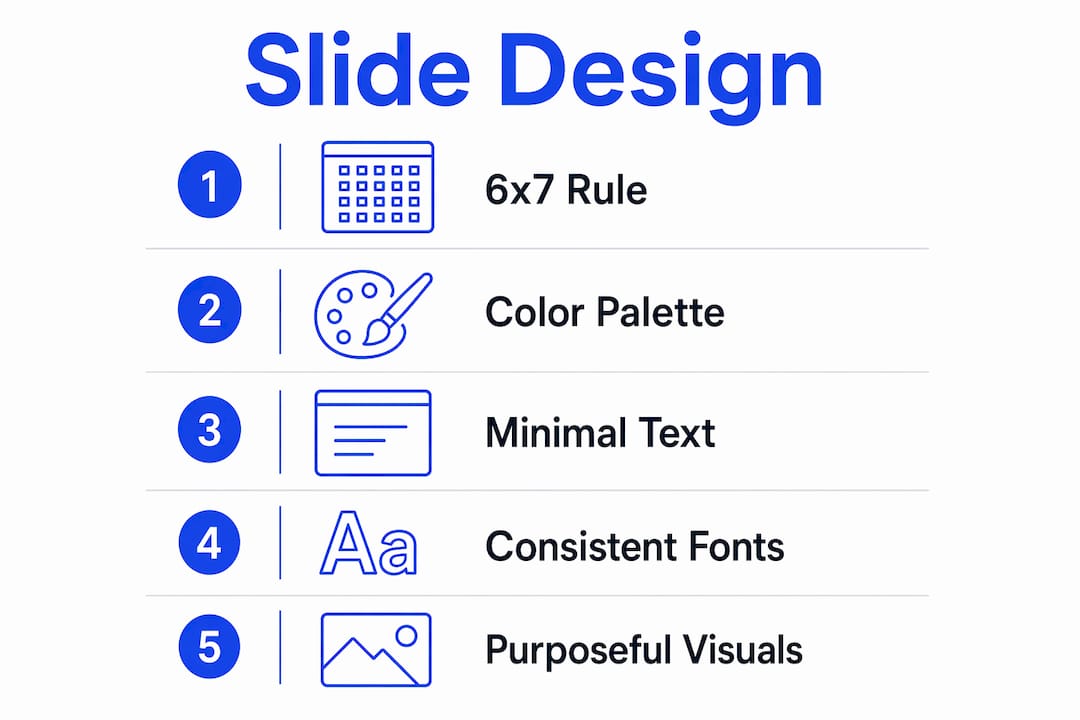
Color choice also affects how your audience receives your message. Limit your palette to 4–5 coherent colors. More than that creates visual noise. Fewer than three can feel flat and unengaging.
| Element | Rule | Why it matters |
|---|---|---|
| Text per slide | Max 6 lines, 7 words per line | Keeps speaker as the focal point |
| Color palette | 4–5 coherent colors | Reduces visual noise, improves focus |
| Images | Authentic, high-resolution only | Reinforces message, avoids distraction |
| Font style | Consistent, readable typeface | Signals professionalism and clarity |
Pro Tip: Build your slide deck last. Write your full script first, then decide what belongs on screen. Most professionals do it backward and end up with slides that compete with their voice.
Pacing and vocal delivery
Pacing is a delivery skill most presenters underestimate. Speak slightly slower than feels natural to you. Your audience is processing both the language and the content simultaneously. Vocal variety, including changes in pitch and volume, keeps attention alive across a 20-minute presentation.

How can you prepare your Spanish presentation content effectively?
Audience understanding must come before slide design. Know who is in the room, what they already know, and what decision or action you want from them. That clarity shapes every word you choose.
Here is a practical preparation sequence that works for both conversational and business Spanish contexts:
- Define your core message. Write one sentence that captures what you want your audience to remember. Everything else in the presentation supports that sentence.
- Build your vocabulary list. Identify the professional or technical terms specific to your topic. Learn them before you write your script, not after.
- Write a full script using formal language. Use business vocabulary and avoid colloquial shortcuts. Tools like Grammarly catch grammar errors and flag awkward phrasing in Spanish text.
- Practice pronunciation of difficult sounds. Clear enunciation of consonants like “d,” “r,” and “s” is critical. A fast or mumbled delivery creates comprehension barriers even for fluent listeners.
- Build in strategic pauses. Pause for 2–3 seconds after each key point. That silence gives your audience time to absorb what you just said before you move on.
Pro Tip: Record a 3-minute section of your presentation and play it back at 1.25x speed. If you can still follow the argument clearly at that pace, your delivery is tight enough. If it sounds rushed, slow down.
Knowing key Spanish communication skills beyond vocabulary also helps. Register, tone, and cultural awareness all shape how your message lands. A technically correct sentence delivered in the wrong register can still confuse or alienate a professional audience.
What are best practices for designing visuals in Spanish presentations?
Visuals should complement your spoken content, not replace it. The moment your audience is reading your slide, they have stopped listening to you. That is a problem you design your way out of before you ever step in front of a room.
- Apply the 6×7 rule without exception. Six lines maximum, seven words per line. If a point needs more explanation, that explanation belongs in your spoken delivery.
- Use authentic, high-resolution images. Authentic images that directly relate to your message reinforce what you are saying. Generic clipart does the opposite. It signals low effort and distracts from your argument.
- Limit your color palette to 4–5 colors. Choose colors that carry emotional weight appropriate to your topic. Blues and grays signal professionalism. Warm tones signal energy and creativity.
- Keep font styles consistent. Use one typeface for headings and one for body text. Mixing three or more fonts makes slides look unfinished.
- Avoid decorative elements with no function. Every visual element on a slide should earn its place by supporting the message. If removing it changes nothing, remove it.
| Approach | Effective | Ineffective |
|---|---|---|
| Images | High-resolution, topic-specific photos | Generic clipart or stock filler |
| Text density | 6 lines max, 7 words per line | Full paragraphs on screen |
| Color | 4–5 coherent, purposeful colors | 8+ colors with no visual logic |
| Fonts | 1–2 consistent typefaces | 3+ mixed styles |
The 6×7 rule prevents audience disengagement by keeping the speaker as the focal point of the room. When slides are dense with text, the presenter becomes a narrator rather than a communicator. That shift costs you authority and attention.
How should you practice and deliver your Spanish presentation?
Practicing aloud daily and recording yourself are the two most effective rehearsal habits for building confident Spanish speaking. Self-recording reveals pronunciation gaps, pacing problems, and filler words that you cannot detect in your own head.
- Record yourself daily. Listen back with the goal of catching one specific issue per session. Fix that issue before the next recording.
- Imitate native speaker intonation. Find a Spanish-language TED Talk or business speech on a topic similar to yours. Shadow the speaker’s rhythm and stress patterns, not just their vocabulary.
- Simulate Q&A sessions. Ask a language partner or an AI tutor to ask you questions after your practice run. Unscripted answers reveal the gaps in your actual fluency.
- Adapt your tone to the setting. A corporate presentation in Singapore calls for a different register than a conversational pitch to a startup team. Academic Spanish requires formal structures that business Spanish sometimes relaxes.
- Use turn-taking phrases for virtual presentations. In online settings, phrases like “¿Tienen alguna pregunta?” and “Voy a pausar aquí para comentarios” keep the session interactive and prevent the flat, one-way dynamic that kills virtual engagement.
Strategic pauses after key points significantly improve comprehension and retention. A 2–3 second pause feels long to the speaker and natural to the listener. That asymmetry is worth understanding. The silence you find uncomfortable is the processing time your audience needs.
Pro Tip: Do at least one full dress rehearsal in the actual setting, whether that is a physical room or a video call platform. Technical problems and unfamiliar acoustics are the two most common causes of opening-minute nerves. Eliminate them in advance.
For professionals building an efficient Spanish learning workflow, consistent daily practice beats long irregular sessions. Thirty minutes of focused rehearsal every day produces better results than a three-hour marathon the night before.
Key takeaways
Mastering Spanish presentations requires clear tripartite structure, formal language, purposeful visuals, and daily rehearsal to deliver confident and engaging communication.
| Point | Details |
|---|---|
| Use tripartite structure | Open, develop 2–4 points with signposts, and close with a clear summary phrase. |
| Apply the 6×7 rule | Limit slides to 6 lines and 7 words per line to keep yourself as the focal point. |
| Prioritize audience analysis | Understand your audience before designing a single slide or writing a single phrase. |
| Practice aloud and record | Daily self-recording reveals pronunciation and pacing issues faster than any other method. |
| Use strategic pauses | Pause 2–3 seconds after key points to give your audience time to process and retain. |
What I have learned about presentations that most guides miss
Most presentations fail not because the speaker lacks vocabulary but because they prioritize data over connection. I have watched professionals deliver technically flawless Spanish with perfect grammar and zero emotional impact. The audience checked their phones by slide three.
Emotional connection and storytelling transform a presentation from a data transfer into a conversation. The most memorable business presentations I have seen in Spanish all had one thing in common: the speaker distilled a complex idea into a single story that made the data feel personal. That is a skill you build through practice, not through grammar drills.
The other mistake I see constantly is building slides before building the argument. Professionals open PowerPoint or Google Slides and start typing. The result is a presentation shaped by the software rather than by the message. Write your argument on paper first. Then decide what, if anything, belongs on a slide.
Avoiding common Spanish mistakes in formal contexts also matters more than most learners expect. A misused subjunctive or a wrong register choice signals to a native-speaking audience that you are not yet comfortable in the language. That perception is hard to reverse mid-presentation. Fix those errors in rehearsal, not in the room.
The professionals who improve fastest are the ones who treat every presentation as a data point. They record, review, identify one problem, fix it, and repeat. That cycle, done consistently, produces fluency and confidence faster than any classroom exercise.
— Paul
Build your Spanish presentation skills with Spanish Explorer
Spanish Explorer offers group, private, and corporate Spanish classes designed for adult professionals in Singapore who need real-world communication skills, not just textbook grammar. Whether you are preparing for a client presentation, a regional business meeting, or a conference in Latin America, the courses are structured to build the language precision and confidence you need.

Classes are available online via Zoom and in person at 10 Anson Road, level 22, International Plaza, right above Tanjong Pagar MRT. Explore the full range of Spanish courses to find the format that fits your schedule and goals. For a more tailored path, private Spanish classes let you focus directly on the presentation skills and vocabulary that matter most for your specific professional context.
FAQ
What structure works best for a Spanish presentation?
Effective Spanish presentations use a three-part structure: a concise introduction, a body with 2–4 key points marked by signposting phrases, and a conclusion using “Para concluir.” This structure keeps your audience oriented throughout.
How do I improve my pronunciation for Spanish presentations?
Focus on clear enunciation of consonants “d,” “r,” and “s,” and speak at a slightly slower pace than feels natural. Recording yourself daily and imitating native speaker intonation patterns accelerates improvement faster than passive study.
How many colors should I use on my Spanish presentation slides?
Limit your slide palette to 4–5 coherent colors. More than five creates visual noise that distracts from your message and reduces audience focus on what you are saying.
What is the 6×7 rule for Spanish presentation slides?
The 6×7 rule means no more than 6 lines of text per slide and no more than 7 words per line. This keeps slides readable and ensures the speaker, not the screen, remains the center of attention.
How can I manage nerves when presenting in Spanish?
Focus on message clarity rather than linguistic perfection. Mistake-friendly practice builds the resilience to recover quickly when you lose a word or mispronounce a phrase, which reduces performance anxiety over time.
Recommended
- Master an Efficient Workflow for Learning Spanish Online
- Spanish Training for Professionals: Your Career Guide
- Essential Spanish for Meetings: A Professional’s Guide
Start Learning Spanish Today
Book a trial class and see how quickly you can progress with a professionally trained native-speaker teacher guiding the way.
Book a Trial Class