 Spanish
TL;DR:
- Effective Spanish workshops center on structured sessions with fixed group sizes, timed activities, and consistent materials to ensure balanced participation. Organizers should limit groups to sixteen participants, segment by proficiency, and incorporate regular partner rotations and clear expectations. Building confidence and a positive environment encourages ongoing engagement and trust among adult learners.
Organizing Spanish workshops effectively means structuring every session around clear participant goals, balanced speaking time, and consistent materials. Whether you are an educator running weekly adult classes or a community organizer planning a one-off language event, the difference between a workshop that energizes participants and one that falls flat comes down to planning. This guide covers how to organize Spanish workshops from group sizing and session timing to venue selection and common pitfalls, giving you a practical framework you can apply immediately.
How to organize Spanish workshops: start with group size and levels
Group size is the single most controllable variable in workshop quality. Research recommends a maximum of 16 participants per group to maintain engagement. Beyond that number, quieter participants stop speaking, advanced learners dominate, and the facilitator loses the ability to monitor progress.

When attendance exceeds 16, divide participants into subgroups of 4–6 and assign a discussion leader to each. This keeps every person accountable for contributing. The role of group classes in language learning confirms that smaller clusters produce more speaking repetitions per person than large plenary formats.
Segmenting by proficiency level matters just as much as raw numbers. A beginner placed in a group of intermediate speakers will freeze within the first 10 minutes. Use a short pre-workshop placement activity, such as a 5-minute written response or a brief spoken introduction, to sort participants into at least two tiers: foundational and conversational.
- Foundational tier: participants who need vocabulary scaffolding and sentence starters
- Conversational tier: participants who can sustain a 2-minute exchange without prompts
- Mixed-ability groups: use only when the task is explicitly designed for peer teaching, where the advanced participant has a coaching role
Pro Tip: Send a one-question pre-registration survey asking participants to rate their comfort speaking Spanish on a scale of 1–5. Use the responses to pre-assign groups before the session starts, saving 10 minutes of in-room sorting.
What session structure and timing work best for Spanish workshops?
A fixed session rhythm reduces participant anxiety more reliably than any single activity. Structured, time-boxed segments with a predictable order give participants a mental map of the session, which frees up cognitive space for actual language use.
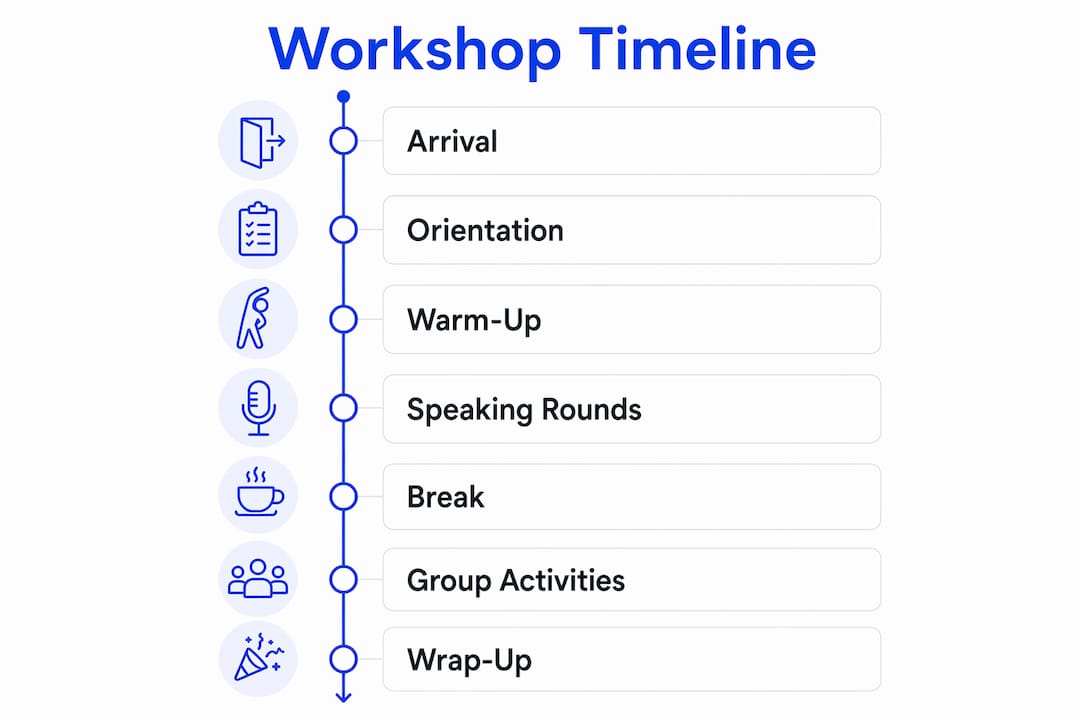
The most effective blueprint for a 90-minute workshop runs as follows:
- Arrival and orientation (10 minutes): Welcome participants, explain the session rules, and distribute any printed prompts or vocabulary sheets.
- Warm-up activity (10 minutes): A low-stakes task such as describing a photo or answering one question in Spanish gets voices moving before the pressure of conversation rounds.
- First speaking round (20 minutes): Pairs or triads work through a structured prompt. A visible timer keeps groups on pace.
- Partner rotation (5 minutes): Participants switch partners. This prevents the same two people from carrying the conversation for the entire session.
- Second speaking round (20 minutes): A new prompt, slightly more complex than the first, builds on vocabulary introduced in the warm-up.
- Task-based segment (15 minutes): A collaborative activity such as planning a trip, solving a scenario, or debating a topic in Spanish consolidates the language used in the rounds.
- Closing reflection (10 minutes): Each participant states one word or phrase they learned and one thing they want to practice before the next session.
This structure mirrors the 90-minute exchange format used by experienced language exchange organizers, and it works equally well for formal workshops and informal community sessions.
| Segment | Duration | Purpose |
|---|---|---|
| Arrival and orientation | 10 min | Set expectations and distribute materials |
| Warm-up activity | 10 min | Reduce anxiety and activate vocabulary |
| Speaking round 1 | 20 min | Structured conversation with prompts |
| Partner rotation | 5 min | Increase speaking variety |
| Speaking round 2 | 20 min | Deeper or more complex exchange |
| Task-based activity | 15 min | Apply language in a real scenario |
| Closing reflection | 10 min | Consolidate learning and set next steps |
Pro Tip: Display the session timer on a shared screen or whiteboard. Visible countdowns remove the facilitator from the role of timekeeper and let participants self-manage their pacing.
Which interactive activities and prompts drive real participation?
The best Spanish workshop ideas share one trait: they force participants to produce language rather than observe it. Role plays, scenario debates, and task-based activities all outperform passive listening exercises because they require an immediate spoken response.
Partner rotations every 10–15 minutes increase total speaking time per participant and prevent extroverted speakers from dominating the room. Rotating partners also exposes participants to different accents, vocabulary choices, and communication styles, which mirrors real-world Spanish use. For practical ideas you can adapt directly, the collection of Spanish speaking activities for adult learners offers formats tested in Singapore’s multilingual context.
Effective prompt types for adult workshops include:
- Open-ended opinion prompts: “What would you change about your city?” forces participants to use subjunctive and conditional structures naturally.
- Role play scenarios: A job interview, a restaurant complaint, or a travel booking puts language in a functional context that adults find immediately relevant.
- Debate formats: Assign positions on a low-stakes topic. The structure of defending a point pushes participants past their comfort vocabulary.
- Cultural scenario cards: Cards describing a social situation in a Spanish-speaking country prompt discussion about cultural norms, which deepens engagement beyond grammar.
Incorporating real-life scenarios also addresses one of the most common adult learner complaints: that classroom Spanish feels disconnected from actual communication. When participants can see a direct line between the workshop activity and a conversation they might have in a professional or travel context, attendance and motivation both improve.
How do you choose venues and tools for Spanish workshops?
The physical or virtual environment shapes participation before a single word of Spanish is spoken. Libraries, community rooms, and cultural centers are the preferred venue types because they offer low background noise, flexible seating arrangements, and easy public transit access. Cafes work only when the space is quiet and the group is small.
For in-person venues, evaluate these criteria before booking:
- Noise level: Background noise above a conversational hum forces participants to raise their voices, which increases fatigue and reduces session length.
- Seating flexibility: Chairs that move allow you to shift from plenary to pairs to small groups without losing time.
- Accessibility: A venue near a major transit stop reduces no-shows, particularly for after-work sessions.
Online workshops require a different set of tools. Zoom’s breakout room feature replicates the partner rotation structure of in-person sessions. Google Meet works for smaller groups. For prompt sharing and collaborative tasks, Google Docs or Notion allow all participants to see and edit materials simultaneously. For community building between sessions, a WhatsApp or Discord group keeps participants connected and accountable.
Registration management is often overlooked. A simple Google Form with a confirmation email reduces no-shows by setting a clear commitment. Send a reminder 24 hours before the session with the venue address or Zoom link, the session agenda, and any vocabulary list participants should review in advance.
What common challenges arise when planning Spanish sessions?
The most disruptive challenge in any Spanish workshop is uneven participation. Advanced speakers fill silence naturally, while beginners withdraw. Left unmanaged, this dynamic turns a workshop into a performance by two or three participants while the rest observe.
Consistent materials across all groups prevent a second common problem: perceived unfairness. When different subgroups receive different prompts or vocabulary lists of unequal difficulty, participants notice. That perception erodes trust and reduces willingness to engage in future sessions.
Clear rules and shared expectations set at the start of every session are the most effective tool an organizer has. Participants who know the format, the time limits, and the speaking norms arrive ready to engage rather than waiting to see what happens.
Additional pitfalls to address before they occur:
- Facilitator over-correction: Stopping participants mid-sentence to correct grammar kills conversational flow. Reserve corrections for the closing reflection.
- Unstructured free time: Open-ended “just talk” segments default to the dominant language in the room, which is rarely Spanish.
- Inconsistent scheduling: Irregular session dates fragment group cohesion. A fixed weekly or biweekly slot builds the habit of attendance.
Balancing structure with flexibility is the final challenge. A rigid script leaves no room for a conversation that is genuinely engaging the group. Build one optional extension activity into every session plan. If the task-based segment runs long because participants are deeply engaged, the extension activity gives you permission to drop the closing reflection without losing the session’s arc.
Key Takeaways
Effective Spanish workshop organization requires fixed group sizes, a timed session structure, and consistent materials to produce balanced participation across all proficiency levels.
| Point | Details |
|---|---|
| Cap group size at 16 | Divide larger groups into subgroups of 4–6 to keep every participant speaking. |
| Use a timed 90-minute structure | Seven fixed segments from warm-up to closing reflection reduce anxiety and maximize speaking time. |
| Rotate partners every 10–15 minutes | Rotations increase individual speaking opportunities and expose participants to varied language use. |
| Match materials across all groups | Consistent prompts and vocabulary lists prevent perceived unfairness and build participant trust. |
| Choose venues for noise and flexibility | Low-noise spaces with movable seating, or online platforms with breakout rooms, support structured rotations. |
What I’ve learned from running workshops that actually work
The biggest mistake I see organizers make is treating the session plan as the product. They spend hours designing activities and almost no time thinking about the emotional experience of a participant who hasn’t spoken Spanish in public before. That participant is not thinking about the prompt on the card. They are thinking about whether they will embarrass themselves.
Building confidence and a positive environment is a more realistic goal for short-term workshops than measurable language mastery. This is not a lowered standard. It is an accurate one. A participant who leaves a workshop feeling capable will return. A participant who leaves feeling exposed will not.
The practical implication is that your first session with any new group should prioritize trust over content coverage. Run shorter speaking rounds. Use lower-stakes prompts. Let the closing reflection run long if participants are sharing honestly. The confidence built through pronunciation practice and structured speaking carries over directly into workshop engagement, which is why I always recommend pairing workshops with some form of individual practice between sessions.
The organizers I respect most treat participant feedback as a design input, not a report card. After every session, I ask one question: “What would make next time better?” The answers are almost always specific and almost always right. Adapt the next session based on what you hear, and participants will notice that their experience is being taken seriously.
— Paul
Spanish Explorer’s adult Spanish courses and workshops
Spanish Explorer offers adult Spanish courses in group, private, and corporate formats, all taught by certified instructors fluent in both Spanish and English. The group class format mirrors the workshop structures covered in this article, with structured sessions designed to build real-world speaking confidence.
Classes run in person at International Plaza, Singapore 079903, directly above Tanjong Pagar MRT, and online via Zoom for learners who prefer flexible scheduling. Corporate training programs are available for teams that need Spanish for professional communication. Visit the Spanish teachers page to learn about the instructors and find the right format for your learning goals.
FAQ
How many participants should a Spanish workshop have?
A maximum of 16 participants per group is the standard recommendation. For larger attendance, divide into subgroups of 4–6 with a designated discussion leader for each.
How long should a Spanish workshop session be?
A 90-minute session is the most effective format. It allows time for a warm-up, two structured speaking rounds with a partner rotation, a task-based activity, and a closing reflection without participant fatigue.
What is the best way to handle mixed-ability groups?
Assign advanced participants a peer coaching role in mixed-ability tasks. For standard speaking rounds, segment participants by proficiency level using a brief placement activity before the session begins.
What online tools work best for virtual Spanish workshops?
Zoom is the preferred platform for its breakout room functionality, which replicates in-person partner rotations. Google Docs supports prompt sharing and collaborative tasks, while WhatsApp or Discord maintains community engagement between sessions.
How do you prevent advanced speakers from dominating a workshop?
Use timed speaking segments with a visible countdown and enforce equal turn-taking within each pair or triad. Partner rotations every 10–15 minutes also distribute speaking time more evenly across the group.
Recommended
Start Learning Spanish Today
Book a trial class and see how quickly you can progress with a professionally trained native-speaker teacher guiding the way.
Book a Trial Class