 Spanish
TL;DR:
- Effective Spanish learners set specific, measurable goals aligned with their motivation and assessed their current level honestly. They focus on balancing all four skills through “can-do” objectives and track progress regularly to stay motivated and adapt effectively. Limiting resources, prioritizing speaking from the start, and establishing consistent routines accelerate progress toward functional fluency.
Most adult learners start with genuine enthusiasm and vague intentions. “I want to be fluent” sounds like a goal, but it gives you nothing to work with. Knowing how to set Spanish learning goals properly is what separates learners who make real progress from those who cycle through apps and quit after three months. This guide walks you through the whole process: assessing where you are now, building goals that are specific and measurable, balancing all four language skills, choosing the right tools, and reviewing your progress so your goals stay relevant and motivating.
Table of Contents
- Key takeaways
- How to set Spanish learning goals: start with yourself
- Applying the SMART framework to Spanish goals
- Balancing skills and functional “can-do” objectives
- Choosing tools and building a study routine
- Tracking progress and adjusting your goals
- My honest take after years of guiding adult learners
- Start your goal-oriented Spanish journey with Spanish Explorer
- FAQ
Key takeaways
| Point | Details |
|---|---|
| Start with honest self-assessment | Know your current level and motivation before writing a single goal. |
| Use the SMART framework | Goals need a specific outcome, a measurement method, and a real deadline. |
| Build “can-do” functional goals | Define tasks first, then reverse-engineer the vocabulary and grammar you need. |
| Limit your learning tools | Sticking to three complementary resources prevents burnout and builds consistency. |
| Review goals regularly | Monthly check-ins let you adjust targets before frustration sets in. |
How to set Spanish learning goals: start with yourself
Before you write down a single goal, you need two things: an honest read of your current skill level and a clear answer to why you want to learn Spanish in the first place.
For your level, take a free online placement test or use the Common European Framework of Reference (CEFR) scale as your reference. The CEFR runs from A1 (complete beginner) to C2 (mastery), and knowing where you sit tells you what kind of progress is realistic in your available time. Do not just pick a level based on gut feeling. Test yourself on reading, listening, and speaking separately because most learners are uneven across skills.
Once you have your level, get honest about your strengths and weaknesses in all four core areas: speaking, listening, reading, and writing. Most adult learners significantly overestimate their listening comprehension and underestimate how rusty their speaking actually is. Identifying the gap early prevents you from setting goals that only play to your strengths.
Then ask yourself why. Aligning your goals with motivation creates relevance and keeps you engaged over months, not just weeks. The reason matters because it shapes every goal you write:
- Traveling to Spanish-speaking countries: prioritize conversational speaking, listening, and survival vocabulary
- Business and professional use: focus on formal writing, presentations, and industry-specific vocabulary
- Personal enrichment or cultural connection: balance all skills with emphasis on reading and cultural context
- Expat or relocation preparation: weight all four skills equally with strong grammar foundations
Pro Tip: Write your motivation in one sentence and put it somewhere visible. When you hit a plateau three months in, reading “I need this for my role in Latin American markets” is more useful than rereading a syllabus.
Applying the SMART framework to Spanish goals
The SMART framework is the most reliable tool for setting Spanish learning objectives that actually produce results. Each letter does specific work, and measurable goals let you track progress and stay motivated through concrete milestones.
Here is how each element applies to Spanish learning specifically:
- Specific. “Improve my Spanish” is not a goal. “Hold a 10-minute work conversation about my job responsibilities without switching to English” is. The more concrete the scenario, the better.
- Measurable. Attach a number or a clear pass/fail condition. The SMART framework works best with metrics like learning 50 vocabulary words per month, completing 20 lessons, or sustaining a 10-minute conversation.
- Achievable. Be honest about your schedule. Basic conversation proficiency typically requires 30 minutes of daily practice for 3 to 6 months. Intermediate fluency needs 45 minutes a day for 12 to 18 months. Set goals that fit your real life, not your best-case scenario.
- Relevant. A goal is only worth pursuing if it connects directly to your motivation. If you are learning for business, goals about ordering tapas in a restaurant have limited relevance in the short term.
- Time-bound. Every goal needs a deadline. Break larger goals into monthly targets and weekly habits.
| Weak goal | SMART version |
|---|---|
| Learn more Spanish vocabulary | Learn 200 high-frequency work words in 60 days using Anki flashcards |
| Get better at speaking | Hold a 5-minute self-introduction in Spanish by end of month two |
| Understand Spanish podcasts | Follow a 10-minute slow-speed podcast without pausing by week eight |
| Improve grammar | Use past tense correctly in three written paragraphs by end of month three |
Writing down specific targets boosts goal achievement success by 42%. That is not a minor difference. Get it on paper.
Pro Tip: Break each SMART goal into weekly tasks. “Learn 50 words this month” becomes “review 12 words on Monday, Wednesday, Friday, and Saturday.” Specificity at the weekly level is what turns goals into habits.
Balancing skills and functional “can-do” objectives
One of the most common mistakes adult learners make is focusing exclusively on one skill, usually reading or app-based exercises, while neglecting speaking and listening. Effective goal setting covers all three communication modes: interpersonal (two-way conversation), interpretive (reading and listening), and presentational (structured speaking or writing for an audience). Focusing only on one leaves you unprepared for real-world interaction.
The most practical way to structure your goals is through “can-do” statements. Instead of “study grammar,” you write: “I can order food and make a reservation at a restaurant in Spanish.” That single statement tells you exactly what vocabulary, verb tenses, and phrases you need to practice.
Here is how “can-do” goals look at different levels:
- Beginners: “I can introduce myself, state my nationality, and describe my job in Spanish”
- Intermediate learners: “I can explain a problem to a colleague, ask for help, and follow their instructions”
- Business learners: “I can participate in a 20-minute conference call in Spanish and follow the key discussion points”
Defining tasks first, then working backward to identify the vocabulary and grammar you actually need, is the key to avoiding wasted effort on content that will not serve your real goals. — From effective language learning research.
For time allocation, a practical split for an adult learner with 45 minutes per day might look like 15 minutes on structured grammar or vocabulary, 15 minutes on listening practice, and 15 minutes on speaking or writing output. The exact ratio shifts based on your weakest skill, but no single area should be ignored for more than two weeks.
Choosing tools and building a study routine

The number of Spanish learning apps available in 2026 is genuinely overwhelming. But limiting yourself to three tools actually produces better results than using ten, because switching between platforms fragments your attention and creates the illusion of progress without consistent depth.
Here is a three-resource setup that works well for most adult learners:
- A structured course or class. This is your foundation. A live class or structured program keeps grammar and curriculum organized in a way no app fully replicates. It also gives you a teacher who can correct errors before they become habits.
- A vocabulary tool. Spaced repetition tools like Anki are specifically designed for long-term retention. Pair this with goal-specific word lists so you are not memorizing random vocabulary that does not match your “can-do” objectives.
- A conversation practice platform. Speaking out loud with another person, whether a tutor or a language exchange partner, is the only way to develop real spoken fluency. You can also build a daily practice workflow with music and listening activities to make this feel less like studying.
Consistent daily habits yield better results than sporadic intense sessions. A 20-minute daily review beats a three-hour weekend session. Practical ways to integrate Spanish into your existing schedule include:
- Morning flashcard review during breakfast or your commute
- Listening to a Spanish podcast during your lunch break
- Writing two to three sentences in a journal before bed, using grammar from that week’s lesson
When life gets busy and you cannot maintain your full study schedule, switch to a maintenance goal: one 15-minute session per day just to keep your vocabulary and listening active. A scaled-back goal beats no goal.
Pro Tip: Set your study session as a recurring calendar block, not a daily decision. “Will I study today?” is a question that loses to tiredness every time. Treating it as a fixed appointment removes the friction entirely.
Tracking progress and adjusting your goals
Setting goals is only half the work. The other half is building a system to know whether you are actually hitting them.
The most useful tracking methods for Spanish learners are:
- Flashcard app statistics (words learned, retention rates, streak length)
- Conversation length logs (can you now hold a 7-minute conversation vs. 3 minutes six weeks ago?)
- Lesson completion records from your course or app
- Written output journals where you compare sentences from week one to week eight
- Accountability check-ins with a teacher or study partner
Scheduling monthly or quarterly goal reviews prevents the plateau problem. Every four weeks, sit with your original goals and ask: Did I hit them? If not, was the goal too ambitious or was my study time genuinely insufficient? Both are useful answers. One tells you to adjust the goal. The other tells you to protect your schedule better.
Signs you need to raise the bar: you are completing exercises too quickly, vocabulary feels easy, or conversations feel repetitive. Signs you need to scale back: you are skipping sessions regularly, feeling frustrated after every lesson, or making the same errors after weeks of practice.
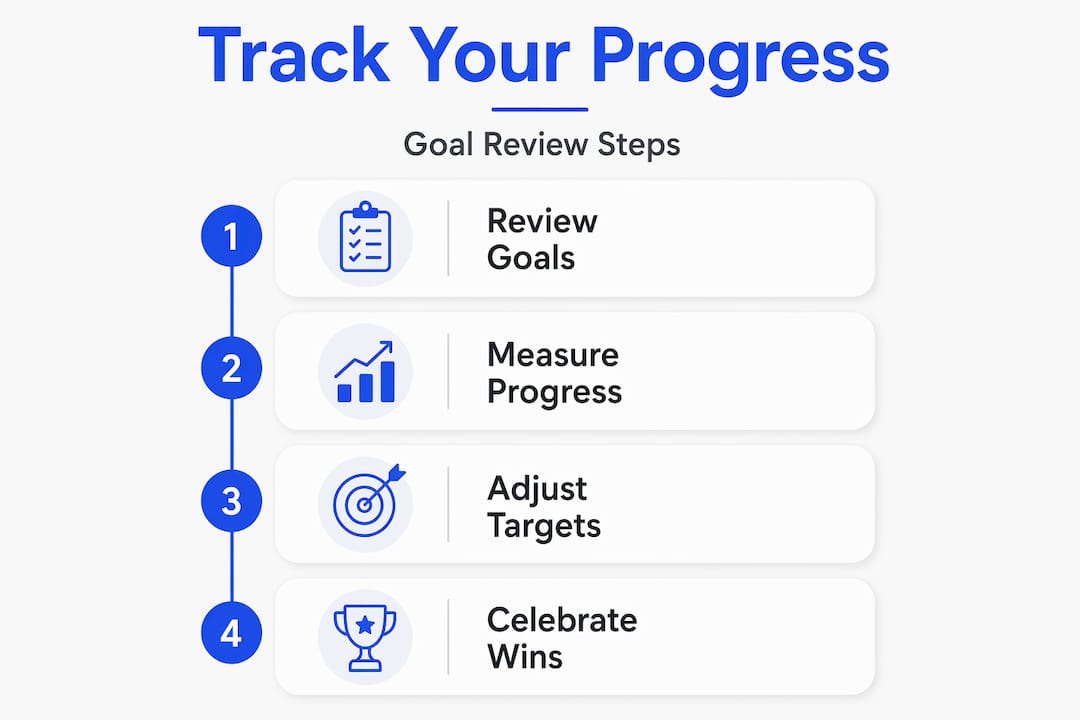
Celebrate milestones deliberately. When you complete your first real conversation entirely in Spanish, acknowledge it. When you finish a full unit or reach a new CEFR level, mark it. Motivation built on visible progress is far more durable than motivation built on willpower alone.
My honest take after years of guiding adult learners
I have worked with adult Spanish learners long enough to notice one pattern that holds across almost every student: the ones who struggle are almost always measuring effort instead of outcomes. They track how many hours they studied, not whether they can do something new with the language.
In my experience, the shift to functional “can-do” goals is the single most powerful change a learner can make. When a student stops asking “did I study today?” and starts asking “can I now explain my job in Spanish without hesitating?”, their progress accelerates visibly. The goal creates the practice, not the other way around.
I have also seen learners burn out by setting unrealistically aggressive timelines. Fluency is not a six-week outcome for an adult with a full-time job. What you can achieve in six weeks is a confident, functional beginner who can handle everyday interactions. That is worth celebrating on its own terms.
My strongest advice: prioritize spoken output from week one. Do not wait until your grammar is “good enough.” It never feels good enough. Get speaking practice in early and let your grammar improve around real conversation. That is how the language becomes usable, not just known.
— Paul
Start your goal-oriented Spanish journey with Spanish Explorer

If this article has helped clarify your approach to setting Spanish learning objectives, Spanish Explorer’s adult courses are built around exactly this kind of structured, goal-oriented learning. Based in Singapore at 10 Anson Road, Level 22, International Plaza (just above Tanjong Pagar MRT), Spanish Explorer offers group classes, private lessons, and corporate training programs designed for working adults.
Every course begins with a placement assessment so your goals are calibrated to your actual starting point, not a general assumption. Private classes let you work directly on your specific functional targets, whether that is conversational fluency or business Spanish. Online Zoom classes give you the same structured instruction with full scheduling flexibility.
Explore the full range of adult Spanish courses or learn more about private class options tailored to your goals and timeline. You can also start with online Spanish classes if you prefer learning from home.
FAQ
What is the best way to start setting Spanish learning goals?
Begin with a placement test to identify your current CEFR level, then write one or two specific “can-do” goals tied directly to your motivation, whether that is travel, work, or personal growth.
How do SMART goals apply to language learning?
SMART goals in Spanish learning mean defining a specific task, attaching a measurable metric like vocabulary count or conversation length, setting a realistic timeline based on your available study time, and connecting the goal to your real-world reason for learning.
How long does it take to reach basic Spanish conversation skills?
With 30 minutes of daily practice, most learners reach basic conversational ability in 3 to 6 months. Intermediate fluency at 45 minutes per day takes 12 to 18 months.
How often should I review and adjust my Spanish goals?
Monthly reviews are ideal for catching problems early. If you are consistently missing targets or breezing through them, that is your signal to adjust the difficulty, timeline, or method.
What should I do when I cannot keep up with my study schedule?
Switch to a maintenance goal rather than stopping entirely. A single 15-minute daily session keeps vocabulary and listening skills active and prevents the regression that comes from full breaks.
Recommended
- Master an Efficient Workflow for Learning Spanish Online
- How to learn Spanish fast in Singapore: proven steps
- Learning Spanish the easy way: A guide for Singapore adults
- Learn Spanish fast in Singapore: steps for quick fluency
Start Learning Spanish Today
Book a trial class and see how quickly you can progress with a professionally trained native-speaker teacher guiding the way.
Book a Trial Class