 Spanish
TL;DR:
- Mastering core Spanish grammar, vocabulary, and paragraph connectors improves writing fluency faster than complex rules. Daily practice, reading, and avoiding word-for-word translation help learners develop natural, confident Spanish writing skills. Structured instruction and feedback further enhance progress toward natural and compelling writing.
Writing in Spanish is defined as the ability to communicate ideas clearly using correct grammar, vocabulary, accent marks, and paragraph structure in the Spanish language. Mastering how to write in Spanish effectively means more than translating English thoughts word for word. It requires building a foundation in core grammar rules, understanding how Spanish sentences are organized, and practicing consistently. Whether you are a working professional, a self-learner, or someone preparing for business communication, this Spanish writing guide gives you the tools to write with confidence and natural flow.
What are the essential grammar and vocabulary foundations for writing in Spanish?
The fastest path to competent Spanish writing runs through a small set of high-priority rules. Mastering 20% of core grammar covers 80% of daily writing needs. That means you do not need to memorize every verb conjugation before you start writing well.
The verbs that carry most of your writing
Focus first on the 15–20 most frequent Spanish verbs: ser, estar, tener, ir, hacer, poder, querer, saber, venir, and decir are the core group. These verbs appear in nearly every sentence you will write. Knowing them cold frees your attention for the harder parts of composition.
The beginner Spanish grammar rules that matter most are subject-verb-object order, gender and number agreement, and correct use of ser versus estar. Spanish uses two verbs where English uses one (“to be”), and mixing them up is one of the most common errors in written Spanish.
Gender and number agreement
Every noun in Spanish carries a gender, masculine or feminine, and every adjective must match it. “A red car” becomes un coche rojo, not un coche roja. This agreement extends to articles, pronouns, and past participles in compound tenses. Getting this right makes your writing sound natural immediately.
Accent marks and the Spanish alphabet
The Spanish alphabet includes 27 letters, including the letter ñ, which does not exist in English. Accent marks are not optional decoration. The word sí means “yes,” while si means “if.” A missing accent changes the meaning of a sentence entirely. Learning to place accents correctly is one of the highest-return habits you can build early.
Pro Tip: Keep a vocabulary notebook organized by topic, such as work, food, travel, and emotions. Adding 5 new words per day in context sentences builds recall far faster than memorizing lists.
- Learn ser vs. estar as your first grammar priority
- Memorize gender with every new noun from day one
- Practice accent placement on common words like él, tú, más, and qué
- Build topic-based vocabulary lists rather than random word collections
- Use the Spanish vocabulary for daily use as a reference for high-frequency words
How to structure paragraphs and organize ideas in Spanish writing
Spanish paragraph structure differs from English in one key way: the topic sentence does not always come first. Spanish paragraphs have flexible topic sentence placement and rely heavily on connectors to guide the reader through the logic. This surprises many English speakers who expect a strict topic-sentence-first format.
Using connectors to link ideas
Connectors are the glue of Spanish prose. Without them, sentences feel choppy and disconnected. The most useful ones to learn first are listed below, organized by function.
- To add information: además (furthermore), también (also), asimismo (likewise)
- To contrast: sin embargo (however), no obstante (nevertheless), aunque (although)
- To show cause and effect: por lo tanto (therefore), por eso (that is why), debido a (due to)
- To sequence: primero (first), luego (then), finalmente (finally)
- To clarify: es decir (that is), o sea (in other words), por ejemplo (for example)
Using these connectors consistently makes your writing feel organized and professional, even at an intermediate level.
Avoiding the word-for-word translation trap
The single biggest mistake adult learners make is writing in English mentally and then translating each word into Spanish. Word-for-word translation produces unnatural syntax that no native speaker would write. The sentence “I am having a good time” does not translate as Estoy teniendo un buen tiempo. The correct phrase is Lo estoy pasando bien or Me lo estoy pasando bien.
The fix is to write directly in Spanish using only the vocabulary and structures you already know. Write a simpler sentence correctly rather than a complex sentence awkwardly.
| English writing habit | Spanish writing approach |
|---|---|
| Topic sentence always opens the paragraph | Topic sentence can appear mid-paragraph or at the end |
| Connectors are optional | Connectors are expected and guide reader logic |
| Translate complex ideas directly | Simplify the idea and write it in known Spanish |
| One tense per paragraph is common | Tense consistency is critical; mixing tenses confuses meaning |
Keeping verb tenses consistent
Tense shifts within a paragraph are a common error in learner writing. If you start a story in the past tense using pretérito indefinido, stay in that tense throughout the paragraph. Switching to the present tense mid-paragraph signals a grammar error, not a stylistic choice. Consistency in tense is one of the clearest markers of writing maturity in Spanish.
What practical daily exercises and tools support improvement?
Consistent daily writing practice of 15–20 minutes boosts vocabulary recall and writing fluency more than one long weekly session. Short, regular practice builds the automatic recall that makes writing feel natural over time.
Beginners should start by writing 3–5 simple sentences each day on a familiar topic: what they ate, what they did at work, or what the weather was like. This removes the pressure of finding a complex topic and focuses attention on correct grammar and vocabulary use.
Pro Tip: Write your first draft without stopping to check grammar or spelling. Get your ideas down in Spanish first. Then go back and correct in a separate review pass. Separating these two phases produces better writing and faster improvement.
Here are the most effective daily writing habits for adult learners:
- Journal in Spanish daily. Write 3–5 sentences about your day. Consistency matters more than length.
- Use writing prompts. Prompts like “describe your ideal weekend” or “write about a recent work challenge” give you a starting point when you feel stuck.
- Translate short English texts into Spanish. Take a paragraph from a news article and rewrite it in Spanish using your own words, not a machine translation.
- Review with a grammar guide. After writing, check your work against a reference like the Real Academia Española online dictionary or a trusted grammar guide.
- Get feedback from a native speaker or tutor. Peer review catches errors that self-correction misses. A tutor can identify patterns in your mistakes that you cannot see yourself.
Your daily Spanish practice routine should treat writing as a core skill alongside speaking and listening. Many learners neglect writing because it feels slower. Writing actually reinforces grammar and vocabulary more deeply than passive study.
How to refine your style and make Spanish writing compelling
Precise and simple writing centered on strong verbs is more effective than complicated sentences. This is true in English and even more true in Spanish, where ornate sentence structures can obscure meaning quickly.

The best Spanish writers use clear nouns and active verbs. They avoid stacking adjectives or using long subordinate clauses when a short sentence will do. Ella corrió hacia la puerta (She ran to the door) is stronger than Ella se dirigió de manera apresurada en la dirección de la puerta (She moved in a hurried manner in the direction of the door).
Reading Spanish extensively is the most reliable way to internalize natural style. Reading novels, news sites like El País or BBC Mundo, and Spanish blogs supplies mental models for sentence rhythm, connector use, and vocabulary in context. You absorb patterns that no grammar rule can fully teach.
Style habits that separate competent writing from compelling writing:
- Choose verbs over nouns. Write decidió (decided) instead of tomó la decisión de (made the decision to).
- Vary sentence length. Mix short punchy sentences with longer ones to control pace and emphasis.
- Use sensory details. Concrete details make writing vivid. El café estaba frío (The coffee was cold) is more engaging than La situación no era buena (The situation was not good).
- Read your writing aloud. If it sounds unnatural spoken, it reads unnatural on the page.
- Study punctuation. Spanish uses inverted question and exclamation marks (¿ and ¡) at the start of questions and exclamations. Missing them marks your writing as non-native immediately.
What common challenges do learners face when writing in Spanish?
Gender and number agreement mistakes are the most noticeable errors in learner writing. Native readers spot them immediately. Fixing agreement errors has more impact on your writing quality than mastering advanced verb moods like the subjunctive.
The second most common challenge is accent placement. A missing accent on él (he) versus el (the) changes the word class entirely. Accent errors accumulate quickly in longer texts and undermine the reader’s confidence in your writing.
Here are the most frequent writing challenges and how to address them:
- Agreement errors: Read each sentence and check that every adjective matches the noun it describes in gender and number. Do this as a dedicated review step, not while drafting.
- Accent omissions: Use a Spanish keyboard layout or enable autocorrect for Spanish on your device. Do not rely on memory alone for accent placement.
- Word-for-word translation: When you catch yourself translating, stop and ask what a Spanish speaker would say naturally. Simplify the idea if needed.
- Tense inconsistency: After writing a paragraph, underline every verb and check that tenses are consistent throughout.
- Avoidance of mistakes: Mistakes are data. Every error you identify and correct is a grammar rule that sticks. Treat your error log as a study tool.
The Spanish writing skills guide for adults covers these challenges in detail with exercises designed for adult learners at every level.
Key Takeaways
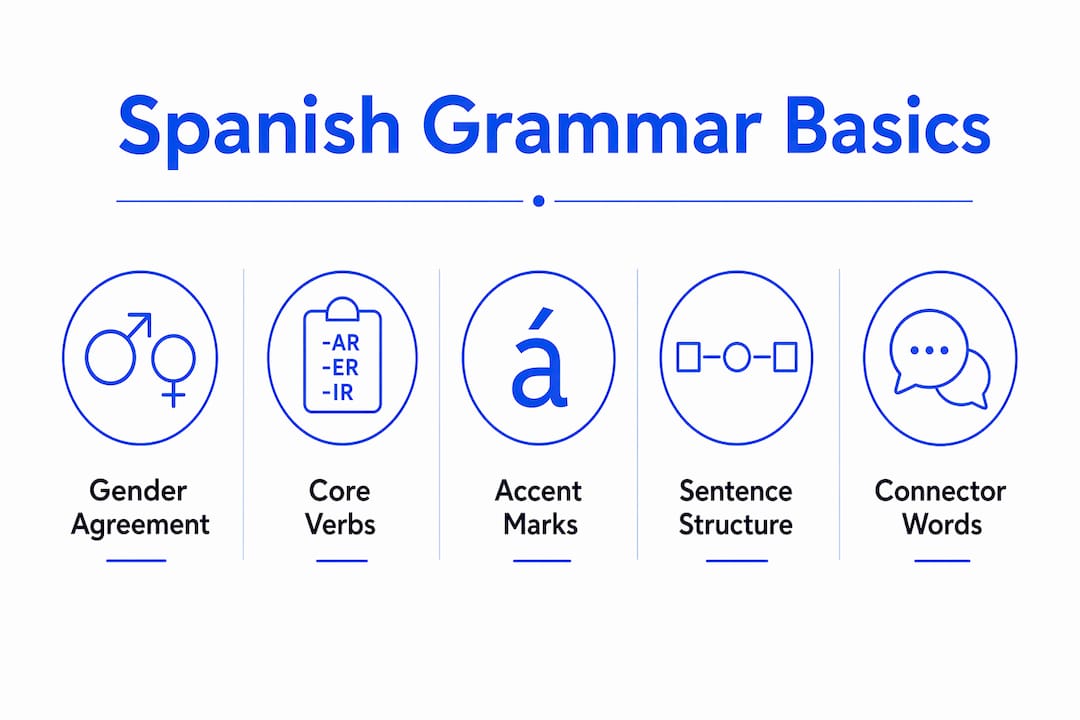
Effective Spanish writing requires mastering gender agreement, core verb forms, and paragraph connectors before attempting complex style or advanced grammar.
| Point | Details |
|---|---|
| Master core grammar first | Focus on 15–20 high-frequency verbs and gender agreement before advanced forms. |
| Write directly in Spanish | Avoid word-for-word translation; simplify ideas and write in known vocabulary. |
| Use connectors consistently | Words like sin embargo and por lo tanto guide reader logic and signal fluency. |
| Practice daily in short sessions | 15–20 minutes of daily writing builds recall faster than sporadic long sessions. |
| Read Spanish regularly | Novels, news, and blogs supply natural sentence patterns that grammar rules cannot teach. |
What I have learned about writing in Spanish that most guides skip
Most Spanish writing guides focus on rules. Rules matter, but they are not what makes writing feel natural. What actually changed my writing was separating the drafting phase from the correction phase completely.
When I started writing Spanish without stopping to fix errors mid-sentence, my fluency improved faster than any grammar drill produced. The brain works differently when it is not constantly interrupted by self-correction. Write first. Fix later. That sequence is not a shortcut. It is how writing fluency actually develops.
The second thing most guides underestimate is reading. I read El País for 10 minutes each morning before writing anything. Within a few weeks, my sentence rhythm in Spanish changed. I stopped writing Spanish that sounded like translated English. The patterns from reading transferred directly into my writing without deliberate effort.
The uncomfortable truth is that most learners spend too much time studying Spanish and not enough time writing it. A grammar textbook cannot teach you to write. Only writing teaches you to write. Start with three sentences today. They do not need to be perfect. They need to exist.
— Paul
Structured Spanish courses to build your writing skills
Writing in Spanish improves fastest when you have structured feedback and a clear progression path. Self-study builds habits, but a qualified instructor identifies the specific patterns in your errors that are hardest to see yourself.

Spanish Explorer offers adult Spanish courses in Singapore designed for conversational and business communication, with flexible group classes, private Spanish lessons, and online learning via Zoom. Certified instructors who are fluent in both Spanish and English guide you through writing, speaking, and grammar in a structured environment. Whether you are preparing for professional communication or building personal fluency, the Spanish courses at Spanish Explorer give you a clear path from beginner sentences to confident, natural writing. Book a trial class and see the difference structured instruction makes.
FAQ
What is the first grammar rule to learn for Spanish writing?
Gender and number agreement is the highest-priority rule. Mastering it removes the most noticeable errors from your writing faster than any other single fix.
How long does it take to write Spanish naturally?
Most adult learners who practice 15–20 minutes daily reach natural sentence flow within several months. Consistent short sessions outperform occasional long study blocks.
Should I use machine translation when writing in Spanish?
Use machine translation only to check your own writing, not to draft it. Writing directly in Spanish and correcting afterward produces stronger results than translating full sentences from English.
What are the best tools for checking Spanish writing?
The Real Academia Española online dictionary is the authoritative reference for Spanish spelling and usage. Grammar checkers and tutors are useful for catching agreement and accent errors in longer texts.
How do accent marks affect Spanish writing?
Accent marks change word meaning and word class entirely. The difference between sí (yes) and si (if), or él (he) and el (the), is a single accent mark. Missing accents mark writing as non-native immediately.
Recommended
- What Are Spanish Writing Skills? A Guide for Adults
- Learning Spanish the easy way: A guide for Singapore adults
- How to learn Spanish grammar: techniques for adults
- How to Communicate in Spanish: A Practical Guide
Start Learning Spanish Today
Book a trial class and see how quickly you can progress with a professionally trained native-speaker teacher guiding the way.
Book a Trial Class