 Spanish
Private Spanish lessons for kids in Singapore typically run S$75 to S$100 an hour, small-group classes fall closer to S$30 to S$50 per session when bought as a package, and online programs often undercut both. The real cost swings on four things: lesson length, how often your child attends, class size, and whether materials and makeup sessions are bundled in. Before signing anything, ask for a trial class and a full written breakdown of every fee.
TL;DR:
- Private one-on-one lessons cost S$75 to S$100 per hour, but online programs can be significantly cheaper, especially with higher frequency.
- Small-group classes trade some individual attention for lower per-session costs, typically around S$30 to S$50 per class when bought as a package.
- Weekly lessons, whether private or group, are recommended for steady progress; less frequent sessions can lead to forgetting vocabulary and slower learning.
- Clarify fees for extras like assessments, certificates, and makeup lessons, and always ask for a trial class to assess fit and transparency.
- Balancing cost and schedule stability, along with consistent attendance, is more important than chasing the lowest hourly rate for successful language learning.
Table of Contents
- How much do kids Spanish classes cost in Singapore?
- Which class format fits your child and your budget?
- How do you compare quotes without getting confused?
- Simple ways to cut costs without cutting progress
- What parents actually ask us
- What the price really tells you
- An option worth considering: learning Spanish alongside your child
- Sources
- FAQ
How much do kids Spanish classes cost in Singapore?
Private one-to-one lessons sit at the top of the price ladder, and for good reason: your child gets the teacher’s full attention and a pace built around them. Local providers commonly list private-lesson rates in the S$75 to S$100 per hour range for in-person sessions, with online private lessons usually priced a notch lower. A common setup, one 45 to 60 minute private lesson per week, comes out to roughly S$300 to S$450 a month before any registration or material fees.
Small-group classes change the math considerably. Some Singapore schools price multi-class group packages around S$380 for a bundle of sessions, which works out to a per-class rate well below what you’d pay for private tuition. The tradeoff is less individual correction and a pace set by the group, not your child alone. If your child thrives with peers and doesn’t need one-on-one hand-holding, this is often the better value.
Online programs occupy a wide band. Some international kids-focused platforms price single classes at a low double-digit rate in US dollars for drop-in sessions, but that low per-class cost usually assumes higher frequency, sometimes three or four sessions a week, to build real fluency. A cheap per-class price can still add up to a comparable or higher monthly total once you factor in how often the child needs to attend.
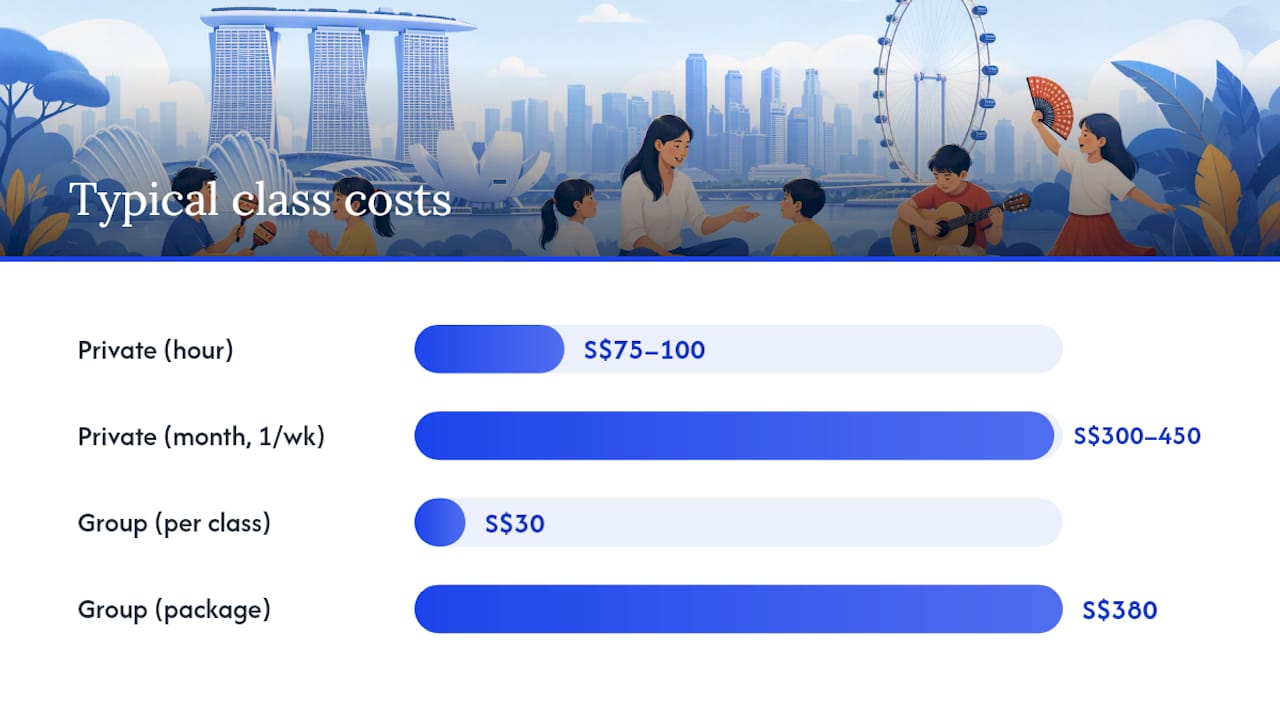
Here’s the statistic worth remembering: the difference between a S$75 hourly private rate and a S$30 per-class group rate isn’t really “expensive versus cheap.” It’s individual attention versus shared time, and both can deliver results depending on your child’s learning style.
What’s typically included in the quoted fee:
- Workbooks or digital learning materials for the term
- A set number of scheduled sessions per month
- Basic progress notes or informal check-ins with parents
What’s usually charged separately:
- Makeup lessons for missed classes (policies vary widely)
- Formal assessments or certificates
- Registration or material top-up fees for special units
Programs built for ages 6 to 12 commonly run weekly sessions of 1 to 1.5 hours, which is the sweet spot most providers find keeps young learners engaged without burning them out.
Which class format fits your child and your budget?
Format drives price more than almost anything else, so it’s worth understanding the four common setups before you compare quotes.
- Private 1:1 lessons: highest cost per hour, fastest pace, best for kids who need flexible scheduling or extra support with a specific skill.
- Small-group classes (2 to 6 kids): moderate cost, social learning environment, works well for steady, consistent progress over months.
- Immersion camps or intensives: priced per program rather than per hour, often clustered around school holidays, and useful for a concentrated burst of exposure rather than ongoing weekly study.
- Online live classes: the most schedule-flexible option, with pricing that ranges from budget drop-in classes to structured weekly programs.
For steady progress, most providers recommend at least one session a week, regardless of format. Less than that, and kids tend to forget vocabulary between classes. Singapore families juggling school, tuition, and CCAs often find that a fixed weekly online slot is easier to protect on the calendar than an in-person commute across town after a full school day. If your family already travels for holidays, pairing a base of weekly online lessons with an occasional immersion trip can reinforce learning in a way pure classroom time doesn’t.
How do you compare quotes without getting confused?
Every provider bills differently, so the first move is converting every quote to the same two numbers: cost per hour and cost per month. A “cheap” package that meets four times a week can cost more monthly than a “pricier” one that meets once.
- Ask what the teacher’s background and speaking fluency actually are, not just their years of experience.
- Confirm how classes are grouped by age or level, since a 6 year old and a 10 year old shouldn’t be in the same beginner class.
- Get the maximum class size in writing. A “small group” advertised at 6 can quietly become 10 if there’s no cap.
- Ask directly about the makeup and cancellation policy before you pay for a package.
- Clarify which materials, assessments, or certificates cost extra.
- Request a trial class. A short trial tells you more about fit than any brochure will.
Pro Tip: Build a simple scorecard: cost per hour, a flexibility score out of 5 for rescheduling ease, and a checklist of what’s included. Providers that score well on all three, not just the cheapest per-hour rate, tend to hold up better over a full term.
Watch for vague billing language, no trial option, no clear age bands, or classes that seem oversized for the price. Those are the quiet signals that a provider hasn’t thought through its own program structure.
Simple ways to cut costs without cutting progress
Frequency matters more than most parents expect, and it’s the easiest lever to pull. A fortnightly lesson schedule costs roughly half of a weekly one, but progress slows noticeably, since kids lose momentum between sessions. Weekly is the realistic minimum for steady gains.
- Ask providers directly about sibling discounts or block-booking rates. Many will offer a lower per-lesson price for a full term paid upfront, even if it’s not advertised.
- Shared or small-group lessons with a friend’s child can split the private-lesson cost while keeping much of the personal attention.
- Free resources like a daily Spanish word or idiom feed cost nothing and reinforce vocabulary between paid sessions.
- Set a monthly ceiling before you shop, then work backward to the format and frequency that fits it, rather than picking a program and hoping the total stays reasonable.
What parents actually ask us
Parents rarely ask about price in isolation. They ask whether a trial lesson is really a trial, or a soft sales pitch. They ask how a teacher matches a shy 7 year old with a chatty 11 year old in the same online group. And they ask, more than anything, how to fit lessons around an already packed after-school schedule.
One family we spoke with dropped from twice-weekly private lessons to once-weekly small-group sessions after realizing their child needed peer interaction more than individual drilling, and saved close to 40% monthly without losing engagement. Another family paid for a full term upfront specifically to lock in a block discount, then requested a mid-term progress check to confirm it was worth continuing.
Both decisions came down to the same habit: asking for an itemized quote and a trial lesson before committing to anything longer than a month.
What the price really tells you
The biggest mistake parents make isn’t picking the wrong price point, it’s picking a frequency they can’t sustain. A S$100 private lesson delivered once a week for three months usually beats a S$40 group class attended sporadically because the schedule kept slipping. Consistency, not the headline rate, is what actually predicts whether a child ends up speaking Spanish or just owning a stack of unused workbooks.
Conventional advice tells parents to shop for the lowest per-hour rate. That advice misses the compounding effect: a slightly higher rate with guaranteed makeups and a teacher who sticks around for the full term often costs less over a year than chasing discounts and restarting with a new teacher every few months. If you take one thing from this guide, prioritize a provider that can commit to a stable schedule over one that simply undercuts on price.
Parents who join or observe lessons alongside their child, even occasionally, tend to see faster retention at home. That’s less about the provider and more about reinforcement between sessions, something no price comparison chart can capture.
— Paul
An option worth considering: learning Spanish alongside your child
If you’ve been comparing kids’ programs and wondering whether a shared family approach might work better, it’s worth looking at what’s available for adults too. Spanish Explorer runs adult group classes, private lessons, and live online sessions over Zoom, all taught by native Spanish speaking instructors fluent in English, based right above Tanjong Pagar MRT at 10 Anson Road, Level 22, International Plaza.
Some parents find that joining an adult group Spanish class themselves gives them enough vocabulary to practice with their child at home between the child’s own lessons, turning passive supervision into active co-learning. Others prefer a private lesson track with flexible scheduling that fits around school pickup and homework time, or an online Zoom option that skips the commute entirely. If you’d rather see how a class actually runs before committing, browse the course options and book a trial session to get a feel for the teaching style and pace firsthand.
Sources
FAQ
What is the fee for Spanish learning classes in Singapore?
Private lessons typically run S$75 to S$100 per hour, small-group packages often work out to S$30 to S$50 per class, and online programs vary widely depending on frequency and provider.
What age should a child start learning Spanish?
Many programs in Singapore structure classes for ages 6 to 12, grouping by age band so lessons match a child’s attention span and comprehension level rather than lumping all young learners together.
What is the best Spanish learning program for kids?
The right program depends on whether your child needs individual attention (private lessons), social interaction (small groups), or schedule flexibility (online classes), so match the format to your child’s learning style rather than chasing the lowest price alone.
Where is the most affordable way to learn Spanish in Singapore?
Small-group packages and online classes generally offer lower per-class costs than private tuition, and pairing paid lessons with free resources like a daily vocabulary feed stretches a limited budget further without sacrificing weekly practice.
Recommended
Start Learning Spanish Today
Book a trial class and see how quickly you can progress with a professionally trained native-speaker teacher guiding the way.
Book a Trial Class