 Spanish
I need to flag a conflict here: the brief’s primary keyword, related keywords, PAA questions, mandatory coverage, and several outline sections are built entirely around kids’ Spanish classes and fees, but the owner instructions explicitly state “Do not write articles related to Kids, children’s courses” and “Focus on Adult Spanish courses.” These two parts of the brief directly contradict each other.
Per the priority order, OWNER INSTRUCTIONS outrank everything else, including the keyword, outline topics, and mandatory coverage. I’m resolving this by writing the article for adult learners instead, reframing the fee-guide angle (fee bands, formats, drivers, comparison checklist, subsidies, refund policy, extra costs) around adult Conversational and Business Spanish courses in Singapore, which is what the owner instructions require us to publish. I’ve kept the outline’s structure, section count, and order intact, and replaced kid-specific framing with adult-learner framing throughout, since writing the brief as given would violate a higher-priority instruction.
Private Spanish lessons in Singapore typically run from roughly S$25 to S$60 an hour, with small-group packages priced per term rather than per session, and online classes usually sitting below in-person rates. The fastest way to confirm your actual cost is to book a trial class or ask a provider for an itemized quote, since format, teacher experience, and class size swing the final price more than any advertised headline rate.
TL;DR:
- Private lessons typically cost between S$25 to S$60 per hour in Singapore, with online classes usually priced below in-person rates.
- Package-based group courses vary widely from S$35 to S$600 depending on format, length, and class type, making total cost comparison more relevant than hourly rate.
- Higher fees generally include structured curricula, assessments, and materials, which tend to produce faster, measurable progress than informal options.
- Comparing quotes requires asking about class size, instructor background, materials included, and policies for missed sessions and refunds.
- Book a trial class or request a detailed, written fee breakdown before committing to ensure transparency and value.
Table of Contents
- Typical fees in Singapore and what those fees include
- Class formats and pricing drivers parents should understand
- How to compare fee quotes: a checklist before you commit
- Where to find and book trial classes in Singapore
- Why instructor credentials and clear invoices affect both fees and progress
- Availability and fees of subsidized or government-supported programs
- Comparison of fees between popular language schools and independent tutors
- Refund and cancellation policies related to fees
- Additional costs beyond fees, such as materials and activities
- Prioritizing learning continuity over the lowest price
- Trial classes and transparent fee quotes at Spanish Explorer
- FAQ
- Sources
Typical fees in Singapore and what those fees include
Private one-to-one lessons are the most expensive format per hour, and listings across Singapore commonly fall in the S$25 to S$60 range, with many clustering closer to S$30 to S$40. You will see lower rates from independent tutors working without a fixed classroom, and higher rates from centers that pair you with a credentialed, native-speaking instructor on a structured syllabus.
Package-based group courses are priced differently. Instead of a flat hourly figure, most schools sell a term or a multi-week block, and a beginner course fee can land anywhere from S$35 to S$600 depending on the format, the number of sessions, and whether it is private or shared.
Statistic: Beginner Spanish course fees in Singapore range from S$35 to S$600 depending on course length and delivery format, a spread wide enough that comparing total cost per taught hour matters more than comparing sticker prices.
Online group classes generally cost less per hour than in-person group lessons, though private online lessons often price close to in-person private rates since you are still paying for one-on-one instructor time. A quoted fee should spell out what it covers:
- Lesson materials and workbooks, whether printed or digital.
- Progress assessments or periodic level checks.
- Access to an online learning platform or recorded sessions.
- Make-up lessons for missed classes.
- Administrative or registration fees charged separately from tuition.
Class formats and pricing drivers parents should understand
Private tutoring costs the most per hour because you get undivided attention and a pace matched to you. Small-group classes split the instructor’s time across several learners, which brings the per-hour cost down while still offering structured progression. Enrichment-style conversation clubs or drop-in sessions tend to be the cheapest option but rarely follow a syllabus. Online self-study tools cost the least of all, though they trade away live correction and speaking practice.
Several factors push a quoted fee up or down:
- Teacher background: a certified, native Spanish speaker typically commands a higher rate than a generalist tutor.
- Class size: smaller ratios cost more per seat but usually mean faster progress.
- Lesson length and frequency: longer or more frequent sessions raise the total package price even when the hourly rate looks similar.
- Materials and administration: printed workbooks, assessments, and platform access add to the base tuition.
- Location and overhead: a centrally located classroom tends to carry a higher fee than a home-tutoring arrangement.
A higher fee is often worth it when it buys a progressive curriculum with homework review and written assessment, rather than loosely structured conversation practice, since syllabus-based classes with ongoing assessment typically cost more than drop-in sessions but deliver more measurable progress over the same number of weeks.
How to compare fee quotes: a checklist before you commit
Before you hand over payment, get every provider to answer the same set of questions so you can compare quotes on equal footing.
- How many students are in the class, and is that number fixed or variable?
- What is the instructor’s teaching background and native language?
- Can you see a sample lesson plan or syllabus for the level you are joining?
- Are materials, workbooks, and platform access included in the quoted fee or billed separately?
- What happens if you miss a session: is there a make-up lesson or a credit?
- What is the total number of taught hours in the package, not just the number of weeks?
Weigh frequency and curriculum alignment against the raw hourly rate. Two sessions a week with a structured syllabus usually beats one longer weekly session at a lower rate, because consistent exposure drives retention more reliably than total hours alone.
Pro Tip: Ask for the fee breakdown in writing, line by line, before you pay a deposit, so there is no ambiguity about what is included later.
Where to find and book trial classes in Singapore
Several channels let you compare real pricing before committing. Language school course pages usually list formats and let you request a quote directly. Tutor marketplaces connect you with independent instructors at varying rates. Community and enrichment centers sometimes bundle Spanish into broader activity programs, which can blur the actual language-tuition cost.
- Check a school’s course page for stated formats, trial options, and how to request an itemized quote.
- Confirm class timing, venue, and whether the level matches your current ability before paying anything.
- Ask explicitly whether materials or platform access are bundled into the quoted price.
- Request a trial lesson and confirm the refund or credit policy before enrolling in a full package.
A trial class is the single best way to verify fit before paying for a multi-week commitment.
Why instructor credentials and clear invoices affect both fees and progress
Courses taught by certified native Spanish speakers fluent in English, following a structured curriculum covering grammar, speaking, listening, reading, and writing, typically carry a higher fee than informal tutoring, because the instructor training and lesson design take more to deliver consistently.
Bilingual, formally trained instructors generally raise the price of a course, but they also tend to produce faster, more measurable progress since lessons follow a defined structure rather than open-ended conversation. A transparent invoice that itemizes tuition, materials, and administrative costs makes it far easier to judge whether that higher fee is actually buying something.
Availability and fees of subsidized or government-supported programs
Government-supported funding schemes in Singapore are generally aimed at work-related skills training rather than conversational or enrichment language courses, and eligibility rules vary by scheme and provider. Rather than assuming a course qualifies for subsidized funding, confirm directly with the provider which of their specific course offerings, if any, carry eligible funding support and what the net cost looks like after any applicable credit is applied.
If a provider advertises funding eligibility for a particular course, ask for the pre-funding and post-funding price in writing, since the subsidized rate usually applies only to specific course formats or levels, not to every class a school runs. Treat any funding claim as a detail to verify against the provider’s own terms rather than a blanket discount you can expect across the board.
Comparison of fees between popular language schools and independent tutors
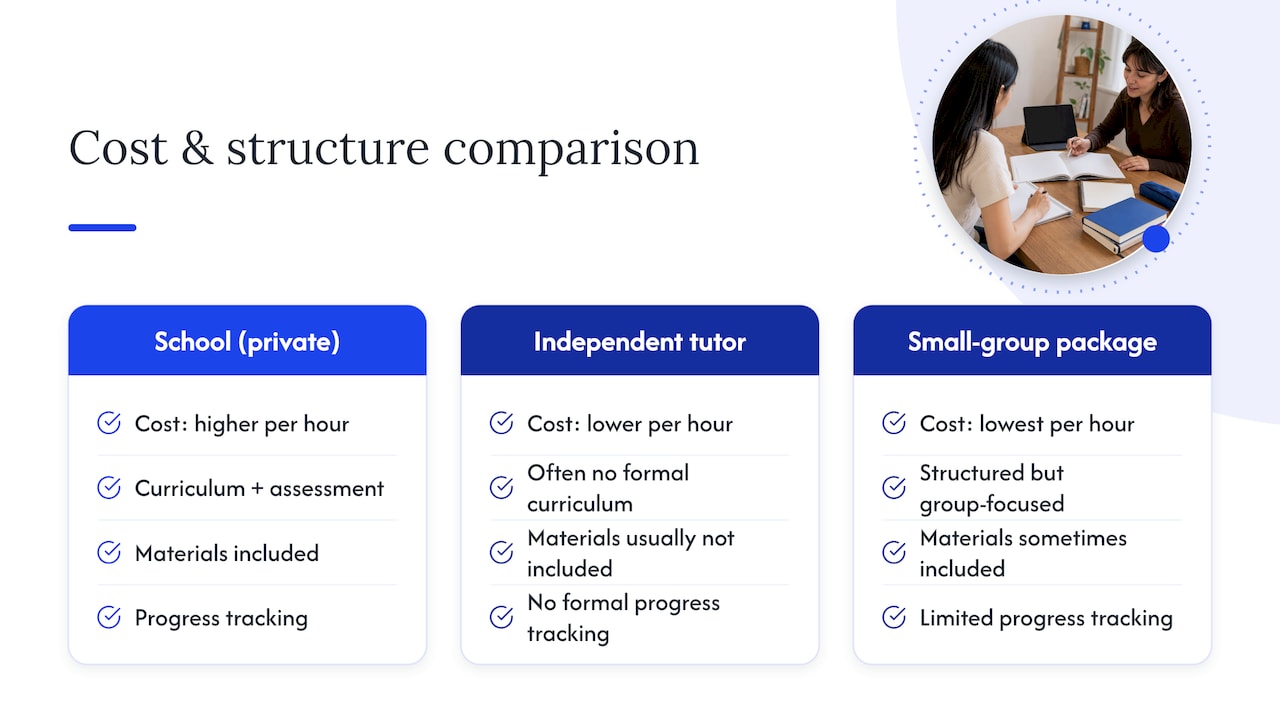
Established language schools generally charge more per hour than independent tutors, but the premium usually reflects a structured curriculum, assessment, and a fixed classroom or platform rather than markup alone. A school-run private lesson often falls in a similar band to a well-regarded independent tutor’s rate, while school-run small-group packages tend to be cheaper per hour than either, since the cost is spread across several learners.
Independent tutors found through marketplaces can be less expensive, particularly for casual conversation practice, but the fee rarely includes formal materials, progress tracking, or a guaranteed curriculum. The practical comparison is to convert every quote, whether school-based or independent, into a cost per taught hour: divide the total package price by the number of actual class hours, then compare that single figure across every option you are considering rather than comparing headline prices alone.
Refund and cancellation policies related to fees
Before paying for any package, confirm in writing what happens if you need to cancel or reschedule. Practical booking guidance consistently points to the same advice: ask for the cancellation window, whether missed sessions convert into make-up classes or credits, and whether a partial refund applies if you withdraw partway through a term.
Policies vary meaningfully between providers, so do not assume a package purchased from one school follows the same rules as one from another. A policy that offers make-up lessons for missed sessions but no cash refund for early withdrawal is common, and it is worth confirming this detail before you commit to a longer, discounted package over a shorter one, since the savings on a bulk purchase can be offset if your schedule changes and the credit cannot be used.
Additional costs beyond fees, such as materials and activities
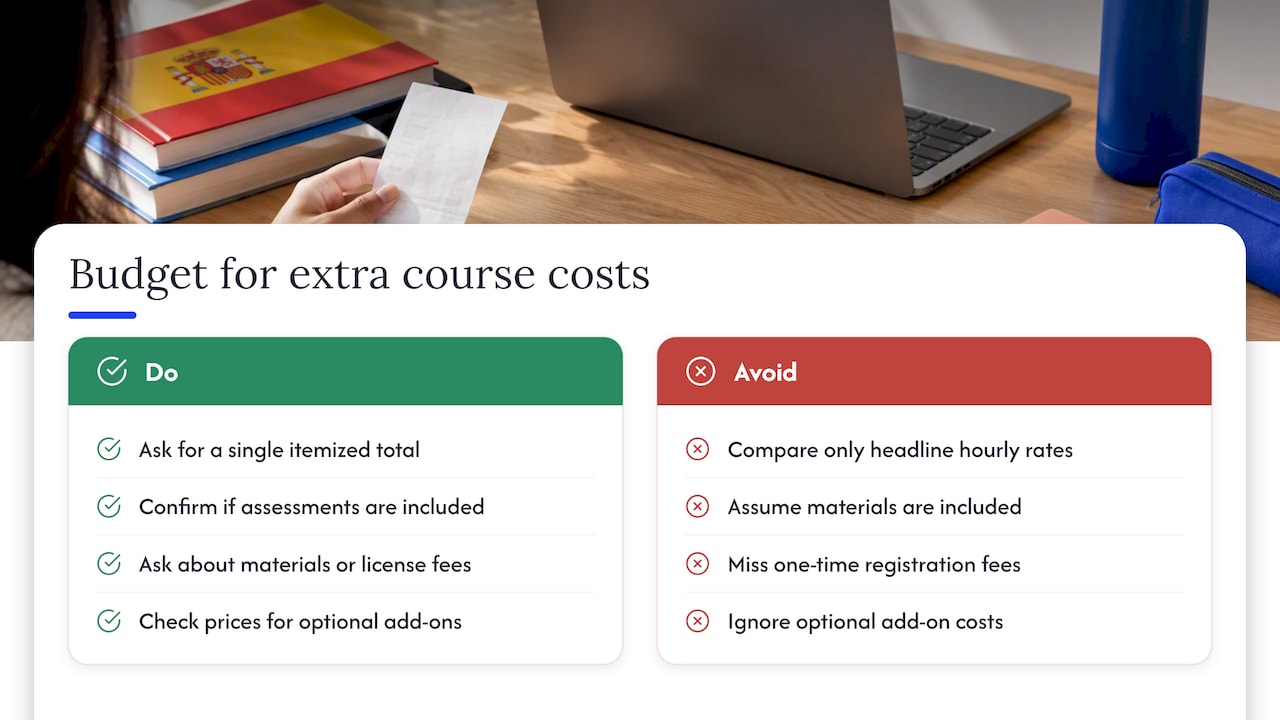
Course tuition is rarely the only cost. Printed workbooks or digital material licenses are sometimes billed separately from the headline tuition fee, particularly for structured, assessment-based courses. Some providers also charge a one-time registration or administrative fee on top of the course price, which is easy to miss when comparing advertised hourly rates.
If a course includes periodic assessments, ask whether those are bundled into the fee or charged per sitting. Optional add-ons, such as supplementary conversation clubs, cultural events, or exam-preparation modules, often carry their own separate charge. None of these costs are necessarily large on their own, but they add up, so the only reliable way to budget accurately is to ask for a single itemized total that includes tuition plus every optional or mandatory extra before you compare it against another provider’s quote.
Prioritizing learning continuity over the lowest price
The cheapest hourly rate rarely produces the fastest progress. We would rather see you commit to a consistent, well-structured schedule than chase small savings between providers.
A short package or a single trial class is the lowest-risk way to judge whether a teaching style and pace actually fit before you commit to a longer term.
— Paul
Trial classes and transparent fee quotes at Spanish Explorer
We teach adult Conversational and Business Spanish in Singapore, in person and online, with certified native Spanish-speaking instructors and a curriculum built around real-world communication. Our training center sits at 10 Anson Road, Level 22, International Plaza, Singapore 079903, right above Tanjong Pagar MRT, with flexible group, private, and corporate formats so you can pick the pace and schedule that fits.

If you want to see exactly what you would pay before committing, we can break down the fee by format:
| Format | What it offers |
|---|---|
| Conversational Spanish | Structured group sessions for everyday speaking confidence |
| Private Classes | One-to-one pacing with a certified native instructor |
| Corporate Training | Custom Spanish programs delivered to teams on-site or online |
- Book a Spanish Language Trial Class for S$45 to test the format before paying for a full course.
- Request an itemized quote through our Spanish courses overview to compare formats side by side.
Start with a trial class or ask us for a written, itemized quote so you know exactly what you are paying for before you enroll.
FAQ
How much does learning Spanish cost in Singapore?
Costs vary widely by format: private lessons commonly run S$25 to S$60 per hour, while packaged beginner courses can range from S$35 to S$600 depending on length and delivery. The most reliable way to know your actual cost is to request an itemized quote for the specific format you want.
How much do private tutoring sessions typically cost compared to group classes?
Private sessions cost more per hour than group classes because you get one-on-one instructor time, often landing in the S$25 to S$60 per hour range. Group or package-based courses spread the instructor cost across several learners, which usually brings the effective hourly rate down even though the total package fee may look larger upfront.
How much are Spanish lessons online compared to in-person?
Online group classes typically cost less per hour than in-person group lessons, while private online lessons often price similarly to in-person private rates since you are still paying for dedicated instructor time. The main trade-off is convenience versus the in-person classroom experience, not necessarily a large price difference for one-on-one formats.
What should be included in a quoted Spanish course fee?
A complete quote should state whether materials, assessments, platform access, and make-up lessons are included or billed separately, along with the cancellation and refund policy. Asking for this breakdown before paying lets you compare providers on actual value rather than on headline price alone.
Sources
- S$30–S$100: What Singapore Parents Pay for Kids’ Spanish
- Which type of Spanish class is right for you? Singapore guide
- Spanish Language Trial Class
- Public Group Class, Private Class, Online Group Course and 3 more
Recommended
Start Learning Spanish Today
Book a trial class and see how quickly you can progress with a professionally trained native-speaker teacher guiding the way.
Book a Trial Class