 Spanish
TL;DR:
- To learn Spanish quickly in Singapore, set clear goals based on your motivation and daily time commitment, combining structured courses with self-study techniques like spaced repetition. Establish a daily routine that balances active speaking, listening, reading, and regular SRS review to ensure consistent progress and avoid burnout. Tracking vocabulary, comprehension, and speaking milestones helps maintain motivation and measure your journey toward fluency.
Learning Spanish slowly when you have real deadlines is genuinely frustrating. Whether you are chasing a promotion that requires Spanish communication, preparing for university abroad, or simply wanting to connect with a new culture, waiting years to reach conversational fluency is not an option for most people in Singapore. This guide walks you through a proven, step-by-step framework for accelerating your Spanish acquisition, covering goal setting, evidence-based techniques, daily routines, and smart ways to measure your growth so every study hour counts.
Table of Contents
- Set your learning goals and requirements
- Essential tools and techniques for rapid Spanish learning
- Step-by-step strategy: Daily actions to boost fluency
- Troubleshooting common challenges and mistakes
- How to measure your progress and celebrate achievements
- Why speed matters, but balance is key in Spanish learning
- Fast-track your Spanish learning with expert courses in Singapore
- Frequently asked questions
Key Takeaways
| Point | Details |
|---|---|
| Define your goals | Clear objectives help tailor your Spanish learning strategy for faster results. |
| Use spaced repetition | This evidence-based method boosts word retention by 25% for rapid progress. |
| Follow a daily routine | Consistent practice accelerates fluency and prevents learning plateaus. |
| Troubleshoot challenges | Address common mistakes early to keep your Spanish learning on track. |
| Celebrate milestones | Recognizing achievements keeps motivation high and reinforces habits. |
Set your learning goals and requirements
Now that you know why rapid Spanish proficiency is valuable, let’s set your objectives and find the best pathway.
Before picking an app or enrolling in a class, you need clarity on why you are learning and how much time you can realistically commit. These two factors determine everything else, from the format you choose to the timeline you set.
Identify your core motivation. Personal enrichment goals (travel, culture, family connections) allow more flexibility in pacing. Academic goals such as DELE certification or university entrance requirements demand structured, exam-aligned content. Professional goals, like communicating with Latin American business partners or working in a Spanish-speaking environment, require business vocabulary and professional etiquette alongside grammar. Each motivation leads to a different learning pathway.
Understand realistic timelines. Most learners reaching basic conversational fluency (A2 level) need roughly 150 to 200 hours of focused study. Reaching B1 (independent user) typically takes 300 to 400 hours. If you can dedicate 90 minutes daily, that is roughly 45 hours per month, meaning A2 is achievable in as little as four months. If you can only manage 30 minutes a day, double that timeline.
Compare learning formats available in Singapore:
| Format | Pace | Flexibility | Feedback Quality | Best For |
|---|---|---|---|---|
| Group classes | Moderate | Low to Medium | Shared | Social learners, budget-conscious |
| Private classes | Fast | High | Individualized | Busy professionals, fast-track needs |
| Online classes | Variable | Very High | Good | Travelers, remote workers |
| Self-study only | Slow | Very High | Minimal | Supplements other formats |
Choosing between a fast-track and traditional structure is a meaningful decision. Traditional courses progress through grammar in a sequential, comprehensive way that can feel slow. Fast-track formats focus on high-frequency vocabulary, practical phrases, and immediate application. The best results typically come from combining both: a structured course for grammar scaffolding and self-directed daily practice for volume. You can explore learn Spanish fast in Singapore approaches and tips on choosing Spanish class types to make a more informed decision about your format.
Questions to answer before you start:
- What is your current Spanish level (zero, beginner, or intermediate)?
- How many hours per week can you genuinely commit?
- Do you need formal certification at the end?
- Do you learn better in groups or one-on-one settings?
Essential tools and techniques for rapid Spanish learning
With your goals defined, equip yourself with proven tools and techniques for accelerated Spanish learning.
The most impactful shift you can make early on is adopting a spaced repetition system (SRS). SRS is a study method where flashcards (digital or physical) are shown to you at increasingly spaced intervals based on how well you remember them. Hard cards appear more often; easy cards less so. Research confirms that SRS improves vocabulary retention by 25% over traditional study methods, and this holds across all proficiency levels. That is not a marginal gain. Over 300 hours of study, 25% better retention means hundreds of extra words locked in your memory.

Top tools for rapid Spanish learning in Singapore:
| Tool | Type | Best Use | Cost |
|---|---|---|---|
| Anki | SRS flashcard app | Vocabulary memorization | Free |
| Duolingo | Gamified app | Daily habit building | Free / Premium |
| SpanishPod101 | Audio and video | Listening and phrases | Subscription |
| iTalki | Online tutoring | Live speaking practice | Per session |
| Language Transfer | Audio course | Grammar foundations | Free |
Five steps to build your core learning workflow:
- Start each session by reviewing your SRS flashcard deck (10 to 15 minutes).
- Listen to a short Spanish audio clip or podcast episode at your level (10 minutes).
- Study new grammar or vocabulary from your course material (20 to 30 minutes).
- Speak or write at least five new sentences using today’s vocabulary.
- Add new words from today’s session into your SRS deck before closing.
This workflow, consistently applied, creates a compound effect. Each day builds on the last. Explore more effective ways to learn Spanish or dive into the best online Spanish courses that pair well with self-study tools. For a more detailed breakdown, the efficient learning workflow guide is a strong reference.
Pro Tip: Combine SRS with active listening. After reviewing your flashcards, immediately listen to a Spanish audio clip that uses those same words. Hearing vocabulary in context cements it far more effectively than silent review alone.
Step-by-step strategy: Daily actions to boost fluency
Next, let’s translate tools into daily actions for consistently rapid progress.
A structured daily routine removes the guesswork from learning. Instead of asking “What should I study today?” you follow a rhythm that guarantees consistent progress across all four skills: speaking, listening, reading, and writing.
Morning routine (30 to 45 minutes):
- SRS review: Start with your Anki or flashcard deck before your brain fills with other tasks.
- Listen to a Spanish podcast, song, or short video on your commute or during breakfast.
- Read three to five sentences aloud to activate your speaking muscles for the day.
Evening routine (45 to 60 minutes):
- Study new grammar or course content while you are relaxed.
- Practice speaking for at least 15 minutes using a tutor, language exchange partner, or recorded self-practice.
- Add new vocabulary to your SRS deck so tomorrow’s review is ready.
- Write a short journal entry in Spanish (3 to 5 sentences) to reinforce the day’s material.
Balance active and passive learning. Active learning means speaking, writing, and deliberate study. Passive learning means listening to Spanish while commuting, watching Spanish shows, or reading simple Spanish articles. Both are important, but most fast learners underinvest in active speaking practice. Real Spanish speaking activities should take up at least 30% of your daily study time.
Avoiding burnout is just as important as avoiding laziness. The temptation when motivated is to study two or three hours per day in week one, then crash by week three. Consistent 60 to 90 minute sessions five days a week will outperform sporadic three-hour marathons every time. Check out easy learning for adults for pacing strategies that fit a working adult’s schedule.
“Motivation gets you started, but routine keeps you fluent.”
Pro Tip: Every Sunday, review the week. Did you miss days? Were sessions too long and tiring? Adjust your schedule for next week. Tracking your actual hours each week reveals patterns that would otherwise stay invisible. Small adjustments compound into dramatically better results over months.
Troubleshooting common challenges and mistakes
Even with a strong routine, fast learning can hit roadblocks. Here’s how to fix the most common ones.
Most learners who plateau early make the same set of mistakes. Recognizing them early saves weeks of frustration.
Common problems and their fixes:
- Not speaking enough. Many learners spend 90% of their time reading and listening, then feel paralyzed when asked to speak. Speaking from week one, even badly, builds neural pathways that reading alone cannot create.
- Skipping SRS review days. Missing two or three days means your retention gaps grow exponentially. Since SRS retention gains of 25% depend on consistent review intervals, even a few skipped sessions reset much of that advantage.
- Jumping to advanced material too soon. Watching native-speed Spanish dramas before reaching A2 is mostly noise. Your brain cannot acquire language faster than it can process input. Stay at your level plus 10%.
- Missing personalized feedback. Self-study tools are powerful but blind. They cannot hear your pronunciation errors or identify patterns in your grammar mistakes. A qualified instructor catches what apps miss.
- Studying grammar without using it. Grammar studied in isolation fades quickly. Every rule you learn needs to appear in sentences you create yourself within 24 hours.
“The fastest learners are not the ones who study the most. They are the ones who correct course the fastest.”
If you feel stuck, examine your speaking-to-studying ratio first. Then look at whether you are genuinely applying a structured teaching style that builds skills progressively. And if you have ever wondered whether the language itself is the problem, it helps to read up on is Spanish hard to learn for English speakers. Spoiler: it is one of the easier languages for English speakers to acquire.
How to measure your progress and celebrate achievements
After troubleshooting, it’s important to know you’re progressing and feel good about each milestone.
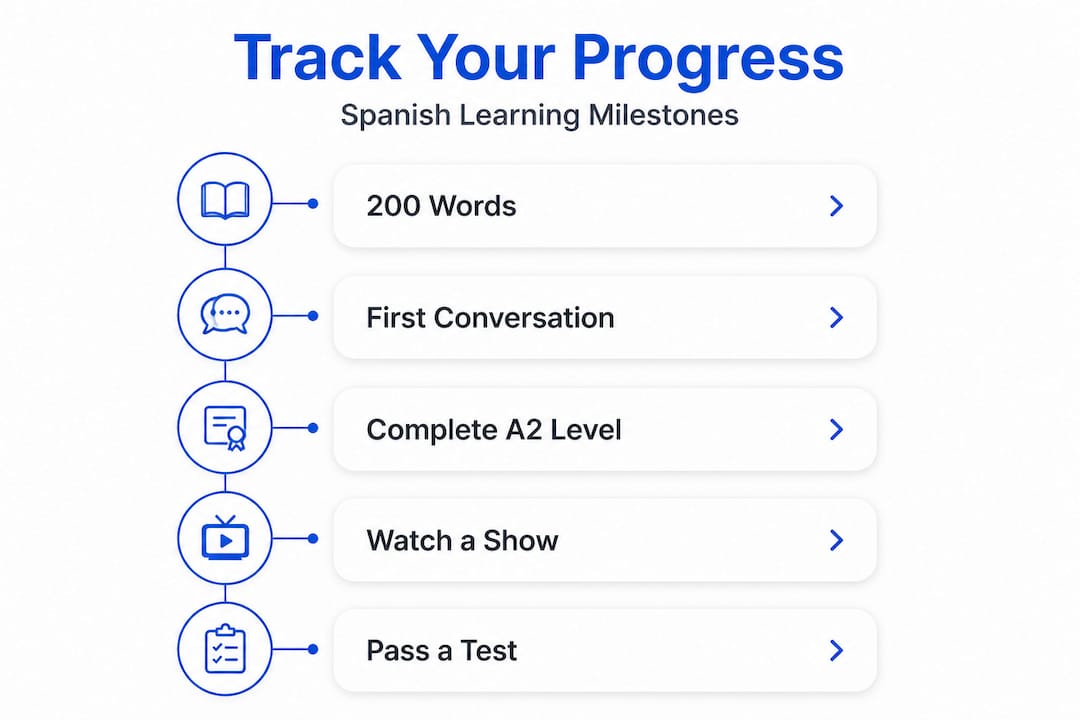
Measuring progress is what separates motivated learners from frustrated ones. Without checkpoints, it is easy to feel like you are studying a lot but going nowhere.
Five ways to track your Spanish progress:
- Vocabulary count. Use your Anki deck to track total words learned. Hitting 500 words is a meaningful milestone. At 1,500 words, most learners can hold basic conversations.
- Comprehension tests. Take a free online A1, A2, or B1 level quiz monthly to see where you land on the CEFR scale (Common European Framework of Reference for Languages).
- Speaking recordings. Record yourself speaking for two minutes on a topic. Save it. Re-listen one month later. The difference is usually remarkable and motivating.
- Conversation fluency. Note whether you are pausing less, searching for words less, and understanding replies more naturally during speaking sessions.
- Formal assessment. When you feel confident at B1 or above, consider taking the DELE Spanish exam for an internationally recognized credential.
Progress milestone tracker:
| Milestone | Target Timeline | Celebration Idea |
|---|---|---|
| 200 words learned | Week 2 to 3 | Watch a Spanish short film |
| First full conversation | Month 1 to 2 | Visit a Spanish restaurant and order in Spanish |
| A2 level test pass | Month 3 to 4 | Book a trip to a Spanish-speaking destination |
| B1 level test pass | Month 6 to 9 | Register for the DELE exam |
| Spoke for 10 min without stopping | Month 4 to 5 | Treat yourself to a Spanish cultural event |
Celebrations are not trivial. Research in behavioral science consistently shows that rewarding milestones reinforces habit loops. When your brain links Spanish study with positive feelings, it becomes less of a chore and more of something you actually look forward to.
Why speed matters, but balance is key in Spanish learning
Here is a perspective most fast-learning guides skip entirely: raw speed is not the goal. Usable fluency is.
We see this pattern often among highly motivated learners in Singapore. They drill vocabulary, hit impressive word counts, and pass level tests, then freeze in real conversations because their learning was all input and no output. The fastest path to functional fluency is a balance between absorbing language and producing it from the very first week.
Singapore’s bilingual environment is actually a significant advantage here. English shares a meaningful portion of vocabulary with Spanish through shared Latin roots. Words like communication (comunicación), natural (natural), and important (importante) are instantly recognizable. English’s role in learning Spanish is often underestimated, but for Singapore learners, it can shave weeks off vocabulary acquisition if leveraged consciously.
The uncomfortable truth about acceleration is this: you can compress the study timeline, but you cannot fully compress the exposure timeline. Your brain needs time and repetition to make language automatic. Pushing too hard too fast often creates fragile knowledge that collapses under real-world pressure. Sustainable daily practice of 60 to 90 minutes will always beat exhausting weekend marathons when you measure results at the six-month mark.
Balance means mixing grammar study with conversation, passive listening with active output, and individual study with instructor-guided feedback. Speed and depth are not opposites. Done right, they reinforce each other.
Fast-track your Spanish learning with expert courses in Singapore
To maintain your momentum, consider structured courses and expert guidance.
All the strategies in this article become dramatically more effective when paired with professional instruction. A qualified teacher catches errors you cannot hear yourself, structures your learning in a proven sequence, and keeps you accountable when motivation dips.

At Spanish Explorer, our Spanish courses in Singapore are designed specifically for learners who want structured, accelerated progress aligned with DELE standards. Whether you prefer the energy of group sessions, the focused pace of private Spanish classes, or the convenience of online Spanish classes, we have a format built around your goals and schedule. Our certified instructors teach in both Spanish and English, giving you the fastest route to real-world fluency from our central Singapore location.
Frequently asked questions
How long does it take to learn Spanish quickly in Singapore?
With daily practice and evidence-based methods, basic conversational fluency is achievable in 3 to 6 months, depending on daily time commitment and learning format.
What is the most effective method for memorizing Spanish words fast?
Spaced repetition systems boost vocabulary retention by 25% compared to traditional methods, making them the single most effective tool for rapid memorization at any proficiency level.
Are online Spanish courses as effective as in-person classes for fast learning?
Online courses offer strong flexibility and solid tools for fast progress, especially when combined with regular live speaking practice through a tutor or language partner.
How can adults in Singapore avoid burnout when learning Spanish quickly?
Set realistic daily targets of 60 to 90 minutes, rotate between active and passive learning activities, and review your weekly schedule to adjust intensity before fatigue sets in.
Should I take the DELE exam to measure my Spanish progress?
The DELE exam provides internationally recognized, formal validation of your proficiency and is especially valuable for learners with academic or professional goals tied to their Spanish skills.
Recommended
- How to learn Spanish fast in Singapore: proven steps
- Build Spanish Vocabulary Fast: A Singapore Learner’s Guide
- Top Spanish speaking practice ideas to boost skills in Singapore
- Spanish speaking activities: 5 practical ideas for Singapore
Start Learning Spanish Today
Book a trial class and see how quickly you can progress with a professionally trained native-speaker teacher guiding the way.
Book a Trial Class