 Spanish
If you want a direct answer: the best learn.fluenz.com alternatives depend on your goal. For grammar-driven study, Babbel or Rocket Spanish deliver structured lessons without Fluenz’s steep price. For audio-first speaking practice, Pimsleur is the clearest match. For free, bite-sized daily practice, Duolingo is the go-to recommendation from Wirecutter. For unlimited live tutoring, Baselang or iTalki give you real human conversation that no app can replicate.
- Best for grammar-driven study: Babbel or Rocket Spanish (structured, practical, affordable)
- Best for audio-first speaking practice: Pimsleur (lesson-by-lesson spoken dialogue, no screen required)
- Best free/bite-sized practice: Duolingo (gamified, 10–15 minutes daily, iOS/Android/web)
- Best for unlimited live tutoring: Baselang (Flat monthly fee, unlimited Spanish sessions with certified teachers)
All options below are available to US-based learners on iOS, Android, or web unless noted.
Table of Contents
- How do Fluenz and its top alternatives compare side by side?
- Mini-reviews: what each option actually feels like
- How do you pick the right Fluenz alternative for your goals?
- When does live instruction outperform self-study apps?
- What should you do next?
- How does the user experience compare across these platforms?
- How responsive is customer support across these platforms?
- How long does it take to complete each program?
- What community and supplementary resources does each platform offer?
- Key Takeaways
- What actually matters when you choose a language platform
- Spanish Explorer: live, teacher-led Spanish for adult learners
- FAQ
- Useful sources and further reading
How do Fluenz and its top alternatives compare side by side?
| Dimension | Fluenz | Pimsleur | Rosetta Stone | Duolingo | Babbel | Baselang | iTalki | Preply | Rocket Spanish | Spanish Explorer |
|---|---|---|---|---|---|---|---|---|---|---|
| Best for | Grammar-focused video study | Audio-first speaking | Immersion, no translation | Free daily habit | Structured practical lessons | Unlimited live Spanish tutoring | Flexible tutor marketplace | Tutor + structured lessons | Audio drills + grammar | Live CEFR-aligned classes |
| Pricing model | One-time purchase | Subscription or one-time | Subscription | Free / Plus subscription | Subscription | Flat monthly fee | Pay-per-lesson | Pay-per-lesson or subscription | One-time purchase | Course packages |
| Typical cost | $1,815–$3,277 (15–30 hrs) | — | ~$12–$14/mo | Free; Plus ~$7/mo | ~$14/mo | Flat monthly fee | $10–$40/hr (varies by tutor) | $15–$40/hr (varies) | ~$150 one-time | Contact for pricing |
| Teaching method | Video explanations + grammar | Audio dialogue repetition | Immersion, no English | Gamified exercises | Grammar-led short lessons | Live tutor-led sessions | Tutor-led, learner-directed | Tutor-led + curriculum | Audio lessons + drills | Live instruction, CEFR curriculum |
| Live speaking / tutoring | None | None | None | None | None | Yes, unlimited | Yes, on demand | Yes, on demand | None | Yes, group and private |
| Languages | Spanish, French, Italian, Mandarin, Portuguese, German | 50+ languages | 25 languages | 40+ languages | 14 languages | Spanish only | 150+ languages | 50+ languages | Spanish, French, Italian, German, Japanese, Korean | Spanish |
| Platform | Web, iOS, Android | iOS, Android, web | iOS, Android, web | iOS, Android, web | iOS, Android, web | Web, iOS, Android | iOS, Android, web | iOS, Android, web | iOS, Android, web | Online (Zoom) + in-person |
| Trial / refund | No free trial; refund policy varies | 7-day free trial | 3-day free trial | Free tier available | 7-day free trial | 7-day free trial | Free to browse; book 1 trial lesson | Free trial lesson available | 60-day money-back guarantee | Contact school for trial lesson |
Two trade-offs worth weighing before you pick:
- Time commitment vs. cost: — Fluenz’s one-time pricing looks premium upfront per PCMag’s review, but subscription apps like Babbel cost far less monthly. Baselang’s flat fee makes sense only if you actually use multiple sessions per week.
Mini-reviews: what each option actually feels like

Fluenz
Lessons feel like a one-on-one class with a patient teacher on video. PCMag notes it suits learners who want instructional, grammar-focused sessions rather than gamified repetition. No live speaking component, and the price is high.
- Cons: — No live tutoring; expensive; limited language catalog
Pimsleur
Pure audio. You listen, repeat, and respond — no screen needed, which makes it ideal for commutes. Nerdisa’s review positions it as the top audio-focused speaking alternative to Fluenz.
- Pros: — Hands-free learning; strong pronunciation focus; 50+ languages
Rosetta Stone
No English, no translations — you learn by associating images with words, the way a child absorbs a first language. Wirecutter recommends it for immersion-style learners who want to think in the target language from day one. Understanding what language immersion actually means helps set realistic expectations.
- Pros: — True immersion method; polished interface; 25 languages
Duolingo
Ten minutes a day, streaks, and a green owl. Wirecutter calls it the best free, bite-sized option. It builds vocabulary and basic grammar habits, but research consistently shows that game-based apps alone rarely produce long-term conversational mastery.
- Pros: — Free; 40+ languages; highly motivating for beginners
Babbel
Short, practical lessons built around real-life conversations — ordering food, navigating airports, handling work meetings. Grammar is explained in plain English, which makes it a natural step up from Duolingo for learners who want structure without Fluenz’s price.
- Cons: — Only 14 languages; no live tutoring
Baselang
Unlimited live sessions with certified Spanish teachers for a Flat monthly fee. If you use it four or more times a week, the per-session cost drops well below what you’d pay on iTalki. Spanish only, which keeps the curriculum focused.
- Pros: Unlimited sessions; structured curriculum available; certified teachers
- Cons: Spanish only; requires consistent scheduling to justify the cost
- Best for: Serious Spanish learners ready to commit to daily or near-daily practice
- Try it: 7-day free trial
iTalki
A marketplace of community tutors and professional teachers across 150+ languages. You set the pace, pick the teacher, and book when it suits you. Quality varies widely by tutor, so read reviews carefully before committing.
- Pros: — Huge tutor selection; flexible scheduling; 150+ languages
Preply
Similar marketplace model to iTalki, but Preply adds a structured lesson plan layer and a subscription option that bundles lessons with study materials. Slightly higher average tutor rates, but the interface is cleaner.
- Pros: Structured lesson plans available; clean UX; trial lesson policy
- Cons: More expensive than iTalki on average; subscription lock-in
- Best for: Learners who want tutor flexibility plus some curriculum scaffolding
- Try it: Free trial lesson available
Rocket Spanish
Audio lessons paired with grammar reinforcement drills. Guide2Fluency’s comparison highlights the key difference from Fluenz: Rocket leans on audio and repetition drills while Fluenz leads with video grammar explanations. One-time purchase keeps the lifetime cost low.
- Pros: Audio-first with grammar support; one-time price; 60-day money-back guarantee
- Cons: Interface feels dated; less depth than Fluenz’s video explanations
- Best for: Budget-conscious learners who want audio lessons with grammar backup
- Try it: 60-day money-back guarantee
Spanish Explorer
Live, teacher-led classes aligned to the CEFR framework, available online via Zoom or in-person in Singapore. Unlike every app on this list, Spanish Explorer gives you a certified native Spanish-speaking instructor who corrects your pronunciation in real time. Adult group classes, private lessons, and corporate training are all available. Explore course options or read about why structured adult courses outperform app-only study.
- Pros: Live certified instructors; CEFR-aligned curriculum; flexible formats (group, private, corporate)
- Cons: Requires scheduling; not self-paced
- Best for: Adult learners who want real accountability and measurable progress toward conversational or business Spanish
Pro Tip: Before committing to any paid platform, run a 7-day trial using only that platform’s free tier or trial period. Track how many minutes you actually complete each day — not how many you planned. If you average under 15 minutes daily, a subscription-based app will likely lapse unused. If you hit 30 minutes consistently, you are ready for a structured course or live tutoring.
How do you pick the right Fluenz alternative for your goals?
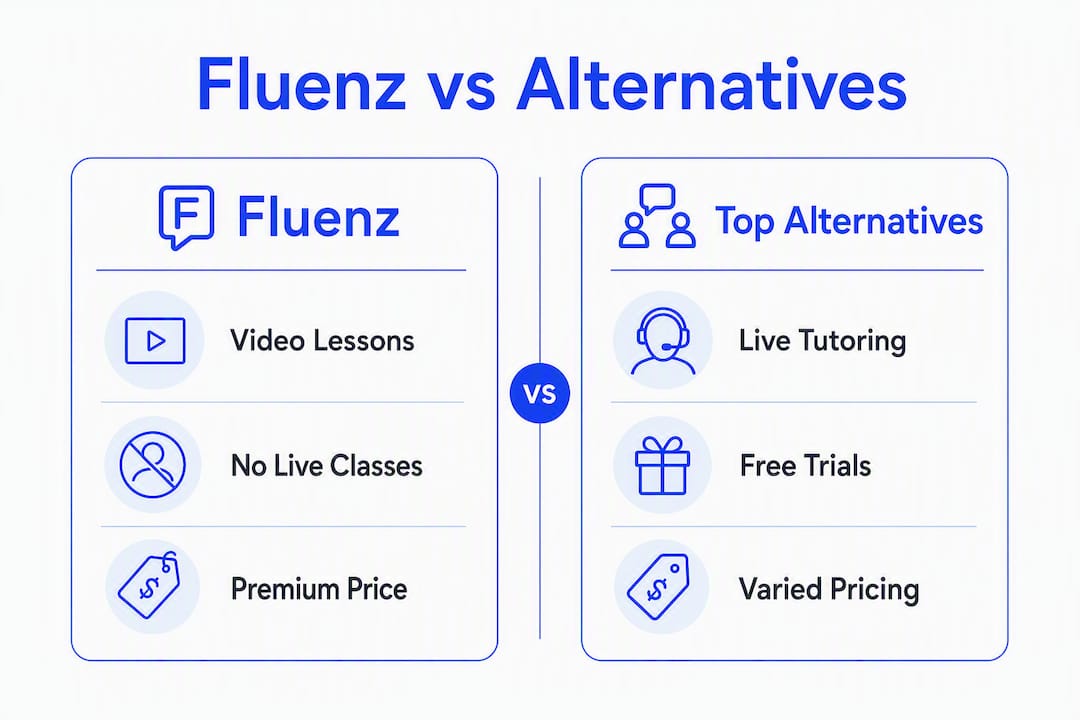
Start with your primary goal, not the platform’s feature list. Grammar mastery, spoken fluency, convenience, and budget pull you toward completely different tools.
Decision path:
- Define your goal. Travel Spanish in 3 months? Business Spanish for a promotion? Conversational fluency with no deadline? Each goal maps to a different method.
- Set your weekly time. Less than 30 minutes daily favors apps (Duolingo, Babbel). More than 30 minutes, or a hard deadline, favors structured courses or live tutoring.
- Match to method. Grammar-led learners: Babbel or Rocket Spanish. Audio-first: Pimsleur. Immersion: Rosetta Stone. Live accountability: Baselang, iTalki, Preply, or Spanish Explorer.
- Try before you buy. Every serious option offers a trial. Use it for a full week before paying.
Checklist before you commit:
- Does the platform offer at least 15–30 minutes of daily content at your level?
- Is live speaking practice available, or will you need to supplement separately?
- Are teacher qualifications listed and verifiable?
- What is the refund or cancellation policy?
- Does it work on the devices you actually use daily?
- Is the language depth sufficient for your target level (A1 through C1)?
- Does the pricing model reward consistent use, or penalize it?
Red flags: no trial period, no refund policy, unclear pricing, and zero live speaking options are all reasons to pause. Industry analysts note that learners frequently prioritize “fun” features over durability of learning — a platform that keeps you entertained but never pushes you to speak is a motivation tool, not a fluency tool.
When does live instruction outperform self-study apps?
The short answer: almost always, for speaking. PCMag’s testing makes the point plainly — apps are most effective when supplemented by live teachers who can correct pronunciation and provide nuance that pre-recorded content cannot. Apps teach mechanics reliably: grammar rules, vocabulary, sentence structure. What they cannot replicate is the unpredictability of a real conversation, where a native speaker responds in ways no algorithm anticipates.
Corrective feedback is the gap. A teacher hears that you are mispronouncing a vowel and fixes it in the moment. An app marks you correct or incorrect and moves on. For learners targeting real fluency through grammar, that real-time correction compounds over weeks into a measurable pronunciation advantage.
A practical weekly split that practitioners recommend: 30 minutes of app drills daily for vocabulary and grammar reinforcement, plus one 60-minute live session per week for speaking correction and conversation practice. Over 12 weeks, that structure produces measurable milestones: basic sentence construction in weeks 1–3, conversational exchanges in weeks 4–8, and topic-specific fluency (travel, work, social) by week 12.
Translation apps are not a substitute for this. Understanding why real-time translation differs from language lessons matters: translation tools handle output, not acquisition. They do not build the mental models that let you think in Spanish.
- Apps build the foundation; live instruction builds the speaker.
- Pronunciation errors caught early are far easier to correct than habits formed over months.
- Structured adult courses consistently outperform app-only study for learners with professional or conversational goals.
What should you do next?
For most adult learners, the clearest path forward looks like this: pick one structured option, run a 7-day trial, and measure actual daily minutes completed.
- If your goal is conversational Spanish: start with Babbel’s 7-day trial for structure, then add a weekly live session on Baselang or through Spanish Explorer once you have basic sentences down.
- If your goal is business Spanish: skip the gamified apps entirely. Book a private assessment lesson with a certified teacher to identify your gaps before investing in a subscription.
- If you have tried an app for 8 weeks with no noticeable improvement in speaking: that is the signal to switch methods. Apps alone rarely produce spoken fluency; live instruction is the missing piece.
How does the user experience compare across these platforms?

Fluenz has a clean, video-first interface that feels like a premium course rather than an app. Babbel and Duolingo are the most polished mobile experiences — fast, intuitive, and designed for short sessions. Rosetta Stone’s interface is visually rich but can feel slow for learners who want explicit feedback. Pimsleur is audio-only, so “interface” is almost irrelevant; the app is minimal by design.
Baselang’s platform is functional rather than beautiful — the value is in the live sessions, not the UI. iTalki and Preply both have marketplace-style dashboards that take a session or two to navigate comfortably. Rocket Spanish’s interface is the most dated of the group, though the content holds up. Spanish Explorer’s online classes run on Zoom, which most adult learners already know, removing any learning curve entirely.
How responsive is customer support across these platforms?
Fluenz support is email-based and response times vary. Duolingo and Babbel offer in-app help centers with community forums, but live support is limited on free tiers. Rosetta Stone has phone and chat support, which stands out in this category. Pimsleur’s support is primarily email and FAQ-driven.
Baselang, iTalki, and Preply all have responsive support teams because their business model depends on resolving tutor-booking issues quickly. Spanish Explorer, as a school with direct instructor contact, offers the most personal support channel of any option here — you reach a person, not a ticket queue.
How long does it take to complete each program?
| Platform | Typical course duration |
|---|---|
| Fluenz | 15 hrs (Fast Track) to 30 hrs (Comprehensive Track) of structured content |
| Pimsleur | 30 lessons per level (~15 hrs per level) |
| Rosetta Stone | 120–150 hrs of content across all levels for major languages |
| Duolingo | Open-ended; no defined completion point |
| Babbel | ~15 hrs per level; 7 levels available for Spanish |
| Baselang | Ongoing; structured curriculum available in parallel |
| iTalki | Learner-defined; no set curriculum |
| Preply | Learner-defined; structured plans available |
| Rocket Spanish | ~120 hrs of audio and written content across 3 levels |
| Spanish Explorer | Course packages by CEFR level; duration varies by format (group, private, corporate) |
What community and supplementary resources does each platform offer?
Duolingo has the largest active learner community, with forums, leaderboards, and language clubs built into the app. Babbel offers a magazine and podcast series that extend learning beyond the app. Rosetta Stone includes live group coaching sessions (called “Tutoring” sessions) as an add-on. Pimsleur provides a digital workbook and reading exercises alongside audio lessons.
Rocket Spanish includes a forum and cultural notes within each lesson. iTalki has a community section where learners post writing for correction by native speakers. Preply offers a blog and study resources, though the community is less active than iTalki’s. Baselang provides structured study materials alongside live sessions.
Spanish Explorer supplements live classes with course materials, homework, and direct teacher access between sessions — a model closer to a traditional school than a self-study app.
Key Takeaways
The clearest lesson from this comparison: no single app replaces a live teacher for spoken fluency, and no live teacher replaces daily app drills for vocabulary retention. The best results come from combining both.
| Point | Details |
|---|---|
| Match method to goal | Grammar learners: Babbel or Rocket Spanish. Audio-first: Pimsleur. Live fluency: Baselang, iTalki, or Spanish Explorer. |
| Prioritize live speaking | Apps build mechanics; only live instruction corrects pronunciation and handles real conversation. |
| Use apps for daily consistency | 30 minutes of daily app drills reinforces vocabulary between live sessions more effectively than longer sporadic study. |
| Watch for pricing traps | Fluenz costs $1,815–$3,277 for 15–30 hours of content; Baselang’s flat fee only pays off with frequent weekly sessions. |
| Test before committing | Every serious platform offers a trial; run it for a full 7 days and track actual daily minutes, not planned ones. |
| Spanish Explorer for live instruction | Spanish Explorer offers CEFR-aligned, teacher-led group, private, and corporate Spanish classes online and in-person. |
What actually matters when you choose a language platform
The conventional wisdom says pick the app that fits your schedule. That is true but incomplete. The deeper issue is that most learners underestimate how quickly motivation-driven apps plateau. Duolingo’s streak system is genuinely effective at building a daily habit — but a habit of completing exercises is not the same as a habit of speaking. After a few months, many learners have strong reading recognition and weak spoken output. That gap is not a personal failure; it is a structural limit of self-paced apps.
The platforms that close that gap fastest are the ones with live human feedback: Baselang for Spanish-only learners who want volume, iTalki for flexibility, and Spanish Explorer for learners who want a structured curriculum with a certified teacher rather than a marketplace browse. The app-versus-tutor framing is also a false choice for most adults. A 15-minute Babbel session in the morning and a 60-minute live class once a week costs less than Fluenz’s one-time fee and produces better spoken results.
One more thing worth saying plainly: if you are learning Spanish for professional reasons, the business case for language investment is different from personal enrichment. Business Spanish requires register, cultural nuance, and industry vocabulary that no gamified app currently teaches well. That is where teacher-led instruction earns its cost most clearly.
Spanish Explorer: live, teacher-led Spanish for adult learners
If you have been comparing apps and tutor marketplaces and still feel like something is missing, it is probably the accountability and structure that only a real class provides. Spanish Explorer offers CEFR-aligned Spanish courses taught by certified native-speaking instructors, available online via Zoom or in-person in Singapore. Unlike Fluenz’s pre-recorded video lessons, every Spanish Explorer session is live — your teacher hears you, corrects you, and adapts to where you actually are, not where the algorithm thinks you should be.
Adult group classes, private one-on-one lessons, and corporate training programs are all available, covering conversational Spanish through to business-level fluency. Whether you are preparing for a work assignment, building confidence for travel, or pursuing Spanish for personal enrichment, the course structure is designed around real communication goals. View available Spanish courses or book a private lesson to start with a personalized assessment.
FAQ
What is the cheapest Fluenz alternative for beginners?
Duolingo is free and available on iOS, Android, and web. For a paid option with more structure, Babbel costs around $14/month and offers a 7-day free trial.
Which Fluenz alternative is best for spoken Spanish fluency?
Baselang offers unlimited live sessions with certified Spanish teachers for a Flat monthly fee, making it the strongest option for learners who prioritize speaking practice over self-study.
Does Fluenz offer a free trial?
Fluenz does not offer a free trial. Most alternatives, including Babbel, Pimsleur, and Baselang, offer 7-day free trials. Rocket Spanish provides a 60-day money-back guarantee.
How does Spanish Explorer differ from Fluenz?
Fluenz uses pre-recorded video lessons with no live instruction. Spanish Explorer provides live, teacher-led classes aligned to the CEFR framework, with real-time pronunciation correction and flexible formats for adult, corporate, and online learners.
How long does it take to reach conversational Spanish with an app?
Most learners reach basic conversational ability after 60–120 hours of focused study, but apps alone rarely produce spoken fluency. Combining daily app drills with weekly live sessions accelerates results significantly.
Useful sources and further reading
The sources below were used to verify pricing, method descriptions, and platform recommendations in this article. Check trial and refund pages directly before purchasing, as terms change.
- PCMag: The Best Language Learning Apps We’ve Tested — Hands-on editorial testing across major platforms; useful for method comparisons and Editors’ Choice context.
- Wirecutter: The 4 Best Language Learning Apps — Independent testing; basis for Duolingo and Rosetta Stone recommendations by learning style.
- Spanish Explorer — CEFR-aligned live Spanish courses for adults; group, private, and corporate formats available online and in-person.
This article provides general information for comparison purposes. Pricing and trial terms change; verify current details directly with each platform before purchasing.
Recommended
Start Learning Spanish Today
Book a trial class and see how quickly you can progress with a professionally trained native-speaker teacher guiding the way.
Book a Trial Class