 Spanish
Private online Spanish lessons in Singapore typically run at rates higher than typical subscription platforms, while small-group classes offer a mid-range pricing option, and subscription-style platforms provide the lowest per-lesson equivalent price. Corporate training is quoted separately, usually per employee or as a block-hours package.
Which one fits you depends on your goal, not just your budget:
- Private lessons suit anyone who wants fast progress or focused business vocabulary, since every minute is tailored to you.
- Small-group classes work well if you want regular speaking practice without the higher cost of private lessons.
- Subscription platforms make sense if flexibility matters more than consistency of teacher.
If you want a Singapore-based option that covers all three without forcing you to piece together your own curriculum, Spanish Explorer’s course offerings cover private, group, and corporate formats under one roof. Booking a trial lesson first is the fastest way to confirm fit before committing to a package.
Key Takeaways
Online Spanish class prices in Singapore range from roughly S$10 per lesson on subscription platforms to S$120 per hour for private tuition, and the right choice depends on your goal, not the lowest number on the page.
| Point | Details |
|---|---|
| Private lessons cost more, deliver faster | Expect S$60–S$120/hour, best for business Spanish or tight timelines. |
| Group classes balance cost and practice | S$60/person/hour gets you regular speaking practice at a lower total cost. |
| Subscriptions are cheap but inconsistent | Platform lessons can run S$10–S$30 equivalent but often vary in teacher continuity. |
| Budget by hours, not just rate | Plan for 12–48 hours per CEFR level depending on how fast you want to progress. |
| Spanish Explorer covers all three formats | Private, group, and corporate Zoom classes with CEFR-aligned instruction and a trial lesson before you commit. |
Table of Contents
- Online Spanish Classes Singapore Price at a Glance
- How Does Pricing Differ by Class Format?
- What Actually Drives the Price You’re Quoted?
- How Do You Choose Between Providers?
- What Does Spanish Explorer Offer for Adult Learners?
- What Should You Budget for Real Progress?
- Smart Ways to Buy Lessons Without Overpaying
- Why Most Pricing Guides Get This Wrong
- Ready to Book a Trial Lesson?
- Sources
- FAQ
Online Spanish Classes Singapore Price at a Glance
Before comparing providers, it helps to know what a quoted rate is actually buying you. A “cheap” hourly rate that excludes materials or caps group size at 12 people isn’t necessarily cheaper once you factor in what you’re not getting.
| Format | Typical SGD Range | What’s Usually Included |
|---|---|---|
| Private 1:1 (online) | S$60–S$120/hour | Custom lesson plan, materials, flexible scheduling |
| Small-group (3–6 people) | S$60/person/hour | Shared materials, fixed timetable, structured syllabus |
| Subscription/platform | S$10–S$30/lesson equivalent | Access to lesson library, variable teacher assignment |
| Corporate/bespoke training | Quoted per employee or per block | Custom curriculum, progress reporting, flexible timing |
A few things to check before you compare numbers across providers:
- Whether the rate includes course materials or charges them separately.
- Whether lesson recordings are provided for review, since not all platforms offer this.
- Whether there’s a placement test to confirm you’re not overpaying for a level you’ve already passed.
- What the rescheduling window looks like. Some providers require 24 hours’ notice; others charge a fee for late changes.
Most reputable providers, including Lingoda’s structured course model, offer a trial or sample lesson before you commit. Always ask for one.
How Does Pricing Differ by Class Format?
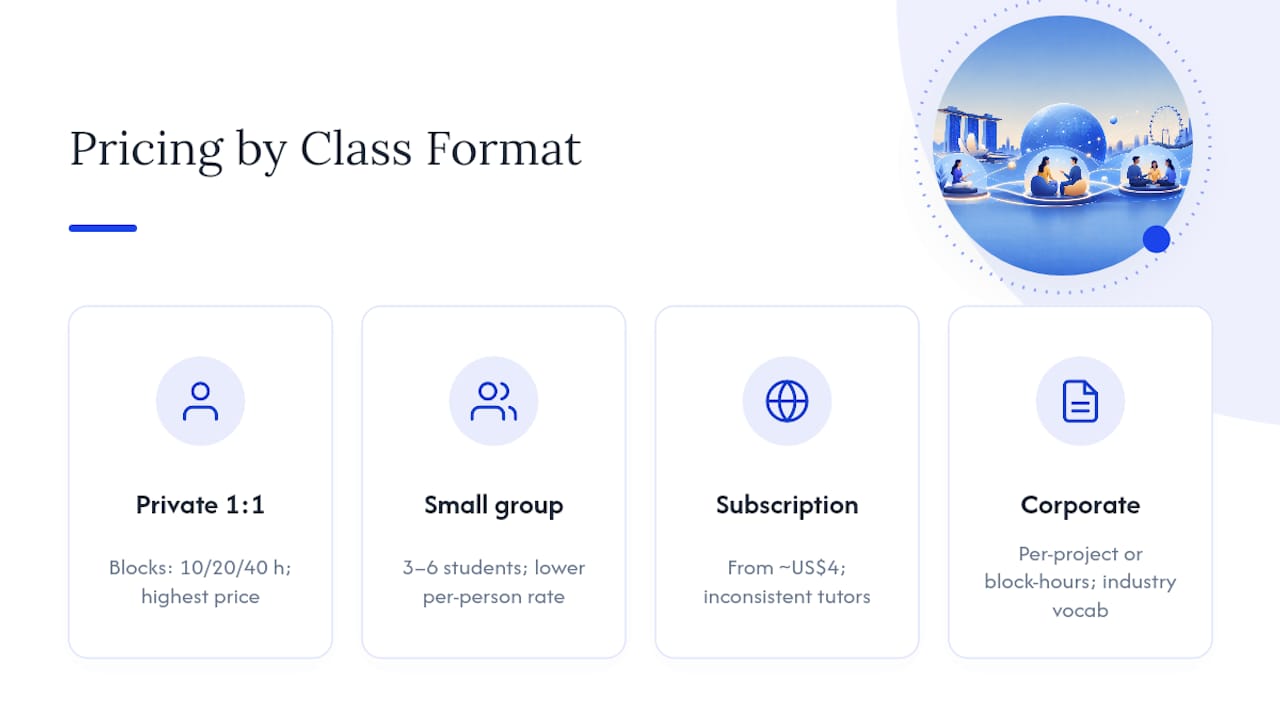
The price gap between formats isn’t arbitrary. It reflects how much individual attention you’re actually getting, and how much risk the provider is taking on your schedule.
Private 1:1 lessons sit at the top of the range because every session is built around you. Packages are usually sold in blocks of 10, 20, or 40 hours, with the per-hour rate dropping slightly as the block size increases. This format is worth the premium if you’re prepping for a specific work trip, presentation, or relocation timeline where generic group pacing won’t cut it. Private Spanish lessons let you set the pace entirely around your own schedule and goals.
Small-group classes split the teacher’s time and cost across three to six students, which is why the per-person rate drops. You get less individual correction time but more conversational practice, which actually helps some learners more than 1:1 does.
Subscription platforms operate on marketplace economics. Italki’s tutor marketplace lists lessons starting from around US$4, but that low floor usually means less consistency in teacher assignment and curriculum structure session to session.
Corporate training is priced per project: per-employee rates for cohort classes, or a block-hours quote for bespoke programs. Spanish training for professionals typically factors in industry-specific vocabulary, which generic group classes don’t cover.
Pro Tip: If your company is footing the bill, ask for a block-hours quote instead of a per-employee rate. It’s usually cheaper once you have more than four staff enrolling, and it gives HR one line item to budget instead of several.
What Actually Drives the Price You’re Quoted?
- Teacher credentials matter more than the label “native speaker.” A native speaker with no formal teaching background can charge the same as a trained instructor with a decade of classroom experience. Ask specifically about teaching certification, not just nationality.
- Class size changes the math fast. A group of four splits the teacher’s attention four ways; a group of ten barely gets you more than a lecture.
- Materials, recordings, and assessments are sometimes bundled, sometimes billed separately. Always confirm before comparing two “per-hour” rates head to head.
- Cancellation and rescheduling policies are the hidden cost most people miss. A rigid 48-hour cancellation window can quietly cost you a full lesson fee if your schedule shifts, which happens constantly with work travel.
How Do You Choose Between Providers?
Comparing quotes gets easier once you have a short list of questions ready, rather than just comparing the headline number.
- Match the format to your actual goal. Conversational fluency for travel needs different pacing than business vocabulary for client calls, so say that upfront when you ask for a quote.
- Ask for the teacher’s background, not just a bio blurb. Request a sample lesson plan for your level.
- Ask how progress gets measured. A provider with no answer beyond “you’ll feel more confident” is a weaker bet than one with defined milestones per level.
- Confirm the refund and reschedule policy in writing before paying for a package.
- Watch for red flags: vague teacher qualifications, no trial lesson offered, or admin fees that only appear after you’ve paid.
For budgeting hours, a common baseline is 12 live class hours per CEFR level for steady progress, with 24 to 48 hours recommended if you want faster movement between levels.
Pro Tip: Book a trial with at least two providers before committing to a package. The difference in teaching style becomes obvious within one session, and it’s a lot cheaper to find that out for S$0 to S$30 than after buying 20 hours.

What Does Spanish Explorer Offer for Adult Learners?
Spanish Explorer runs adult-focused online Spanish courses over Zoom, structured around conversational and business use rather than exam tracks. The formats include private 1:1 sessions, small-group adult classes, and corporate training programs built for teams.
Lessons are taught by experienced native Spanish speaking instructors fluent in both Spanish and English, with course structure aligned to CEFR levels so progress from one stage to the next is measurable rather than guesswork.
What you can expect when booking:
- Trial lesson process to confirm teacher fit and current level before committing to a package.
- Flexible online Zoom scheduling for private and group formats, designed around Singapore work hours; see the full list of options at James Spanish School’s online lessons.
- Corporate training programs that can be scoped per employee or as a block-hours quote for teams.
- In-person option at the current training centre at 10 Anson Road, Level 22, International Plaza, Singapore 079903, right above Tanjong Pagar MRT, for learners who want to combine online and face-to-face sessions.
Full details on the online class structure and booking process are available for anyone comparing formats before making a decision.
What Should You Budget for Real Progress?
Turning an hourly rate into a realistic total cost means knowing how many hours a given goal actually takes; nobody gets fluent from three lessons no matter how good the teacher is.
- Basic conversation (A1): roughly 12 to 24 hours, so at S$60 to S$120/hour private rates, budget S$720 to S$2,880 depending on pace.
- Functional conversation (A2/B1): another 24 to 48 hours on top of A1, pushing total private-lesson spend toward S$1,440 to S$5,760 for the full stretch.
- Business-ready competence (B1/B2): expect to combine structured hours with role-play focused sessions; Lingoda’s course model recommends weekly lessons over 8 to 12 weeks per level rather than expecting mastery inside a month.
Part-time learners spread this across six months to a year. Intensive learners doing two or three sessions weekly can compress it substantially, though rushed pacing tends to hurt retention. A detailed breakdown of study timelines for adult learners in Singapore is worth reading before locking in a package size.
Smart Ways to Buy Lessons Without Overpaying
A few habits protect both your wallet and your progress:
- Always request a trial lesson first, and get the reschedule and refund policy in writing before paying for a bundle.
- Bundles beat monthly subscriptions when you know your schedule; subscriptions win when your calendar is unpredictable month to month.
- Ask about recordings, materials, and assessment access before paying, since these are often the difference between two “identical” quotes.
Why Most Pricing Guides Get This Wrong
Most articles on Spanish class pricing treat the cheapest per-lesson number as the winner. That’s backward. A S$10 lesson that leaves you with a different teacher every week and no measurable progress checkpoint is more expensive than a S$90 hour that gets you to conversational competence in half the time.
The conventional advice to “shop around for the lowest rate” ignores that hours-to-goal, not cost-per-hour, is the number that actually determines your total spend. Someone who buys 40 cheap hours and plateaus at A1 has spent more, and gotten less, than someone who bought 20 well-structured hours and reached A2.
What I’d prioritize first: ask every provider how they measure progress and how many hours they’d recommend for your specific goal, before asking about price at all. A provider who can’t answer that question with any specificity is guessing at your outcome the same way you’d be guessing at the value of their quote. Price only means something once you know what it’s buying you.
— Paul
Ready to Book a Trial Lesson?
If you’ve read this far, you already know that the cheapest per-lesson rate isn’t the same as the best value. Spanish Explorer’s online adult courses run over Zoom in private, small-group, and corporate formats, taught by native Spanish speaking instructors with CEFR-aligned lesson structure, so a private hour typically lands in the same S$60 to S$120 range covered above, with package discounts on larger blocks.
Instead of piecing together a marketplace tutor here and a subscription app there, you get one consistent teacher, a measurable curriculum, and a Singapore-based team that can answer scheduling questions in real time. Book a private Spanish lesson to try a session and see the teaching style firsthand before committing to a package.
Sources
Marketplace platforms like italki and structured providers like Lingoda show useful market patterns for per-lesson and subscription pricing. Local Singapore providers, including inlingua’s Spanish program, commonly quote per-package pricing instead, so treat these as reference points rather than exact benchmarks for your own quote.
- 12 Best Online Spanish Classes (2026 Review) – Learn languages with italki
- A2 Spanish Courses | Elementary Spanish Course | Lingoda
FAQ
Can I Learn Spanish in 3 Months?
You can reach basic conversational ability (A1 to early A2) in three months with consistent weekly lessons plus self-study, but functional fluency for business or travel typically needs 6 to 12 months of structured hours.
Where Is the Best Place to Learn Spanish in Singapore?
It depends on your format preference: a structured provider like Spanish Explorer works well if you want a consistent teacher and CEFR-aligned progress tracking, while marketplace platforms suit learners who prioritize flexibility over continuity.
What’s the Cheapest Way to Learn Spanish?
Subscription platforms and per-lesson marketplaces offer the lowest sticker price, sometimes under S$15 per lesson equivalent, but they trade off teacher consistency, which can slow overall progress and raise your true cost per level reached.
Can I Learn Spanish in 30 Days?
Thirty days is enough time to learn survival phrases and basic greetings, but reaching even A1-level conversational ability realistically takes 8 to 12 weeks of regular lessons, based on how most structured course providers pace their curriculum.
Recommended
Start Learning Spanish Today
Book a trial class and see how quickly you can progress with a professionally trained native-speaker teacher guiding the way.
Book a Trial Class