 Spanish
TL;DR:
- Structured Spanish programs enhance professionals’ careers by improving communication skills and industry-specific fluency.
- Most learners report career advancement and increased earnings, with multilingual individuals earning up to $3,000 more annually.
Language schools play a direct, measurable role in professional development by delivering structured Spanish instruction aligned to real career goals. Adult language programs show that 81.1% of adult professional learners link their language training directly to career advancement. That is not a soft benefit. It reflects what happens when instruction is built around workplace communication rather than textbook grammar.
The core value language schools bring to professionals is specificity. A general app teaches you to order coffee. A structured school teaches you to negotiate a contract, manage a bilingual team, or present to a Spanish-speaking client. The American Council on the Teaching of Foreign Languages reports that 58% of language-dependent employers actively track employee language skills, and 29% invest directly in training. Employers are paying attention.
Here is what language schools actually do for professional learners:
- Align Spanish instruction with sector-specific vocabulary and real workplace scenarios
- Build communicative competence, not just grammatical accuracy
- Develop cognitive skills like executive function, multitasking, and cross-cultural decision-making
- Offer flexible formats that fit around demanding work schedules
- Provide credentialing pathways that signal proficiency to employers
81.1% of adult professional learners report career advancement linked to their language education. That figure comes from research on communicative competence in adult programs, and it holds across industries.
Table of Contents
- 1. How language schools give your career a concrete edge
- 2. What teaching methods actually work for busy professionals
- 3. How to choose a Spanish language program for your career
- 4. What Spanish Explorer offers professional learners
- 5. What career advancement looks like after structured Spanish training
- 6. Why industry-specific language learning outperforms general Spanish
- Spanish Explorer is built for professionals who need real results
- FAQ
- Key Takeaways
1. How language schools give your career a concrete edge
The career benefits of learning Spanish through a structured school go well beyond being able to hold a conversation. The economic benefits of multilingualism, as documented by the U.S. Department of Education, show that multilingual individuals earn $2,000–$3,000 more on average than monolingual peers. A separate analysis of bilingual labor market outcomes puts the wage premium for bilingual employees at 19% in 2026.

Beyond earnings, Spanish proficiency opens access to bilingual-required roles in healthcare, legal services, finance, and international trade. These are not entry-level positions. They tend to require advanced communication skills in both languages, which is exactly what a professional Spanish program builds.
The cognitive side matters just as much. Research on bilingualism and executive function shows that individuals who actively use two languages outperform monolinguals on tasks requiring inhibitory control and selective attention. In practical terms, that translates to better multitasking, sharper decision-making under pressure, and stronger cross-team collaboration.
- Higher average earnings and access to premium bilingual roles
- Improved executive function and cognitive flexibility on the job
- Stronger cross-cultural communication with Spanish-speaking clients and colleagues
- Greater competitiveness in global industries where Spanish is a working language
2. What teaching methods actually work for busy professionals
The shift in professional language education over the past decade has been away from grammar drills and toward communicative, scenario-based learning. The difference in outcome is significant. Communicative competence drives career advancement far more reliably than grammatical perfection, because what employers need is someone who can perform in Spanish, not recite conjugation tables.
Effective programs for professionals use role-play, simulated negotiations, and industry-specific dialogues. A lawyer learns how to conduct a client intake in Spanish. A finance professional practices presenting quarterly results. A customer service manager runs through complaint resolution scenarios. Sector-specific training maps proficiency directly to career language requirements rather than chasing abstract fluency.
Blended learning combining live sessions with asynchronous digital tools is now standard in strong professional programs. It accommodates irregular schedules without sacrificing the accountability of real-time instruction. For retention, daily micro-habits of 20 minutes outperform weekend cramming sessions. Consistent, incremental exposure builds the kind of automatic recall that holds up in a real meeting.
- Communicative, scenario-based instruction over grammar-focused teaching
- Role-play and workplace simulations tailored to your industry
- Blended formats combining live instruction with digital practice tools
- Daily micro-learning habits for stronger long-term retention
- Proficiency assessments mapped to specific career language requirements
3. How to choose a Spanish language program for your career
Start with a clear-eyed self-assessment. What do you actually need Spanish for? Client calls, written reports, team management, or trade negotiations each demand different vocabulary and different skill priorities. A program that cannot tell you which professional contexts it prepares you for is not built for professionals.
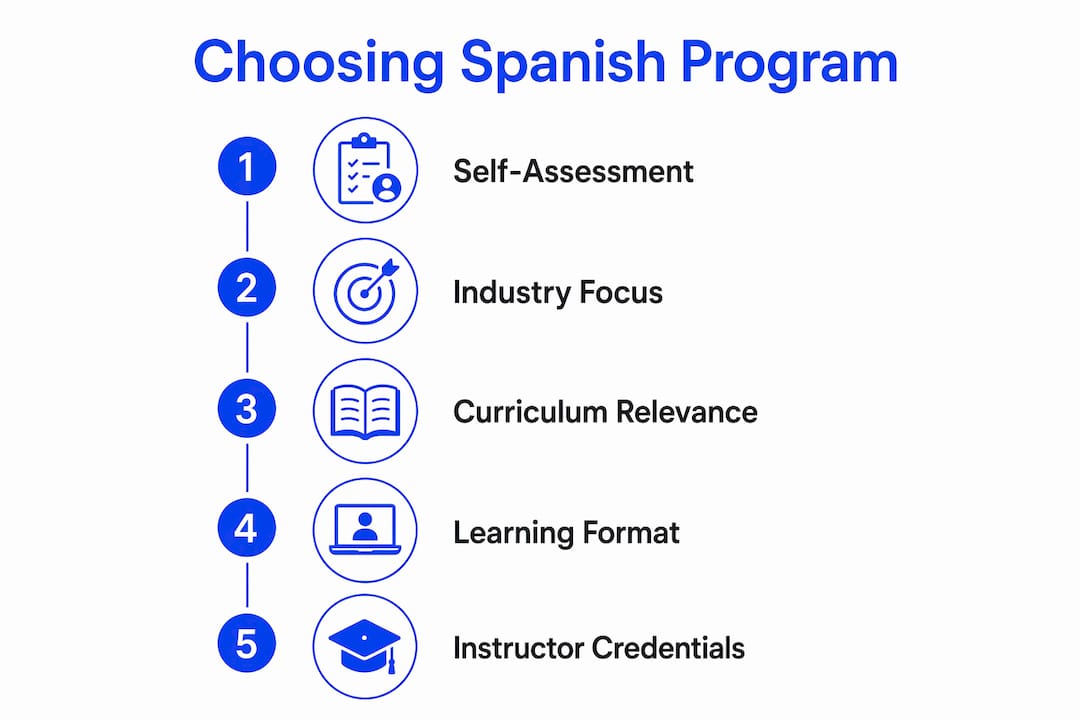
Check whether the curriculum covers functional, industry-relevant language. Generic conversational Spanish has its place, but if your goal is career advancement, the program needs to address the specific interactions you will face at work. Business language programs tailored to sectors like law, finance, and customer service deliver measurably better outcomes for working adults than general-purpose courses.
Scheduling flexibility is non-negotiable for most professionals. Look for programs offering evening or weekend sessions, online live classes, or private instruction that fits around your calendar. Also ask about credentialing options. A recognized certificate of proficiency carries weight with employers and validates the investment you have made.
Pro Tip: Verify that your instructor is fluent in both Spanish and English and has experience working with professional learners. An instructor who understands your industry context can adapt examples and scenarios on the fly, which accelerates learning considerably.
- Identify your specific professional use cases before choosing a program
- Prioritize curricula with functional, industry-specific vocabulary
- Confirm flexible scheduling options: evenings, weekends, or online live sessions
- Ask about certification or proficiency credentials relevant to your field
- Check instructor qualifications and professional sector experience
4. What Spanish Explorer offers professional learners
Spanish Explorer is a structured Spanish language school with programs designed specifically for adult learners pursuing conversational and business Spanish. The course formats include group classes, private one-on-one instruction, corporate training for teams, and online Zoom classes for learners who need maximum scheduling flexibility.
Instructors are certified, bilingual in Spanish and English, and experienced with adult professional learners. That dual-language fluency matters: it means explanations happen in the language you already think in, which cuts through confusion faster than immersion-only approaches. The curriculum focuses on real-world communication skills rather than abstract fluency, with content adapted to professional contexts.
Corporate training programs are available for companies that want to upskill teams working with Spanish-speaking markets or clients. These are not off-the-shelf courses. They are structured around the specific communication needs of the organization. Structured language courses for adults consistently show stronger professional outcomes than self-directed learning, and Spanish Explorer’s program design reflects that.
- Group, private, corporate, and online Zoom class formats
- Bilingual instructors fluent in Spanish and English
- Curriculum focused on professional communication and real-world use
- Corporate training tailored to team and organizational needs
- Accessible location in Singapore’s central business district
5. What career advancement looks like after structured Spanish training
The pattern across professional learners is consistent. Adults who complete structured Spanish programs in professional contexts report outcomes that are specific and measurable: a promotion that required bilingual capability, a new client relationship opened because they could communicate directly, a move into a role with international scope.
Healthcare professionals who complete Spanish training report being able to conduct patient consultations without an interpreter, which improves both efficiency and patient trust. Finance professionals describe closing deals with Latin American counterparts that would have stalled without direct communication. These are not abstract gains. They show up in performance reviews, compensation discussions, and career trajectory.
The labor market outcomes research on bilinguals in the U.S. confirms that language skills provide the greatest competitive advantage in service industries where communication is central to the work. For professionals in those fields, Spanish proficiency is not a resume decoration. It changes what roles you can access.
6. Why industry-specific language learning outperforms general Spanish
Generic Spanish instruction teaches you to survive a trip to Mexico. Industry-specific language training teaches you to perform your job in Spanish. The gap between those two outcomes is what separates a useful credential from a transformative career skill.
Legal professionals need vocabulary around contracts, liability, and client rights. Healthcare workers need terminology for symptoms, procedures, and informed consent. Customer service teams need the register and tone that builds trust with Spanish-speaking customers, not just the words. Industry-specific programs prioritize communication skills relevant to real workplace scenarios, which is why they produce faster, more durable results for professionals.
The accent reduction and communication clarity dimension also matters in professional settings. Being understood clearly in high-stakes conversations, whether a negotiation or a client presentation, depends on more than vocabulary. Programs that address pronunciation and delivery alongside vocabulary give professionals a more complete toolkit. Integrating language learning with your actual job function, rather than treating it as a separate study track, is what makes the skill stick.
Spanish Explorer is built for professionals who need real results
If you are a working adult who needs Spanish for your career, not just for travel, Spanish Explorer offers a direct path. The programs are structured for professional outcomes: business Spanish, conversational fluency for client-facing roles, and corporate training for teams. Every format, from private classes to live online Zoom sessions, is designed around the schedules and goals of working adults.
The concrete difference from self-study or general language apps is accountability and structure. You work with certified bilingual instructors who adapt content to your professional context, track your progress, and push you past the plateau that stops most self-directed learners. Spanish courses at Spanish Explorer cover the full range from beginner conversational to advanced business Spanish, with private class options for learners who want a fully customized program. Browse the course offerings and book a consultation to find the format that fits your career goals.
FAQ
How do language schools support professional development?
Language schools support professional development by delivering structured, career-focused instruction that builds communicative competence in workplace contexts. Research shows 81.1% of adult professional learners link their language training directly to career advancement.
What is the wage benefit of learning Spanish professionally?
Multilingual individuals earn $2,000–$3,000 more on average than monolingual peers, according to U.S. Department of Education data, with a 19% wage premium reported for bilingual employees in current labor market analyses.
How long does it take to reach professional Spanish proficiency?
Time commitment varies by starting level and learning intensity, but professionals using structured programs with consistent daily practice typically reach functional workplace proficiency within several months.
What formats does Spanish Explorer offer for working adults?
Spanish Explorer offers group classes, private one-on-one sessions, corporate team training, and live online Zoom classes, all designed to fit around professional schedules.
Is industry-specific Spanish better than general conversational courses?
For career advancement, yes. Sector-specific training maps vocabulary and scenarios directly to your job role, producing faster and more durable professional results than general-purpose language instruction.
Key Takeaways
Language schools drive professional advancement by delivering structured, career-aligned Spanish instruction that builds communicative competence, cognitive skills, and industry-specific fluency.
| Point | Details |
|---|---|
| Career advancement rate | 81.1% of adult professional learners link language training directly to career advancement. |
| Wage premium | Multilingual individuals earn $2,000–$3,000 more on average, with a 19% wage premium for bilingual employees. |
| Most effective method | Communicative, scenario-based instruction with daily micro-habits outperforms grammar-focused or infrequent study. |
| Employer demand | 58% of language-dependent employers track employee language skills; 29% invest in training programs. |
| Spanish Explorer | Offers group, private, corporate, and online Zoom Spanish courses built for adult professional learners. |
Recommended
Start Learning Spanish Today
Book a trial class and see how quickly you can progress with a professionally trained native-speaker teacher guiding the way.
Book a Trial Class