 Spanish
Spanish business culture runs on confianza, personal trust built face to face, more than on formal process or written procedure. Senior figures usually hold final decision authority even after open debate, and status matters in how you dress, address people, and show up. The single best move for any visiting professional is to invest in that relationship before pushing the agenda. Everything else, meetings, timing, negotiation, dining, follows from getting that first part right.
TL;DR:
- Building confianza through face-to-face relationships and personal introductions is essential before advancing business agendas in Spain.
- Formal greetings, professional titles, and conservative dress are crucial for making a good first impression in Spanish business settings.
- Meetings typically start with socializing and small talk, with energetic, overlapping conversations that signal engagement rather than disorder.
- Negotiations proceed slowly and rely heavily on relationships, with verbal commitments and follow-up calls often more effective than written proposals alone.
- Business meals are key relationship-building opportunities, lasting longer and starting later, with invitations generally accepted to foster trust.
Table of Contents
- Why Confianza and Hierarchy Drive Spanish Corporate Culture
- How Do Meetings Run in Spanish Companies?
- Greetings, Address, Cards, and Dress: Getting the Basics Right
- Timing It Right: Punctuality and the Split Workday
- Negotiation Style: Why Deals Move Slowly and What Speeds Them Up
- Business Meals: Turning Lunch and Dinner Into Real Rapport
- Why Learning Business Spanish Pays Off Faster Than You Think
- Gender Roles and Diversity in Spanish Workplaces
- A Practical Take on What Actually Moves the Needle
- A Practical Way to Build Business Spanish Skills
- Sources
- FAQ
Why Confianza and Hierarchy Drive Spanish Corporate Culture
Confianza is not a soft nicety in Spain. It is the operating system. Spanish business culture is defined by a strong emphasis on trust built through long term, personal, face to face relationships rather than formal systems alone, which explains why a warm introduction from a mutual contact often opens doors that a cold email never will.
Hierarchy reinforces this. Meetings can be lively and full of debate, but managers are expected to lead decisively, and final decisions often sit with senior figures even after the room has argued through several positions. Knowing who actually signs off matters more than knowing who talks the most.
Regional identity adds another layer. A company in Barcelona may operate with different norms and even different working language expectations than one in Madrid or Bilbao. Reading the room for status cues helps too:
- Job titles and seniority get acknowledged early, often in the first few sentences of introduction.
- Formal address (usted) is the safer default until a senior counterpart signals otherwise.
- Third-party referrals and in-person introductions build trust faster than written proposals alone.
Pro Tip: Ask a local partner or contact to make the introduction rather than emailing cold. A five-minute favor from someone trusted can save weeks of relationship-building later.
How Do Meetings Run in Spanish Companies?
Spanish meetings rarely start with the agenda item. Meetings often begin with introductions and small talk, and agendas tend to stay flexible, with discussion moving in a non-linear, conversational way rather than ticking down a list.
Expect animated, expressive communication. Overlapping conversation and gestures are common and signal engagement, not disrespect or disorder. Reading that correctly saves visiting professionals from misreading enthusiasm as conflict.
A short checklist for your first meeting:
- Arrive on time, even if the room is not fully ready when you get there.
- Greet the most senior person first, using surname and title until invited otherwise.
- Let small talk run its course before steering toward business.
- Take notes visibly. It signals seriousness without interrupting the flow.
- Send a short written follow-up within 24 hours, then reinforce it with a call.
Pro Tip: Bring a printed agenda, but treat it as a loose outline, not a script. Forcing rigid structure onto a Spanish meeting often reads as impatience.
Greetings, Address, Cards, and Dress: Getting the Basics Right
First impressions in Spain lean formal until proven otherwise; mastering your presentation topics for managers can help you win e-signature buy-in and make a polished first impression in meetings. A firm handshake works for most first meetings; cheek kisses (one on each side) are common in social settings and among women or mixed pairs who already know each other, but not typically in an initial business context.
- Use usted with new or senior contacts, and switch to tú only when they invite it.
- Lead with professional titles (Doctor, Ingeniero, Licenciado) where they apply, especially in law, medicine, and engineering.
- Present and receive business cards with both hands where possible, and glance at the card before putting it away.
- Dress smartly and conservatively for a first meeting. Professional presentation signals status and respect in Spain, particularly in finance, law, and traditional industries where a polished suit still outperforms business casual.
Timing It Right: Punctuality and the Split Workday
Spain’s traditional office schedule, jornada partida, runs roughly 9:00 to 14:00, breaks, then resumes around 16:00 to 19:00 or 20:00. Plenty of international firms and modern offices in Madrid and Barcelona now run a continuous schedule instead, but the split day still shapes retail hours and traditional sectors.
- Punctuality matters more in formal, senior-level meetings; a little flexibility is tolerated in casual internal check-ins.
- Avoid scheduling around August, when much of the country slows down for vacation, and around local puentes (long weekends built around a holiday).
- Confirm meeting times a day ahead, since a split schedule can shift start times by an hour depending on the company.
Negotiation Style: Why Deals Move Slowly and What Speeds Them Up
Negotiation in Spain is relationship-led, not transaction-led. A written offer rarely closes anything on its own; written contracts get reinforced by verbal commitment, and a phone call or in-person visit after a proposal often does more than a follow-up email.
- Identify the actual decision-maker early. Enthusiasm from a mid-level contact does not guarantee a “yes” from above.
- Expect papeleo, the bureaucratic paperwork layer, to add time. Many companies engage a gestor, a local administrative specialist, to move trámites through faster.
- Reinforce every written offer with a call or a visit rather than waiting silently for a reply.
- Treat silence as a normal part of the pace, not a rejection. Persistent, polite check-ins beat one aggressive push.
Pro Tip: After sending a written proposal, call within 48 hours just to confirm it arrived and ask if anything needs clarifying. That one call often does more than the document itself. A clean written follow-up still helps, and a Spanish email etiquette guide can help you get the tone right.
Business Meals: Turning Lunch and Dinner Into Real Rapport
Meals are not a break from business in Spain. They are where business actually gets decided. Lunch can last a lengthy time and dinner often starts late in the evening., so pace yourself and skip the urge to rush to a close.
- Do accept invitations to lunch or dinner; declining reads as disinterest in the relationship.
- Do let the host order or suggest dishes, and try a reasonable amount of what’s offered.
- Don’t bring up hard numbers right when the food arrives. Let conversation warm up first.
- Do accept a modest gift if offered, but keep any gift you give understated. Anything that looks like a bribe undermines the trust you’re trying to build.
Why Learning Business Spanish Pays Off Faster Than You Think
You don’t need fluency to shift how a Spanish counterpart sees you. Attempting Spanish, even imperfectly, measurably improves how trustworthy and respectful you come across in business settings, which matters more in a confianza-driven culture than almost anywhere else.
A handful of phrases go a long way:
- “Mucho gusto en conocerle” (a pleasure to meet you) for a formal first greeting.
- “Quedo a su disposition” (I remain at your disposal) as a polished email closer.
- “¿Le parece bien si…?” (would it work for you if…) to propose next steps politely.
Pro Tip: Learn the closing line of a formal email before anything else. It’s the line a Spanish counterpart reads last, and it shapes their overall impression of the whole message. For structured phrasing, a professional Spanish for business guide or a corporate module through Spanish training for professionals covers this in more depth than a phrasebook ever will.
Gender Roles and Diversity in Spanish Workplaces
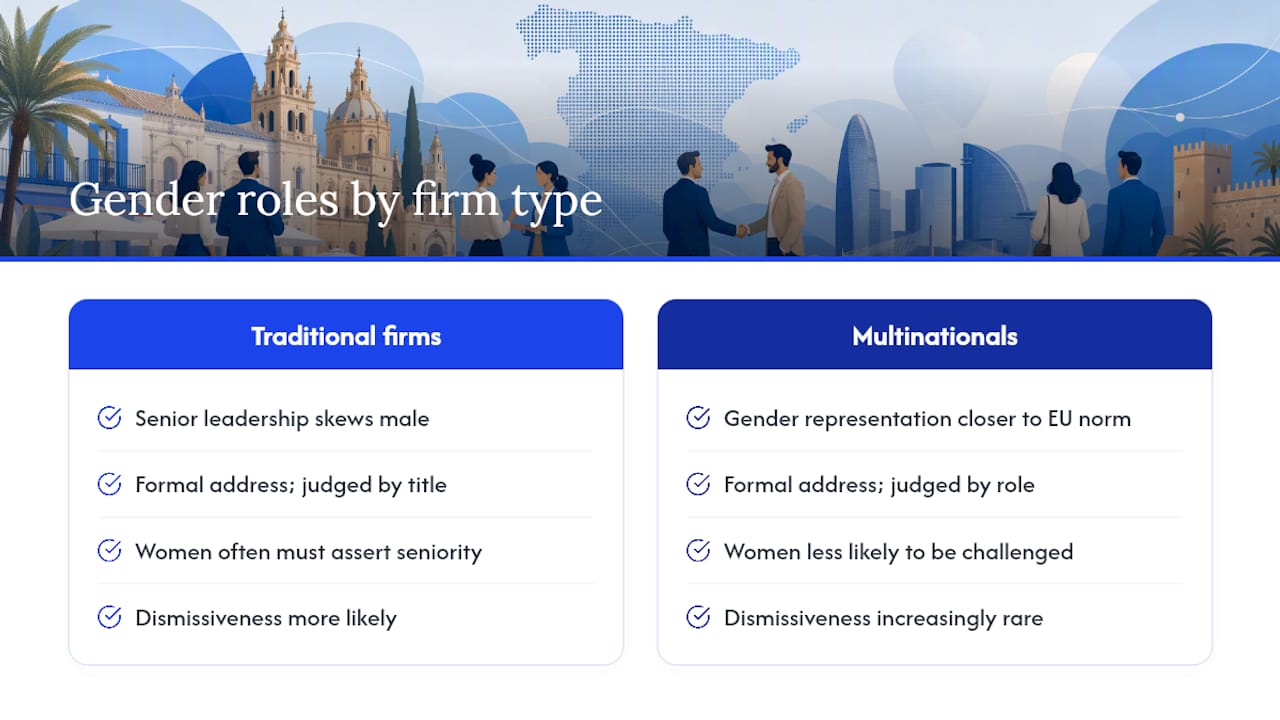
Spanish corporate culture has shifted meaningfully over the past two decades, but old patterns still surface in traditional industries like construction, finance, and manufacturing, where senior leadership skews male. Larger multinationals and firms in Madrid and Barcelona tend to run closer to broader European norms on gender representation in management.
Visiting professionals, regardless of gender, should expect to be addressed formally and judged first on title and role rather than on personal characteristics. Women in senior roles sometimes report needing to assert seniority more explicitly in first meetings, particularly with counterparts from more traditional sectors or older generations. That said, dismissiveness based on gender is increasingly the exception rather than the norm in urban business centers.
Diversity beyond gender, nationality, age, disability status, is also gaining visibility on corporate agendas, especially among firms competing for international talent or clients. If you’re leading a delegation or a negotiating team, it helps to brief every team member on the formality norms in this guide beforehand, since expectations around address and presentation apply uniformly regardless of who on your team is speaking. The safest approach is consistency: extend the same formal courtesy, the same attention to titles, and the same patience with hierarchy to every counterpart in the room.
A Practical Take on What Actually Moves the Needle
The mistake most guides make is treating Spain as one uniform culture instead of city-by-city and industry-by-industry variation. Pick one tactic, usually a follow-up call after a written proposal, and track whether it shortens your next negotiation.
— Paul
A Practical Way to Build Business Spanish Skills
There are other ways to pick up workplace Spanish: apps, free online lessons, borrowing a coworker’s old textbook. Most of them teach vocabulary without the context that actually changes how a Spanish counterpart perceives you in a meeting. Adult courses often focus specifically on conversational and business use, so the phrasing you practice is the phrasing you’ll actually need at the negotiating table or in a follow-up email.

Training runs online over Zoom for flexible scheduling, or in person at Com’s training center at 10 Anson Road, Level 22, International Plaza, Singapore 079903, right above Tanjong Pagar MRT. Options include group classes, private one-on-one lessons, and corporate training built around your team’s industry and counterparts. If you’re negotiating with Spanish partners regularly, a focused corporate module gets you further than a general course. Start by browsing the Spanish courses page or looking into corporate training options to find a format that fits your schedule and your goals.
Sources
- Spain Business Culture Guide | Global Business Culture
- Spain country commercial guide — business travel
- Spanish – Business Culture
- Business etiquette in Spain: punctuality, gift giving and CSR
FAQ
What Are the Top Spanish Business Traditions to Know?
The essentials are building confianza before pushing an agenda, respecting hierarchy in decision-making, treating long lunches and late dinners as relationship-building time, dressing sharply for first meetings, and following up written offers with a call or visit.
How Many Hours a Day Do People in Spain Typically Work?
Many traditional offices still run a split schedule, roughly 9:00 to 14:00 and then 16:00 to 19:00 or 20:00, though a growing number of modern companies have switched to a continuous workday without the long midday break.
Does Spain Have a Four-Day Workweek?
No nationwide four-day workweek exists in Spain; some individual companies have piloted shorter or compressed schedules, but the split or continuous eight-hour day remains the standard across most industries.
Is Spain a Good Country for Doing Business?
Spain offers strong access to European and Latin American markets and a business culture that rewards patience and relationship-building, though newcomers should budget extra time for bureaucratic steps and decision-making that runs through senior leadership.
How Long Should I Expect a Spanish Business Lunch to Last?
Plan for roughly two hours at minimum, since lunch is treated as genuine relationship-building time rather than a quick break between meetings.
Recommended
Start Learning Spanish Today
Book a trial class and see how quickly you can progress with a professionally trained native-speaker teacher guiding the way.
Book a Trial Class