 Spanish
The correct phrase is “clase de español.” You’ll also hear “clase de castellano” in some regions, since “castellano” is another name for the Spanish language, but “clase de español” is the version every teacher and school actually uses. Say it “KLAH-seh deh ehs-pahn-YOL.” If you’re past the vocabulary question and actually want to sit in one, here’s your one-line next step: book a trial lesson or take a quick placement test before you commit to a package.
- Right now: decide if you want a placement test (if you’ve studied before) or a trial lesson (if you’re starting fresh), and book one this week rather than “eventually.”
Key Takeaways
Learning to say “clase de español” correctly is the easy part; the real decision is matching class format, level, and teacher quality to your actual goal.
| Point | Details |
|---|---|
| Correct phrase | “Clase de español” is the standard term; “clase de castellano” is a regional variant. |
| Match format to goal | Group classes suit budget and speaking practice; private lessons suit fast, targeted progress. |
| Know your level first | Take a placement test before enrolling to avoid wasting time in the wrong-level class. |
| Speak from lesson one | Comprehensible input paired with early active speaking practice produces faster conversational gains than grammar drills alone. |
| Start with a trial | Spanish Explorer offers group, private, corporate, and online classes with native, bilingual instructors and a trial lesson before you commit. |
Table of Contents
- What Types of Spanish Classes Are Available?
- How Long Does It Take to Learn Spanish as an Adult?
- Who Should Teach You, and What Actually Works for Adults?
- What Do Schedules and Pricing Typically Look Like?
- How Do You Choose and Enroll in a Class?
- How Should You Prepare for Your First Spanish Class?
- Ready to Book Your First Spanish Class?
- Sources
- FAQ
What Types of Spanish Classes Are Available?
“Clase de español” covers a lot of ground once you start comparing formats. Group classes, private lessons, corporate training, and live online sessions all teach the same language, but they get you there differently, and picking the wrong one wastes both time and money.
Group classes put you with 4 to 8 other adults working through the same curriculum. Private lessons are one-on-one, built around your schedule and your specific gaps, whether that’s business vocabulary or getting your subjunctive tense unstuck. Corporate training brings a certified instructor to your team, either in person or over Zoom, with content tailored to your industry. Online/Zoom classes replicate the classroom experience remotely, often in small groups, and suit anyone who can’t commit to a fixed location.
Here’s how to match format to goal:
- Want the cheapest path to conversational fluency? Group classes give you more speaking reps per dollar because you’re practicing with classmates, not just the teacher.
- Need fast, targeted progress for a specific trip or job? Private lessons move at your pace and skip material you already know.
- Managing a team that needs Spanish for client calls? Corporate training lets you build the curriculum around real workplace scenarios.
- Can’t get to a physical classroom? Live online classes over Zoom deliver the same structured course format without the commute.
Pro Tip: Private lessons are worth the premium when you have a hard deadline (a relocation, a big client meeting) or a specific weak spot to fix. For general conversational growth, small-group classes usually beat private tutoring because you’re forced to think on your feet with people who aren’t your teacher.
Not sure which one fits your situation? A format comparison guide can help you weigh the trade-offs before you book anything.
How Long Does It Take to Learn Spanish as an Adult?
Most language schools measure progress using the CEFR scale, which runs from A1 (absolute beginner) to C2 (near-native). For adult learners in structured classes, the realistic range most people care about is A1 through C1.
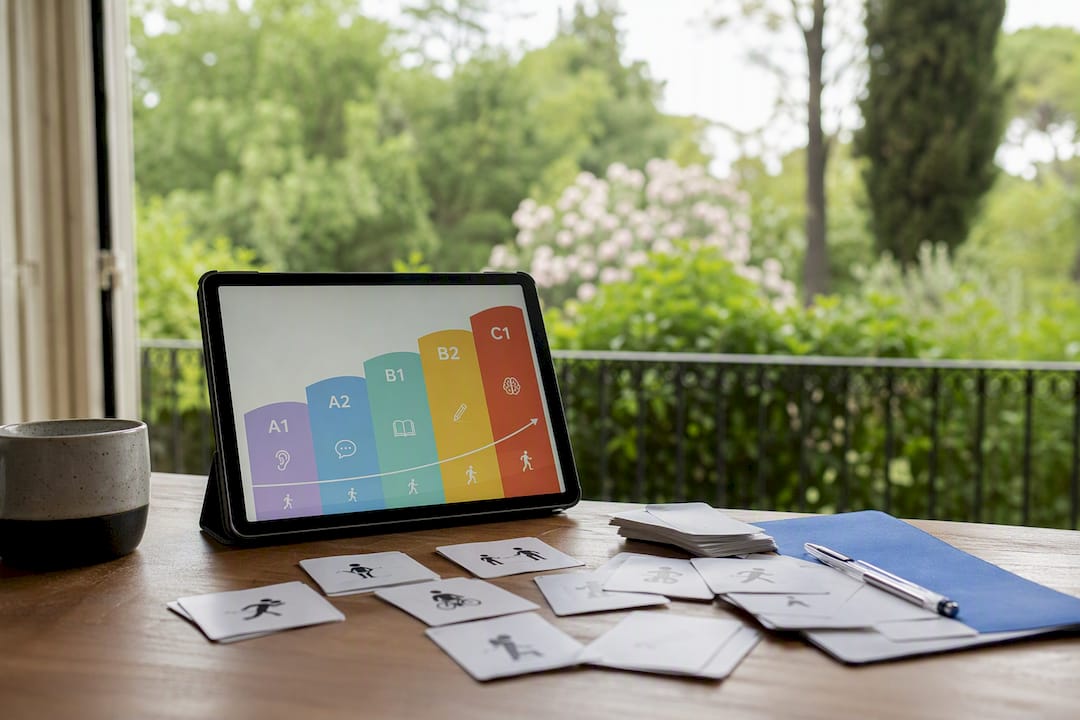
At A1, you can introduce yourself, order food, and handle basic transactions with a lot of pausing. A2 gets you through simple past and future conversations, more comfortable but still hesitant. B1 is the level where things click. You can hold a real conversation, describe experiences, and follow most everyday Spanish without translating in your head. B2 adds fluency and nuance, letting you debate opinions and understand native speakers at normal speed. C1 means you operate professionally in Spanish, negotiating and writing formally with minimal errors.
| CEFR Level | What You Can Do | Typical Timeline (Adult, Live Classes + Self-Study) |
|---|---|---|
| A1 | Basic greetings, simple transactions | a few months |
| A2 | Past/future tense, simple conversations | a few months more |
| B1 | Sustained conversation, describing experiences | about half a year or more |
| B2 | Fluent discussion, understanding native speed | several months beyond B1 |
| C1 | Professional and formal communication | a significant period of extended study |
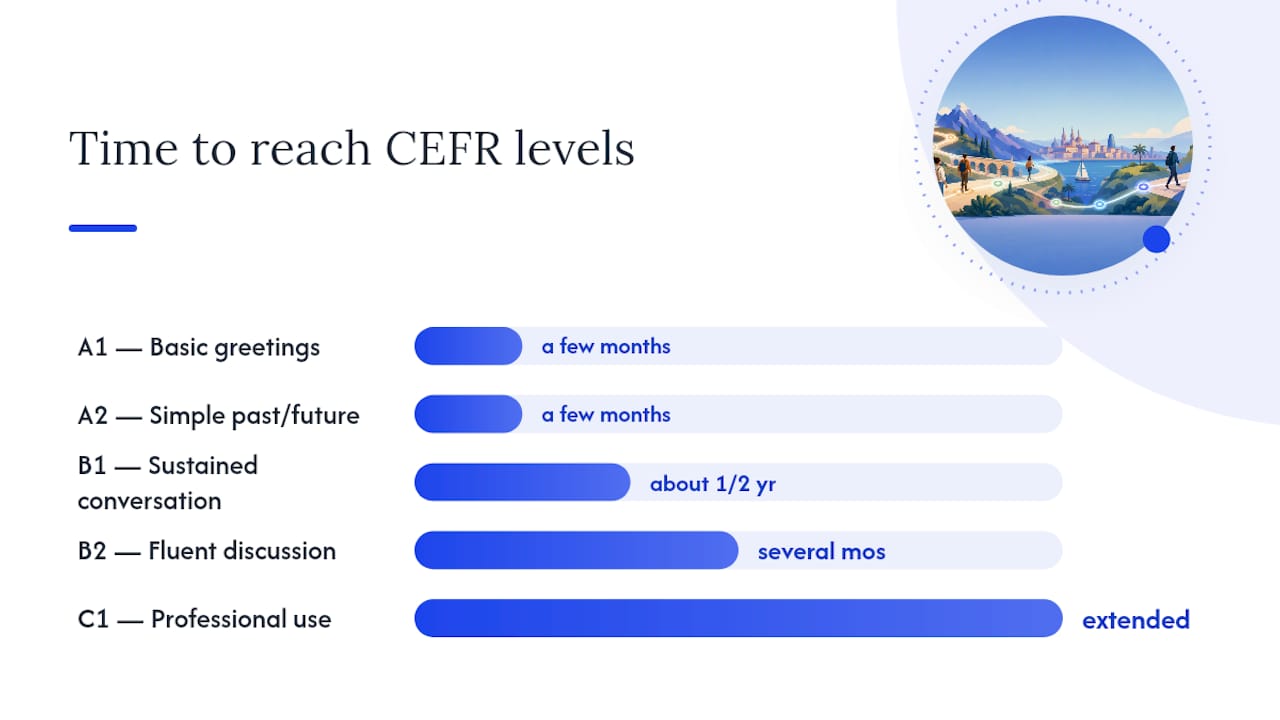
These ranges assume regular weekly classes plus practice outside the classroom, not just showing up once a week and hoping for osmosis. Guides on learning Spanish consistently point to the same accelerator: prioritizing high-frequency verbs and connecting words early, rather than memorizing long noun lists, gets you forming real sentences faster.
If you’ve studied Spanish before but don’t know where you land, don’t guess. Take a placement test first. Starting a beginner class when you’re actually at B1 wastes your time and money, and starting too high kills your confidence in week one.
Who Should Teach You, and What Actually Works for Adults?
Not every fluent Spanish speaker makes a good teacher for adults, and not every teaching method produces conversational speed. Two things matter more than the rest: who’s in front of you, and what they’re asking you to do in class.
Look for instructors who are native or near-native speakers with real experience teaching adults specifically, not just kids or exam-prep students. Bilingual ability matters too. A teacher fluent in both Spanish and English can explain a grammar point in ten seconds when a Spanish-only explanation would burn five minutes. Feedback style is the other filter: you want correction that happens in the moment, not a red-marked worksheet handed back a week later.
On methodology, the research lines up: the combination that reliably works for adults is comprehensible input paired with active output, meaning you listen and read material slightly above your level while also speaking and writing constantly, with grammar introduced as you need it rather than drilled in isolation upfront.
When you’re sizing up a school, run through this checklist:
- Does it offer a placement test or trial lesson before you commit to a package?
- Are class sizes small enough that you’re actually speaking, not just listening?
- Are instructors native speakers with documented experience teaching adults?
- Can you sit in on or preview a sample lesson before paying?
Spanish Explorer’s instructor team is built around exactly these criteria, with native speakers who teach in both languages depending on what the moment calls for.
What Do Schedules and Pricing Typically Look Like?
Spanish classes for working adults tend to cluster around a few predictable time slots: weeknight evening group classes (the most common option), weekend intensives for people who want to compress hours, weekday business-hours blocks for corporate training, and evening online sessions for anyone juggling time zones or just avoiding the commute.
Pricing usually splits into two models: hourly private rates, which cost more per hour but need fewer total hours since the content is fully personalized, and package pricing, where you pay per course block and the per-hour cost drops as group size goes up. The biggest price drivers are class size, format (private costs more than group), and whether you’re booking corporate training with custom content built for your team.
Before paying for anything, book a trial lesson. It’s the cheapest way to check three things:
- Does the teaching pace match how fast you actually learn?
- Is the class size small enough that you’re speaking, not just nodding along?
- Does the school have a reasonable reschedule policy if work or travel gets in the way?
Most schools, including private class options here, allow rescheduling with reasonable notice, which matters more than people expect once real life starts colliding with a fixed weekly slot.
How Do You Choose and Enroll in a Class?
Run through five questions before you book anything: What’s your actual goal (travel, business, general fluency)? How many hours a week can you realistically commit? Which format fits your life, group, private, corporate, or online? What’s your budget per month? And do you already know your level, or do you need a placement test first?
Once you’ve got answers, enrollment usually follows the same sequence at any serious school:
- Take a placement test (or skip straight to a trial if you’re a true beginner).
- Choose your format based on the checklist above.
- Schedule a trial lesson to test the teaching style and pace.
- Confirm your package once you’re satisfied with the trial.
- Do a bit of prep work before your first real class (more on that below).
If you want a starting point that removes the guesswork, Spanish Explorer’s course pages lay out group, private, and corporate options side by side, all taught by instructors experienced with adult learners specifically. Booking a trial lesson is the fastest way to find out if the pace and teaching style actually fit how you learn, before you commit to a full package.
How Should You Prepare for Your First Spanish Class?
The single biggest lever for a strong first class is learning the first 30 to 50 high-frequency words before you walk in, greetings, numbers, basic verbs like “ser,” “estar,” and “tener.” You don’t need fluency. You need enough raw material that your brain isn’t starting from zero when the teacher asks a question.
Spend 20 minutes reviewing basic pronunciation, especially vowel sounds, since Spanish vowels are far more consistent than English ones and getting them right early improves how natively you sound from your very first sentences. Write down two or three things you want to be able to say within a month, whether that’s ordering food confidently or handling a work call. Having a concrete goal gives your teacher something to build toward instead of guessing what you need.
If you’re nervous about speaking in front of others, practice saying a few sentences out loud alone first, even badly. The goal isn’t correctness. It’s getting your mouth used to producing the sounds before class starts, so the first time you speak Spanish isn’t also the first time you’ve heard your own voice do it.
Bring a notebook, show up five minutes early if it’s in person, and resist the urge to translate every word in your head. That habit is the single biggest speed limiter for adult learners, and breaking it starts in lesson one, not lesson twenty.
A Note on What Actually Moves the Needle
What surprises most adult learners is that grammar isn’t the bottleneck. Speaking early, even imperfectly, is what separates people who reach conversational fluency in a year from people who study for three years and still freeze up ordering coffee. Our approach centers on conversational and business Spanish from day one, with native, bilingual instructors who correct in the moment rather than after the fact.
Ready to Book Your First Spanish Class?
If you’ve read this far, you already know more than most people who walk into a language school cold. The next move is simple: stop researching and book a trial lesson. Spanish Explorer runs group, private, corporate, and live online classes for adults, all built around conversational and business Spanish rather than exam drills, taught by native, bilingual instructors who work with adult schedules instead of fighting them.

Start with a trial class to test the pace and teaching style before committing to a package, or browse the full course lineup to compare group, private, and corporate formats. If Zoom fits your schedule better than a commute, the online class page covers live sessions, group sizes, and timing. Our training center sits at 10 Anson Road, Level 22, International Plaza, Singapore 079903, right above Tanjong Pagar MRT, for anyone who prefers to learn in person. Either way, the fastest way to know if a class fits is to sit in one.
Sources
- How to Learn Spanish Fluently (Get Conversational in 90 Days)
- The Best Way to Learn Spanish: A Complete Guide for Beginners and Beyond | Inklingo Blog
FAQ
How Do You Say “Learning Spanish” in Spanish?
“Learning Spanish” translates to “aprender español” or “aprendiendo español” when describing an ongoing process, as in “estoy aprendiendo español” (I’m learning Spanish).
What Do You Call “Class” in Spanish?
“Class” is “clase,” a feminine noun, so it always pairs with feminine articles and adjectives: “la clase,” never “el clase.”
How Do You Say “I’m Taking Spanish Classes”?
Say “estoy tomando clases de español” or the more natural regional alternative “estoy llevando clases de español,” both of which mean the same thing.
Do You Say “La Clase” or “El Clase”?
It’s always “la clase.” Spanish nouns ending in “e” are usually masculine, but “clase” is one of the common exceptions and takes the feminine article.
How Do I Know Which Spanish Class Level to Start At?
Take a placement test if you’ve studied Spanish before, or start at A1 if you’re a complete beginner; a trial lesson at Spanish Explorer can confirm the right starting point either way.
Recommended
Start Learning Spanish Today
Book a trial class and see how quickly you can progress with a professionally trained native-speaker teacher guiding the way.
Book a Trial Class