 Spanish
The two certifications worth pursuing from Singapore are the DELE) and the SIELE. Both map to the CEFR scale from A1 through C2, and both carry weight with universities and employers who need proof of Spanish ability beyond a class certificate. Your next move is straightforward: pick the CEFR level that matches your goal, then find a course built specifically to prepare for that exam rather than a general conversation class.
Here’s how the two options break down before you commit to either path:
- DELE is issued on behalf of Spain’s Instituto Cervantes and tends to carry more weight for academic admissions.
- SIELE is delivered digitally, bookable online, and suits people who want faster results and flexible test dates.
- Local DELE sessions have historically run through university language centers such as NUS.
- SIELE reservations happen entirely through its own online booking system, no local test center required.
Key Takeaways
Recognized Spanish certification in Singapore comes down to two exams, DELE and SIELE, and success depends on matching your course to the specific CEFR level and skills each exam tests.
| Point | Details |
|---|---|
| Two main certification routes | DELE and SIELE both map to CEFR A1 to C2 and are recognized for academic and professional use. |
| Registration timing differs | DELE sessions need booking weeks ahead through university hosts; SIELE reservations run online with more flexibility. |
| Course format shapes results | Group classes build speaking fluency, private lessons sharpen exam-specific skills, and online Zoom suits working schedules. |
| Study hours guide planning | Expect roughly 80 to 120 hours of instruction to move one full CEFR level. |
| Spanish Explorer aligns to CEFR | Its group, private, and corporate courses follow the same DELE/SIELE-aligned framework this guide recommends. |
Table of Contents
- What DELE and SIELE Actually Measure
- Where to Sit the Exam and How to Register
- Which Course Format Actually Gets You Certified
- How to Vet a Course Before You Enroll
- How Spanish Explorer Supports Certification-Track Learners
- What Actually Matters When You’re Chasing Certification
- Ready to Start Working Toward Certification?
- Sources
- FAQ
What DELE and SIELE Actually Measure
DELE and SIELE both test the same four skills: speaking, listening, reading, and writing. Where they differ is delivery. DELE runs as a traditional paper-and-oral exam scored by human examiners, while SIELE is fully digital and often returns results faster. Neither is objectively “harder.” The choice usually comes down to what an employer or university asks for, since some academic programs specifically name DELE in their admissions criteria.
CEFR levels describe what you can actually do with the language, not how many classes you’ve sat through:
- A1 and A2 — basic introductions, simple transactions, short present-tense conversations.
- B1 and B2 — holding your own in unscripted conversation, understanding native-speed media, writing structured emails or reports.
- C1 and C2 — near-native fluency, nuanced argument, professional or academic-level writing.
Most working adults in Singapore aiming for career or university use target B1 or B2, since that’s the level most job postings and exchange programs actually reference. According to Instituto Cervantes’ own framing on the NTU language center page, DELE certification at a given level is valid indefinitely, which makes it a one-time investment rather than something you renew.
Where to Sit the Exam and How to Register
Registration logistics differ quite a bit between the two exams, and missing a deadline can push your certification back months.
- DELE: sessions have been hosted through university language programs including NUS’s Centre for Language Studies; check their published calendar for the next sitting, since dates are limited to a few windows per year.
- SIELE: reservations open online with far more flexibility, and you can select a date range and location through the official reservation portal.
- Book well ahead for DELE sittings, since seats at university-hosted sessions fill quickly.
- On test day, bring a valid passport or NRIC, arrive at least 30 minutes early, and expect no personal electronics in the exam room.
- Results typically take a few weeks to a few months for DELE, and considerably faster for SIELE given its digital scoring.
Which Course Format Actually Gets You Certified
Not every Spanish class is built to prepare you for an exam, and that distinction matters more than most people realize before they enroll. A conversation-focused group class is great for building comfort with the language, but if nobody in the room is running timed writing drills or oral exam simulations, you’re not actually training for DELE or SIELE.
- Group classes work well for pacing through CEFR levels steadily, and having classmates at the same stage gives you built-in speaking practice you won’t get studying alone.
- Private lessons move faster when you need targeted feedback on oral responses or writing tasks, which are the two components most learners struggle to self-correct.
- Online Zoom classes suit working adults who can’t commit to a fixed weekly commute, and recorded sessions let you review grammar points after work hours.
- Corporate training maps business vocabulary and negotiation scenarios directly onto CEFR levels, useful if your certification goal is tied to a client-facing role.
As a rough guide, moving one full CEFR level (say, A2 to B1) tends to take somewhere between 80 and 120 hours of structured instruction and practice for most adult learners, though this varies with how much Spanish exposure you get outside class.
Pro Tip: If your target is a specific exam date, work backward: count the weeks until the sitting, divide your estimated study hours by that window, and confirm your course actually delivers that many contact hours before you enroll.
How to Vet a Course Before You Enroll
A good exam-prep course looks noticeably different from a casual conversation club, and asking the right questions upfront saves you from discovering the gap halfway through a term.
- Confirm the target CEFR level the course is built around, and ask whether the syllabus explicitly references DELE or SIELE task types.
- Ask about mock exams — a course without at least one full practice test before your real exam date is not preparing you properly.
- Check teacher qualifications, specifically whether instructors have experience grading or coaching for oral and written exam components.
- Ask about class size, since anything above 8 to 10 students in a group setting cuts into your individual speaking time.
- Get the course length in writing and compare it against the 80 to 120 hour benchmark for a one-level jump.
Red flags worth walking away from: a school that can’t name which CEFR level its course targets, no mention of past exam pass rates or mock testing, and instructors who can’t answer basic questions about DELE or SIELE format. For a broader look at how adult learners approach language study differently from younger students, this guide on adult language learning is worth a read before you commit to any provider.
How Spanish Explorer Supports Certification-Track Learners
Spanish Explorer runs its adult course curriculum around the same CEFR framework that DELE and SIELE test against, so what you learn in class connects directly to what shows up on exam day. Classes are taught by certified Spanish instructors fluent in both Spanish and English, which matters most at the lower levels when you still need explanations in your own language.
- Group, private, and corporate class formats, so your pace and budget shape the course rather than the other way around.
- A syllabus structured around speaking, listening, reading, and writing in equal measure, not weighted toward conversation alone.
- Instructors experienced in coaching the oral and written components most learners underprepare for.
- Flexible scheduling, including online Zoom classes for professionals who can’t attend in person every week.
Certification isn’t the finish line of learning Spanish. It’s proof you can use the language in the situations that actually matter to your career or your degree.
What Actually Matters When You’re Chasing Certification
Most guides to Spanish certification treat DELE and SIELE as interchangeable boxes to tick, and that’s where the conventional advice falls apart. The exam you pick should follow from what you need it for, not the other way around. A university admissions officer asking specifically for DELE won’t accept SIELE as a substitute, no matter how well you scored.

The bigger blind spot, though, is course selection. Learners spend weeks researching which exam to take and almost no time vetting whether their chosen class actually trains exam skills. A conversation club that never runs a timed writing task under exam conditions will leave you underprepared no matter how many hours you log. Prioritize the mock exam question over the price question when you’re comparing providers. Cost differences between local schools are usually modest. The gap between a course that simulates real exam pressure and one that doesn’t is what actually determines whether you pass on the first attempt.
Ready to Start Working Toward Certification?
You’ve seen the exam options, the registration steps, and what a real exam-prep course should include. Spanish Explorer’s adult Spanish courses are built around that same CEFR structure, with class sizes kept small enough for real speaking practice and instructors who coach the oral and written components DELE and SIELE actually test.
Whether you’re prepping for an upcoming DELE sitting or want the flexibility of an online course around a full-time job, you can browse DELE-focused preparation or online Zoom classes and pick the format that fits your schedule. The school operates out of 10 Anson Road, Level 22, International Plaza, Singapore 079903, right above Tanjong Pagar MRT, if you’d rather learn in person. Get in touch to find out which course level matches where you’re starting from, and lock in a class before the next exam window closes.
Sources
FAQ
Which Spanish certification is best, DELE or SIELE?
Neither is universally “better.” DELE tends to carry more weight for university admissions since it’s issued through Spain’s Instituto Cervantes, while SIELE suits learners who want faster results and flexible booking dates.
What do A1, A2, B1, B2, C1, and C2 mean in Spanish?
They’re CEFR proficiency levels ranging from basic introductions and simple transactions at A1 and A2, to confident unscripted conversation at B1 and B2, up to near-native fluency at C1 and C2.
Can I become fluent in three months of studying Spanish?
Reaching true fluency, typically C1 or higher, in three months is unrealistic for most adult learners; moving even one CEFR level generally takes around 80 to 120 hours of structured study, and fluency spans several levels.
Where is the best place to learn Spanish in Singapore?
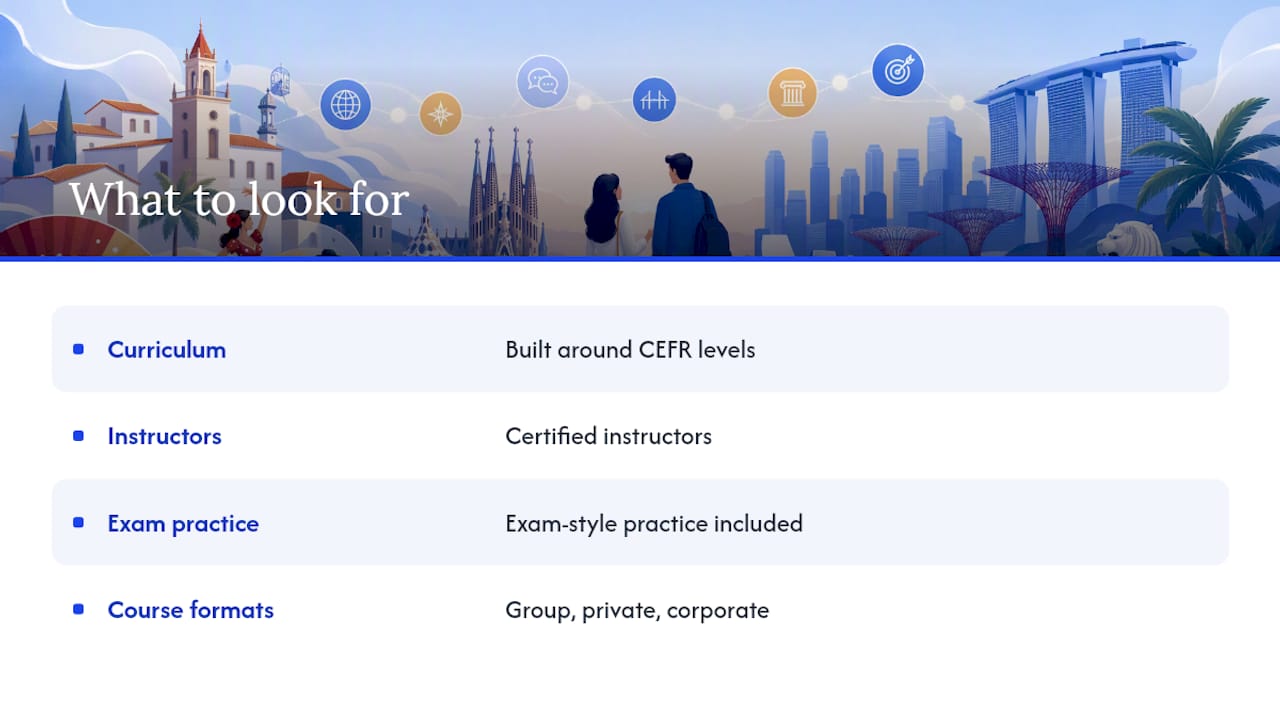
Look for a school whose curriculum is explicitly built around CEFR levels with certified instructors and exam-style practice; Spanish Explorer structures its group, private, and corporate courses around exactly that framework.
How long does it take to prepare for a DELE or SIELE exam?
Preparation time depends on your target level, but a realistic estimate is 80 to 120 hours of instruction per CEFR level, plus time for mock exams closer to your test date.
Recommended
Start Learning Spanish Today
Book a trial class and see how quickly you can progress with a professionally trained native-speaker teacher guiding the way.
Book a Trial Class