 Spanish
In Singapore, adult Spanish courses fall into three duration bands: short intensives (20 to 40 hours over two to four weeks), standard part-time terms (36 to 48 hours over 8 to 12 weeks), and multi-month pathways (50-plus hours). Match the band to your weekly hours and goal, then book a trial class to confirm the pace fits before committing to a full term.
TL;DR:
- Short intensive courses of 20 to 40 hours are ideal for quick basic survival skills before travel or exams, often lasting two to four weeks.
- Standard part-time courses of 36 to 48 hours over 8 to 12 weeks typically build a solid foundation, reaching around CEFR level A1 or A2.
- Multi-month pathways exceeding 50 hours, spaced across several months, are necessary for conversational fluency at B1 or B2 levels.
- Spaced classes, such as twice-weekly evening sessions, significantly improve retention compared to marathon weekend classes.
- A trial class costing $45 helps confirm pacing and teaching style matches your schedule before committing to full-term courses.
Table of Contents
- How Long Is a Spanish Course in Singapore, Really?
- How Format Changes Your Timeline
- Choosing the Right Pace for Your Goal
- From Zero to B1: What the Timeline Actually Looks Like
- How Spanish Explorer Structures Its Course Durations
- What Spanish Courses Actually Cost in Singapore
- When Does a Course Actually “Finish”?
- Comparing Duration and Cost Across Singapore Providers
- Why Most Duration Advice Online Misses the Point
- Ready to Find Your Pace? Book a Trial Class
- Where to Check Schedules and Contact Hours
- Sources
- FAQ
How Long Is a Spanish Course in Singapore, Really?
The honest answer depends on what “finishing a course” means to you. A short intensive gets you through survival phrases before a trip. A standard term builds a real foundation. A multi-month pathway is what it actually takes to hold a conversation without switching back to English mid-sentence.
Short intensives (20 to 40 hours, 2 to 4 weeks) suit travelers cramming before a flight or students doing last-minute exam revision. Some local providers run short intensive courses squeezed into a week or two right before a trip or test, prioritizing speed over depth.
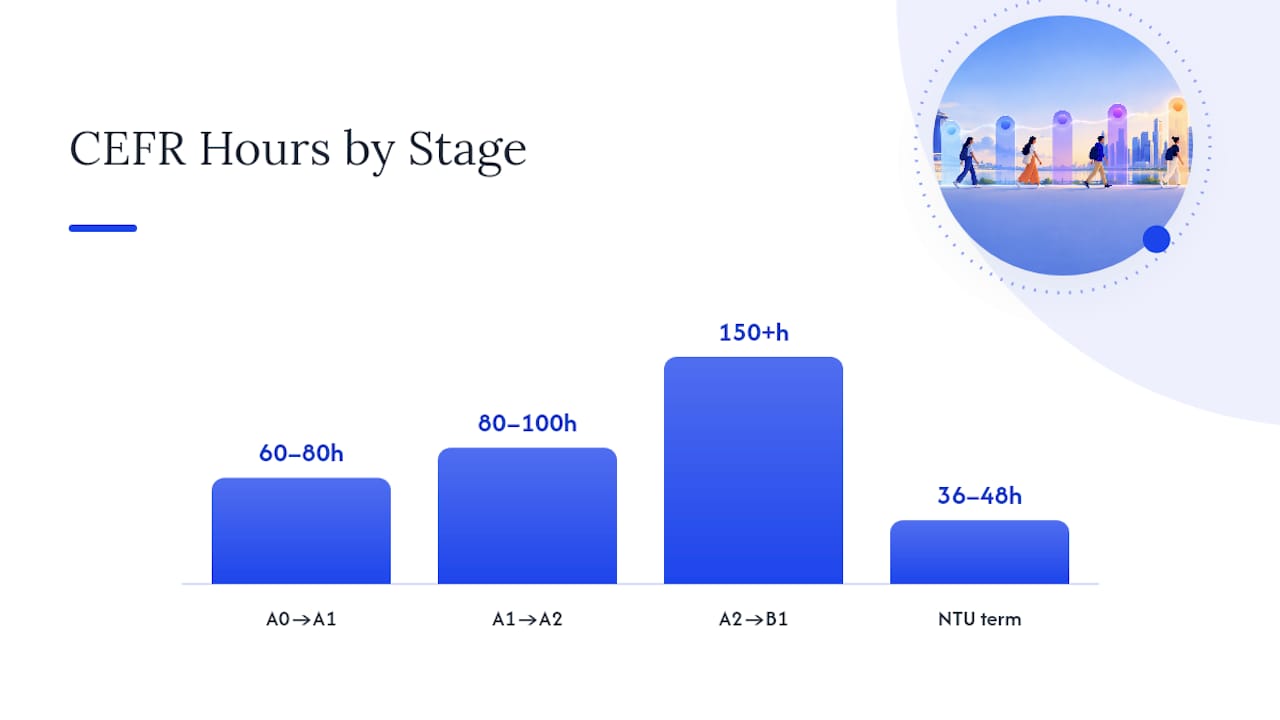
Standard part-time terms (36 to 48 hours, 8 to 12 weeks) are the most common structure at both universities and private schools. NTU’s Centre for Modern Languages runs a credited Spanish course at 48 contact hours, split between 36 in-person hours and 12 delivered online. That blended model compresses classroom time without cutting speaking practice, and it typically moves a true beginner from zero to a working A1.
Multi-month pathways (50-plus hours across several months) are for people chasing B1 or B2, whether for relocation, a long-term posting, or a formal exam. These usually stack two or three standard terms back to back, sometimes with a break between them for the material to settle.
A few things shape which band actually works for you:
- How many hours a week you can realistically commit, not how many you wish you could.
- Whether your goal has a deadline (a trip, an interview, an exam date).
- Whether you are starting from zero or rebuilding half-forgotten high school Spanish.
- Whether you learn faster in a group with peer pressure or one-on-one with full attention.
How Format Changes Your Timeline
Total hours only tells half the story. The same 40 hours delivered as one long weekend crash course versus two evenings a week for ten weeks produces very different results, because your brain needs spacing to actually retain new vocabulary and grammar.
Common formats in Singapore include:
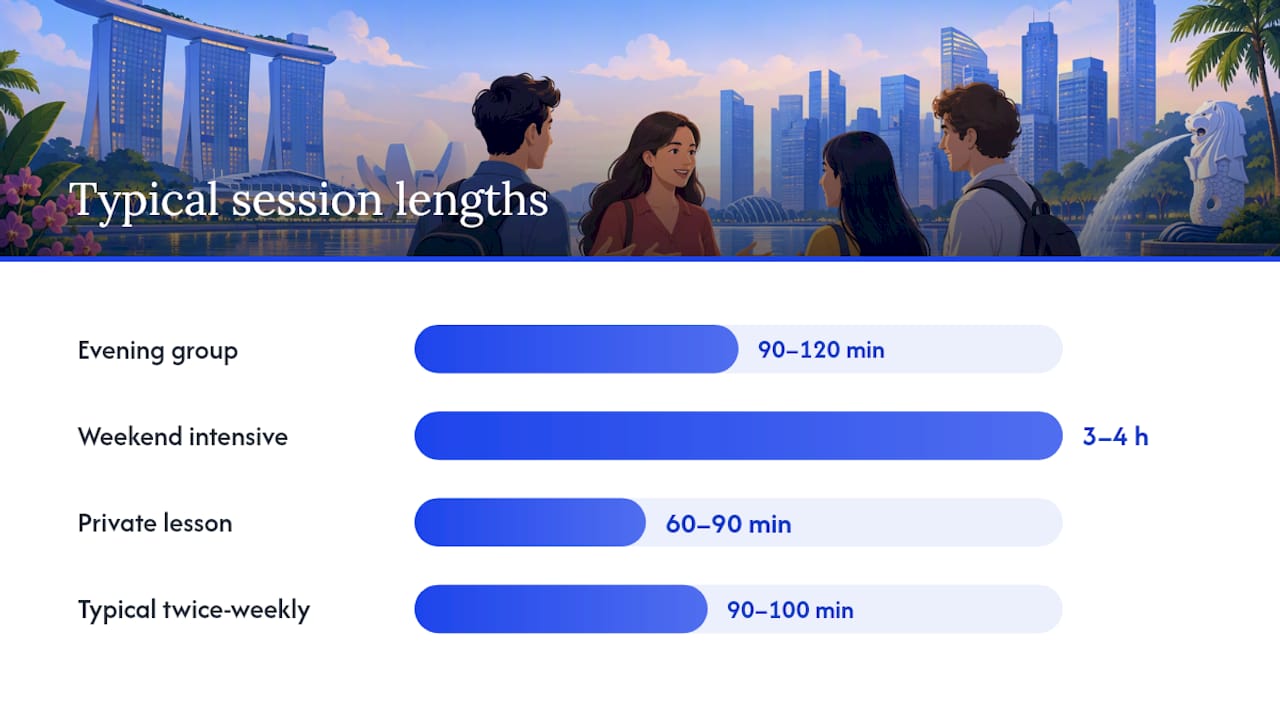
- Evening group classes, twice weekly — sessions of 90 to 120 minutes, usually spread over 8 to 12 weeks. NUS’s language programme runs a typical example: Tuesday and Thursday evenings from 7:50 to 9:20 PM for ten weeks, which lands right in the standard-term range.
- Weekend intensives — longer blocks (3 to 4 hours) on Saturdays or Sundays, compressing a term into fewer calendar weeks but demanding more focus per session.
- Private lessons — flexible timing, usually 60 to 90 minutes per session, paced entirely around your availability and goals.
- Online Zoom classes — the same structure as in-person group or private classes, minus the commute, which matters if you are squeezing lessons around a full workday.
Twice-weekly evening sessions of 90 to 100 minutes are the pattern most universities and private schools default to, and there is a reason it sticks: it balances real classroom exposure against the demands of a working adult’s schedule. Cram the same hours into one weekly four-hour block and fatigue starts eating into the second half of every session.
Pro Tip: If you are choosing between a once-weekly long class and a twice-weekly shorter one, take the twice-weekly option if your schedule allows it. Spaced practice beats marathon sessions for actually remembering vocabulary a week later.
Piano teachers run into the identical trade-off when advising students on lesson length: shorter, more frequent sessions tend to build skill faster than long, infrequent ones, because the brain consolidates new material between sessions, not just during them.
Choosing the Right Pace for Your Goal
Start with your goal, not the course catalog. Someone prepping for a two-week trip to Barcelona needs a different plan than someone who just took on a client-facing role covering Latin America.
- Match hours to outcome. Conversational basics for travel: 20 to 40 hours. Comfortable everyday conversation: 60 to 100 hours. Business-ready fluency: 150-plus hours spread across multiple terms.
- Be honest about weekly availability. Two hours a week gets you through a standard term in its full 8 to 12 weeks. Five or six hours a week can compress that timeline meaningfully, provided the school offers a schedule that supports it.
- Decide group versus private early. Group classes cost less and add social pressure that keeps some learners accountable; private lessons move at your pace alone and are worth it if your schedule is unpredictable or your goal is narrow (an upcoming negotiation in Spanish, for instance).
- Ask providers direct questions before enrolling: How many contact hours, exactly? Is there a placement check for returning learners? What is the class size? Who teaches, and are they a native speaker?
Watch for red flags when a provider cannot answer these clearly. A course that cannot state its contact hours, has no defined level progression, and skips placement testing for anyone claiming prior experience is a course that cannot tell you how long it will actually take.
From Zero to B1: What the Timeline Actually Looks Like
Rough hour ranges commonly used to gauge CEFR jumps: roughly 60 to 80 hours from A0 to A1, another 80 to 100 hours from A1 to A2, and 150-plus additional hours to reach B1. NTU’s credited course with its selected contact hours is considered a solid first step towards beginner proficiency rather than a complete beginner-to-fluent solution on its own.
Where you land depends heavily on three variables: prior exposure (a rusty high school Spanish class counts for something), how much immersion you get outside the classroom, and whether you put in self-study between sessions. A learner doing two hours of classroom time weekly plus even 30 minutes of daily review will outpace someone doing classroom hours alone, often by a wide margin.
A realistic progression plan for reaching A2 within a year:
- Months 1 to 3: One standard term, 36 to 48 hours, twice-weekly evenings. Target: solid A1.
- Months 4 to 6: A short break for consolidation, then a second term at the same pace. Target: A2.
- Months 7 to 12: Move into a multi-month pathway, or shift to private lessons for targeted gaps, layering in 2 to 3 hours of self-study weekly throughout.
That timeline assumes consistency, not intensity. Someone who never misses a class but skips self-study entirely will land a few weeks behind someone doing the same classroom hours plus regular practice. A realistic Singapore-specific timeline breakdown can help you set expectations before you enroll, rather than after week six when the pace feels off.
How Spanish Explorer Structures Its Course Durations
Adult course offerings generally fit these duration bands: group classes for structured, social progression; private classes for a fully custom pace; and online Zoom courses to accommodate different learner needs. Corporate training is often adjusted to a company’s timeline rather than an individual’s.
Every format uses native Spanish speaking instructors fluent in English, with a curriculum mapped to CEFR levels (A1 through B2 and beyond) so progression is never a guessing game. The school operates from 10 Anson Road, Level 22, International Plaza, Singapore 079903, directly above Tanjong Pagar MRT, making evening classes an easy stop on the way home from work.
[Student outcome data and course completion figures to be added.]
For anyone weighing formats, the full course lineup lays out group, private, and online options side by side against the timelines already covered above.
What Spanish Courses Actually Cost in Singapore
Course length and price move together, but not in a straight line. A Conversational Spanish online course runs $350 one-off, a rate that reflects the shorter, more focused format built for people who want practical speaking skills without a multi-month commitment.
Private and structured courses cost more because they buy flexibility and individual attention. Beginner Conversational Spanish private classes range from $1,280 to $1,880 one-off, while more structured private tracks (Elementary, Intermediate, or Business Spanish) run $1,480 to $2,080 one-off, through Spanish Explorer’s private class page. The range within each tier usually comes down to total hours booked and how customized the syllabus is.
If you are unsure which duration and price tier fits before committing, a trial class costs $45 and gives you a direct feel for pacing, teaching style, and class size before you commit to a full term. Some providers also list shorter intensive packs starting at competitive prices for short duration blocks, which sits at the lower end of the short-intensive band. It works mainly as pre-trip or pre-exam revision rather than sustained progress.
Ask every provider whether registration or material fees sit on top of the quoted course price. Not every school bundles textbooks or workbook materials into the headline rate, and that gap is where budgets quietly slip.
When Does a Course Actually “Finish”?
A Spanish course “finishing” usually means one of two things: you complete the term’s contact hours, or you reach a defined level checkpoint. These are not always the same moment, and mixing them up is where a lot of learners get frustrated.
A standard 36 to 48 hour term over 8 to 12 weeks finishes on the calendar the day the last class happens. Reaching an actual CEFR checkpoint (say, a confirmed A2) can take longer if you started with gaps in your foundation, or shorter if you came in with prior exposure and the school runs a placement check to confirm it.
Multi-month pathways are built with checkpoints along the way rather than a single finish line. Progress gets reviewed every term, sometimes with a short assessment, so you (and the school) know whether you are actually ready to move up a level or need another term at the same one. That structure matters more than the calendar date on your enrollment, because a learner who rushes through checkpoints without solidifying them tends to plateau a level or two below where the paperwork says they should be.
Comparing Duration and Cost Across Singapore Providers
University language centers and private schools solve the same problem differently. NTU’s credited course delivers 48 contact hours (36 in-person, 12 online) as part of an academic credit structure, which suits students already inside that system more than a working adult looking for a standalone course. NUS runs a similar twice-weekly evening pattern, Tuesday and Thursday from 7:50 to 9:20 PM across ten weeks, without the credit requirement attached.
Private language schools generally offer more scheduling flexibility than university programs, plus a wider range of formats (private, group, online, corporate) under one roof. That flexibility is also where costs diverge most: a private course custom-built around your calendar costs more per hour than a fixed university term, but it removes the wait for the next semester’s enrollment window.
The practical comparison boils down to three questions: how fixed is the schedule, how much say do you get in the pace, and does the price reflect a group rate or a fully private one. A learner who values structure and doesn’t mind waiting for term dates may prefer the university route; someone who needs to start now, on their own schedule, tends to land with a private school instead.
Why Most Duration Advice Online Misses the Point
Most articles on this topic hand you a single number: “learn Spanish in 300 hours” or some version of it, borrowed from a general language-learning framework that was never built with Singapore’s course calendar in mind. That number is not wrong, exactly. It is just useless on its own, because it ignores the actual constraint most working adults here are solving for: how many hours a week can I realistically protect, and does the course structure match that.
The NTU and NUS examples matter precisely because they are not abstractions. Forty-eight contact hours over a defined term, or a fixed Tuesday and Thursday evening slot for ten weeks, tells you something a generic hour-count never can: whether the pace fits a life that already includes a full-time job. I’d argue the real mistake learners make is picking a duration band based on ambition rather than availability, then quietly falling behind and blaming the course.
If there is one thing worth prioritizing above all else, it is testing the format before committing months to it. A trial class reveals in ninety minutes whether a twice-weekly evening pace, a private schedule, or a weekend intensive actually fits how you learn, something no hour-count on a course page will ever tell you.
— Paul
Ready to Find Your Pace? Book a Trial Class
For adults seeking flexible course lengths that fit their weekly availability rather than fixed semester schedules, some private language schools offer formats—group, private, and online—aligned to common duration bands, enabling learners to choose between short intensives or multi-month pathways.

The most direct next step is a Spanish Language Trial Class for $45. Before booking, have two things ready: your preferred weekly schedule (evenings, weekends, or online) and a rough sense of your goal level, whether that is travel-ready basics or business-level conversation. From there, you can move into a private class built around your pace or an online conversational course if Zoom sessions fit your routine better than commuting to Tanjong Pagar. Either way, the trial class removes the guesswork before you commit to a full term.
Where to Check Schedules and Contact Hours
For exact contact hours and registration windows, NTU’s Centre for Modern Languages and NUS’s CLS language programme list current course dates and hour breakdowns. Spanish Explorer’s course overview page covers current group, private, and online schedules for adult learners.
Sources
FAQ
Can I Learn Spanish in 2 Months?
In two months you can realistically reach a solid A1, enough for basic travel conversations and simple exchanges, especially with a short intensive or a fast-paced standard term. Full conversational comfort takes considerably longer, since A1 to A2 alone typically needs another 80 to 100 hours of contact time.
Can I Learn Spanish in 4 Months?
Four months of consistent classes, roughly one to two standard terms back to back, usually gets a beginner to a confident A2. That is enough for everyday conversations on familiar topics, though business-level fluency still sits further down the timeline.
How Long Does It Typically Take to Study Spanish?
It depends entirely on your target level and weekly hours: a short intensive (20 to 40 hours) covers travel basics in a few weeks, a standard term (36 to 48 hours over 8 to 12 weeks) builds a real A1 to A2 foundation, and reaching B1 or beyond generally requires 150-plus hours across several months. Consistent weekly classes plus a bit of self-study move you through these bands faster than classroom time alone.
Can I Learn Spanish in 2 Years?
Two years of steady part-time study, roughly two standard terms a year plus regular practice, comfortably reaches B1 and often pushes into B2 for motivated learners. That timeline also leaves room for a break between terms without losing meaningful ground, since spaced practice tends to hold retention better than back-to-back cramming.
Recommended
Start Learning Spanish Today
Book a trial class and see how quickly you can progress with a professionally trained native-speaker teacher guiding the way.
Book a Trial Class