 Spanish
Most Singapore-based Spanish schools run rolling monthly intakes rather than rigid academic terms, though a few institutional programs still follow fixed semester dates. The fastest way to confirm the next opening is to check a provider’s course page directly or book a trial class, which usually doubles as a placement check. Current start dates are typically published on course pages, and the sections below cover schedules, fees, levels, and how to register.
TL;DR:
- Most private Spanish courses in Singapore offer rolling monthly intakes, allowing students to start within a few weeks, unlike university programs with fixed semester dates.
- Contact hours vary significantly between formats, with private lessons and small groups costing more per hour but offering greater scheduling flexibility.
- Course levels follow the CEFR scale, with typical beginner classes requiring around 40 contact hours to reach A1 or A2 levels, and progressions are mapped for easy planning.
- Schools that publish clear start dates, detailed syllabi, and teacher credentials tend to be more reliable, while hidden schedules and vague fee structures signal caution.
- Urban location and MRT access increase attendance for in-person classes, and online formats remove commute issues, making it easier to stay consistent with learning.
Table of Contents
- How Spanish Course Intakes Work in Singapore
- Group, Private, Corporate, or Online: Which Format Fits Your Schedule?
- What Do You Actually Learn at Each Level?
- Fees and Budgeting: What Singapore Learners Actually Pay
- How to Register for an Intake: Step by Step
- What Separates a Reliable Spanish School From a Risky One
- Class Size and Student-to-Teacher Ratio
- Where Are Classes Held, and How Easy Is It to Get There?
- Can You Keep Learning After Finishing Your First Level?
- Quick Take: Matching Intake Type to Your Situation
- Spanish Explorer’s Next Intakes and How to Book a Trial
- Sources
- FAQ
How Spanish Course Intakes Work in Singapore
Private language schools in Singapore mostly run rolling intakes, meaning a new group starts roughly every four to six weeks rather than waiting for a September or January term. This matters if you are choosing between providers: a school with monthly starts gets you into a classroom faster than one that only opens twice a year.
University-affiliated programs work differently. NUS’s language programme listings publish specific start dates, weekly meeting times, and course durations tied to the academic calendar, so a course might only begin in January or August with a fixed 10-week run. That structure suits planners but leaves little room if you decide in October that you want to start next week.
When you’re scanning any course listing, whether from an independent school or a university program, confirm these details before assuming a seat is available:
- The exact start date and the last date you can register before the class fills or closes enrollment.
- The minimum class size needed to run the course. Some group intakes get postponed or merged if enrollment is thin.
- The total number of sessions and weeks, not just “X hours per week,” since that number determines your total commitment.
- Whether the listed schedule is confirmed or provisional, since some pages show a tentative slot pending enough sign-ups.
If a page shows no start date at all, that is usually a sign the format runs on-demand. Email or call to ask when the next cohort is forming rather than assuming it is dead.
Group, Private, Corporate, or Online: Which Format Fits Your Schedule?
The format you pick determines how flexible your intake really is. Public group classes and live online Zoom groups run on a fixed cohort schedule, so you join a set start date alongside other learners. Private lessons work on your calendar, which means the “intake” is really just whenever you and your teacher agree to begin.
Here’s how the common formats break down for adult learners in Singapore:
- Public group classes meet weekly, often on weeknight evenings (7:00 to 9:00 PM windows are common) or weekend mornings, over a set number of weeks.
- Live online Zoom groups mirror the same fixed schedule as in-person classes but remove the commute, which suits professionals working from home or outside the central business district.
- Private lessons run one-on-one or in small pairs, scheduled around your availability rather than a fixed class calendar.
- Corporate cohorts are scheduled around a company’s internal training calendar, often during lunch hours or immediately after work, and typically require HR or manager sign-off before booking.
Contact hours matter more than the calendar length. A course billed as “10 weeks” could mean 20 contact hours or 40, depending on session length, so always ask for the total hours, not just the duration in weeks.
Pro Tip: If your work schedule shifts often, a private class is usually the safer intake choice. You lose the group energy, but you never lose a session to a canceled evening meeting.
What Do You Actually Learn at Each Level?
Course levels in Singapore generally follow the CEFR scale, running from A1 (absolute beginner) through B2 (upper intermediate), with most adult learners stopping at B1 or B2 unless they need Spanish for academic or exam purposes. NTU’s Centre for Modern Languages lists a beginner Spanish course totaling 48 contact hours mapped to CEFR level A1.1, which gives a useful benchmark for how much class time a true beginner level typically demands.
Here’s what each stage generally covers:
- A1 (beginner): greetings, basic questions, present tense verbs, ordering food, and simple travel phrases. Expect around forty contact hours to finish comfortably.
- A2 (elementary): past tense, daily routines, shopping and directions, and short conversations without heavy reliance on memorized scripts.
- B1 (intermediate): opinions, work-related conversation, subjunctive basics, and enough fluency to handle unscripted small talk.
- B2 (upper intermediate): nuanced argument, workplace negotiation, and reading unadapted articles or short stories.
If you’re unsure where you land, a placement test or trial class settles it fast. NTU’s course pages reference placement checks as a standard intake step, and most Singapore schools follow the same practice so new students don’t end up bored in a class that’s too easy or lost in one that’s too hard. Conversational goals usually top out comfortably at B1; business Spanish intakes often push toward B2 because workplace negotiation needs more vocabulary control.
Fees and Budgeting: What Singapore Learners Actually Pay
Group course fees in Singapore typically run from a few hundred dollars for a short beginner block up to several thousand for a full private course package, and the gap comes down to format, not just hours. Spanish Explorer, for example, lists a Conversational Spanish course at $350 for the online format, while private and specialized courses covering Beginner Conversational Spanish run from $1,280 to $1,880, and private DELE prep or Business Spanish courses run from $1,480 to $2,080.
A few factors drive that spread:
- Class size. Smaller groups and one-on-one lessons cost more per hour than a large public class, since you’re paying for more direct instructor attention.
- Instructor experience. Native-speaking teachers with formal qualifications tend to command higher rates than generalist tutors.
- Course length and materials. Longer courses with printed workbooks or online platform access cost more upfront but usually lower the effective per-hour rate.
- Format. Private lessons and small-group work in Singapore typically cost more per hour than large public group classes, even when total contact hours are similar.
A quick way to compare fairly: divide the total course fee by total contact hours, not by weeks. A $1,280 course with 40 hours costs $32 per hour; a $350 course with 10 hours costs $35 per hour. The cheaper-looking sticker price isn’t always the better deal once you run the math.
Most schools ask for a deposit or full payment before the intake starts, with refund or reschedule terms varying by provider. Ask about the cancellation window before you pay, particularly if your work schedule is unpredictable.
How to Register for an Intake: Step by Step
Booking a seat is usually a short process, but skipping a step can leave you stuck in the wrong level or without a confirmed spot. Here’s the sequence most Singapore providers follow:
- Confirm the start date. Check the course page directly or contact the school, since listed dates sometimes shift if a cohort hasn’t hit minimum enrollment.
- Book a trial class or placement test. This step usually decides which level you join and gives you a feel for the teaching style before committing.
- Pay the deposit or full fee. Most schools require payment to lock your seat, especially for popular evening slots that fill quickly.
- Receive your materials and confirmed schedule. You should get a syllabus outline, meeting link (for online formats), or classroom address before day one.
For corporate bookings, add one more step: get sign-off from HR or your manager before paying, since many companies require an internal training request number or invoice matching.
Pro Tip: Before paying anything, ask what happens if the class doesn’t hit minimum enrollment. A reputable school will either guarantee the date, offer a full refund, or move you to the next confirmed cohort at no extra cost.
Watch for red flags: no clear syllabus, no published fee structure, or reluctance to let you try a single session before committing to a full package. A legitimate provider answers these questions without hesitation.
What Separates a Reliable Spanish School From a Risky One
Course quality isn’t guesswork if you know what to check. CEFR alignment and stated contact hours tell you whether a “beginner course” actually covers enough ground to reach real conversational ability, or whether it’s a light introduction dressed up as a full course. Teacher bios matter too: look for native or near-native fluency, formal teaching credentials, and comfort teaching in English alongside Spanish, since a teacher who can’t explain grammar in your first language will slow you down.
Transparent fees and published start dates are underrated trust signals. Publishing precise start dates and meeting times increases student confidence and reduces last-minute withdrawals, because learners know exactly what they’re committing to before they pay.
A school that hides its syllabus, its fees, or its schedule until after you’ve paid a deposit is telling you something about how it operates. The ones worth your time put contact hours, level outcomes, and start dates on the page for anyone to check.
- Check whether the syllabus states which CEFR level you’ll reach by the course’s end.
- Read teacher bios for fluency claims, teaching background, and years of classroom experience.
- Confirm the fee covers materials, or if there’s an extra charge for workbooks or platform access.
- Look for a published cancellation and refund policy before you commit.
Class Size and Student-to-Teacher Ratio
Class size shapes how much speaking practice you actually get, which matters more than most learners expect going in. A group of 15 students in a two-hour evening class means each person might get a few minutes of direct speaking correction per session; a group of six or eight gets considerably more.
Public group classes in Singapore commonly run with somewhere between six and fourteen students, though exact caps vary by provider and by course level. Beginner courses tend to run larger since the material is more lecture-driven early on, while intermediate and business-focused classes often shrink in size, partly because fewer learners reach that stage and partly because conversational practice needs more individual feedback.
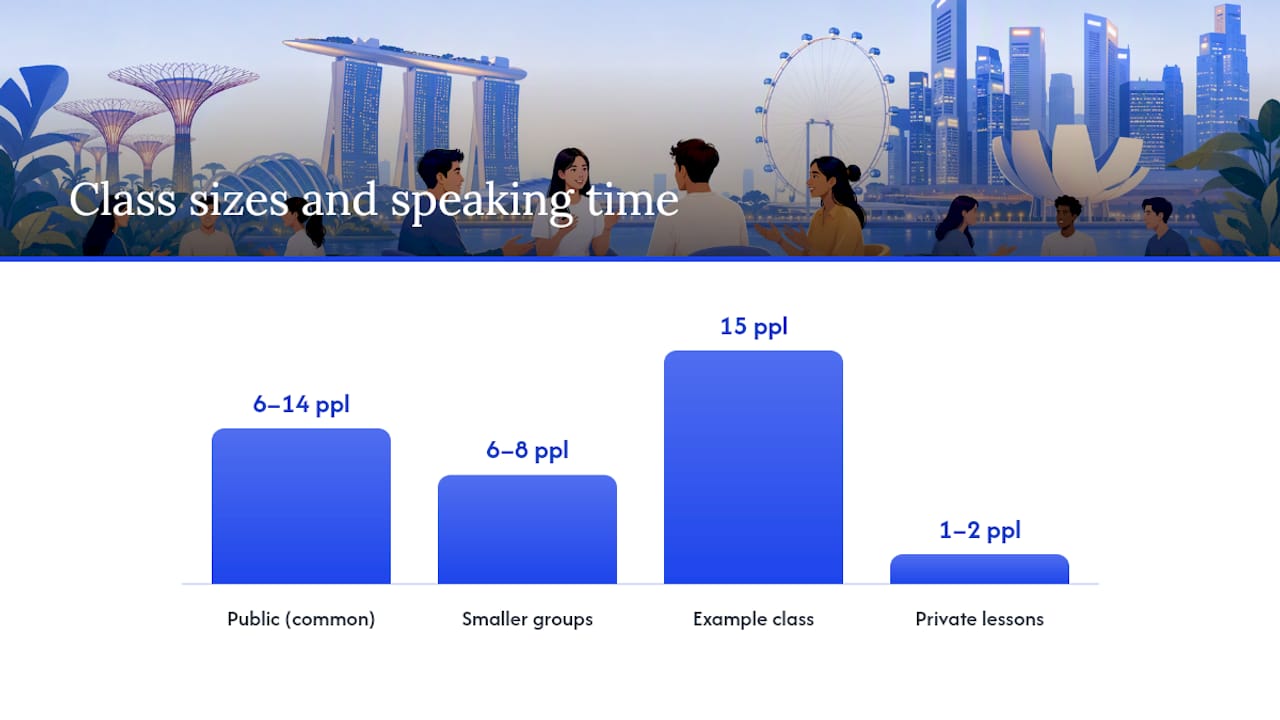
Private lessons flip the ratio entirely, giving you one-on-one time or, at most, a shared session with one other learner at a similar level. That’s the tradeoff: group classes cost less per hour but dilute your speaking time, while private lessons cost more but put every minute of the session on you.
If speaking confidence is your main goal rather than passing a written test, ask about the actual headcount before you enroll, not just the advertised “small class” language. A school that caps groups at eight and actually enforces that cap is offering something meaningfully different from one that advertises “small classes” but fills seats up to twenty.
Where Are Classes Held, and How Easy Is It to Get There?
Location decides whether you actually show up to a 7:00 PM class after a full workday, which is why centrality and MRT access matter more than they sound like they should. A venue buried in an industrial estate with no direct train access quietly kills attendance over a ten-week course, even for motivated learners.
Spanish Explorer’s training center sits at 10 Anson Road, Level 22, International Plaza, Singapore 079903, directly above Tanjong Pagar MRT station. That means you can walk from the train platform to the classroom without surfacing onto the street, which matters on a rainy evening after work. Being in the central business district also makes it a realistic stop between a Tanjong Pagar or Raffles Place office and home, rather than a detour that adds thirty minutes each way.
For online Zoom group intakes, location stops mattering entirely, which is part of why that format has grown popular among learners who work outside the city center or in shift-based jobs. If you’re deciding between in-person and online, weigh your actual commute pattern honestly: a central, MRT-linked venue removes most of the friction that causes people to skip sessions, but a stable internet connection and a quiet room at home solve the same problem for less hassle.
Can You Keep Learning After Finishing Your First Level?
Finishing an A1 or A2 course isn’t the end of the road, and most Singapore providers structure their offerings so you can keep progressing without starting your search from scratch. Look for a school that maps out a clear path from beginner through intermediate and business-level Spanish, rather than one that only offers a single standalone course with no obvious next step.
A structured syllabus that shows how each level connects to the next makes this easier to plan around. If you finish A2 in June, you should be able to see exactly what B1 covers and when the next intake for it opens, rather than waiting months for a school to decide to run it.

Continuing learners also benefit from providers that offer specialized tracks beyond general conversation, such as business Spanish for workplace use or exam-focused preparation for those pursuing formal certification. Ask whether advanced levels run on the same rolling monthly cadence as beginner courses, since some schools slow down intake frequency for higher levels simply because fewer students reach that point. If continuity matters to you, confirm this before you commit to level one, so you’re not stuck waiting for a B2 cohort to finally hit minimum enrollment six months later.
Quick Take: Matching Intake Type to Your Situation
Working professionals do best with evening group intakes or live online Zoom classes, since both fit around a 9-to-5 without demanding a weekend. If your calendar shifts week to week, private lessons remove the risk of missing a fixed class slot entirely.
Learners chasing fast progress should look for intensive weekend or short-block formats. These compress contact hours into fewer weeks, which suits someone prepping for a trip or a work assignment on a deadline rather than building fluency over a year.
Company-sponsored learners should confirm the corporate cohort’s schedule and get internal sign-off before booking, since corporate training often runs on a calendar set by HR, not by the school.
— Paul
Spanish Explorer’s Next Intakes and How to Book a Trial
Spanish Explorer is the practical alternative to piecing together a course from scattered listings and guessing which one actually has an open seat. Instead of chasing down start dates across five different school websites, you get one place with in-person group classes, live online Zoom courses, private lessons, and corporate training, all taught by native Spanish speakers fluent in English.

The course pages list current formats and let you see what’s running now, and the $45 trial class is the fastest way to confirm your level and lock a seat in the next available intake before it fills. Teachers are fluent in both languages, and the curriculum follows a structured progression through grammar, speaking, listening, and writing, so you’re not guessing whether a course actually covers what it claims. If you want to compare per-hour costs across formats first, the private and specialized course page breaks down pricing for beginner and business tracks side by side. Book a trial class this week if you want to be in a classroom or on Zoom before the month is out.
Sources
FAQ
When Does the Next Spanish Course Intake Start in Singapore?
Most private Singapore schools run rolling monthly intakes, so a new group typically starts every four to six weeks rather than on a fixed academic calendar. Check the provider’s course page directly, or book a trial class to confirm the exact next date and secure a seat.
How Much Does a Spanish Course Cost in Singapore?
Fees depend heavily on format. Spanish Explorer’s Conversational Spanish course is $350, while private Beginner Conversational Spanish runs $1,280 to $1,880, and private DELE prep, elementary, intermediate, or business tracks run $1,480 to $2,080.
Do I Need to Take a Placement Test Before Enrolling?
A placement test or trial class is standard practice at most Singapore providers, including NTU’s Centre for Modern Languages, to ensure you join the right level. Skipping it risks landing in a class that’s either too easy or too advanced for your current ability.
What’s the Difference Between Group and Private Class Intakes?
Group classes and live online Zoom groups follow a fixed cohort schedule with a set start date, while private lessons are scheduled around your own calendar. Private lessons cost more per hour but offer more flexibility if your work schedule changes often.
Is Spanish Explorer’s Training Center Easy to Reach?
Yes. The center is located at 10 Anson Road, Level 22, International Plaza, Singapore 079903, directly above Tanjong Pagar MRT station, making it accessible without a long walk from the train platform.
Recommended
Start Learning Spanish Today
Book a trial class and see how quickly you can progress with a professionally trained native-speaker teacher guiding the way.
Book a Trial Class