 Spanish
TL;DR:
- Fluency in Spanish is defined by international frameworks like CEFR and ACTFL, not sounding native.
- Most learners aim for B2 level, enabling effective professional, travel, and personal communication.
- Achieving fluency typically requires 600 to 1,100 hours of study, with consistent practice and immersion.
Many learners assume Spanish fluency means sounding indistinguishable from a native speaker in Madrid or Buenos Aires. That assumption sets an unrealistic bar and causes a surprising number of capable speakers to underestimate their own skills. The truth is that fluency is a practical, measurable concept defined by international frameworks that millions of learners, employers, and universities rely on every year. Whether you are studying Spanish for personal enrichment, planning to work with Latin American clients, or preparing for a DELE certification exam, understanding what fluency actually means gives you a clear target and a smarter study strategy.
Table of Contents
- How is ‘fluency’ in Spanish actually defined?
- Spanish fluency benchmarks: What level do you need?
- The journey to fluency: How long does it take and what influences progress?
- How can you measure and develop your Spanish fluency?
- Our take: What most people get wrong about Spanish fluency
- Next steps: Unlock your Spanish fluency in Singapore
- Frequently asked questions
Key Takeaways
| Point | Details |
|---|---|
| Fluency has clear benchmarks | Spanish fluency is defined by internationally recognized standards, not perfection. |
| B2 or C1 is enough for most | Professional and academic success comes at B2 or C1 level, not at native-like C2. |
| 600–1100 hours to fluency | Most learners need 600–1100 study hours, depending on effort and method. |
| Measure progress with tests | Tools like DELE or self-assessment frameworks let you track your Spanish growth. |
| Active use beats passive study | Immersion and regular speaking are keys to reaching real fluency in Spanish. |
How is ‘fluency’ in Spanish actually defined?
With misconceptions about fluency addressed, let’s clarify how language experts and institutions actually define Spanish fluency.
Most people use the word “fluency” loosely, the way you might say someone is “good at” something without specifying what that means. In language education, fluency is far more precise. Two major frameworks shape how teachers, universities, and employers worldwide evaluate Spanish ability: the Common European Framework of Reference for Languages (CEFR) and the American Council on the Teaching of Foreign Languages (ACTFL) proficiency guidelines.
The CEFR divides learners into six levels from A1 (beginner) to C2 (mastery), while ACTFL uses its own scale of Novice, Intermediate, Advanced, and Superior. These frameworks are not just labels. They describe what a speaker can actually do with the language in real situations, which is where the FACT criteria become useful.
FACT stands for Functions, Accuracy, Context, and Text Type. These four dimensions describe proficiency across any language task. The ACTFL Proficiency Guidelines explain that fluency aligns roughly with Advanced (equivalent to B2 on the CEFR) for professional use, and Superior (C1) for abstract topics and specialized discussions. In plain terms, if you can sustain a conversation about your industry, negotiate a misunderstanding, and recover gracefully when you don’t know a word, you are functioning at a fluent level.
“The ACTFL Proficiency Guidelines describe language ability using the FACT criteria: the Functions a speaker can perform, the Accuracy with which they perform them, the Contexts in which they can operate, and the Text types they can handle.”
— ACTFL Proficiency Guidelines
Here is how the upper CEFR levels compare in practical terms:
| CEFR Level | ACTFL Equivalent | What you can do |
|---|---|---|
| B1 | Intermediate High | Handle routine situations; describe experiences; basic opinion-sharing |
| B2 | Advanced | Discuss complex topics fluently; understand most native content; professional interaction |
| C1 | Superior | Argue abstract ideas; write nuanced reports; handle ambiguity |
| C2 | Distinguished | Near-native range; academic/literary precision; extremely rare for non-natives |
One important point: C2 is not the practical goal for most learners. Even highly educated non-natives rarely reach C2 because it requires command of idiomatic nuance, regional variation, and literary register that takes decades of immersive exposure. For Singaporeans choosing the right Spanish class, recognizing that B2 or C1 is a legitimate and highly respected endpoint changes everything about how you plan your learning journey.
The word “fluency” in everyday conversation usually corresponds to B2. At this level, you can hold your own in a meeting, manage a client call, travel independently, and understand most TV shows and podcasts without constant dictionary lookups. That is a powerful and achievable goal, not a consolation prize.
Spanish fluency benchmarks: What level do you need?
Once you know what the expert frameworks mean, you will want to map them to your real-world goals and local opportunities.
Not every learner in Singapore needs the same level of Spanish. Your target proficiency should reflect your actual reason for learning the language. Here is a quick picture of what each level unlocks:
| CEFR Level | Real-life ability examples |
|---|---|
| B1 | Order food, book accommodation, describe your job, follow simple news |
| B2 | Lead a client presentation, write professional emails, debate opinions, understand films |
| C1 | Write academic essays, chair a meeting entirely in Spanish, analyze complex texts |
| C2 | Translate literary texts, lecture at a university, pass for an educated native speaker |
Common reasons Singaporeans pursue Spanish fluency, in rough order of frequency:
- Career advancement in multinational companies with Latin American operations
- Academic requirements for exchange programs or international degrees
- Travel to Spain, Mexico, or South America for business or leisure
- Personal enrichment and connection to Hispanic culture, music, or literature
- Supporting expat spouses or family members in Spanish-speaking countries
- Pursuing bilingual job roles in trade, diplomacy, or international development
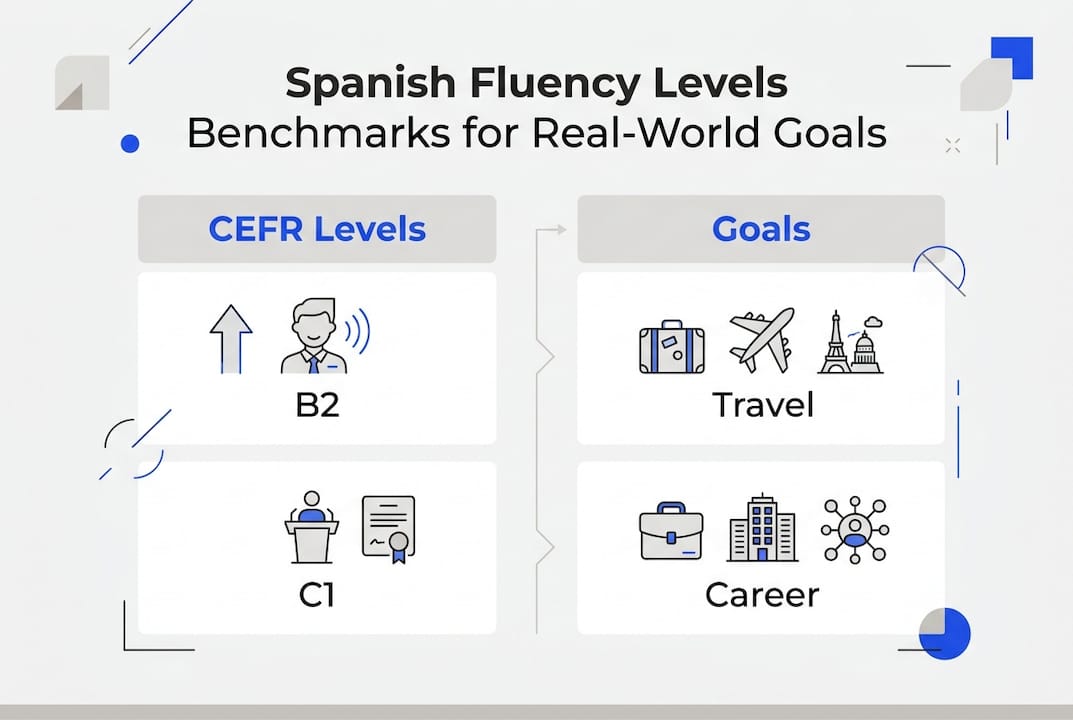
For most of these goals, CEFR B2 is the recognized benchmark for career-oriented learners and travelers, while C1 is the standard for advanced academic study and senior executive contexts where nuanced communication matters.
The DELE (Diplomas de Español como Lengua Extranjera) certification, issued by the Instituto Cervantes, is the most internationally recognized credential for non-native speakers. It is accepted by universities, employers, and immigration authorities worldwide. Earning a DELE B2 or C1 certificate puts a verifiable, respected credential on your resume that goes beyond a language school certificate.
Pro Tip: For the majority of learners in Singapore, B2 is your practical sweet spot. Unless you plan to pursue postgraduate studies at a Spanish university or operate in executive-level negotiation roles entirely conducted in Spanish, C1 provides diminishing returns relative to the additional study time required.
Strong Spanish speaking practice tips can help you build toward B2 faster than you might expect, especially when you combine structured classes with real-world conversation practice.
The journey to fluency: How long does it take and what influences progress?
Now that you know which level of fluency to pursue, the next step is understanding the time and effort required to reach your goal.
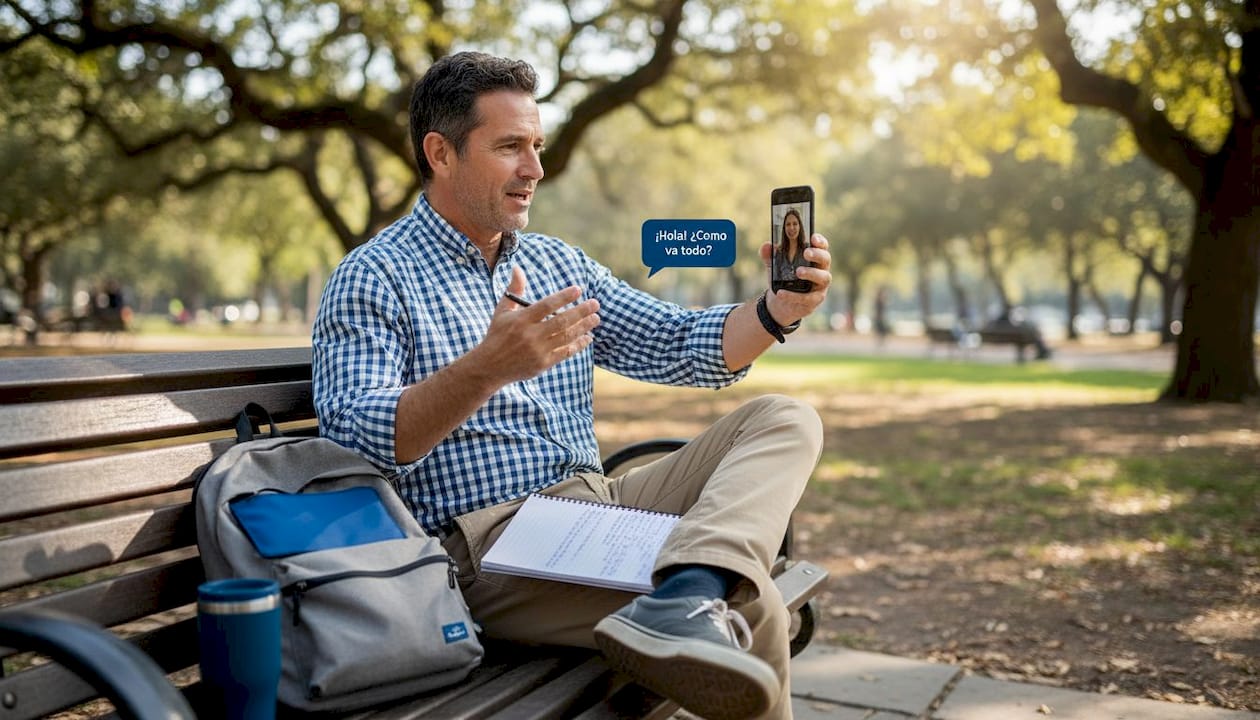
Here is a number that surprises most learners: reaching Spanish fluency requires roughly 600 to 1,100 hours of study and practice. Research on language learning benchmarks confirms this range for Category I languages like Spanish, which are classified as among the easier targets for English speakers due to shared Latin-derived vocabulary and familiar grammar structures. The lower end of that range assumes intensive, immersive study, while the upper end reflects more casual, intermittent learning.
Several key factors influence where you land on that spectrum:
What speeds up progress:
- Daily exposure through conversation, media, and reading
- Structured instruction with qualified teachers who correct errors systematically
- High motivation with a specific, concrete goal (such as a job role or an upcoming trip)
- Prior experience with other Romance languages like French, Italian, or Portuguese
- Active speaking from early in the learning process, even imperfectly
- Using Spanish at work or in social settings outside of class
What slows progress:
- Sporadic study with long gaps between sessions
- Passive-only learning (watching content without speaking or writing)
- Fear of making mistakes that prevents real conversation practice
- Relying exclusively on apps without structured grammar or feedback
- Trying to learn too many languages simultaneously
For Singaporeans balancing a full-time career and family commitments, finding consistent time is the biggest practical challenge. Even 30 to 45 focused minutes per day adds up to roughly 180 hours per year. At that rate, reaching B2 takes approximately three to four years of steady effort. Intensive methods compress this significantly. If you can study or practice for two or more hours daily, such as through immersion courses or an intensive class schedule, the same milestone can arrive in 18 months or less.
Pro Tip: Consider fast-tracking your Spanish learning through an intensive program or adding online Spanish classes during commute time. Even short daily sessions done consistently outperform long weekly study marathons.
One often overlooked advantage for Singaporean learners is the multicultural and multilingual environment. Being accustomed to switching between languages, reading contextual cues, and tolerating ambiguity are genuine cognitive skills that transfer directly into language acquisition. Learners who are already bilingual in English and Mandarin or Tamil often adapt faster to Spanish than monolingual learners in other countries.
How can you measure and develop your Spanish fluency?
With your expected timeline in mind, it is critical to know how to measure your progress and choose strategies that fit your life in Singapore.
Progress in Spanish often feels invisible until a breakthrough moment reveals how far you have actually come. Structured measurement prevents that frustrating fog. Using “can-do” descriptors for self-assessment is one of the most reliable starting points. These are plain-language statements like “I can follow a business presentation in Spanish” or “I can write a formal complaint letter.” Checking these regularly gives you a concrete sense of where your skills stand without requiring a formal exam.
Here is a recommended process for measuring and improving your Spanish fluency in Singapore:
- Run a baseline self-assessment using CEFR can-do descriptors or a free online placement test from a reputable provider such as EF SET or the Instituto Cervantes.
- Set a target level based on your specific goal, whether that is B1 for travel, B2 for career use, or C1 for academic purposes.
- Enroll in structured classes aligned to your target level with qualified instructors who can give systematic feedback.
- Schedule monthly reviews where you revisit can-do descriptors or take short practice tests to confirm progress.
- Register for a formal certification exam like DELE when your class instructor or practice tests indicate you are ready.
- Continue beyond the exam because fluency maintenance requires ongoing use, not just a passing score.
For active immersive practice outside the classroom, consider these approaches:
- Attend Spanish language meetups or cultural events in Singapore, several of which are organized by Spanish embassies and expatriate communities
- Follow Spanish-language podcasts, YouTube channels, or Netflix series with Spanish audio (not just subtitles)
- Join online Spanish conversation groups or tandem exchange apps to practice with native speakers
- Read Spanish news sites like El País or BBC Mundo for 10 minutes each morning to build reading speed
One nuance worth knowing: receptive skills like reading and listening almost always develop faster than productive skills like speaking and writing. Many learners at B1 or B2 can understand a native conversation clearly but still hesitate when they need to respond. This is normal. The B1 to B2 boundary is specifically where speakers shift from needing support to communicating autonomously. Targeted speaking and writing practice closes that gap faster than passive consumption alone.
Practical Spanish speaking activities tailored to your level can bridge the gap between understanding Spanish and actually using it confidently in real situations.
Our take: What most people get wrong about Spanish fluency
Stepping back from technical details, here is a candid perspective based on years of teaching and observing learners at all stages of the journey.
The biggest mistake we see is treating fluency as a fixed destination rather than a dynamic, shifting capability. Learners who reach B2 and then stop actively using Spanish often find their skills plateau or quietly erode. Fluency requires continued use to stay sharp.
The second mistake is waiting until you feel “ready” to start speaking. Real fluency begins with active use, not passive study. Grammatical perfection is far less important than the courage to communicate and the adaptability to recover when a conversation goes sideways. How English can support learning Spanish is an underrated advantage for Singaporeans, given the significant vocabulary overlap between English and Spanish through shared Latin roots.
Singaporean learners also carry a cultural superpower: multicultural awareness. Navigating meaning across cultures, tolerating ambiguity, and reading social cues are things Singaporeans do naturally in everyday life. These skills transfer directly into Spanish communication. Fluency is ultimately about using the language with confidence and purpose, not performing like a news anchor.
Next steps: Unlock your Spanish fluency in Singapore
Armed with a better understanding of fluency, here is how you can make your Spanish journey both effective and rewarding.
Spanish Explorer offers structured Spanish courses in Singapore aligned to CEFR and DELE standards, taught by certified instructors who are fluent in both Spanish and English. Whether you are a beginner building toward B1, a mid-level learner targeting B2, or a professional preparing for DELE exam preparation, the school provides a clear, supported pathway. All classes are designed to build real communication skills quickly, not just textbook knowledge. Our qualified Spanish teachers work with you to close the gap between understanding the language and actively using it with confidence.
Frequently asked questions
What does B2 Spanish fluency actually let you do?
At B2, you can communicate autonomously in conversations about work, school, and leisure, and handle travel, negotiations, and most daily tasks in Spanish without support.
How many hours does it take to become fluent in Spanish?
Reaching Spanish fluency typically takes 600 to 1,100 hours of study and practice, depending on your method, consistency, and starting level.
Is C2 level necessary for working in a Spanish-speaking country?
No. Most professionals succeed at B2 or C1, and C2 is rare even among non-native university graduates working in Spanish-speaking environments.
Which test is best to prove Spanish fluency in Singapore?
DELE is the most practical choice because DELE certifications are internationally recognized and accepted by universities, employers, and immigration authorities worldwide.
Can I be fluent in Spanish by just watching TV or using apps?
Apps and TV build strong receptive skills, but structured immersive methods including classes, writing practice, and real conversation are necessary to reach true fluency at B2 and beyond.
Recommended
Back to all articlesStart Learning Spanish Today
Book a trial class and see how quickly you can progress with a professionally trained native-speaker teacher guiding the way.
Book a Trial Class