 Spanish
“Customer service” in Spanish is servicio al cliente or atención al cliente — both are correct, but atención al cliente tends to appear more in formal, frontline settings like call centers and retail counters. The two opening lines every agent needs are: “Buenos días, ¿en qué le puedo ayudar?” (Good morning, how can I help you?) and “Buenas tardes, le saluda [nombre]” (Good afternoon, you’re speaking with [name]). Those two phrases alone will get you through the first ten seconds of almost any Spanish-speaking customer interaction.
Mini cheat sheet — keep this at your workstation:
- Servicio al cliente / Atención al cliente — customer service (both terms; use either)
- ¿En qué le puedo ayudar? — How can I help you?
- Por favor (por fah-VOR) — please
- Gracias (GRAH-syahs) — thank you
- Un momento, por favor — one moment, please
- Con mucho gusto — with pleasure / you’re welcome (formal)
The sections below expand each of these into full phrase banks, phone scripts, billing vocabulary, and practice drills you can run before your next shift.
Key Takeaways
Mastering Spanish for customer service comes down to three things: using the right formal register (usted), memorizing complete micro-scripts rather than isolated words, and practicing with real roleplay until the phrases are automatic.
| Point | Details |
|---|---|
| Two terms for “customer service” | Use servicio al cliente or atención al cliente — both are correct; the latter is more common in formal settings. |
| Always use usted | In customer-facing Spanish, usted is the required formal pronoun; never default to tú unless the customer invites it. |
| Learn micro-scripts, not word lists | Memorize complete opening, hold, and closing lines so you can retrieve them automatically under pressure. |
| De-escalation has three steps | Acknowledge (Comprendo su frustración), apologize (Le pido disculpas), and offer a solution (Voy a ocuparme de esto de inmediato). |
| Spanish Explorer for faster results | Private and corporate Spanish lessons at Spanish Explorer focus on workplace scripts, phonetics, and roleplay with certified instructors. |
Table of Contents
- What is Spanish for customer service, and which phrases matter most?
- How do you handle phone calls in Spanish for a call center?
- How do you handle unhappy customers in Spanish?
- What billing and account phrases do you need in Spanish?
- How do you pronounce Spanish phrases clearly, and when do you use usted?
- Short scripts and roleplay drills to build real fluency
- What are the best ways to learn Spanish for customer service quickly?
- What actually works when teaching customer-service Spanish
- Faster results with targeted Spanish training
- Sources
- FAQ
What is Spanish for customer service, and which phrases matter most?
The phrase servicio al cliente is the direct translation, and the Cambridge Dictionary lists atención al cliente as an equivalent. In practice, atención al cliente is the phrase you’ll see on department signs, phone menus, and company websites across Latin America and Spain. Either term is understood everywhere, so use whichever your employer already uses on signage or scripts.
The phrases that matter most fall into six situations: greeting, asking for details, confirming, putting someone on hold, handling a problem, and closing. Master those six moments and you can handle the vast majority of customer interactions in Spanish.
Greetings and polite openings
| Spanish | English | Phonetic hint |
|---|---|---|
| Buenos días, ¿en qué le puedo ayudar? | Good morning, how can I help you? | BWEH-nos DEE-ahs, en KAY leh PWEH-doh ah-yoo-DAR |
| Buenas tardes, ¿en qué le puedo servir? | Good afternoon, how can I serve you? | BWEH-nahs TAR-des, en KAY leh PWEH-doh ser-VEER |
| Bienvenido/a | Welcome | byehn-veh-NEE-doh / dah |
| ¿Cómo le puedo ayudar hoy? | How can I help you today? | KOH-moh leh PWEH-doh ah-yoo-DAR oy |
| Con mucho gusto le atiendo | It’s my pleasure to assist you | kon MOO-choh GOOS-toh leh ah-TYEHN-doh |
Courtesies and confirmations
| Spanish | English | Phonetic hint |
|---|---|---|
| Por favor | Please | por fah-VOR |
| Gracias | Thank you | GRAH-syahs |
| De nada / Con mucho gusto | You’re welcome | deh NAH-dah / kon MOO-choh GOOS-toh |
| Disculpe | Excuse me / I’m sorry | dees-KOOL-peh |
| Claro que sí | Of course | KLAH-roh keh SEE |
| Entendido | Understood | ehn-tehn-DEE-doh |
| ¿Me permite un momento? | May I have a moment? | meh pehr-MEE-teh oon moh-MEHN-toh |
Asking for details
| Spanish | English | Phonetic hint |
|---|---|---|
| ¿Me puede dar su nombre? | Can you give me your name? | meh PWEH-deh dar soo NOM-breh |
| ¿Cuál es su número de cuenta? | What is your account number? | kwahl ehs soo NOO-meh-roh deh KWEHN-tah |
| ¿Me puede repetir eso, por favor? | Can you repeat that, please? | meh PWEH-deh reh-peh-TEER EH-soh |
| ¿Cuál es el problema? | What is the problem? | kwahl ehs ehl proh-BLEH-mah |
| ¿Tiene alguna pregunta? | Do you have any questions? | TYEH-neh ahl-GOO-nah preh-GOON-tah |
Closing the interaction
| Spanish | English | Phonetic hint |
|---|---|---|
| ¿Hay algo más en que le pueda ayudar? | Is there anything else I can help you with? | eye AHL-goh mahs ehn keh leh PWEH-dah ah-yoo-DAR |
| Fue un placer atenderle | It was a pleasure to assist you | fweh oon plah-SER ah-tehn-DER-leh |
| Que tenga un buen día | Have a good day | keh TEHN-gah oon bwehn DEE-ah |
| Hasta luego | Goodbye | AHS-tah LWEH-goh |
FluentU’s categorized phrase list notes that customer-service verbs are almost always conjugated in the formal usted form to show respect — which is why every phrase above uses le and su rather than te and tu. That single grammar choice signals professionalism before you’ve said anything else.
How do you handle phone calls in Spanish for a call center?
Phone interactions demand a slightly tighter script than in-person ones. There’s no body language to fill the gaps, so the opening line, hold phrase, and closing need to be crisp and practiced. Fundéu recommends replacing the anglicism “call center” with centro de atención al cliente, centro de atención telefónica, or centro de llamadas — a useful distinction if you’re writing internal scripts or signage.
Standard phone opening lines
- “Buenas tardes, le saluda [nombre] de [empresa]. ¿En qué le puedo ayudar?”
Good afternoon, this is [name] from [company]. How can I help you? - “Buenos días, habla con [nombre]. ¿En qué le puedo servir?”
Good morning, you’re speaking with [name]. How can I serve you? - “Gracias por llamar a [empresa]. Le atiende [nombre].”
Thank you for calling [company]. This is [name] speaking.
Study highlights that me permite is more polite than puede darme when asking a customer for information — a small swap that noticeably softens the tone on a call.
Hold and transfer phrases
- “¿Le puedo poner en espera un momento, por favor?” — Can I put you on hold for a moment, please?
- “No tardará mucho.” — It won’t be long.
- “Le voy a transferir con el departamento correspondiente.” — I’m going to transfer you to the appropriate department.
- “¿Me permite verificar esa información?” — May I verify that information?
- “Gracias por su paciencia.” — Thank you for your patience.
Sample phone script (memorize this)
Agent: Buenas tardes, le saluda María de Servicios al Cliente. ¿En qué le puedo ayudar?
Customer: Tengo un problema con mi pedido.
Agent: Entendido. ¿Me permite su número de cuenta, por favor?
Customer: Sí, es el 4-5-7-2.
Agent: Gracias. Un momento, por favor. (brief hold) Gracias por su paciencia. Ya tengo su información. Voy a resolver esto de inmediato.
Four lines. That’s enough to handle the opening of almost any inbound call.
Pro Tip: Speak slightly slower than you would in English. Spanish vowels are short and consistent, so rushing blurs them together. A deliberate pace also signals confidence, which calms anxious callers.
How do you handle unhappy customers in Spanish?
The three-step framework that works in English works just as well in Spanish: acknowledge, apologize, offer a solution. The difference is that Spanish has specific phrases for each step that carry the right emotional weight — a word-for-word translation often sounds flat or even dismissive.
Step 1: Acknowledge the frustration
- “Comprendo su frustración.” — I understand your frustration. (kom-PREHN-doh soo froos-trah-SYOHN)
- “Entiendo perfectamente su situación.” — I fully understand your situation.
- “Tiene toda la razón.” — You are absolutely right.
Step 2: Apologize sincerely
- “Le pido disculpas por los inconvenientes.” — I apologize for the inconvenience.
- “Lamentamos mucho lo ocurrido.” — We are very sorry for what happened.
- “Eso no debió ocurrir.” — That should not have happened.
Step 3: Offer a solution
- “Voy a ocuparme de esto de inmediato.” — I’ll take care of this right away. (voy ah oh-koo-PAR-meh deh EHS-toh)
- “Le ofrezco las siguientes opciones…” — I can offer you the following options…
- “Vamos a resolverlo juntos.” — Let’s resolve this together.
FluentU specifically flags “Comprendo su frustración” and “Voy a ocuparme de esto de inmediato” as high-value empathy and ownership statements — the kind that shift a caller’s tone within seconds.
What NOT to say (phrases that sound dismissive)
- “No es mi culpa.” — That’s not my fault. (Never say this.)
- “No puedo hacer nada.” — I can’t do anything. (Closes the door; use “Déjeme ver qué puedo hacer” instead.)
- “Eso no es posible.” — That’s not possible. (Too blunt; soften with “En este momento no tenemos esa opción, pero…”)
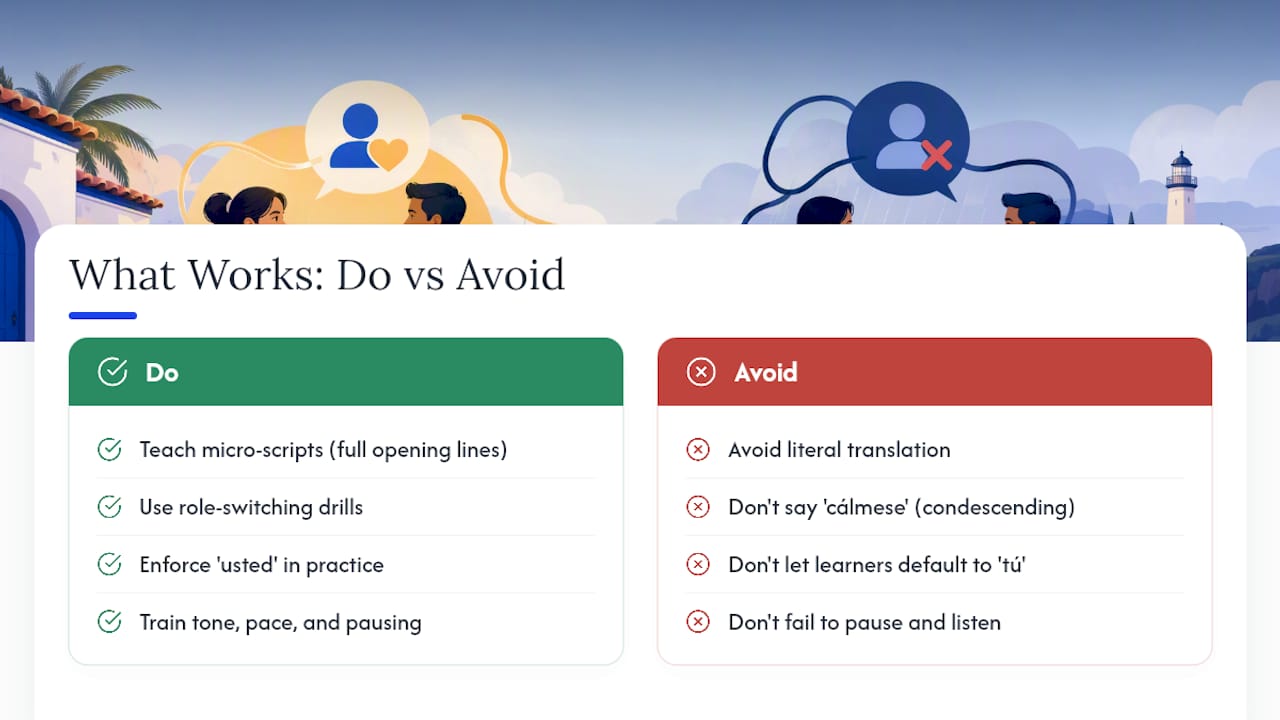
- “Cálmese.” — Calm down. (Escalates almost every time.)
To regain rapport after a tense moment: “Quiero asegurarme de que quede satisfecho/a con nuestra solución.” (I want to make sure you’re satisfied with our solution.) That one sentence signals ownership and care simultaneously.
What billing and account phrases do you need in Spanish?
Payment and account questions are where agents most often freeze up, because the vocabulary is specific and the stakes feel higher. Here are the terms and sentences you’ll use most.
Core billing vocabulary
- La factura (lah fahk-TOO-rah) — invoice / bill
- El recibo (ehl reh-SEE-boh) — receipt
- El saldo (ehl SAHL-doh) — balance
- La fecha de vencimiento (lah FEH-chah deh vehn-see-MYEHN-toh) — due date
- El método de pago (ehl MEH-toh-doh deh PAH-goh) — method of payment
- El reembolso (ehl reh-ehm-BOHL-soh) — refund
- El cargo (ehl KAR-goh) — charge
- La cuenta (lah KWEHN-tah) — account
- El número de cuenta (ehl NOO-meh-roh deh KWEHN-tah) — account number
- El pago (ehl PAH-goh) — payment
Billing phrases and example sentences
| Situation | Spanish phrase | English |
|---|---|---|
| Ask for account number | ¿Me puede dar su número de cuenta? | Can you give me your account number? |
| Confirm a charge | Veo un cargo de $X en su cuenta del [fecha]. | I see a charge of $X on your account from [date]. |
| Explain a refund timeline | El reembolso tardará entre 5 y 7 días hábiles. | The refund will take 5–7 business days. |
| Ask for payment method | ¿Cuál es su método de pago? | What is your payment method? |
| Confirm balance due | Su saldo pendiente es de $X. | Your outstanding balance is $X. |
| Offer a receipt | ¿Le envío el recibo por correo electrónico? | Shall I send the receipt to your email? |
Pro Tip: When reading account numbers back to a customer, say each digit individually in Spanish: uno, dos, tres… Grouping them in pairs (as some agents do in English) can cause confusion across dialects.
How do you pronounce Spanish phrases clearly, and when do you use usted?
Pronunciation: the sounds that trip people up
Spanish pronunciation is consistent once you know the rules. Five sounds cause the most trouble for English speakers in customer-service contexts:
- R (single): a quick tap of the tongue behind the upper teeth, like the “d” in the American English word “butter.” Practice with por favor and recibo.
- RR (double): a rolled or trilled sound. Start by saying “d-d-d” rapidly while exhaling. Key word: reembolso.
- LL / Y: in most of Latin America, both sound like the English “y” in “yes.” Llamo sounds like YAH-moh.
- Ñ: like “ny” in “canyon.” Número starts with a regular N, but mañana has the ñ sound: mah-NYAH-nah.
- J / G (before e or i): a strong “h” sound from the back of the throat. Gracias — the G is soft; gerente (heh-REHN-teh, manager) uses the harder H sound.
Vowels are the real key. Spanish has five vowel sounds and they never change: A = “ah,” E = “eh,” I = “ee,” O = “oh,” U = “oo.” Once those are locked in, your pronunciation becomes dramatically clearer.
Usted vs. tú: always use usted in customer service
Usted is the formal “you” in Spanish. Tú is informal. In customer-facing interactions, the rule is simple: always use usted unless the customer explicitly invites you to use tú.
Using tú with a stranger in a professional setting can read as presumptuous or even disrespectful in many Spanish-speaking cultures. FluentU confirms that customer-service verbs are consistently conjugated in the usted form to show respect. That means:
- ✓ ¿En qué le puedo ayudar? (usted form)
- ✗ ¿En qué te puedo ayudar? (tú form — too casual for most service contexts)
The verb endings change too: usted habla (you speak) vs. tú hablas. Stick to the usted conjugations in every script and you’ll never accidentally offend a customer.
Pro Tip: On phone calls, slow down at the end of each sentence. Spanish speakers often interpret a rushed close as impatience. A half-second pause before “¿Hay algo más?” signals that you’re genuinely waiting for an answer, not rushing to end the call.
Short scripts and roleplay drills to build real fluency
Reading phrases is one thing. Using them under pressure is another. These scripts and drills are designed to be run in pairs during training or on your own with a recording app.
Script 1: In-store pickup
Agent: Bienvenido/a. Buenos días, ¿en qué le puedo ayudar?
Customer: Vengo a recoger mi pedido.
Agent: Con mucho gusto. ¿Me puede dar su nombre y número de orden?
Customer: Sí, soy Ana López, orden número 3-8-1.
Agent: Perfecto. Un momento, por favor. (checks) Aquí está su pedido, señora López. Que tenga un buen día.
Script 2: Returns counter
Agent: Buenas tardes. ¿En qué le puedo servir?
Customer: Quisiera hacer una devolución.
Agent: Claro que sí. ¿Tiene el recibo?
Customer: Sí, aquí está.
Agent: Gracias. El reembolso tardará entre 5 y 7 días hábiles. ¿Hay algo más en que le pueda ayudar?
Script 3: Phone support
Agent: Buenas tardes, le saluda Carlos de Atención al Cliente. ¿En qué le puedo ayudar?
Customer: Tengo un cargo incorrecto en mi cuenta.
Agent: Entiendo. ¿Me permite su número de cuenta, por favor?
Customer: Es el 7-2-4-9.
Agent: Gracias por su paciencia. Veo el cargo. Voy a ocuparme de esto de inmediato y le enviaré una confirmación por correo.
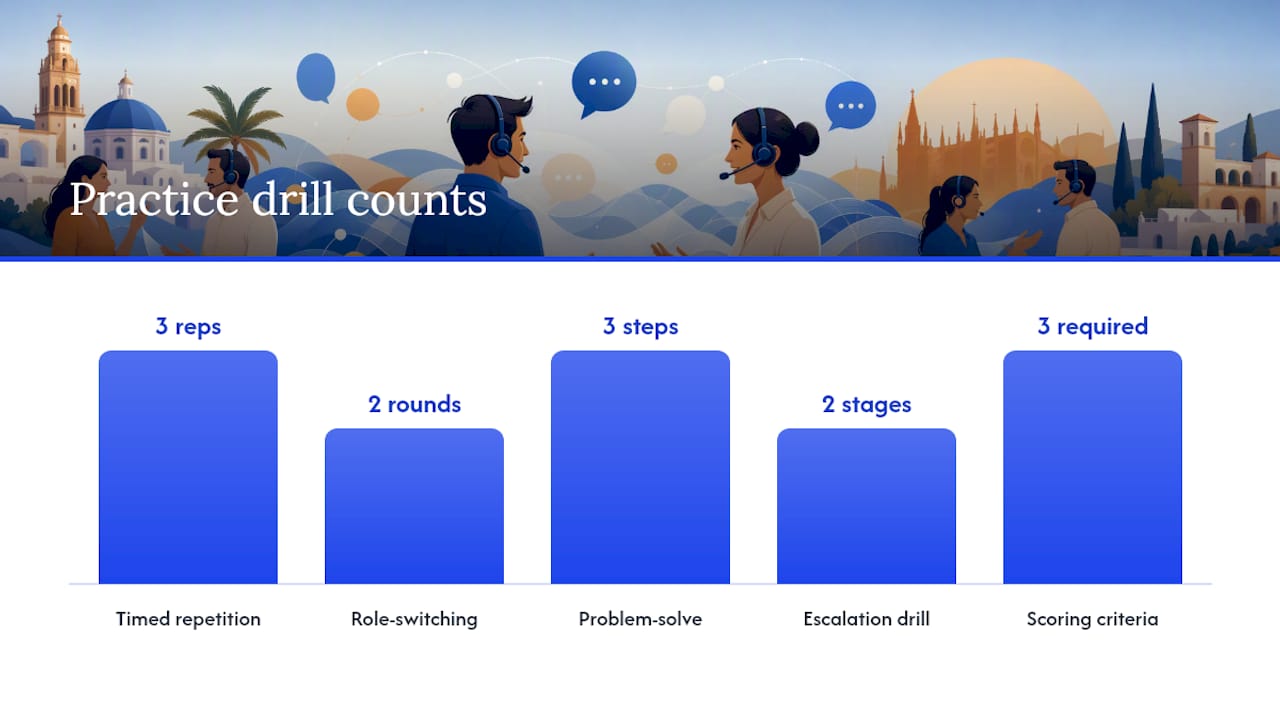
Four practice drills
- Timed repetition drill: Read each script aloud three times, aiming to cut five seconds off each run. Focus on vowel clarity, not speed.
- Role-switching drill: One person plays the agent, the other plays the customer. After two rounds, switch. The “customer” should vary their complaint each time.
- Problem-solve drill: The trainer gives a scenario card (wrong charge, missing item, long wait). The agent must use the three-step de-escalation framework (acknowledge, apologize, offer solution) entirely in Spanish.
- Escalation drill: The customer starts calm, then becomes frustrated mid-call. The agent practices transitioning from standard phrases to empathy phrases without breaking the formal usted register.
Scoring criteria for practice sessions: Did the agent use usted throughout? Was the opening line complete (greeting + name + offer to help)? Did they offer a concrete solution or next step? Three yes answers means the script is ready for a real call.
Structured workplace Spanish lessons that incorporate these kinds of drills consistently produce faster retention than passive vocabulary study alone.
What are the best ways to learn Spanish for customer service quickly?
Vocabulary lists help, but they don’t build the automatic recall you need mid-call. These techniques do.
- Shadow native speakers. Find a Spanish-language customer-service call recording or a YouTube video of a Spanish call center interaction. Play a sentence, pause, repeat it out loud at the same pace and pitch. Study and FluentU both offer audio-enabled phrase lists and example dialogues that work well for this.
- Record yourself. Say a script into your phone’s voice memo app, then play it back. You’ll immediately hear where your vowels collapse or where you rush the ending of a phrase.
- Use spaced repetition. Apps like Anki let you build a custom deck of customer-service phrases. Review five cards in the morning and five before your shift. Retention compounds fast.
- Micro-script practice. Don’t try to memorize 50 phrases at once. Pick one script (the phone opening, for example) and drill it until it’s automatic. Then add the hold phrase. Then the closing. Build the full script in layers.
- Label your workspace. Tape index cards with key phrases to your monitor or counter. Por favor, ¿me puede dar su número de cuenta? on one card. Gracias por su paciencia on another. Passive exposure during a shift adds up.
- Practice with a partner. Even five minutes of roleplay before a shift beats 30 minutes of solo reading. Use the role-switching drill from the section above.
- Focus on the six key moments. Greeting, asking for details, confirming, hold, de-escalation, closing. Master those six and you’re covering 90% of real interactions.
- Use reliable references. SpanishDict is the fastest tool for single-word lookups with audio. FluentU’s phrase list gives you categorized vocabulary with context. Keep both bookmarked.
For key Spanish communication skills that go beyond vocabulary, the goal is building automatic responses — the kind that don’t require you to mentally translate before speaking.
What actually works when teaching customer-service Spanish
Most people who struggle with Spanish in a service context aren’t struggling with vocabulary. They know gracias and por favor. What trips them up is the moment the customer goes off-script — a complaint they didn’t expect, a billing question with unfamiliar terms, or a frustrated caller who speaks quickly.
The techniques that consistently work in a classroom setting are micro-scripts and role-switching. When a learner memorizes a complete opening line rather than individual words, they build a chunk of language they can retrieve under pressure without thinking. The usted rule is the other non-negotiable. Every time a learner defaults to tú in a practice drill, it’s worth stopping and resetting — not because the customer would necessarily be offended, but because the habit of formal address needs to be automatic before it goes live.
Cultural sensitivity matters just as much as grammar. YourNativeTeacher makes the point well: effective Spanish customer service requires more than literal translation. A phrase like “cálmese” (calm down) is technically correct Spanish, but in most Latin American and Spanish-speaking U.S. communities, it reads as condescending. Knowing what not to say is as valuable as knowing what to say. Tone, pace, and the willingness to pause and listen are what actually resolve complaints — the phrases just frame that intention in the right language.
Faster results with targeted Spanish training
Self-study gets you started. A structured course gets you fluent faster, especially when the goal is professional communication under real-world pressure.

Spanish Explorer offers private Spanish classes and corporate training programs built around exactly this kind of practical, workplace-focused content: micro-scripts, phonetics coaching, roleplay with instructor feedback, and the formal register that customer-facing roles demand. Lessons are taught by certified native Spanish-speaking instructors fluent in both Spanish and English, so you get correction that’s precise and context-aware, not generic.
For teams, corporate training can be customized to your industry’s specific vocabulary, whether that’s retail, hospitality, healthcare, or financial services. For individuals, private lessons let you move at your own pace and focus on the exact scenarios you face at work. Online Zoom classes are also available for flexible scheduling. Browse the full course options or contact Spanish Explorer directly to discuss a corporate training package.
Sources
- customer service – English-Spanish translation | Cambridge Dictionary
- «call center» tiene traducción | FundéuRAE
- 115 Words and Phrases in Spanish for Customer Service | FluentU
- Study
- Handling Customer Service in Spanish: Key Phrases and Vocabulary
FAQ
How do you say “customer service” in Spanish?
The two standard terms are servicio al cliente and atención al cliente, as confirmed by the Cambridge Dictionary. Atención al cliente is more common in formal, frontline settings like call centers and retail.
What are the most common customer service phrases in Spanish?
The phrases used most often are ¿En qué le puedo ayudar? (How can I help you?), Gracias por su paciencia (Thank you for your patience), Un momento, por favor (One moment, please), and ¿Me puede dar su número de cuenta? (Can you give me your account number?).
What is another way of saying “customer service” in Spanish?
Atención al cliente is the most common alternative to servicio al cliente, and Fundéu also recommends centro de atención telefónica or centro de llamadas specifically for call-center contexts.
How do I say “how can I help you” in Spanish for customer service?
The formal version is “¿En qué le puedo ayudar?” (en KAY leh PWEH-doh ah-yoo-DAR). Always use le (the usted form) rather than te in professional settings. A slightly more formal alternative is “¿En qué le puedo servir?”
Do I always need to use “usted” with Spanish-speaking customers?
Yes, in virtually every customer-service context in the United States. Usted signals respect and professionalism. Switch to tú only if the customer explicitly uses it first and invites the informal register — and even then, many agents stay with usted for consistency.
Recommended
Start Learning Spanish Today
Book a trial class and see how quickly you can progress with a professionally trained native-speaker teacher guiding the way.
Book a Trial Class